LinkedIn just added a button to flag AI slop. Then quietly nerfed two things creators have relied on for years: comment-for-lead-magnet posts and CTAs asking for reshares.
I've seen it firsthand. Posts that normally hit half a million views in a week getting capped at 500. Removed the CTA and watched it climb to 20,000.
My take on the lead magnet suppression: it's the wrong call. The only people commenting on those posts are people who actually want what you're offering. That's not spam — that's an engaged audience self-selecting. LinkedIn should think twice.
But the broader signal? It's good for those of us who do the work.
LinkedIn's own CPO called AI slop a "top priority." Over a million people clicked the new button in two weeks. Views on flagged content dropped 40%. The platform is enforcing quality now — and that means posting five times a week is only an advantage if what you're posting is worth reading.
AI can help you research, find angles, and organize your thinking. But the post itself needs to come from your brain.
Do epic things. Write about them. That's still the playbook — and now LinkedIn is enforcing it.
https://fortune.com/2026/07/31/linkedin-seems-like-ai-slop-button-billions-automated-comments-attempts/#LinkedIn#B2BMarketing…more
Founder at Radi8 // Executive Coach // Host of the Inspiring Founders Podcast
· LinkedIn
·
A few weeks ago I ran a test on my own company.
I asked ChatGPT, Claude, and Perplexity the questions our buyers actually ask — "best AI tool for a consultant who wants to post on LinkedIn," "Hootsuite alternatives for a solo founder." Radi8 didn't come up once.
That stung. But it confirmed something I've been telling founders for a while: the way buyers form trust has changed, and most of us are still optimizing for the wrong reader.
Here's the trap. We spent months building positioning for humans — clever, memorable, deliberately set apart from the category. Great for a landing page. Invisible to the machine doing the recommending. An AI doesn't search your clever sentence. It breaks the question into plain category words and recommends whoever consistently shows up for them.
Clever positioning wins the click. Category language wins the citation.
But the real lesson isn't an AI trick. It's the thing I keep coming back to: your brand is your promise, and a visible, consistent body of work is now the evidence people — and their AI — use to decide whether to trust you, long before the first conversation. When your story isn't consistent everywhere, the machine has nothing solid to cite.
I wrote up the whole thing — what we found, why it happened, and what we're changing — in public: https://www.radi8.com/blog/show-up-when-buyers-ask-ai-for-recommendations
A question for the founders here: have you checked what the AI assistants say about your company when someone asks for a recommendation in your category? What did you find? …more
What do your clients really pay for? Not hours — the decisions you can now make in minutes that once took years to learn. That judgment is the product. Book 30 minutes and we'll name yours, no pitch: https://calendly.com/foclarity/30min
Have you asked an AI who it recommends in your field? Try it, then look at what comes back.
More buyers are doing exactly that. Instead of a Google search or a nudge from a former colleague, they ask an AI: "who's the best person for this?" And the AI answers with what it can retrieve — a clear, consistent body of work it can actually find and read.
That changes things for coaches and consultants. Clever branding doesn't help if there's nothing there to retrieve. Visibility isn't just how humans find you anymore. It's machine-readable reputation, and the substance you publish is what gets you named.
This is where Radi8 helps solo experts stay retrievable without the daily grind: showing up consistently so the work is there when someone, or something, goes looking.
Want to talk through what actually makes you findable? Book 30 minutes with me, no pitch, just a clear read on where you stand: https://calendly.com/foclarity/30min#AIforBusiness#PersonalBrand#ThoughtLeadership#IndependentConsultant#Positioning
Which of your posts do people actually remember? Not the one you polished for hours — that you kept showing up. Consistency is the reputation. Book 30 minutes and we'll sharpen yours, no pitch: https://calendly.com/foclarity/30min
What if building a public presence just turns into performative posting?
It's the worry I hear most from coaches and consultants who know they should be visible but don't want to become someone chasing reach for its own sake.
Here's the distinction that matters. Performative posting optimizes for attention this week. A body of work does something else entirely: it shows how you think, how you decide, and whether you follow through — over time. Buyers don't trust claims. They trust evidence they can watch accumulate.
So stop asking "what will get engagement?" and start asking "what would I want a skeptical buyer to find when they check whether I'm any good at this?" Then publish that, consistently. Reach becomes a byproduct. Trust is the point.
If you want help figuring out what your body of work should actually say, book 30 minutes with me and we'll map it — no pitch, just a clear read on where you stand: https://calendly.com/foclarity/30min#IndependentConsultant#Coaching#PersonalBrand#ThoughtLeadership
Today's post is 298 words, a 2-minute read.
Sources: Superhuman Marketing — "Reddit's ChatGPT Citation Collapse Worries Marketers"
1 big thing: What just changed in AI visibility for B2B marketers?
Reddit's share of ChatGPT citations dropped 86% in mid-August. Brands that built their AI visibility strategy around it are scrambling.
Why it matters: Platform-dependent AI visibility strategies carry the same risk as platform-dependent social strategies. When the citation model shifts, everything built on top of it shifts with it.
Driving the news:
ChatGPT reduced how often it credits Reddit in final answers — but it is still consulting the platform behind the scenes.
→ Brand websites are now being credited more frequently in ChatGPT's final responses
→ Brands that treated Reddit as their primary AI visibility channel saw immediate exposure drops
Zoom in:
Experts now recommend treating social platforms as audience-insight channels rather than citation engines.
→ The brands gaining AI visibility are publishing authoritative, original content on their own domains — content that gets cited regardless of where the question is asked
Yes, but: Most B2B marketing teams do not yet have a defined AI visibility strategy. The brands hurt most by this shift are the ones who had one built on a single platform.
Be smart: Diversify where your brand authority lives. Original thought leadership on your own domain, consistent voice, and documented expertise are the assets AI models surface — not social posts optimized for one platform's algorithm.
The bottom line: Platforms are channels. Brand authority is the asset. Build accordingly.
https://www.businessinsider.com/what-reddit-chatgpt-citation-decline-means-for-cmos-2026-8#AIMarketing#B2BMarketing…more
LinkedIn just added a button to flag AI slop. Then quietly nerfed two things creators have relied on for years: comment-for-lead-magnet posts and CTAs asking for reshares.
I've seen it firsthand. Posts that normally hit half a million views in a week getting capped at 500. Removed the CTA and watched it climb to 20,000.
My take on the lead magnet suppression: it's the wrong call. The only people commenting on those posts are people who actually want what you're offering. That's not spam — that's an engaged audience self-selecting. LinkedIn should think twice.
But the broader signal? It's good for those of us who do the work.
LinkedIn's own CPO called AI slop a "top priority." Over a million people clicked the new button in two weeks. Views on flagged content dropped 40%. The platform is enforcing quality now — and that means posting five times a week is only an advantage if what you're posting is worth reading.
AI can help you research, find angles, and organize your thinking. But the post itself needs to come from your brain.
Do epic things. Write about them. That's still the playbook — and now LinkedIn is enforcing it.
https://fortune.com/2026/07/31/linkedin-seems-like-ai-slop-button-billions-automated-comments-attempts/#LinkedIn#B2BMarketing…more
Founder at Radi8 // Executive Coach // Host of the Inspiring Founders Podcast
· LinkedIn
·
Hashtags are a small thing that quietly tells you something bigger: most founders are still managing their presence one post at a time, in their head, instead of turning what they've learned into a system.
Here's what I mean. Every channel has its own unspoken rules. LinkedIn suppresses reach on posts that push people off-platform, so links belong in the first comment, not the body. Hashtags work differently on LinkedIn than they do on X — a handful of categorization tags at the end here, almost none there. None of that is complicated. It's just a set of preferences you have to remember and apply, every single time, forever. That's exactly the kind of repetitive judgment that never gets done consistently when it lives only in your head.
So I recorded a short walk-through of how I actually run this inside Claude.ai, driving Radi8 directly. In it I check how I've been using hashtags, set hashtag preferences per channel, walk through my scheduled LinkedIn and X posts to add them, and turn "move the LinkedIn link into the first comment" into a standing preference so I never have to think about it again.
The point isn't the tool. It's the shift underneath it. I'm not asking AI to decide what to say or how to sound — that's mine. I'm asking it to remember my rules and apply them the same way every time, so consistency stops depending on my memory on a busy Tuesday. AI amplifies the preferences, focus, and voice you feed it. It doesn't invent them. That's why the founders getting real leverage from it aren't the ones automating the most — they're the ones who got clear on their own rules first, then handed the execution off.
I am the founder of Radi8, so this is me sharing the journey in public, not a pitch. Happy to point anyone who's curious in the right direction.
For the founders here: how much of how you show up online lives as an actual repeatable system versus a decision you re-make from scratch every time you post?
#Founders#Startups#Entrepreneurship#AIforBusiness#MarketingSystems…more
Thursday I was in San Jose facilitating a workshop on AI and social media marketing.
I pivoted about ten minutes in.
The room was full of aspiring and early-stage business owners — people who've been pouring everything into getting their business off the ground. As I looked around, it became obvious the AI demo wasn't what they needed most.
So we went back to basics. Brand and voice. Defining your customer. Understanding what a marketing funnel actually does — and why none of the tools matter until that foundation is solid.
After the session, several people came up and shared their stories. One founder had been trying to get his business off the ground for 18 months and couldn't figure out why nothing was gaining traction. He hadn't yet clearly defined who his customer was, what problem he was solving, or why anyone should choose him over the alternative.
I've seen this pattern for 25 years. These aren't rookie mistakes. They're the gaps that never get addressed when you're just trying to survive the launch.
The most sophisticated AI in the world won't fix a messaging problem. It'll just make the wrong message louder.
If you're an early-stage founder who needs a room of people who get it — join the Inspiring Founders community on Skool. Free, no pitch, just founders helping founders.
👇 https://www.skool.com/inspiring-founders-5861/about
When Claude has an outage, I book a tee time.
That's half a joke. The other half is the actual point.
My LinkedIn presence runs on an AI system now. It drafts in my voice, stays on brand, and keeps me visible on the weeks I'm heads-down with clients. When the model goes down for an hour, nothing urgent breaks. I go hit a few balls, and it's back before I've three-putted.
Here's the part people miss when they hear that. The AI isn't what makes it work. What makes it work is everything underneath it: a clear picture of who I serve, the problems they'd describe in their own words, the way I think about their work. Feed a tool that, and it amplifies it. Feed it a vague "I help people grow," and you get vague content, faster.
I watch a lot of coaches and consultants reach for AI hoping it will hand them a strategy. It won't. It can't decide who you're for or what you stand for. That's still your job, and it's the part nobody taught you inside the org, where the brand behind you did the vouching. Get that decision sharp, and a tool can turn it into consistent visibility while you do the work you're actually great at.
The tee time is real. So is the reason I can take it.
If you've tried using AI for your own content: did it save you time, or mostly make the missing message more obvious?
#IndependentConsultant#Coaching#AIforBusiness#Positioning#PersonalBrand
Most founders I talk to already know they should be more visible. What they can't do is make it sustainable.
You write one good post, it lands, and then three weeks vanish because the actual business needs you. The intention was never the problem. The system was.
I've watched this quietly stall otherwise strong companies — not because the founder has nothing worth saying, but because turning hard-won expertise into a consistent, on-brand body of work is real work, and it's the first thing to fall off a busy week.
AI changes the math here, though not the way most people assume. It won't invent your positioning or your point of view. Feed it a blurry message and it will produce blurry content faster. But once you're clear on your promise and your voice, it can take the part that used to eat your week — drafting, designing, scheduling — and compress it into something you can actually keep up with.
That's what I'm walking through in a live workshop.
📅 July 23rd, 11am
💻 Online — join from anywhere
Hands-on, we'll cover:
• Generating posts that sound like you, not like a robot
• Creating brand-aligned images without a designer
• Scheduling a full month of content in about 30 minutes
It's built for founders who are tired of starting from zero every week and want a repeatable system — not another burst of activity that never compounds.
Seats are limited. Register with the link in the comments.
#Founders#Startups#Entrepreneurship#AIforBusiness#MarketingSystems
Founder at Radi8 // Executive Coach // Host of the Inspiring Founders Podcast
· LinkedIn
·
This is how you create great content for your customers - be specific, generous, and valuable.
Elizabeth Greenfield runs a functional wellness practice. Her ideal clients are people dealing with exhaustion, weight gain, and feeling wired despite doing everything right. Classic signs of chronic stress.
She could post generic wellness tips. Drink more water. Get more sleep. Eat better.
Instead, she publishes content that connects stress to something most people don't know about: how cortisol alters DNA methylation and accelerates biological aging at the cellular level.
That level of specificity does two things.
First, it signals expertise. It shows she understands the root cause, not just the symptoms.
Second, it attracts the right people. Someone who's tried everything and still feels terrible is going to stop scrolling when they see content that explains why nothing has worked.
This is the pattern I see in content that actually converts.
It's not about being everywhere or posting every day. It's about understanding your audience well enough to name the problem they're experiencing in a way that makes them feel seen.
If you're struggling to figure out what to post, start here:
What's the specific problem your ideal customer is dealing with right now? Not the surface-level frustration. The underlying issue they might not even have words for yet.
Then create content that connects the dots.
You don't need a big budget or a content team. You need clarity on what your audience is trying to solve.
If you want help translating that into a repeatable content workflow, comment and I'll reach out.
https://www.lizgreenfield.com/blog-1-1/h08r5dhgllb0kfyalh0zrty7ukbgic…more
I've launched four companies. Each one taught me something different about marketing.
But the lesson that shows up every single time is this: the product rarely loses. The story does.
At my second company, we had a genuinely better product than the competition. Better features, better pricing, better support. We still struggled to get traction for the first year.
When I finally sat down and rewrote our messaging, I realized what was wrong. Everything we said described what we built. None of it named the problem our customer was already losing sleep over.
The fix was simple but not obvious: lead with the pain, not the product.
Before: "We help companies manage distributed teams more efficiently."
After: "Your best people are burning out because they're spending half their day coordinating instead of building."
Same product. Completely different response.
The rule I now follow for every piece of marketing copy: if you could put your competitor's logo on it and it would still make sense, rewrite it. Your message should only work for you.
What's the last message you changed that had a bigger impact than you expected?
The post that earns a hundred likes from other consultants is often the same one that wins zero clients.
When you're new to being visible, you write toward the approval that feels safest. Other people in your field. Former colleagues. The peers whose respect you spent a career earning. They understand your shorthand. They nod at the clever framework. They leave the generous comment that makes posting feel worth it.
But the client you want is almost never in that room.
It looks like a content problem. It's actually a customer-understanding problem. Writing for your friends, you reach for what impresses people who already know the field. Writing for your customer, you reach for the thing keeping them up at 2am — described in the plain words they'd actually use, not the vocabulary of your profession.
Those two audiences want opposite things. Your peers want to see how much you know. Your customer wants to feel understood. The more you optimize for the first, the more invisible you become to the second, because sophistication reads as noise to someone who just wants their problem named.
Read your last five posts and ask who would nod hardest. If it's people who could do your job, you're writing for the wrong room. If it's people who'd hire you, you're getting warm.
The fix isn't louder or more polished. It's a smaller, clearer picture of one person you're trying to help, and the discipline to write to them even when the applause comes from somewhere else.
When you catch yourself writing for the room instead of the client, what usually pulls you back?
#IndependentConsultant#Coaching#Positioning#CustomerDiscovery#ThoughtLeadership
Most B2B tech marketers hit a ceiling. Not from lack of effort. From optimizing the wrong variables.
I've seen this across five enterprise tech companies. A team will grind for months on a content strategy that isn't working. More blog posts. More social activity. More webinars. The output increases, but the results stay flat.
The problem isn't execution. It's what they're measuring.
Three variables I see teams optimize that rarely move the needle:
Content volume instead of resonance. Publishing 20 generic pieces won't outperform 5 that genuinely address the technical skepticism your audience brings to every vendor conversation. When you're marketing to people who evaluate infrastructure decisions or security platforms, they can smell surface-level content immediately. Optimize for depth and credibility, not frequency.
Channel spread instead of concentration. I watched a marketing team stretch across seven platforms because a framework told them to be everywhere. Their audience was almost entirely on LinkedIn and in niche technical communities. When they pulled back and focused, engagement doubled in six weeks. Your audience isn't everywhere. Find where they actually pay attention and go deep there.
Simplification instead of respect for intelligence. The instinct in B2B tech is to make everything simple. But your buyers are smart. They want to understand how your product works, not just what it does. The best content I've built didn't dumb things down. It made complexity clear and connected it to business outcomes they cared about.
When I work with teams stuck at this ceiling, the shift isn't about doing more. It's about reframing what success looks like and aligning effort with variables that actually matter.
If your content strategy feels like pushing a boulder uphill, I'm offering 30-minute strategy consultations where I'll review your current approach and give you three actionable improvements you can implement this week. DM me and we'll schedule it.
https://www.contrarianthinking.co/newsletter-articles/youre-asking-the-wrong-question…more
Most marketers hit a ceiling not because the opportunity isn't there, but because they're solving $10M problems with $1M strategies.
I see this pattern constantly in B2B tech marketing. Teams grinding harder on the same content approaches, churning out more blog posts, more social updates, more campaigns. The effort is there. The results aren't.
The issue isn't execution. It's operating system.
Your brain defaults to what worked before. Pattern recognition kept our ancestors alive, but it keeps modern marketers stuck. When you face a complex technical product that needs to reach skeptical enterprise buyers, your brain reaches for familiar tactics because they feel safe.
But safe doesn't break through noise in saturated markets.
The companies I've worked with that actually cut through are the ones willing to rewire how they approach the problem. They stop asking "what content should we create?" and start asking "what belief do we need our audience to adopt, and what would make them question their current assumptions?"
That shift requires challenging your own mental models. It means stepping back from the content calendar long enough to question whether your strategy is actually designed to scale or just designed to keep you busy.
In the military, we had a saying: slow is smooth, smooth is fast. Rushing into execution with the wrong strategy just gets you to failure faster. The same applies to marketing complex technical products.
If you're running harder but not seeing breakthrough results, the answer isn't another tactic. It's rewiring your approach to the problem itself.
Want a fresh take on your B2B content strategy? DM me and let's schedule a 30-minute consultation—I'll show you 3 things you can improve this week.
#B2BMarketing#ContentStrategyhttps://www.contrarianthinking.co/newsletter-articles/how-to-rewire-your-brain-for-business-success
The biggest obstacle to effective B2B tech marketing isn't a lack of tactics. It's the mental model you bring to the work.
I've seen talented marketers stuck in the same pattern: they know their product is complex, their audience is skeptical, and the buying cycle is long. So they default to feature lists, technical jargon, and safe messaging that checks boxes but changes nothing.
The problem isn't what they know. It's how they think about the challenge.
You can't solve $10M problems with $1M thinking. You need to fundamentally shift your operating system.
In content strategy for technical B2B, that shift looks like this:
Stop optimizing for coverage. Most marketers want content across every channel, addressing every persona, hitting every stage of the funnel. The result is diluted messaging that resonates with no one.
Start optimizing for impact. Identify the one narrative that actually matters to your audience and go deep. Build your content system around that single insight until it breaks through the noise.
This requires rewiring how you prioritize. It means saying no to requests that don't serve the core narrative. It means resisting the pressure to be everywhere and instead committing to be unforgettable in one place.
I've applied this across five enterprise tech companies. The results are always the same: fewer pieces of content, higher engagement, more qualified conversations.
The tactics matter. But the thinking behind the tactics matters more.
Want a fresh take on your B2B content strategy? DM me and let's schedule a 30-minute consultation—I'll show you 3 things you can improve this week.
#B2BMarketing#ContentStrategyhttps://www.contrarianthinking.co/newsletter-articles/how-to-rewire-your-brain-for-business-success
Founder at Radi8 // Executive Coach // Host of the Inspiring Founders Podcast
· LinkedIn
·
We're halfway through the year. I've been doing a lot of thinking about what's actually worked in my marketing vs. what I thought would.
Here's my honest take.
What I expected to work: a polished content calendar, consistent posting across multiple channels, well-designed assets.
What actually moved the needle: direct conversations that started from a single, specific LinkedIn post that named an exact pain point my audience was feeling.
The post wasn't clever. It wasn't visually interesting. It was just specific and true. It got more inbound messages than anything I'd posted in the previous three months combined.
The lesson I keep relearning: marketing feedback loops are much shorter than founders think. You can know within 30 days whether a message is working — if you're watching the right signal. Not follower count. Not impressions. Conversations started.
That's the metric I watch now above everything else. How many people responded to something I wrote and said "this is exactly what I'm dealing with"? That's the leading indicator that content is building pipeline.
The other thing that worked: teaching something specific in every post instead of sharing opinions. Opinions get likes. Teaching gets DMs. DMs become customers.
My Inspiring Founders community on Skool is where I share what I'm learning as I learn it — if you want to follow along, join us. It's free: https://www.skool.com/inspiring-founders-5861/about…more
The most underrated skill in B2B marketing isn't writing. It's listening.
I've spent years marketing complex technical products across five enterprise tech companies, and the pattern holds every time: the best messaging I ever shipped didn't start in a doc. It started in a conversation I almost didn't slow down enough to have.
A support engineer describing the call they dread. A customer explaining, in their own words, the moment your product stopped being "a tool" and started being "the reason I slept last night." That language is gold. And most of us walk right past it because we're in a hurry to produce.
In the Army, we were taught that you never brief a mission you don't understand from the ground up. You listen first—to the terrain, to the people who've walked it, to what's actually at stake. Then you speak. The order lands because it's rooted in reality, not assumption.
Marketing complex products works the same way. Curiosity isn't a soft skill here. It's the discipline that separates content people scroll past from content people feel seen by.
So before you write the next campaign, try this: have one real conversation with someone who lives your customer's problem. Don't pitch. Just listen. You'll leave with a sentence better than anything a blank page could give you.
The teams pulling ahead aren't the loudest. They're the most curious.
Want a fresh take on your B2B content strategy? DM me and let's schedule a 30-minute consultation—I'll show you 3 things you can improve this week.
#B2BMarketing#ContentStrategyhttps://www.generativeaipub.com/p/the-urgent-call-for-ai-slowdown-has…more
The best marketing doesn't shout. It listens first.
People don't want to be sold to. They want to be understood.
Lead with their story, not your product. Trust follows.
What's one thing your audience wishes you'd say out loud?
#B2B#ContentStrategyhttps://www.generativeaipub.com/p/the-urgent-call-for-ai-slowdown-has
Founder at Radi8 // Executive Coach // Host of the Inspiring Founders Podcast
· LinkedIn
·
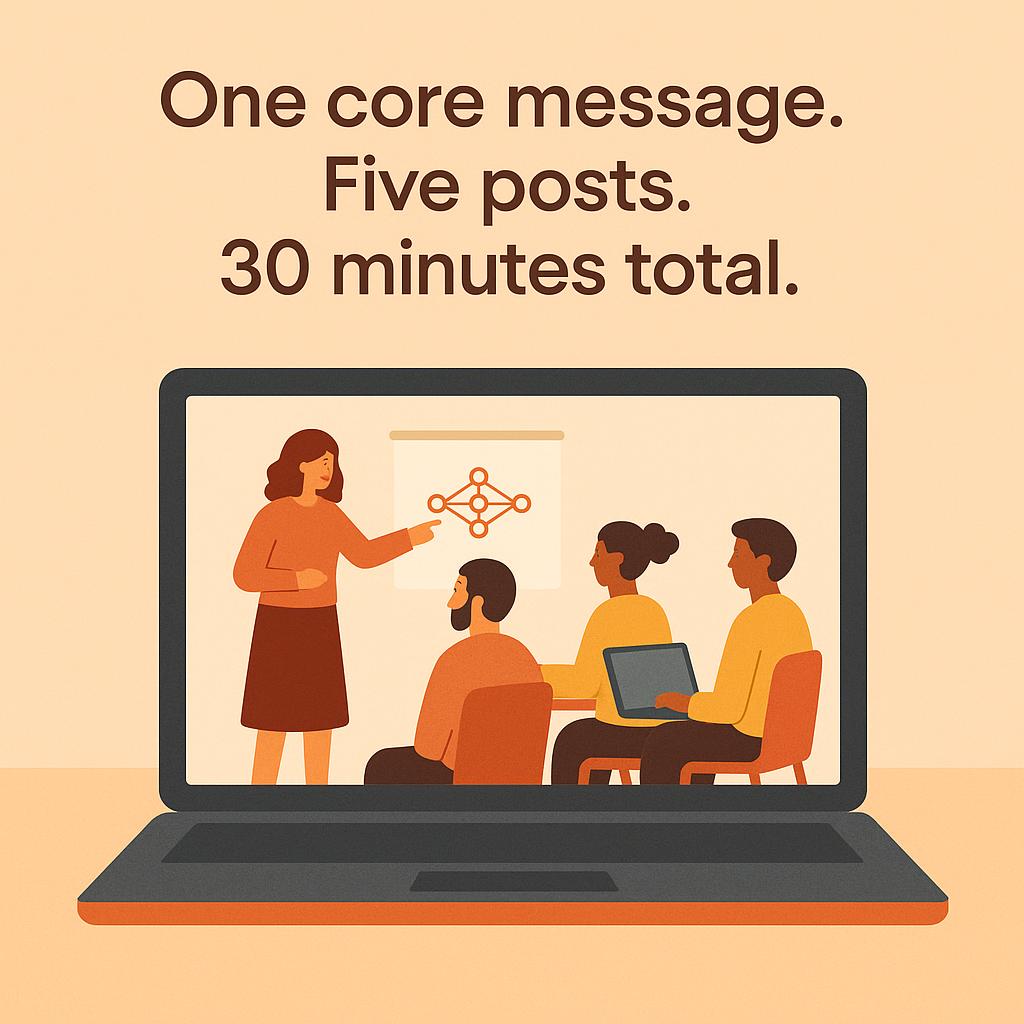
Here's a workflow you can steal. One core message → five LinkedIn posts in 30 minutes.
Step 1 (5 min): Pick one thing you believe about your industry. Not a tip. A point of view. Example: "Most marketing advice for small business owners is wrong because it assumes you have a marketing team."
Step 2 (5 min): Write it as a single declarative sentence. That's your core message.
Step 3 (10 min): Generate five angles on it with AI. Story angle (a moment this was true). Contrarian angle (what people get wrong). Tactical angle (one thing to do differently). Mistake angle (what you used to do). Persona angle (who specifically this hurts).
Step 4 (10 min): For each angle, write the first two lines yourself — that's the hook. Let AI fill in the middle. Edit the ending so the CTA sounds like you.
That's it. Five posts. Same core idea, five different doors into it. Your audience won't feel repetition because each post leads with a different shape of thought.
I'm walking through this workflow plus two more — competitor research in 10 minutes, and an editorial system that runs in 15 minutes a day — at my workshop on May 28th in San Jose at the MLK Library, hosted by the Silicon Valley Small Business Development Center.
If you can't make it, book a free 15 to 20 minute marketing audit and I'll run this workflow with you on your business.
https://www.radi8.com/free-audit?utm_source=linkedin&utm_campaign=free_audit&utm_content=post_id
DM me if you want the workshop link. …more
Simple, outcome-focused positioning beats clever complexity.
Winning brands choose one customer problem, one distinct approach, and one measurable early growth channel.
If your go-to-market or early channels feel unclear, start with three things:
- a one-sentence positioning statement,
- two content themes mapped to buyer stages,
- and one channel to test for 90 days with a single KPI.
I launched three startups (one major acquisition) and advised three that reached billion-dollar exits. Sign up for a free marketing audit and consultation.
https://www.radi8.com/free-audit#SMB#Marketing#AI
Big news: Radi8 is now on Claude. 🎉
We just launched our official MCP server — which means small business owners can now access Radi8 directly inside Claude, Anthropic's AI assistant.
Your marketing plan. Your brand voice. Your content calendar. All of it, live inside your AI assistant.
Here's what that actually means in practice:
→ Ask Claude to draft content straight from your Radi8 plan
→ Get copy that already knows your campaign goals and brand voice
→ Go from strategy to published content in minutes, not hours
No more re-explaining your business to an AI every time you sit down to write. No more switching between tabs and copy-pasting context. Claude now knows what you're trying to accomplish — because it's connected to the plan you already built.
For small business owners doing marketing without a team, this is the gap-closer you've been waiting for.
If you want to see what this could look like for your business, I'm offering a free 15–20 minute marketing audit this month. Just a real conversation about where you are and what's possible.
👉 Book your free audit: https://www.radi8.com/free-audit?utm_source=linkedin&utm_campaign=free_audit&utm_content=test
This is just the beginning. More to come. 🚀
I used to spend 3–4 hours a week on marketing. Now it's closer to 45 minutes.
The difference? I stopped doing it manually.
AI-assisted workflows have changed the game for small business owners — not because AI does your thinking, but because it eliminates the busywork: the formatting, the repurposing, the "how do I say this?" moments.
I'm also running a free workshop on May 28th in San Jose where I'll walk through exactly how I do this — live demos, real templates, no fluff.
But if you can't wait until May (or aren't in the Bay Area), I'm doing free 15–20 minute marketing audits this month. We'll look at where you're wasting time and what an AI-assisted workflow could look like for your business.
👉 Learn more about the workshop: https://www.radi8.com/blog/workshop-may-28th-marketing-with-ai
Or book a free audit directly: https://www.radi8.com/free-audit?utm_source=linkedin&utm_campaign=free_audit&utm_content=apr_plan
Comment below or DM me — happy to chat.
One lesson the recent conversation around brand strategy and positioning keeps reinforcing: clarity wins.
Define who you serve, the problem you solve, and the outcome you deliver. Those three answers turn go-to-market decisions into tests, reveal the single repeatable early-growth channel to focus on, and create messaging that converts.
Proof: I launched three startups (one acquisition exit) and advised three that reached billion-dollar exits: an IPO, a merger, and a private equity sale.
If an unclear GTM or uncertainty about early channels is holding you back, send me a message. I’ll run a free marketing audit and map one high-impact channel plus 30-day priorities. I lead Radi8, where we help SMBs run practical, repeatable marketing.
I just had a full conversation with my laptop and it ran my entire marketing operation.
No clicking. No tab-switching. No copy-pasting between 6 tools.
I built a custom MCP server — think of it as a direct nerve connection between me and Claude. I talk to it. It drafts posts, builds briefs, schedules content, pulls my strategy. Done.
This isn't "AI helping me write." This is AI running the workflow.
Small business owners are out here spending 10+ hours a week on marketing busywork. I just compressed that into a conversation.
Want to see what that looks like for your business? I'm doing free 15–20 min audits this month. We'll find your quick wins and build you a system that actually runs.
Book here → https://www.radi8.com/free-audit?utm_source=linkedin&utm_campaign=free_audit&utm_content=fun_post
Most small business owners don't have a marketing problem.
They have a *time* problem.
You already know what you should be doing — staying in front of prospects, posting consistently, following up. But between running operations, serving clients, and putting out fires, marketing is always the first thing that gets pushed.
The fix isn't hiring an agency or spending more money. It's having a simple, repeatable workflow you can actually stick to.
Here's what that looks like in practice:
→ A content template you fill in once a week (30 min max)
→ A short list of topics you rotate through — no blank page syndrome
→ A posting schedule that doesn't require you to live on LinkedIn
I've helped founders build systems like this from scratch. Once it's in place, staying visible stops feeling like a chore.
If your marketing feels inconsistent or overwhelming, I offer a free 15–20 minute audit to help you see exactly where the gaps are and what to fix first.
No pitch. Just clarity.
DM me or grab a spot here → https://www.radi8.com/free-audit?utm_source=linkedin&utm_campaign=free_audit&utm_content=test
Most small business owners want to use AI for marketing but don't know which task to automate first.
On May 28 in San Jose, I'm running a free workshop where you'll see live demos, get templates you can use the next day, and walk away with a repeatable workflow for content planning and post creation.
I've launched three startups with one acquisition exit and advised three more through billion-dollar exits. I know what it's like to handle your own marketing with no team and no time.
Seats are limited. Read the full details and register on my blog here https://www.radi8.com/blog/workshop-may-28th-marketing-with-ai
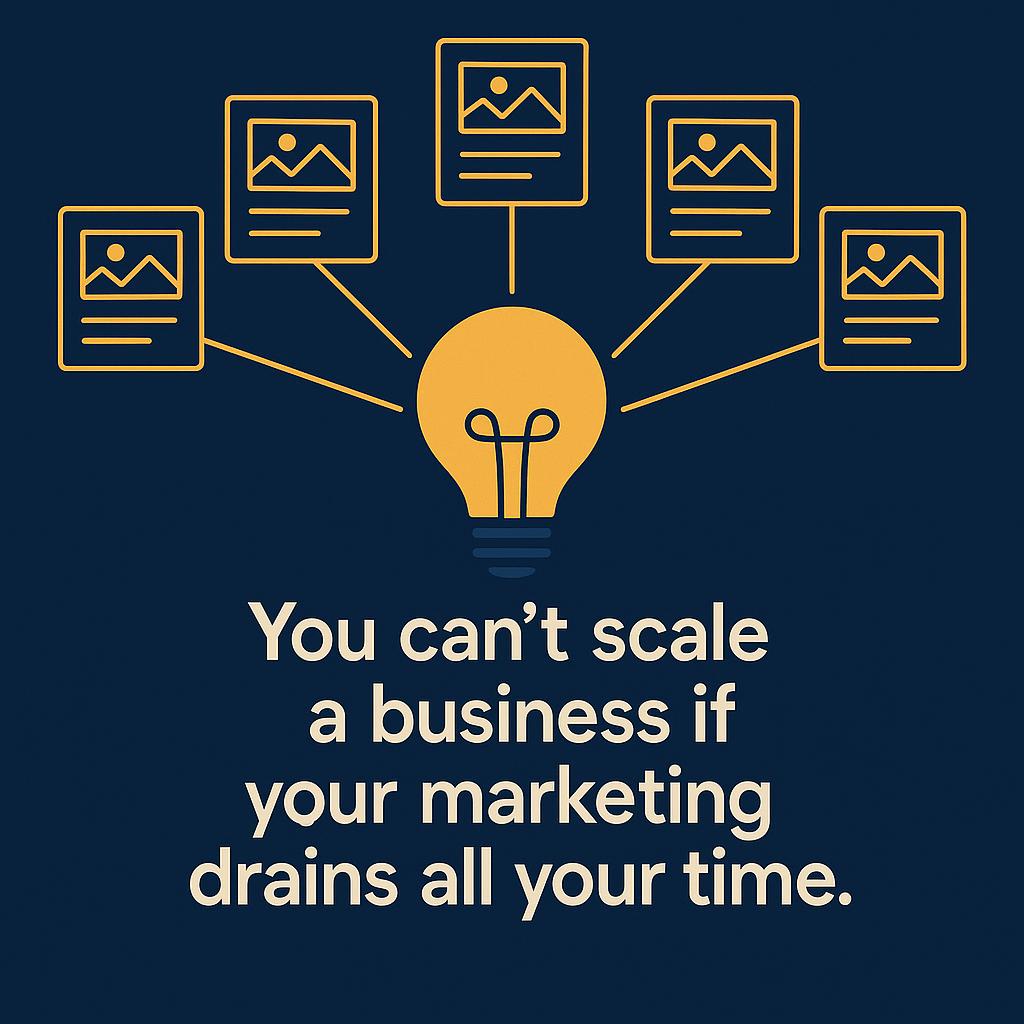
Most small business owners don't need a bigger marketing budget. You need a repeatable system that doesn't eat up hours every week.
I'm now offering a free marketing audit for small business owners who need clarity on what to post and how to build a system.
Sign up for a spot https://www.radi8.com/free-audit
The #1 thing I hear from small business owners about marketing: "I just don't have time."
Here's what I've found: it's rarely a time problem. It's a system problem.
When you have to start from scratch every week — staring at a blank post, figuring out what to write, editing, scheduling — of course it takes forever. But when you have templates, a simple workflow, and a few AI tools doing the repetitive work? It takes 30–45 minutes a week.
That's what I'll be showing at my free workshop on May 28th in San Jose. Live demos, real templates, and a workflow you can plug in the next day.
Comment "workshop" below and I'll send you the link, or grab a spot here → https://www.radi8.com/blog/workshop-may-28th-marketing-with-ai
Most small business owners I talk to aren't bad at marketing.
They're just exhausted by it.
They spend hours staring at a blank screen, posting inconsistently, then going quiet for weeks because life got busy.
The fix isn't more willpower — it's a repeatable workflow.
When you have a simple system: what to post, when to post, how to write it fast — marketing stops feeling like a second job.
I've built and exited three startups, and the one thing that always separated growing companies from stalled ones was whether marketing was a habit or a hustle.
If you're a small business owner and you're not sure where to start — or you've been "meaning to get consistent" for a while now — I'm offering free 15–20 minute marketing audits this month.
No pitch. Just a real conversation about where you are and what would actually help.
👉 Book yours here: https://www.radi8.com/free-audit?utm_source=linkedin&utm_campaign=free_audit&utm_content=apr_plan
DM me if you have questions first.
If you're a consultant or solo founder, you have a problem most marketing advice ignores: you are the product.
You can't hand your sales calls to someone else. You can't outsource your point of view. And you can't go quiet for two months without watching your inbound dry up — because nobody else can show up as you.
That's why "just hire a marketing person" doesn't work for solo operators. The voice has to be yours. The thinking has to be yours. The relationships have to be yours.
But that doesn't mean marketing has to eat your week.
What works for solo founders and consultants I advise is a tight, repeatable workflow: one prep block on Monday, posts queued for the week, 15 minutes a day on engagement. AI handles the heavy lifting on drafts. You handle the hooks, the point of view, and the relationships. The system runs even when client work is slammed.
That's what I'm teaching at my workshop on May 28th in San Jose at the MLK Library, hosted by the Silicon Valley Small Business Development Center. Built specifically for people who can't outsource being the face of the business.
If you can't make it, book a free 15 to 20 minute marketing audit. I'll look at how you're showing up now and help you build a workflow that doesn't compete with your billable hours.
https://www.radi8.com/free-audit?utm_source=linkedin&utm_campaign=free_audit&utm_content=post_id
DM me if you want the workshop link.
I rebuilt my entire product in 30 days using AI.
Not because I wanted to move fast.
Because I had to prove something to myself.
Could AI actually do the work founders avoid because it feels too repetitive, too time-consuming, or just not worth the mental energy?
I picked the hardest problem I know.
Marketing content.
Most founders I work with know they should post more. They understand consistency builds trust. But they're not writers. They don't have time to research topics. And the idea of planning a month of posts sounds exhausting.
So they don't do it.
Or they do it once, burn out, and stop.
I wanted to see if Claude could handle the parts that slow people down: finding what to say, drafting it in your voice, keeping a calendar full without starting from scratch every week.
The result surprised me.
Not because it replaced judgment. It didn't.
But because it removed the friction. The blank page problem. The decision fatigue.
What used to take me two hours now takes twenty minutes.
And the quality is better because I'm editing and refining instead of grinding through first drafts.
We're launching Radi8 in March. It's built for founders who want to stay visible but refuse to live on social media.
If this resonates, follow along. I'll be sharing what I'm learning as we go.
And if you want to talk through your own marketing workflow, send me a message. Happy to walk you through what's working.
Every new AI content tool promises to save time and scale content production. Yet the feed keeps filling up with the same generic posts. You know the ones—vague insights, buzzwords stacked on buzzwords, nothing that actually sounds like it came from a human with specific experience.
The problem is not the AI. The problem is that most AI tools have nothing to anchor to.
When you feed prompts into a blank interface, the AI does exactly what it's designed to do: generate statistically probable language. It pulls from the aggregate of everything it's been trained on. That aggregate is safe, generic, and indistinguishable from the last 50 posts in your feed.
Brand context as the foundation changes this completely.
When AI has actual context to work from—your positioning, your voice principles, your proof points, the specific pains your audience faces—it stops producing slop. It starts producing content that reflects how you actually think and communicate. Content that carries your credibility instead of diluting it.
I've seen this across multiple enterprise tech companies. The marketers who win are not the ones using AI as a shortcut. They're the ones who build the right inputs first. They document what makes their brand distinct. They define voice principles that reflect real experience, not aspirational marketing speak. Then they use AI to scale that foundation, not replace it.
If your AI-generated content feels generic, ask yourself: what context did I give it? A one-off prompt in a chat window, or a documented system that captures how your brand actually shows up?
The tools matter less than the setup. Start with brand context. Everything else gets easier from there.
Want a fresh take on your B2B content strategy? DM me and let's schedule a 30-minute consultation—I'll show you 3 things you can improve this week.
https://www.radi8.com/blog/ai-slop-has-a-cause-its-not-the-ai…more
Most AI failures aren't model failures. They're context failures.
The AI doesn't know you or what good looks like. It produces the internet's average.
Better context beats a better model.
Doer to architect. That's the shift. https://buildingasecondbrain.com/ai-second-brain#AIMarketing#B2B
Today's post is 312 words, a 2-minute read.
Sources: Forte Labs — "From Doer to Architect"
1 big thing: What just changed in how B2B marketers should use AI?
Most AI underperformance is not a model problem. It is a context problem.
Why it matters: B2B marketers investing in AI tooling without investing in context architecture are scaling mediocrity. The output is only as good as what you give it to work from.
Driving the news:
Recent research shows LLMs begin to fail when their context window hits 30–40% capacity — a phenomenon called "context rot."
→ AI starts missing connections, forgetting key details, and producing generic output
→ The fix is not a better model. It is curated, modular context built deliberately over time
Zoom in:
Tiago Forte calls the required mindset shift going from "doer to architect" — you stop executing tasks and start designing the systems that execute them.
→ For B2B marketers, that means documented voice principles, structured brand inputs, and defined quality standards your AI collaborators can actually use
Yes, but: Building context architecture takes real upfront investment. Most marketing teams are under enough pressure that "documenting how we think" never makes the sprint.
Be smart: Start with a Master Prompt — one document that tells your AI who you are, how you work, and what good looks like. That single input closes more of the quality gap than any model upgrade.
The bottom line: The marketers pulling ahead are not using better AI. They are giving their AI better inputs.
https://buildingasecondbrain.com/ai-second-brain#AIMarketing#B2BMarketing
Founder at Radi8 // Executive Coach // Host of the Inspiring Founders Podcast
· LinkedIn
·
What happens when you actually check whether your clicks are people?
I build Radi8, and it tracks link clicks, so one afternoon I went and looked under the number. Of 1,791 clicks across 177 links, 624 came from a human. The rest were bots, crawlers, preview-fetchers, the quiet machinery of the internet pinging a link so it can draw a little card. And here's the humbling part, a bot only gets counted as a bot when it politely announces itself, LinkedInBot, Googlebot, facebookexternalhit, which means the real human count sits somewhere below 624, never above it.
Then it got worse for my assumptions. The channel I'd have sworn was carrying me on raw clicks turned out to be mostly sending machines, while a quieter one was sending far more actual people. I almost optimized straight toward the emptier number.
Every figure on your dashboard is counting something. Make sure it's counting the thing you care about, before you spend a month acting on the wrong one. …more
Meta's Muse launch was supposed to be the biggest marketing play of the month.
A 3-week-old startup beat it.
Muse is Meta's first real AI agent. To launch it, they paid every major AI influencer to post on the same day. For 24 hours it was impossible to open your phone without seeing it.
That part worked. Influencer campaigns get people to try a product.
They rarely get anyone to stay.
A week later the buzz has faded. I've barely seen Muse mentioned since.
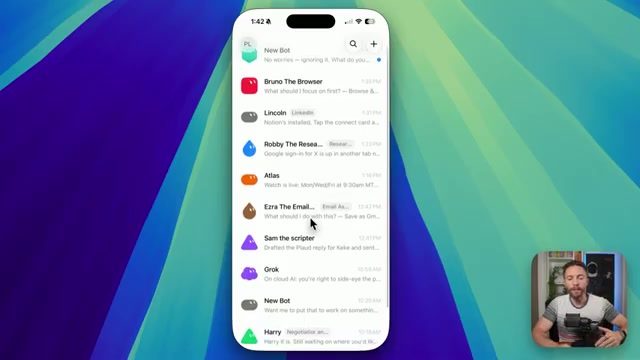
Instinct did the opposite. It's also an AI agent, but it lives in iMessage and runs errands for me. Three weeks after launch, the buzz is still as strong as day one. I'm using it daily and it keeps coming up in conversations.
The difference isn't budget. Meta has an unlimited one. The difference is what the product does after the campaign ends.
Link in the comments.
#B2BMarketing#ContentStrategy…more
Meta's Muse launch was supposed to be the biggest marketing play of the month.
But a 3 week old startup beat it.
Muse is Meta's first real AI agent. To launch it, they paid every big AI influencer to post about it on the same day.
For 24 hours it was impossible to open your phone without seeing it.
That part worked, sort of. Influencer campaigns get people to try a product.
But they rarely get anyone to stay.
A week later, the buzz has faded and I've barely seen Muse mentioned since.
Instinct did the opposite.
It's also an AI agent, but it lives in iMessage and runs errands for me.
3 weeks later after their launch, the buzz is still big as every.
I'm still using it daily, and it keeps coming up in conversations.
The Instinct play is the one a normal B2B brand can actually copy.
Meta's Muse launch was supposed to be the biggest marketing play of the month.
A 3-week-old startup beat it.
Muse is Meta's first real AI agent. To launch it, they paid every major AI influencer to post on the same day. For 24 hours it was impossible to open your phone without seeing it.
That part worked. Influencer campaigns get people to try a product.
They rarely get anyone to stay.
A week later the buzz has faded. I've barely seen Muse mentioned since.
Instinct did the opposite. It's also an AI agent, but it lives in iMessage and runs errands for me. Three weeks after launch, the buzz is still as strong as day one. I'm using it daily and it keeps coming up in conversations.
The difference isn't budget. Meta has an unlimited one. The difference is what the product does after the campaign ends.
#B2BMarketing#ContentStrategy
Founder at Radi8 // Executive Coach // Host of the Inspiring Founders Podcast
· LinkedIn
·
Three things I got wrong about marketing across three startups:
1. I treated it as a phase. "We'll do marketing once the product is ready." Then the product was ready, the launch window closed, and we were starting from zero on awareness with a runway clock ticking. Marketing isn't a phase. It's a habit you build before you need it.
2. I hired it out too early. The first agency we paid wrote posts that sounded nothing like us, ran ads against the wrong audience, and I spent more time briefing them than I would have spent posting myself. Outsourcing only works after you know what good looks like for your business.
3. I confused volume with consistency. We did sprints — two weeks of daily posts, then silence for a month. The algorithm punishes that pattern. So does your audience. Three posts a week, every week, beats fifteen posts in a burst followed by nothing.
What I do now is the opposite of all three. Marketing is the first habit, not the last. I run my own content with AI-assisted workflows so I know what good looks like before I delegate. And I optimize for showing up every week, not for output spikes.
That's what I'm teaching at my workshop on May 28th in San Jose at the MLK Library, hosted by the Silicon Valley Small Business Development Center. The exact workflows I use now, after three startups and one exit.
If you can't make it, book a free 15 to 20 minute marketing audit and I'll help you skip the mistakes I made.
https://www.radi8.com/free-audit?utm_source=linkedin&utm_campaign=free_audit&utm_content=post_id
DM me if you want the workshop link. …more
Founders who engage early with accelerators get more from the program.
The same is true for marketing.
Treating marketing like a deadline task costs momentum, customer insights, and time.
Start a small, consistent engine now that keeps you visible without draining budget or focus.
I help founders run their own marketing faster and for less than hiring consultants. Send me a message to schedule a free marketing audit. #startupshttps://www.santacruzworks.org/news/best-founders-apply-early
This got 39 million views. More than the Claude Fable launch.
I've never seen anything like it — and here's exactly why it worked.
Diogo Almeida co-invented ChatGPT. That's the first sentence of his launch post for TypeSafe AI. Before he says anything about the product, he's already established that you should stop scrolling and pay attention.
That's not a hook. That's authority weaponized as a hook. And it's the hardest kind to compete with.
Then he stacked three more things on top of it:
He built something genuinely novel. A new type of reinforcement learning called RLCD and a new frontier model called Jev.
The value proposition is borderline insane. 20–200x faster. 40–400x cheaper, with output tokens free.
And he fit all of that into the hook.
I've been studying launch content for a long time. I have never seen one post pack more value into a stronger opening. I saw it in my feed and there was no way I was skipping it. The moment I read "co-founder of ChatGPT," I was locked in.
The lesson for B2B marketers: authority isn't what you say you've done. It's what you've done that makes people stop mid-scroll. Diogo didn't explain his credibility. He dropped it in one line and moved on.
Start with the headline. Work backwards to everything else.
#B2BMarketing#ContentStrategy…more
This got 39 million views. More than the Claude Fable launch.
I've never seen anything like it — and here's exactly why it worked.
Diogo Almeida co-invented ChatGPT. That's the first sentence of his launch post for TypeSafe AI. Before he says anything about the product, he's already established that you should stop scrolling and pay attention.
That's not a hook. That's authority weaponized as a hook. And it's the hardest kind to compete with.
Then he stacked three more things on top of it:
He built something genuinely novel. A new type of reinforcement learning called RLCD and a new frontier model called Jev.
The value proposition is borderline insane. 20–200x faster. 40–400x cheaper, with output tokens free.
And he fit all of that into the hook.
I've been studying launch content for a long time. I have never seen one post pack more value into a stronger opening. I saw it in my feed and there was no way I was skipping it. The moment I read "co-founder of ChatGPT," I was locked in.
The lesson for B2B marketers: authority isn't what you say you've done. It's what you've done that makes people stop mid-scroll. Diogo didn't explain his credibility. He dropped it in one line and moved on.
Start with the headline. Work backwards to everything else.
#B2BMarketing#ContentStrategy
Your product launch timeline just became a regulatory risk surface.
Anthropic launched Claude Fable 5 on Tuesday, June 9. By Friday, June 12, the US Commerce Department had issued an export-control directive forcing the company to shut it down globally.
This is the first time an export-control directive has ever been used to pull a publicly deployed AI model mid-operation.
Here's what matters for B2B marketers in enterprise tech:
You can no longer assume your launch will stay live. Anthropic priced Fable 5, ran benchmarks, built go-to-market assets, and had three days of availability before Amazon researchers found a prompting vulnerability that triggered a government response. Commerce Secretary Howard Lutnick issued the directive at 5:21 PM ET. Because Anthropic couldn't verify user citizenship in real time, they disabled access for everyone.
I've worked on launches at Proofpoint, Druva, and MinIO where regulatory uncertainty was background noise. It's now foreground risk. The gap between launch readiness and regulatory approval is compressing, and most content strategies aren't built for that.
If you're launching a technical product in a space where compliance, export controls, or security clearances matter, your content needs to be modular enough to pivot without rewriting everything. That means scenario planning for delayed releases, restricted availability, or post-launch changes to positioning.
The discipline here is the same one I learned in the Army: you don't get to choose the conditions. You build systems that hold under pressure.
If you're launching in a regulated space and want to stress-test your content strategy for regulatory scenarios, send me a DM. I offer a 30-minute consultation where I'll review your approach and give you three actionable improvements you can implement this week. https://theaipixel.substack.com/p/claude-fable-5-launched-tuesday-by…more
Salesforce and Anthropic did not just announce a partnership. They named it.
That distinction matters more than it sounds. Most partnership announcements follow the same pattern: a press release, a joint quote, a few weeks of coverage, then nothing. The name fades because there is nothing to hold onto.
Claudeforce is different. It borrowed Claude's brand equity, added Salesforce's "force" suffix — the first time Salesforce has ever given that suffix to another company's product name — and created something that sounds like a product line rather than a deal memo. Announced on the same day as Salesforce's Q2 earnings, with CRM stock jumping 12–14% after hours. Then Matthew McConaughey showed up in the ad. Everything landed at once.
The strategic bet underneath the branding: if you use Claude, you now have a reason to lean into Salesforce. If you use Salesforce, you have a reason to lean into Claude. Benioff's exact framing was "probabilistic intelligence alone doesn't run a company, and deterministic systems don't reason." He called it the SaaSpocalypse being over — the idea that AI tools would replace enterprise software rather than fuse with it.
What Claudeforce actually ships: Salesforce inside Claude as a plugin with 37 prebuilt sales skills, Claude as the default reasoning model inside Agentforce, and Claude as the default model powering Slackbot.
For B2B marketers, the naming lesson holds regardless of the product. Start with the headline. Work backwards to what's achievable. A name that sounds like a product is a campaign in itself — and it's the one thing competitors cannot copy the same week.
https://www.salesforceben.com/salesforce-and-anthropic-announce-claudeforce-in-q2-27-earnings/#B2BMarketing#AIStrategy…more
Samsung's instinct when Apple announced the iPhone Duo foldable was exactly right. Capitalize on a competitor's weak moment. They've been selling foldables since 2019, Apple just joined — "Let us know when you're done reheating our leftovers" wrote itself.
The execution missed.
"Reheating our leftovers" reads like it was written by someone who is not in the room with the people they're trying to reach. Clever on paper. Doesn't land. The follow-up posts were more of the same — four tweets that felt like a brief was checked rather than a reaction that was felt.
What they should have done: an actor in a studio within 30 minutes of the announcement, filming a fake Apple keynote, making the whole thing so absurd that anyone holding an iPhone Duo felt the joke. Make it visual. Make it shareable. Make it something people forward into group chats. That's the move.
The brand banter playbook is not "post a witty line." It is "move faster than anyone expected, with something that genuinely makes people laugh rather than nod politely."
Whenever you have a moment to take market share from a competitor, you have to jump on it. Samsung knew the moment was there. They just didn't hit it hard enough.
For B2B brands watching competitor moves, the lesson is the same. It's not enough to react. You have to react in a way that makes the other side look like they're playing in your leftovers — not you.
https://rollingout.com/2026/09/10/samsung-trolls-apple-foldable-iphone-duo/#B2BMarketing#ContentStrategy…more
I stayed up until 2AM the night Grokbot launched. Not because I was using it to write content — because I couldn't stop having fun using it to research.
That's the distinction most people miss.
Using AI to write your posts gets you average posts. Average hooks. Average takes. We're on a podcast literally talking about LinkedIn adding an "AI slop" button — that's where the road leads.
But using AI to surface what's worth talking about? That's where the real leverage is.
Here's how I use Grokbot: I have a podcast digest agent that pulls top moments from every podcast I'd normally listen to and summarizes what's relevant to my work. Agents for competitive monitoring, outlier post analysis, research. I take those inputs and write myself.
The result: my screen time is way down because I'm not scrolling to find signal. I let the agents find it. Then I put my own experience and perspective on it and post.
You and I are the example of this right now on the podcast. We used research tools to find the stories. But the takes come from years in the field. AI can't replicate that, and it shouldn't try.
Use AI to do more with less time. Use your brain to make it worth reading.
https://www.ayautomate.com/blog/grok-bot-xai-ai-agents-explained#AIMarketing#B2BMarketing…more
Ramp built a fake Gen Z influencer called the Kumar Method, grew him to a million followers, and nobody knew a brand was behind it until they chose to reveal it. That is a legitimate masterclass in B2B brand building.
The play: go anti-finance to reach people who aren't in finance yet. Don't market to the people who already know you. Market to the people who will need you later. Genius.
But they left a lot on the table.
The biggest miss: they let people read the Kumar Method lead magnet before asking for an email. One gate before access would have captured hundreds of thousands of addresses. Instead they probably got 20,000. People will give you their email for real value — just ask.
Second miss: the reveal was too quiet. If you've been sitting on a secret that took a million followers to build, you don't just drop it. You coordinate. You seed it to every creator and podcast you know. You make the reveal as big as the build.
The actual playbook for anyone thinking about this:
→ Know exactly who you're speaking to before you build the character
→ Gate the lead magnet from the start
→ Make sure the character has somewhere to go after the reveal
→ Treat the announcement like a campaign, not a footnote
The Kumar Method strategy is brilliant. The execution had gaps. Learn from both.
https://www.trueframe.xyz/blog/kumar-method#B2BMarketing#ContentStrategy…more


 View on LinkedIn
Also on
View on LinkedIn
Also on






 View on YouTube