
R

Ryan Swindall
· LinkedIn
Every new AI content tool promises to save time and scale content production. Yet the feed keeps filling up with the same generic posts. You know the ones—vague insights, buzzwords stacked on buzzwords, nothing that actually sounds like it came from a human with specific experience.
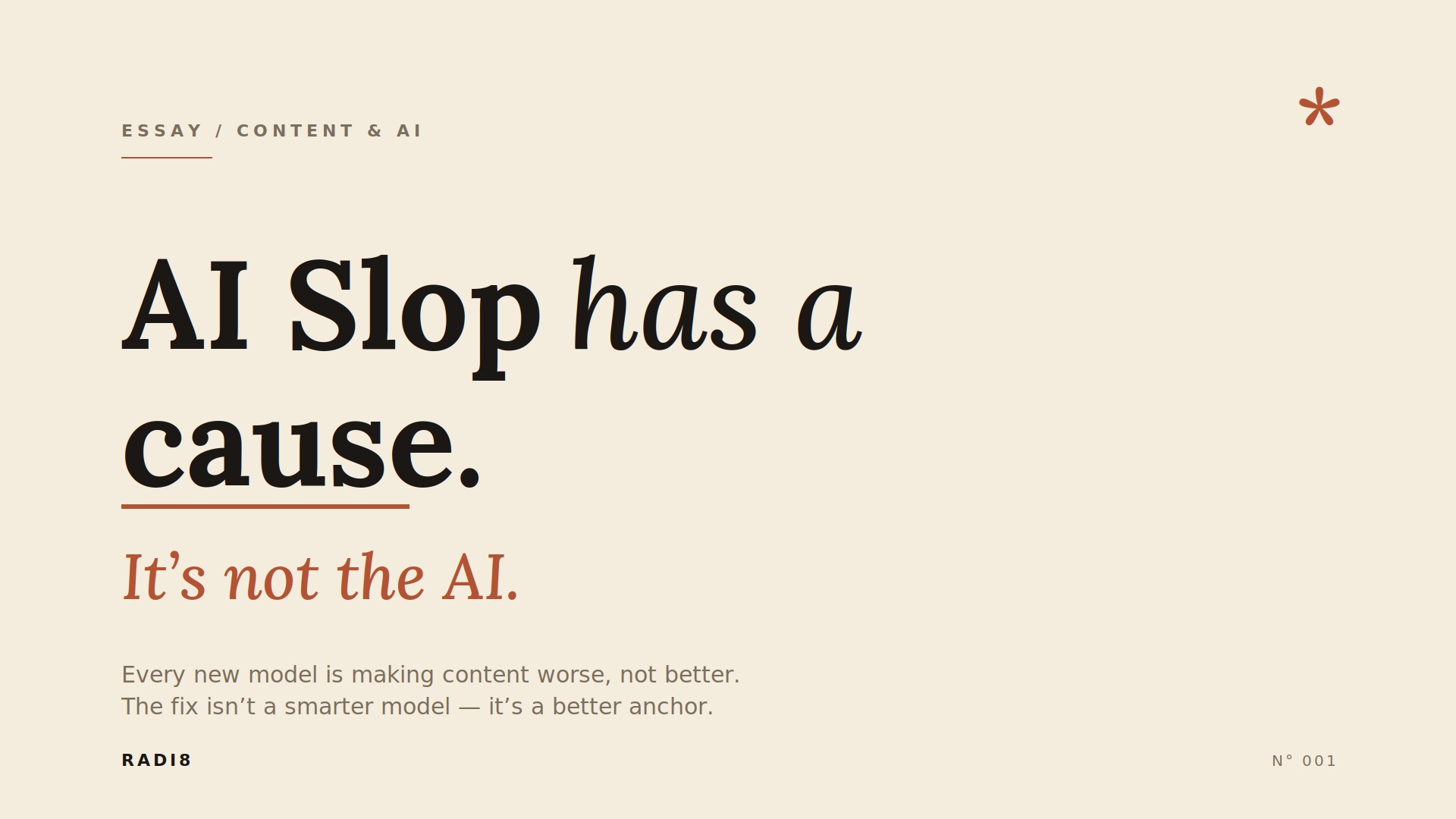
The problem is not the AI. The problem is that most AI tools have nothing to anchor to.
When you feed prompts into a blank interface, the AI does exactly what it's designed to do: generate statistically probable language. It pulls from the aggregate of everything it's been trained on. That aggregate is safe, generic, and indistinguishable from the last 50 posts in your feed.
Brand context as the foundation changes this completely.
When AI has actual context to work from—your positioning, your voice principles, your proof points, the specific pains your audience faces—it stops producing slop. It starts producing content that reflects how you actually think and communicate. Content that carries your credibility instead of diluting it.
I've seen this across multiple enterprise tech companies. The marketers who win are not the ones using AI as a shortcut. They're the ones who build the right inputs first. They document what makes their brand distinct. They define voice principles that reflect real experience, not aspirational marketing speak. Then they use AI to scale that foundation, not replace it.
If your AI-generated content feels generic, ask yourself: what context did I give it? A one-off prompt in a chat window, or a documented system that captures how your brand actually shows up?
The tools matter less than the setup. Start with brand context. Everything else gets easier from there.
Want a fresh take on your B2B content strategy? DM me and let's schedule a 30-minute consultation—I'll show you 3 things you can improve this week.
https://www.radi8.com/blog/ai-slop-has-a-cause-its-not-the-ai
 View on LinkedIn
Told 3 times, Aug 31, 2026 – Sep 4, 2026
· X · Open
Most AI failures aren't model failures. They're context failures.
The AI doesn't know you or what good looks like. It produces the internet's average.
Better context beats a better model.
Doer to architect. That's the shift. https://buildingasecondbrain.com/ai-second-brain
#AIMarketing #B2B
· LinkedIn · Open
Today's post is 312 words, a 2-minute read.
Sources: Forte Labs — "From Doer to Architect"
1 big thing: What just changed in how B2B marketers should use AI?
Most AI underperformance is not a model problem. It is a context problem.
Why it matters: B2B marketers investing in AI tooling without investing in context architecture are scaling mediocrity. The output is only as good as what you give it to work from.
Driving the news:
Recent research shows LLMs begin to fail when their context window hits 30–40% capacity — a phenomenon called "context rot."
→ AI starts missing connections, forgetting key details, and producing generic output
→ The fix is not a better model. It is curated, modular context built deliberately over time
Zoom in:
Tiago Forte calls the required mindset shift going from "doer to architect" — you stop executing tasks and start designing the systems that execute them.
→ For B2B marketers, that means documented voice principles, structured brand inputs, and defined quality standards your AI collaborators can actually use
Yes, but: Building context architecture takes real upfront investment. Most marketing teams are under enough pressure that "documenting how we think" never makes the sprint.
Be smart: Start with a Master Prompt — one document that tells your AI who you are, how you work, and what good looks like. That single input closes more of the quality gap than any model upgrade.
The bottom line: The marketers pulling ahead are not using better AI. They are giving their AI better inputs.
https://buildingasecondbrain.com/ai-second-brain
#AIMarketing #B2BMarketing