

A client told me her two blockers: Blank Screen and Fear of Camera.
If you've ever opened a new post, stared at the cursor, and closed it again... you know the first one. If you've ever hit record and then deleted the take... you know the second.
Both stop you before you've said anything at all.
I told her that I use Radi8, and it makes it all so easy for me.
Which one gets you... the Blank Screen or the Fear of Camera?
#Founders #CEO #Leadership …more
Content Strategy
Work by Michael Ashley · Everyone on Content Strategy
I've written positioning at my desk that didn't survive customers.
It took me a long time to stop doing it. A desk is a comfortable place to decide what customers care about... and it's often wrong, especially when you're launching a product or taking a company into a new market where your assumptions haven't been tested yet.
The clearer version is almost always in how customers describe the problem themselves. Their words, not my framing.
So before I touch the messaging, I ask a few plain questions:
Tell me about the last time this came up.
What did you try?
What did that cost you?
How would you explain the problem to someone on your team?
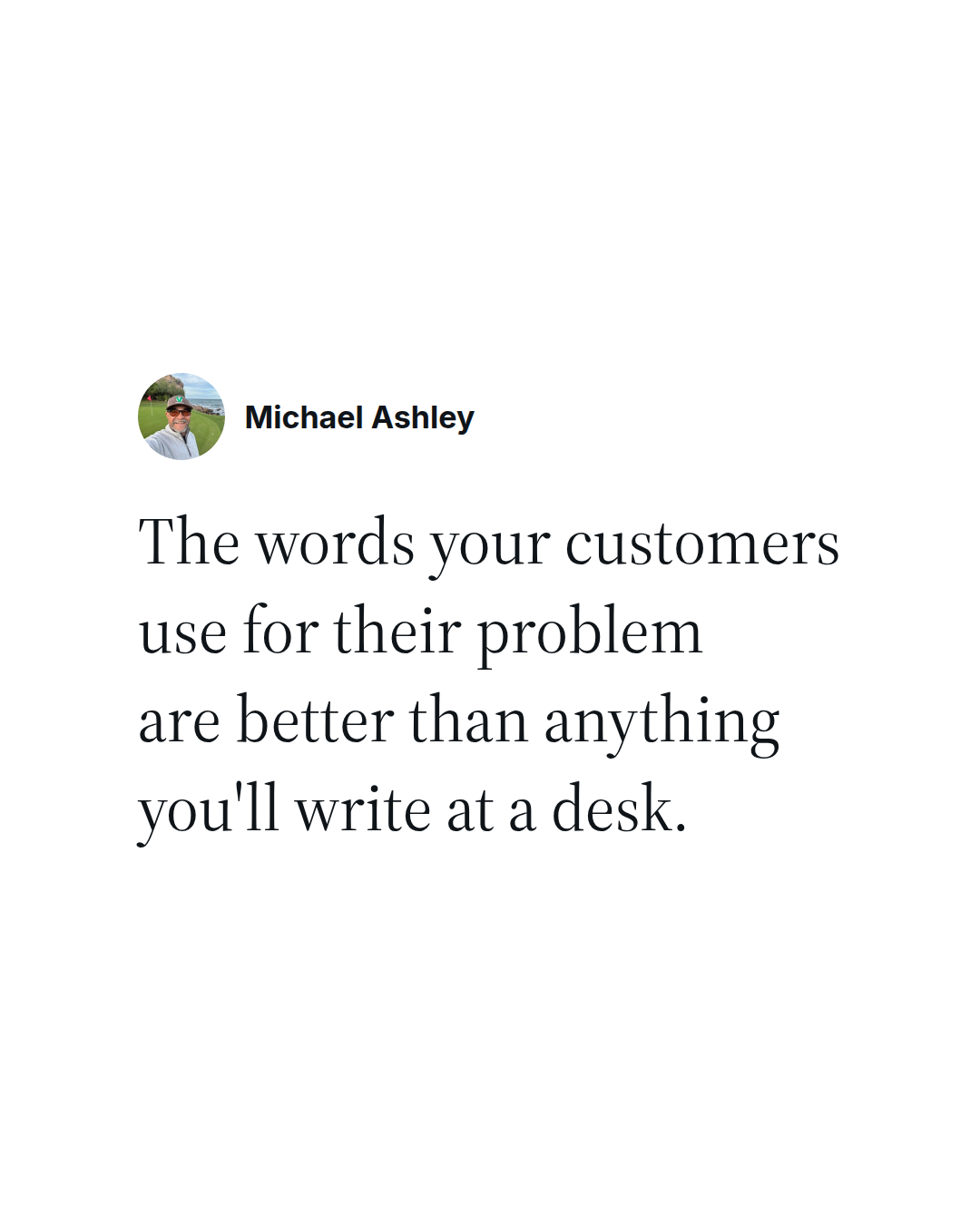
Then I listen, and I write down the exact phrases they use. The words your customers use for their problem are better than anything you'll write at a desk.
Pick three customers this week and ask them.
What's a phrase a customer used that changed how you describe what you do?
#Founders #CEO #GoToMarket #Positioning …more
 View on LinkedIn
Also on
Told 3 times, Nov 17, 2026 – Nov 20, 2026
· Bluesky · Open
25 years building companies, and I still don't trust positioning written at a desk.
The clearest words for what you do are usually the ones your customers already use.
What's a phrase a customer used that changed how you describe your work?
· X · Open
In 25 years, my best positioning never came from a desk.
It came from how customers described their own problem... in their words, not mine.
What customer phrase changed how you describe your work?
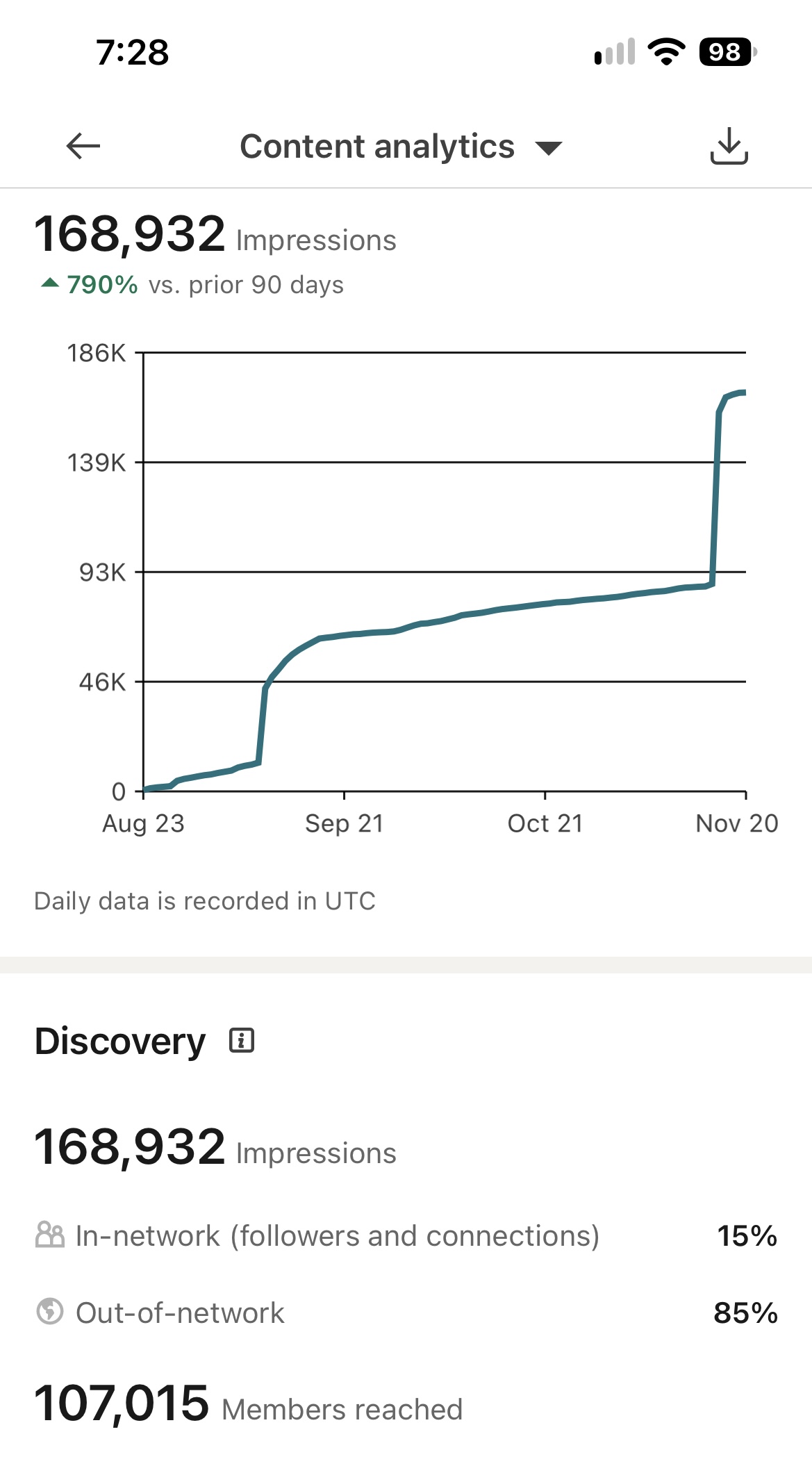
Over the last 90 days I’ve had 2 posts that broke out of my internal network on LinkedIn.
How were they different? 🤷🏻♂️
Each post was a story that resonated with a very specific audience and LinkedIn figured it out, distributed the post outside of my network, and it exploded.
Here’s the problem, if you’re creating content in the hopes of building awareness for your little business, it’s almost impossible to predict what LinkedIn will boost out-of-network.
Anyone else have this experience? …more
I can sum up the whole job of marketing today in one sentence.
For most of my 25 years building companies, marketing meant reach, attention, and moving people from interested to paying. I spent plenty of time figuring out all three, and I still catch myself reaching for those levers first.
AI is changing how people find things. Someone asks a question, gets an answer back, and might never see a list of options at all. That shrinks the job down to one test... when someone asks, are you the answer?
Content, SEO, thought leadership, partnerships... I'd run every one of them through that test before spending another dollar. If it doesn't make you the answer to a real question, it might just be making you busier.
"The whole job of marketing today, in one sentence really, is to be the answer."
The full conversation: https://youtu.be/UBdWhQDHkP0
What's the one question your best customers were asking right before they found you? That's where your answer has to live.
#Founders #CEO #GoToMarket #Strategy …more
This post has video.
Watch it on the channel.
'/%3E%3Cpath fill='%23fff' d='M12 7.3A4.7 4.7 0 1 0 16.7 12 4.7 4.7 0 0 0 12 7.3Zm0 7.8A3.1 3.1 0 1 1 15.1 12 3.1 3.1 0 0 1 12 15.1Zm5-8a1.1 1.1 0 1 0 1.1 1.1A1.1 1.1 0 0 0 17 7.1Zm-5 1.5c-1.5 0-1.7 0-2.3.1a3.8 3.8 0 0 0-1.3.2 2.2 2.2 0 0 0-.8.5 2.2 2.2 0 0 0-.5.8 3.8 3.8 0 0 0-.2 1.3c-.1.6-.1.8-.1 2.3s0 1.7.1 2.3a3.8 3.8 0 0 0 .2 1.3 2.2 2.2 0 0 0 .5.8 2.2 2.2 0 0 0 .8.5 3.8 3.8 0 0 0 1.3.2c.6.1.8.1 2.3.1s1.7 0 2.3-.1a3.8 3.8 0 0 0 1.3-.2 2.5 2.5 0 0 0 1.3-1.3 3.8 3.8 0 0 0 .2-1.3c.1-.6.1-.8.1-2.3s0-1.7-.1-2.3a3.8 3.8 0 0 0-.2-1.3 2.2 2.2 0 0 0-.5-.8 2.2 2.2 0 0 0-.8-.5 3.8 3.8 0 0 0-1.3-.2c-.6-.1-.8-.1-2.3-.1Zm0-1.6c1.5 0 1.7 0 2.4.1a5.5 5.5 0 0 1 1.8.3 3.8 3.8 0 0 1 2.2 2.2 5.5 5.5 0 0 1 .3 1.8c.1.7.1.9.1 2.4s0 1.7-.1 2.4a5.5 5.5 0 0 1-.3 1.8 3.8 3.8 0 0 1-2.2 2.2 5.5 5.5 0 0 1-1.8.3c-.7.1-.9.1-2.4.1s-1.7 0-2.4-.1a5.5 5.5 0 0 1-1.8-.3 3.8 3.8 0 0 1-2.2-2.2 5.5 5.5 0 0 1-.3-1.8C4 13.7 4 13.5 4 12s0-1.7.1-2.4a5.5 5.5 0 0 1 .3-1.8 3.8 3.8 0 0 1 2.2-2.2 5.5 5.5 0 0 1 1.8-.3C10.3 5 10.5 5 12 5Z'/%3E%3C/svg%3E) View on Instagram
Also on

The best marketing doesn't feel like marketing. …more
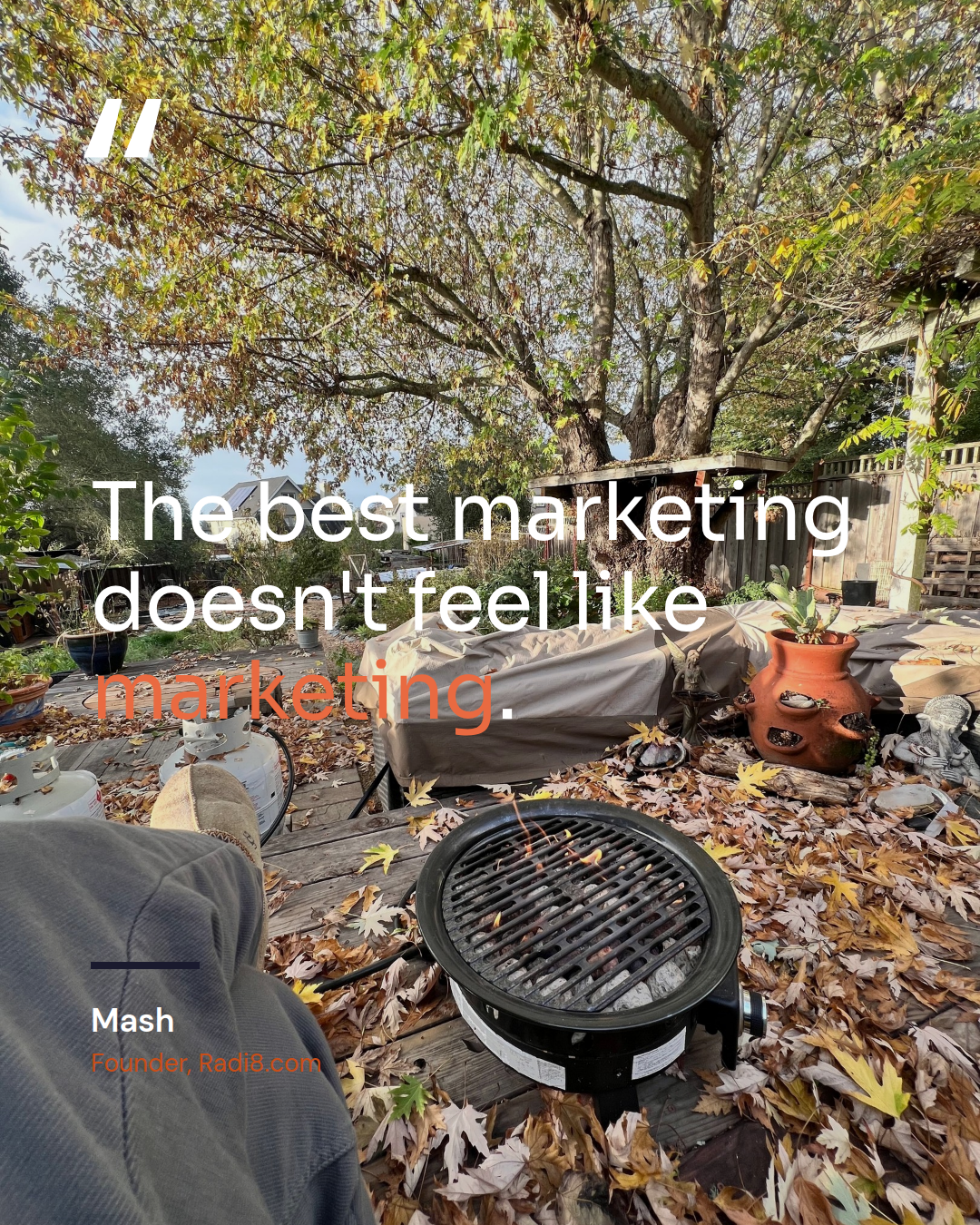
I used to think it was fun to make ai images that looked real. But soon realized they were too real - people felt faked out, scammed, deceived. And I get it, it’s weird. Then I tried ai images that made obvious caricatures, like this one. It’s a little better, but of course the concept is all wrong. That’s on me for bad prompting. But what do you think? Is it ok to generate ai images as long as it’s clearly not fakery? …more

Small business owners have told me, over and over, that coming up with ideas to post on is one of the hard things.
Not posting, exactly. Having something to post about.
So I built something for that one problem. It's called Ideas, and it's in Radi8.
It's a place to capture ideas for future posts and keep track of them, so when it's time to post you're not starting from a blank page.
And because a good idea shouldn't get used once and disappear, Radi8 tracks how your ideas perform... so the ones that work can be reused.
Thank you to everyone who told me this was hard. That's how it got built.
Ideas is live now!
#SmallBusiness #SmallBusinessOwner #Marketing …more
The question I hear most from small business owners about marketing: "What do I even write about?"
Every question a customer has asked you is a post. The thing you explain on every first call. The mistake you see new customers make. If one person asked, others are wondering too.
Keep a note on your phone and write each question down in their words. Then answer one a week, like they're sitting across the table from you.
What's the question you answer most often? …more
 View on Facebook
Also on

Told 2 times, Oct 27, 2026
· Bluesky · Open
The question I hear most from small business owners: what do I even write about? Every question a customer has asked you is a post. Keep a note on your phone, write each one down in their words, then answer one a week like they're sitting across from you.
This is how you create great content for your customers - be specific, generous, and valuable.
Elizabeth Greenfield runs a functional wellness practice. Her ideal clients are people dealing with exhaustion, weight gain, and feeling wired despite doing everything right. Classic signs of chronic stress.
She could post generic wellness tips. Drink more water. Get more sleep. Eat better.
Instead, she publishes content that connects stress to something most people don't know about: how cortisol alters DNA methylation and accelerates biological aging at the cellular level.
That level of specificity does two things.
First, it signals expertise. It shows she understands the root cause, not just the symptoms.
Second, it attracts the right people. Someone who's tried everything and still feels terrible is going to stop scrolling when they see content that explains why nothing has worked.
This is the pattern I see in content that actually converts.
It's not about being everywhere or posting every day. It's about understanding your audience well enough to name the problem they're experiencing in a way that makes them feel seen.
If you're struggling to figure out what to post, start here:
What's the specific problem your ideal customer is dealing with right now? Not the surface-level frustration. The underlying issue they might not even have words for yet.
Then create content that connects the dots.
You don't need a big budget or a content team. You need clarity on what your audience is trying to solve.
If you want help translating that into a repeatable content workflow, comment and I'll reach out.
https://www.lizgreenfield.com/blog-1-1/h08r5dhgllb0kfyalh0zrty7ukbgic …more

Told 3 times, May 20, 2026 – Aug 4, 2026
· LinkedIn · Open
I've launched four companies. Each one taught me something different about marketing.
But the lesson that shows up every single time is this: the product rarely loses. The story does.
At my second company, we had a genuinely better product than the competition. Better features, better pricing, better support. We still struggled to get traction for the first year.
When I finally sat down and rewrote our messaging, I realized what was wrong. Everything we said described what we built. None of it named the problem our customer was already losing sleep over.
The fix was simple but not obvious: lead with the pain, not the product.
Before: "We help companies manage distributed teams more efficiently."
After: "Your best people are burning out because they're spending half their day coordinating instead of building."
Same product. Completely different response.
The rule I now follow for every piece of marketing copy: if you could put your competitor's logo on it and it would still make sense, rewrite it. Your message should only work for you.
What's the last message you changed that had a bigger impact than you expected?
· LinkedIn · Open
The post that earns a hundred likes from other consultants is often the same one that wins zero clients.
When you're new to being visible, you write toward the approval that feels safest. Other people in your field. Former colleagues. The peers whose respect you spent a career earning. They understand your shorthand. They nod at the clever framework. They leave the generous comment that makes posting feel worth it.
But the client you want is almost never in that room.
It looks like a content problem. It's actually a customer-understanding problem. Writing for your friends, you reach for what impresses people who already know the field. Writing for your customer, you reach for the thing keeping them up at 2am — described in the plain words they'd actually use, not the vocabulary of your profession.
Those two audiences want opposite things. Your peers want to see how much you know. Your customer wants to feel understood. The more you optimize for the first, the more invisible you become to the second, because sophistication reads as noise to someone who just wants their problem named.
Read your last five posts and ask who would nod hardest. If it's people who could do your job, you're writing for the wrong room. If it's people who'd hire you, you're getting warm.
The fix isn't louder or more polished. It's a smaller, clearer picture of one person you're trying to help, and the discipline to write to them even when the applause comes from somewhere else.
When you catch yourself writing for the room instead of the client, what usually pulls you back?
#IndependentConsultant #Coaching #Positioning #CustomerDiscovery #ThoughtLeadership
Most founders I work with are genuinely compelling in conversation. They can hold a room, tell a story, make you lean in.
Then they sit down to write a post and it becomes a press release.
Here's the framework I keep coming back to — I use it in my peer groups, in my advisory work, and in my own content.
Three parts:
1. The moment you identified the problem. Not "I noticed a gap in the market." The actual moment — specific, concrete, a little uncomfortable. That's where people trust you.
2. What you tried that didn't work. This is the part most founders skip. It's also where the trust gets built. Showing your failed attempts tells people you arrived at your answer honestly, not theoretically.
3. What you discovered that did work. Not "here's the solution." Here's what I found, tested, and now actually use.
The reason this works: it's the structure of every good story ever told. Problem, struggle, resolution. Your audience has heard a thousand "here's a tip" posts. They haven't heard your specific version of steps 1 and 2.
Try it on your next post. Start with the moment, not the lesson.
Comment "voice" and I'll send you the full one-page framework I share with founders. …more
I've worked with hundreds of founders through my accelerator and peer groups. And when I look at why their marketing isn't converting, it almost always comes down to the same thing.
They built the campaign before they validated the message.
Here's what that looks like in practice: they spend two or three weeks building out a content calendar, designing assets, writing emails, setting up scheduling. Then they launch. And then they find out — through low engagement, no clicks, no replies — that the message doesn't resonate.
All of that work, wasted. Not because the campaign was bad. Because the message was untested.
The fix is simpler than most people think.
Before you build a campaign, send 5 DMs or have 3 sales conversations using your core message. Pay attention to the responses. Do people light up? Do they ask follow-up questions? Do they forward it to someone else?
Or do they politely change the subject?
What you learn in those conversations is worth more than any A/B test you'll run later. Real humans responding to a real message in real time will tell you everything you need to know about whether your campaign is worth building.
Build the conversation first. Build the campaign second.
Book a free audit with me — I'll look at your current messaging and tell you exactly where I'd focus first. …more
In every founder peer group I run, someone says some version of this: "I know I need to be posting more, but I don't want to sound like I'm just selling all the time."
I hear this constantly. And I understand it. Nobody wants to be that person.
Here's what I tell them.
Salesy content isn't caused by selling. It's caused by skipping the value step.
Look at your last 10 posts. How many of them taught something, shared a hard-won lesson, or gave your audience something they could use today? How many were asking for something — a click, a follow, a demo?
The ratio matters more than the message.
When your feed is mostly valuable, your promotional posts don't feel like interruptions. They feel like a natural next step from someone your audience already trusts.
The rule I follow: for every post that promotes something, publish two that teach or share something genuinely useful. Not rephrased common knowledge. Something specific to your experience.
It's not about being less promotional. It's about earning the right to promote.
What's your biggest challenge when it comes to showing up consistently? Comment or DM me — I'm genuinely curious. …more
Channel names and logos are trademarks of their respective owners.