

Someone told me to swap a sales mindset for a mindset of service.
Their line, not mine... and better than anything I'd have come up with.
A lot of founders and CEOs dread the selling part. Fair enough, "selling" can feel like taking something from someone. So the calls get put off, the follow-up gets softened, and a launch or a US expansion that should be moving sits waiting on conversations nobody wants to have.
Service changes the question you walk in with. "How do I close this?" becomes "What's actually going on for this person, and can I help?" Sometimes the honest answer is no, and saying so early is part of the service.
It's how I try to run my own first conversations: 30 minutes to see whether I'm the right person to help. If I'm not, I'd rather say it.
When go-to-market stalls, the problem under it might be how the team feels about the conversations themselves.
What shifted how you think about selling?
#Founders #GoToMarket #Leadership …more
Trust Building
Work by Michael Ashley · Everyone on Trust Building
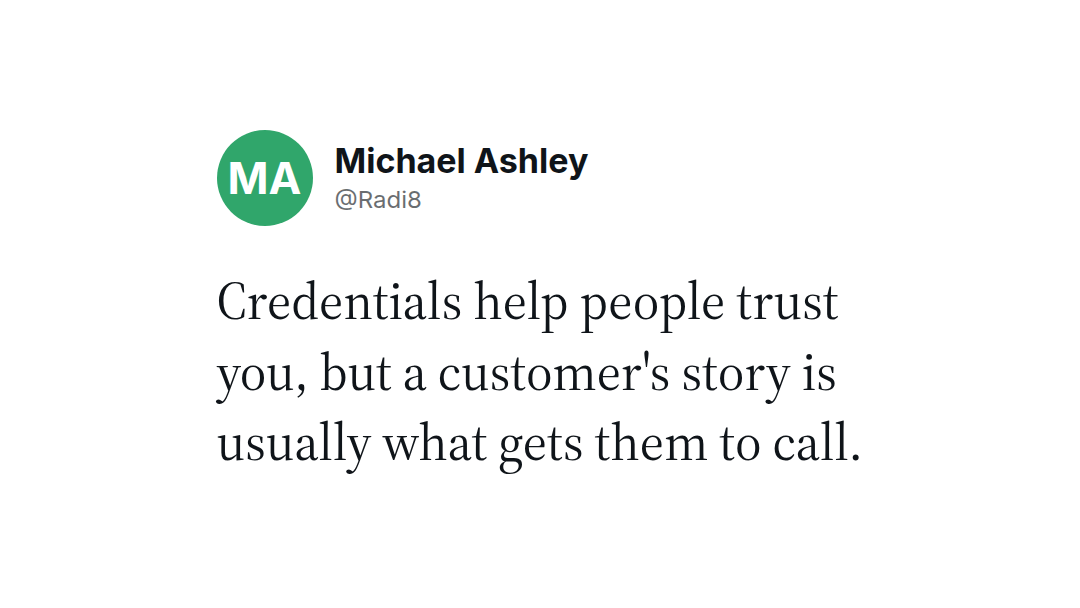
Credentials help people trust you, but a customer's story is usually what gets them to call.
Ask a happy customer for permission, then ask: where were you when we started, what changed, where are you now? Write it in their words. Use it on your site, in posts, in emails to new leads.
Whose story would you tell first? …more
 View on Facebook
Also on


Told 5 times, Oct 22, 2026 – Nov 10, 2026
· LinkedIn · Open
Your credentials help people trust you, but they're rarely the reason someone picks up the phone.
I learned this slowly. My instinct is always the facts and the data... and I miss the story every time.
People buy when they can see themselves in someone else's before and after. So the best marketing a small business has is usually sitting in its customer list, waiting to be asked.
Getting it is simple. Pick a happy customer and ask permission to tell their story. Then ask: where were you when we started, what changed along the way, where are you now? Write it down in their words, not yours. Use it on your website, in a post, in the email you send new leads.
One real story usually does more than an About page full of credentials.
Whose story would you tell first?
#SmallBusiness #Marketing #Storytelling
· Bluesky · Open
Credentials help, but people buy when they see themselves in someone's before and after. Ask a happy customer for permission, then: where were you when we started, what changed, where are you now? Write it in their words. That story will do more than your About page.
· X · Open
Credentials earn trust. A customer's before-and-after story gets people to call. Ask one happy customer for theirs this week.
· X · Open
25 years building, and my brain still jumps to the data and misses the story.
A similar client's story, where they started, what changed, where they landed, beats any list of facts, and it's more honest.
Curious what I'm building? Radi8: https://www.radi8.com
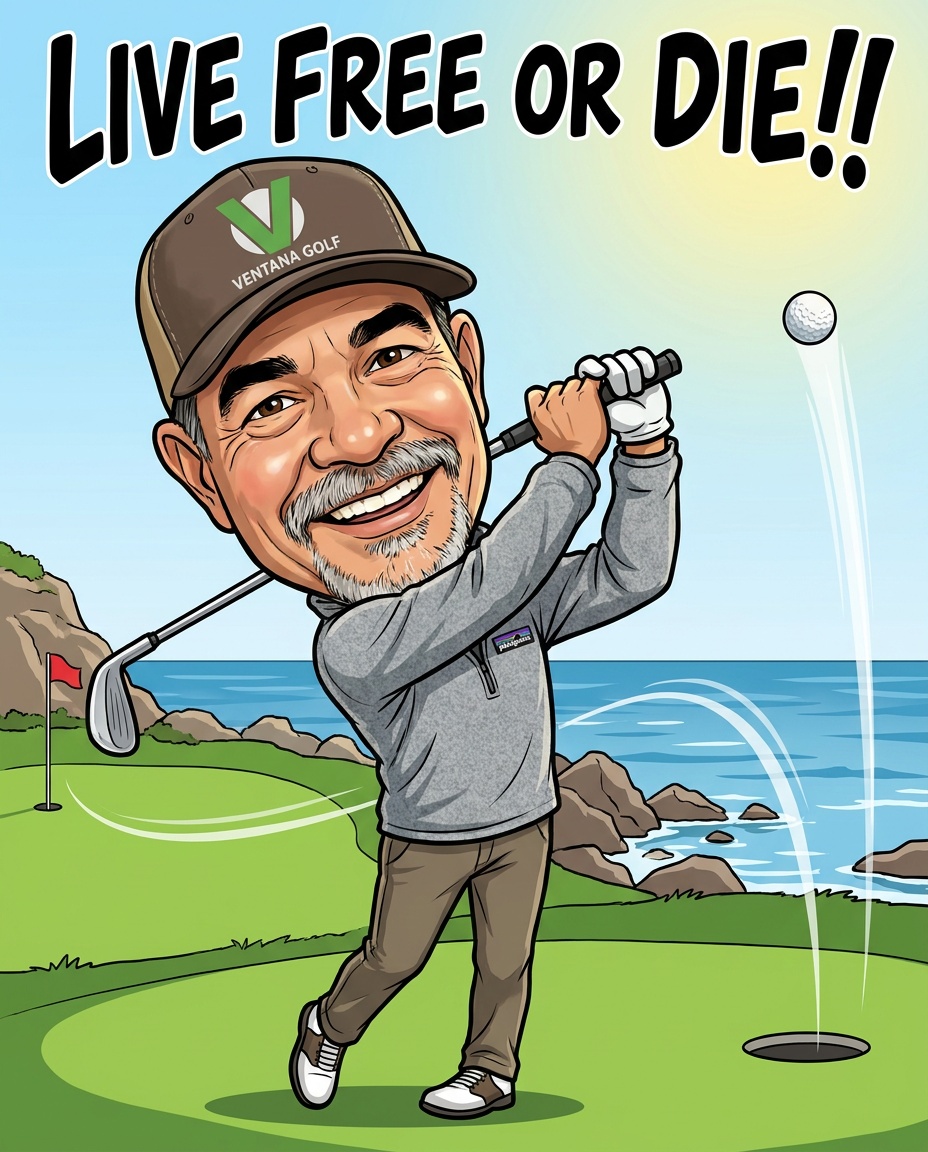
I used to think it was fun to make ai images that looked real. But soon realized they were too real - people felt faked out, scammed, deceived. And I get it, it’s weird. Then I tried ai images that made obvious caricatures, like this one. It’s a little better, but of course the concept is all wrong. That’s on me for bad prompting. But what do you think? Is it ok to generate ai images as long as it’s clearly not fakery? …more
Most coaches and consultants wait until they feel "established" to start capturing proof of their work. I'd flip that.
You're producing evidence every single day you work with a client... a result, a shift, a before-and-after someone would pay to understand. But by the time you finally feel established, years of it have quietly evaporated. The outcome you can't quite reconstruct. The client who moved on. The review you never thought to ask for.
A body of work beats a resume because it's evidence, not claims. And evidence has a shelf life. It's strongest the moment it happens, when the client is thrilled and the details are fresh. Capture it then... a saved testimonial, a documented outcome, a note on exactly what changed. That habit is what a case study, a talk, or a book eventually gets built from.
I learned this one the slow way.
Do you have a system for capturing client outcomes and testimonials? If not, the best time to build one was two years ago. The second best time is today.
If you'd want to think through what that system looks like for your practice, there's a link in the first comment.
#IndependentConsultant #Coaching #PersonalBrand #ThoughtLeadership #GoingIndependent …more
When a Facebook Page connection failed in Radi8, my software told people the same thing every time: you don't have the right admin role.
It was right... sometimes. But under that one message were three different failures, and two had nothing to do with anyone's permissions. So the message sent people off to fix something that wasn't broken — and quietly told them the problem was them.
I went looking for the real cause. Now it names which of the three actually hit. Fixes like that land in hours, not release cycles.
This isn't really about software. When your process fails a client, whose fault does your language imply? "You didn't send the intake form" and "my intake form is confusing" are the same event described by two different people. Default blame is a design choice... usually one nobody examined.
Genuine question — where does your process quietly blame a client for something you could have made clearer?
Link in the first comment.
#IndependentConsultant #Coaching #Solopreneur #CustomerDiscovery #Positioning …more
Most people going independent think visibility is a numbers game. It isn't. It's a memory game.
Your brand is a promise, and a promise only means something once someone has watched you keep it. That's the part the follower count misses. Likes and impressions tell you a post traveled. They say nothing about whether anyone now trusts how you think. Those are two different accomplishments, and only one of them wins clients.
Here's what I've seen over 25 years of building companies and advising people who are great at the work: reach is a symptom, judgment is the asset. When you left the org, you didn't just lose the title. You lost the thing that used to vouch for your judgment — the brand behind you, the internal reputation that meant the work found you. Now you're building that proof from scratch, in public, one decision at a time.
So the goal isn't to be seen more. It's to be seen thinking. When you share how you'd approach a messy client situation, the question you'd ask before a big call, what a project taught you the hard way — you're not chasing attention. You're compounding evidence. A prospect who has watched you reason through six real problems doesn't need a sales pitch. They already know how you'd handle theirs.
That's why the vanity metrics are a poor scoreboard. A post that reaches 10,000 strangers and changes no one's mind is worth less than one that reaches 200 of the right people and makes three of them think, "I want this person in the room when I decide." Demonstrated judgment, consistently, over time — that's a reputation the market can actually see, and it's the one that outlasts any single post.
So a question worth sitting with: when you look back at what you've shared this year, does it show people how you think — or just prove that you posted?
#IndependentConsultant #Coaching #PersonalBrand #ThoughtLeadership #GoingIndependent …more

Told 2 times, Jul 23, 2026 – Aug 22, 2026
· X · Open
People don't buy when they trust you. They buy when they've already seen how you think. What have you let them see lately?
Tom Shen said something in our conversation that I keep coming back to.
He drew a line between answers and questions. Answers, he said — everybody's got one:
"answers. Everybody's got one sometimes. And we've all worked with people like that. They got two or three. But questions,"
That last word hangs there for a reason. Good questions are rare. And the person who asks the right one often adds more value than the person with the ready answer.
I think about this a lot with coaches and consultants. There's a quiet pressure to prove you belong in the room by having every answer, deck loaded, solutions ready before the client finishes talking. It feels like expertise. Often it's the opposite.
The sharper move is to show up curious. A good question does more than fill a silence — it shows you already know what actually matters here. That's not uncertainty. That's judgment made visible.
Tom Shen made this point better than I can, in Episode 7 of the Inspiring Founders podcast. Worth a watch — link in the first comment.
So I'll ask you one: what's the best question you've been asked in a client conversation — one that changed how you saw the problem?
#IndependentConsultant #Coaching #ThoughtLeadership #GoingIndependent …more
Visibility has become part of the job.
I don't think most founders have accepted this yet.
Twenty years ago, you could build a successful business with very little public presence.
Today, that's becoming harder.
Not because people want influencers.
Because people need signals.
Before they buy.
Before they refer.
Before they trust.
They want evidence.
How do you think?
What do you believe?
Have you solved this problem before?
The market used to discover expertise through institutions.
Today, it increasingly discovers expertise through content.
That's why visibility isn't vanity.
It's discoverability.
And for expertise-driven businesses, discoverability is becoming a competitive advantage. …more
Most founders I work with are genuinely compelling in conversation. They can hold a room, tell a story, make you lean in.
Then they sit down to write a post and it becomes a press release.
Here's the framework I keep coming back to — I use it in my peer groups, in my advisory work, and in my own content.
Three parts:
1. The moment you identified the problem. Not "I noticed a gap in the market." The actual moment — specific, concrete, a little uncomfortable. That's where people trust you.
2. What you tried that didn't work. This is the part most founders skip. It's also where the trust gets built. Showing your failed attempts tells people you arrived at your answer honestly, not theoretically.
3. What you discovered that did work. Not "here's the solution." Here's what I found, tested, and now actually use.
The reason this works: it's the structure of every good story ever told. Problem, struggle, resolution. Your audience has heard a thousand "here's a tip" posts. They haven't heard your specific version of steps 1 and 2.
Try it on your next post. Start with the moment, not the lesson.
Comment "voice" and I'll send you the full one-page framework I share with founders. …more
I do my best work when someone hands me a hard problem and gets out of the way.
For years, I thought that made me hard to manage.
Give me a mature, well-run operation and I get restless. Give me something ambiguous, half-broken, and stuck — with the freedom to figure it out — and I come alive.
I used to treat that as a flaw to fix. Now I understand it's just how builders are wired.
Ambiguity isn't a problem to be managed out of us. It's the exact condition where we're most useful.
The catch is that trust and autonomy aren't perks you hand a builder once they've earned them. They're the preconditions for the work in the first place. Take them away and you don't get a more careful builder — you get a worse one.
So if you've got someone on your team who's restless inside the process but comes alive in front of a blank page: don't tighten the leash. Hand them the hardest, least-defined problem you have, and let them go find the answer.
What conditions actually bring out your best work — and are you giving the builders on your team the same freedom? …more
Told 2 times, Jun 25, 2026
· X · Open
I do my best work when someone hands me a hard problem and gets out of the way.
For years I thought that made me hard to manage.
Turns out trust and autonomy aren't perks you give a builder once they've earned them.
They're the conditions the work requires.
When a public engagement gets scrutinized, everyone assumes it's about the price.
It rarely is.
I've watched this play out across organizations for 25 years. A consultant can be delivering enormous value — and still lose the room. Not because the work is bad, but because the people footing the bill can't see how the work connects to the mission.
That's the gap that erodes trust. And it's especially dangerous in public initiatives like Measure M, where the audience is already hurting from job losses and watching every dollar.
Here's the part leaders miss: consulting at this level is genuinely an art. You can't compare a complex transformation engagement to a landscaping contract with a fixed scope and a visible result. The value is real, but it's harder to see — which makes communication part of the work, not an afterthought.
Value delivered in private isn't the same as value understood in public.
So the lesson isn't "charge less" or "do more." It's this:
When stakeholders can't see progress toward the goal, they fill the silence with doubt.
The fix is rarely cheaper. It's clearer:
- Tie the work back to the stated mission, every time.
- Show progress in terms the public actually cares about, not internal milestones.
- Treat transparency as a deliverable, not a courtesy.
Trust isn't built by being the lowest bidder. It's built by letting people see how the work moves the mission forward.
For those of you leading high-visibility, publicly-funded initiatives: how do you make progress legible to people who only see the invoice? …more
 View on LinkedIn
Also on

AI made expertise abundant.
It did not make trust abundant.
For years, expertise was a competitive advantage.
If you knew something others didn't, you could build a business around it.
Today, anyone can ask Chat and get a decent answer in seconds.
That changes the game.
The question is no longer:
'What do you know?'
The question is:
'Why should I trust you?'
Trust comes from consistency.
Experience.
Judgment.
Reputation.
People don't hire advisors, consultants, founders, and experts because they have information.
They hire them because they trust how they think.
That's why I believe trust is becoming one of the most valuable assets in the age of AI.
Expertise may be abundant.
Trust is still scarce. …more
Channel names and logos are trademarks of their respective owners.