I left Silicon Valley for San Diego and went invisible.
I was selling to people who didn't know I existed. Awareness is not acquisition... so I started sharing how I'd solved problems for past clients. …more
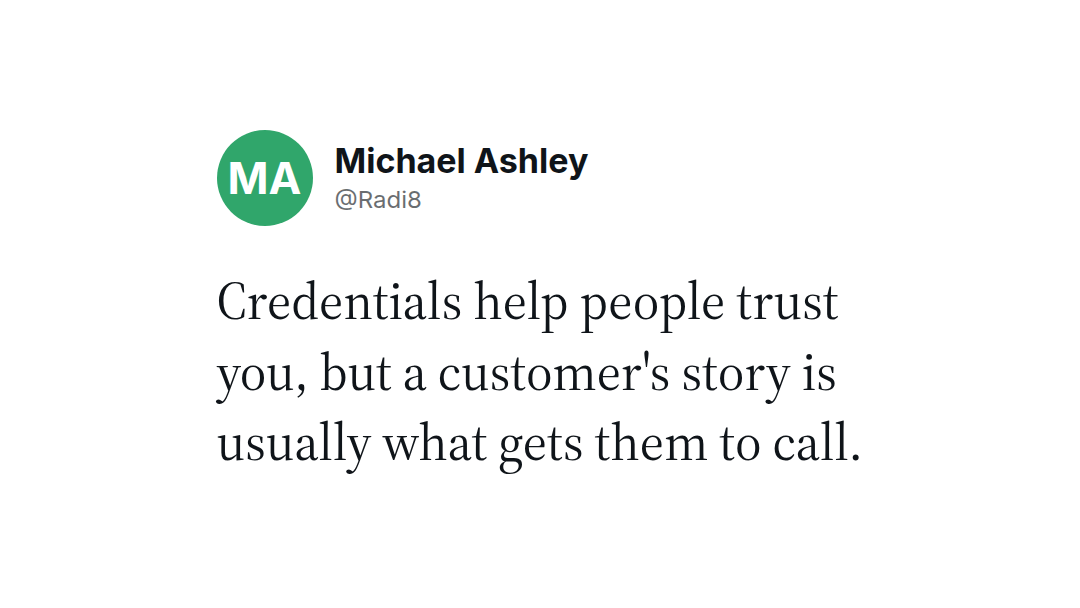
Credentials help people trust you, but a customer's story is usually what gets them to call.
Ask a happy customer for permission, then ask: where were you when we started, what changed, where are you now? Write it in their words. Use it on your site, in posts, in emails to new leads.
Whose story would you tell first? …more
Your credentials help people trust you, but they're rarely the reason someone picks up the phone.
I learned this slowly. My instinct is always the facts and the data... and I miss the story every time.
People buy when they can see themselves in someone else's before and after. So the best marketing a small business has is usually sitting in its customer list, waiting to be asked.
Getting it is simple. Pick a happy customer and ask permission to tell their story. Then ask: where were you when we started, what changed along the way, where are you now? Write it down in their words, not yours. Use it on your website, in a post, in the email you send new leads.
One real story usually does more than an About page full of credentials.
Whose story would you tell first?
#SmallBusiness#Marketing#Storytelling
Credentials help, but people buy when they see themselves in someone's before and after. Ask a happy customer for permission, then: where were you when we started, what changed, where are you now? Write it in their words. That story will do more than your About page.
25 years building, and my brain still jumps to the data and misses the story.
A similar client's story, where they started, what changed, where they landed, beats any list of facts, and it's more honest.
Curious what I'm building? Radi8: https://www.radi8.com
Most founders I work with are genuinely compelling in conversation. They can hold a room, tell a story, make you lean in.
Then they sit down to write a post and it becomes a press release.
Here's the framework I keep coming back to — I use it in my peer groups, in my advisory work, and in my own content.
Three parts:
1. The moment you identified the problem. Not "I noticed a gap in the market." The actual moment — specific, concrete, a little uncomfortable. That's where people trust you.
2. What you tried that didn't work. This is the part most founders skip. It's also where the trust gets built. Showing your failed attempts tells people you arrived at your answer honestly, not theoretically.
3. What you discovered that did work. Not "here's the solution." Here's what I found, tested, and now actually use.
The reason this works: it's the structure of every good story ever told. Problem, struggle, resolution. Your audience has heard a thousand "here's a tip" posts. They haven't heard your specific version of steps 1 and 2.
Try it on your next post. Start with the moment, not the lesson.
Comment "voice" and I'll send you the full one-page framework I share with founders. …more


 View on X

 View on LinkedIn
'/%3E%3Cpath fill='%23fff' d='M12 7.3A4.7 4.7 0 1 0 16.7 12 4.7 4.7 0 0 0 12 7.3Zm0 7.8A3.1 3.1 0 1 1 15.1 12 3.1 3.1 0 0 1 12 15.1Zm5-8a1.1 1.1 0 1 0 1.1 1.1A1.1 1.1 0 0 0 17 7.1Zm-5 1.5c-1.5 0-1.7 0-2.3.1a3.8 3.8 0 0 0-1.3.2 2.2 2.2 0 0 0-.8.5 2.2 2.2 0 0 0-.5.8 3.8 3.8 0 0 0-.2 1.3c-.1.6-.1.8-.1 2.3s0 1.7.1 2.3a3.8 3.8 0 0 0 .2 1.3 2.2 2.2 0 0 0 .5.8 2.2 2.2 0 0 0 .8.5 3.8 3.8 0 0 0 1.3.2c.6.1.8.1 2.3.1s1.7 0 2.3-.1a3.8 3.8 0 0 0 1.3-.2 2.5 2.5 0 0 0 1.3-1.3 3.8 3.8 0 0 0 .2-1.3c.1-.6.1-.8.1-2.3s0-1.7-.1-2.3a3.8 3.8 0 0 0-.2-1.3 2.2 2.2 0 0 0-.5-.8 2.2 2.2 0 0 0-.8-.5 3.8 3.8 0 0 0-1.3-.2c-.6-.1-.8-.1-2.3-.1Zm0-1.6c1.5 0 1.7 0 2.4.1a5.5 5.5 0 0 1 1.8.3 3.8 3.8 0 0 1 2.2 2.2 5.5 5.5 0 0 1 .3 1.8c.1.7.1.9.1 2.4s0 1.7-.1 2.4a5.5 5.5 0 0 1-.3 1.8 3.8 3.8 0 0 1-2.2 2.2 5.5 5.5 0 0 1-1.8.3c-.7.1-.9.1-2.4.1s-1.7 0-2.4-.1a5.5 5.5 0 0 1-1.8-.3 3.8 3.8 0 0 1-2.2-2.2 5.5 5.5 0 0 1-.3-1.8C4 13.7 4 13.5 4 12s0-1.7.1-2.4a5.5 5.5 0 0 1 .3-1.8 3.8 3.8 0 0 1 2.2-2.2 5.5 5.5 0 0 1 1.8-.3C10.3 5 10.5 5 12 5Z'/%3E%3C/svg%3E)
 View on Facebook
