Your old prompts might be slowing your AI agents down.
OpenAI dropped guidance this week saying that instructions written for older, weaker models can actually hurt GPT-4o agent performance. All that scaffolding you built to babysit a less capable model? It's now dead weight that wastes memory and triggers the wrong behaviors.
Three things to fix right now:
Skills — the prompt files that load for specific tasks — need narrow, precise trigger descriptions. If they're too broad, your agent grabs the wrong one.
Your AGENTS.md file loads on every single task. Strip out anything that tells the agent to do things it already does on its own — check tests, follow conventions, run reviews. The smarter the model, the more redundant that instruction becomes.
Task prompts should clearly define what "done" looks like, so the agent knows when to stop rather than pause and ask for clarification.
The broader pattern worth internalizing: as models get smarter, the scaffolding we built around dumber ones becomes the bottleneck. Less hand-holding. Leaner prompts. More trust in the model's own judgment.
OpenAI even suggests asking the agent itself to audit your existing skills and AGENTS.md for dead weight. That's the move.
https://alphasignal.ai/newsletter/openai-gpt-4o-agent-tips#AIMarketing#B2BMarketing…more
To Read or Not to Read the Code? https://every.to/source-code/to-read-or-not-to-read-the-code
1 big thing: Don't miss this shift — AI is ready to run your work in the dark. Don't let it turn the lights out in your head too.
Shipping more has never been easier. Understanding what you're shipping has never been more at risk.
Why it matters: B2B marketers building AI-assisted workflows face the same trap engineers do. The system gets smarter. You get faster. But the judgment that makes you valuable — knowing which of two reasonable-sounding plans will hurt you six months from now — quietly erodes if you let AI handle everything without staying in the work.
Driving the news:
Kieran Klaassen, GM of Every's AI email product Cora, found himself shipping faster than ever while feeling his own thinking get softer. Researchers Margaret Mitchell, Avijit Ghosh, and Samir Passi confirmed the pattern — extended AI agent use measurably erodes the vigilance, critical thinking, and domain skill that human oversight depends on.
→ The phenomenon dates back to 1983 — called the "irony of automation" — where the more capable the automation, the more human skill erodes
→ AI just makes it move faster
Zoom in:
Klaassen's solution: build a deliberate loop for his own learning alongside the AI.
→ His four practices: keep a list of gaps, ask for mechanics not just diffs, recover the reasoning behind the code, and let the model quiz you
Yes, but: This takes discipline most people won't apply. The excuse that you don't have time is exactly what AI removes — but the desire to learn has to come from you.
Be smart: Audit one AI-assisted workflow you run today. Can you explain why it works? Can you catch it when it fails? If not, you have a judgment gap, not a tool gap.
The bottom line: The tools that gave you an edge are becoming easy to copy. The judgment to know where to point them is not.
https://every.to/source-code/to-read-or-not-to-read-the-code#AIMarketing#B2BMarketing…more
Demis Hassabis just put a number on where we are with AI building AI.
On Masters of Scale, the Google DeepMind CEO said we’re in the early days of recursive self-improvement. AI is making human engineers maybe 3 to 5 times more productive. But humans are still very much in the loop: reviewing code, architecting systems, still writing some of it.
The next phase is the one he flags as riskiest. Closed-loop RSI. AI improving itself with no human reviewer. Faster, yes. Also, in his words, “a very dangerous way to get to full AGI.”
Read that from a business seat.
The person running DeepMind isn’t saying “remove the human.” He’s saying the human is both the bottleneck and the brakes.
Marketers should steal this framing:
The multiplier comes from AI doing the work and humans owning the judgment. Review, architecture, taste.
Teams that skip review to ship faster are running their own little closed loop. Off-brand copy and wrong numbers, compounding at scale.
The skill worth building now isn’t prompting. It’s reviewing. Knowing what good looks like, fast.
Some workflows will go fully autonomous. Until then, the human in the loop isn’t overhead. It’s quality control with a pulse.
Where’s your team? Human in the loop, or quietly letting the loop close? …more
The Multilingual Mind helps schools and education teams close the gap between what they know they want to do and what their people actually have the time, training, tools, systems, and support to impl
· LinkedIn
·
An instructional coach, one year into the role, might ask:
“I've been coaching the same teacher for six weeks and I can see her understanding improving in our conversations, but when I visit her classroom, almost none of it shows up. What's the gap I'm missing?”
My first response would be: before deciding there is a gap, make sure there really is one.
Start by naming what I see.
“I can tell your understanding of this has really grown in our conversations. Are you noticing changes in your actual practice too?”
Because maybe they are. Maybe it is happening at a different time of day.
Maybe I keep observing during the same twenty-minute window and I am missing it.
Maybe the growth is smaller than what I was hoping to see, so I am unconsciously filtering for the finished version and overlooking the early version.
Maybe I am carrying pressure from somewhere else about what this teacher “should” be doing by now, and that expectation is shaping what I notice.
Before I decide the learning has not transferred, I need more data.
And I want the teacher’s interpretation too.
Do they think it is showing up?
Where?
When?
What feels easier now?
What still feels hard?
Do they already know what is getting in the way?
Because people vary enormously in their ability to reflect on their own practice, make sense of new learning, and translate understanding into action.
Some people need a long processing runway before implementation.
Some can implement quickly but struggle with consistenct.
Some understand exactly what to do but freeze when the real classroom gets noisy, unpredictable, emotionally charged, or overloaded.
Sometimes the barrier is not the teacher at all.
Maybe I have been too theoretical.
Maybe they need concrete examples.
Maybe we need to role-play it.
Maybe they need to see me do it with their actual students.
Maybe the classroom routine itself needs to change to make the new practice possible.
Maybe another adult in the room needs clearer responsibilities.
Maybe the teacher is carrying so much cognitive and physical load that there simply is not enough capacity left to add something new consistently.
There are so many possibilities.
That's why I get nervous when we move quickly from:
“I’m not seeing it”
to
“They aren’t implementing.”
Those are not necessarily the same thing.
Even when we determine that the change genuinely is not happening, I still want to ask:
What is blocking the flow?
Is it mental?
Emotional?
Practical?
Structural?
Relational?
A lack of modeling?
A lack of practice?
A lack of time?
A lack of support?
Sometimes growth is already there, but it is coming through as a trickle when we hoped for a river.
My job as a coach is not to stand downstream asking why there is not more water.
I need to look upstream.
Where is the dam?
And once we find it, what can we move, redesign, practice, clarify, or support so that the learning has somewhere to go?
That is the real work of implementation. …more
Something I keep thinking about after writing about professional development:
How many things in schools get treated as “we already taught that” when what actually happened was “we already said that”?
Those are not always the same thing.
Sometimes people need the reminder.
Sometimes they need an example.
Sometimes they need someone next to them while they try it.
Sometimes they need to come back to the idea three weeks later, after they have enough real experience for the question to make sense.
I am becoming much more interested in the gap between hearing something and being able to use it consistently.
What is something you learned professionally that only really clicked once you had a chance to try it?
“We told them four times.”
Maybe.
But repetition is not necessarily reteaching.
The same message can appear in an email, a staff meeting, a weekly brief, and a slide deck without anyone becoming more capable of doing the thing.
Sometimes repetition is exactly what helps.
But sometimes people do not need to hear the words again.
They need to see an example.
Try it.
Ask a question.
Make a mistake.
Get feedback.
See how someone else handled the same situation.
Or return to the idea after enough time has passed for them to realize what they did not understand the first time.
There is a difference between repeating information and revisiting learning.
I think schools need both.
But they are not interchangeable.
A teacher tells you they're having trouble getting a child started on independent work.
Is that a training problem?
Maybe. But I don't know that yet.
I might watch what happens, talk it through with the teacher, and practice a response together:
“I see you haven't started yet. Show me where you're stuck.”
We can rehearse the words, the tone, the pause, and what happens next. Then the teacher can try it and we can reflect on what actually happened.
But what if the directions weren't clear? What if the materials weren't ready? What if the teacher has two other responsibilities at exactly that moment?
More practice with the sentence won't fix those problems.
This is why I don't like prescribing PD before I understand what people are trying to do and what keeps getting in the way. Sometimes it's a skill. Sometimes it's time, clarity, tools, or an agreement that hasn't been made. Often it's more than one thing.
And if we do coach the skill, I'd want follow-up that helps the teacher develop, not another score attached to a single moment.
When something isn't improving after another training, what are we missing about the actual work?
The Multilingual Mind helps schools and education teams close the gap between what they know they want to do and what their people actually have the time, training, tools, systems, and support to impl
· LinkedIn
·
A professional development session can look successful because the strongest, most experienced people in the room know what to do with it.
But that can hide a design problem.
If the people who already had the background knowledge, confidence, vocabulary, or prior training were the only ones able to translate the session into practice...
what exactly did the training accomplish?
Sometimes the people who appear to have “learned fastest” were actually filling in gaps from years of previous experience.
That is not a criticism of them.
It is a question about the learning design.
Did the training make the practice accessible?
Or did it work because some people already knew enough to compensate for what was missing?
I think that distinction matters whenever we evaluate professional learning by looking only at who succeeded afterward. …more
What would you never hand to a tool? Building Radi8, the hard part wasn't teaching it to write... it was the restraint I had to give it: it won't post a date nobody vouched for. What you refuse to delegate defines you. Grab 30 min with me: https://calendly.com/foclarity/30min…more
My AI writes well. It just doesn't remember who I'm writing for.
The writing part is mostly solved. Ask ChatGPT or Claude for a post and you'll get clean sentences in seconds.
What it doesn't have is everything around the sentence... who you help, what you offer, how you sound, what you said last week, what's already on the calendar. Start a new chat and most of that is gone. So you explain it all again, or you settle for something generic.
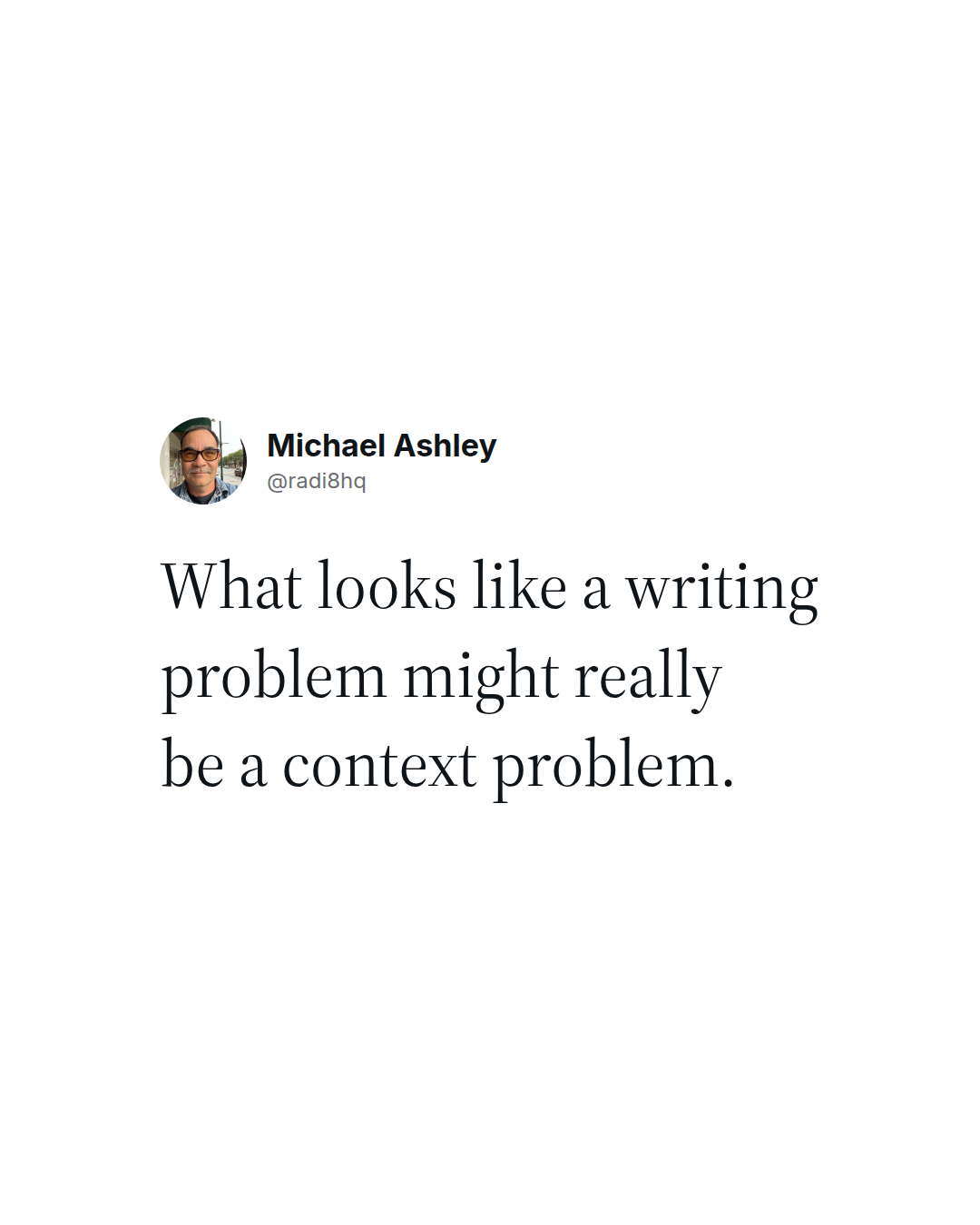
What looks like a writing problem might really be a context problem.
That's a big part of why I'm building Radi8 the way I am. I think chat may become the interface for a lot of software, and the specialized app's job is to supply what general AI can't hold on to by itself: memory, context, state, and the ability to actually do things, like save a draft or line up a week of posts.
You describe the outcome in a sentence. The app brings what it knows about you. Fewer dashboards to learn.
I'm still testing this thesis, and I might be wrong about how fast it happens... but I'd rather build toward it and learn from what breaks.
If you use AI in your business, what do you find yourself re-explaining every single time?
#Founders#Startups#AI#AINativeSoftware#ProductDesign#BuildingInPublic#Entrepreneurship#SmallBusinessOwner#IndependentConsultant#Coaching…more
I don't think anyone needs a better AI writer anymore.
ChatGPT and Claude already write well. Clean sentences, decent structure, fast. When a post still comes out sounding off, I don't think the writing is what broke.
What looks like a writing problem might really be a context problem. The AI doesn't know who you help, the problem you solve for them, why they'd care, what you said last week, or what you're actually offering. So every new chat starts from zero... and you either explain yourself all over again, or settle for something that sounds like everybody else.
My bet is that the chat becomes the interface. You describe the outcome you want instead of learning another dashboard. The specialized apps underneath supply what a general AI can't hold onto by itself: what it knows about you, a memory of what's already happened, where things stand right now, and the ability to actually get it done.
That's the bet I'm testing while building Radi8 inside ChatGPT and Claude. I don't have it all figured out... I'm learning as I go, same as everyone building with this stuff.
So I'm curious. When AI writes something for you and it misses, what's it usually missing?
#Founders#AI
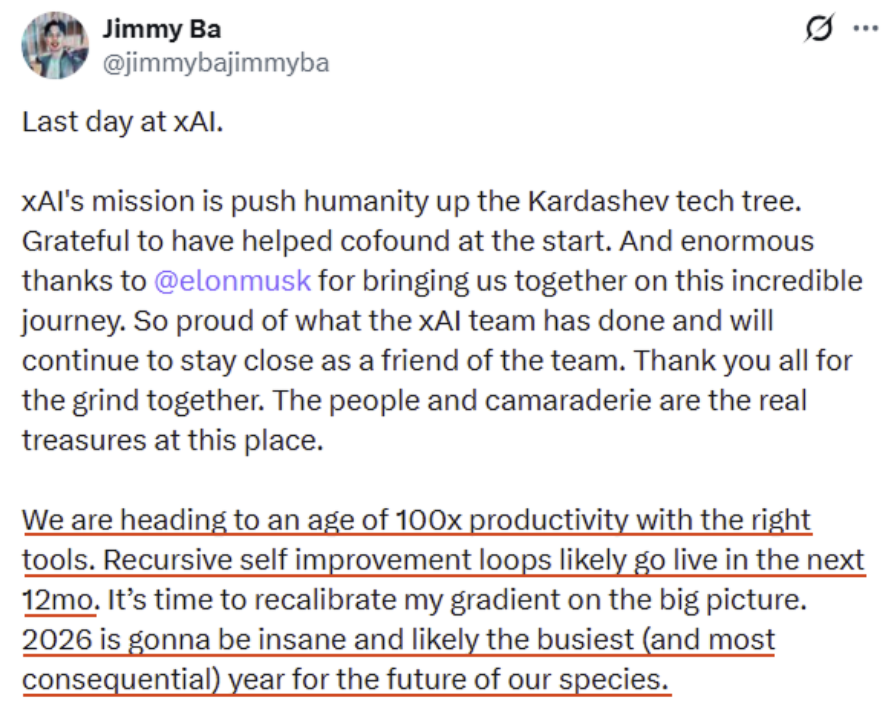
The xAI cofounder who resigned said before leaving: "Recursive self-improvement loops will likely go live within 12 months, and the right tools could unlock 100x productivity."
RSI is the point where AI systems start meaningfully improving themselves. It is the threshold most people treat as a distant theoretical concern. The xAI cofounder is saying it is a 12-month operational timeline.
Separately: OpenAI's roadmap points to an "AI research intern" — an early form of recursive self-improvement — expected around September 2026. Demis Hassabis at DeepMind has forecast AGI within five years. Multiple forecasts from multiple labs are converging on a 2027–2028 window for a fast takeoff.
These are not fringe predictions from AI doomers. These are the technical leads at the organizations building the technology.
For B2B enterprise teams, the relevant question is not whether you believe these timelines. It is what it means for your planning horizon if even one of them is close to right.
A technology that delivers 100x productivity shifts in 12–18 months does not fit inside a standard three-year technology roadmap. The teams that will benefit most are the ones already practicing the muscle of rapid reorientation.
The window is shorter than most roadmaps assume.
#AIStrategy#B2BMarketing…more
Nathan Labenz built Waymark, one of OpenAI's earliest enterprise case studies. He sold the company. Now he runs The Cognitive Revolution, one of the sharpest AI podcasts out there. https://www.cognitiverevolution.ai
His take on where we are: "My crystal ball gets real foggy more than a few months out."
This is someone who has built with AI since before it was cool. Not a pundit. Not a researcher in a lab. Someone who shipped actual products and watched the technology evolve in real time.
His point: the pace of change has made confident long-range forecasting almost meaningless. And that is not a pessimistic read. It's a tactical one.
For B2B marketing and sales teams, this matters practically. Your roadmap shouldn't be anchored to where AI "will be in 18 months." It should be built around what you can test, learn, and ship in the next 90 days.
The teams compounding fastest right now are not the ones with the most detailed 2028 strategy decks. They're the ones running tight cycles, capturing what's working, and not waiting for certainty before they move.
Plan in quarters. Move in weeks.
#AIStrategy#B2BMarketing
An OpenAI researcher on AI timelines: "I used to predict 12 months out. Now I won't go beyond 3."
That's not pessimism. That's honesty from someone building it.
You talk about 2030. Nobody knows what 2030 looks like.
Plan in quarters, not years. https://x.com/dwarkesh_sp/status/2100616332144169048/video/1#AIStrategy
Jack Clark, Anthropic co-founder:
“For years, researchers and sci-fi authors have predicted the singularity, when AI advances so fast humans can barely keep up. I believe this year has given us convincing evidence that it’s already begun.”
Note who’s saying it. Not a futurist on the podcast circuit. One of the people building the thing.
His read on what comes next: confusing and disorienting. Great wealth. Potentially great peril.
Here’s what “humans can barely keep up” looks like inside a company:
The tool you evaluated in Q1 can be outdated by Q3.
Your playbook changes faster than you can train people on it.
The gap between teams that adapt and teams that don’t compounds.
You can’t outrun the pace. You can build for it. Shorter planning cycles. Workflows that swap models without a rebuild. People whose job is to keep learning, not just keep producing.
Disorienting is the right word. The teams that win won’t be the ones who feel calm. They’ll be the ones who keep moving anyway.
Where is your team feeling it most right now?
Marketing and branding consultant with over 20 years of experience helping purpose-driven and socially responsible companies launch their products and build their brands
· LinkedIn
·
Amplifying Human Values in the Age of AI
Recently, I've been doing more incremental training on Claude as a marketer. While I am learning to test and re-test if Claude’s AI approach can help me be more efficient in my workshop training and writing projects, I also learn that it takes quite a bit of time and patience to train AI to think like me.
As I'm going through my AI training, I pause from time to time to reflect on my philosophy about how we should integrate AI into our daily work and personal tasks.
I have always been a believer in keeping skills and superpowers that I own and not outsource them because they are non-negotiables – something that I continue to see as values that I bring to do my best work.
My values are my own experiences, struggles, intuition, perspectives, judgement, and stories that come to shape how I see things, hear things, learn things, feel things, analyze things, and connect with others.
While I'm getting better at working together with AI to do great work, I've been reminded by an interview clip of Seth Godin, who raised the message about creating values in our human work.
Godin is an American author, entrepreneur, and marketing expert known for changing how people think about modern marketing, leadership, and work. I've been following Godin because of his worldly wisdom and interesting things he said that wake people up.
What Godin said in that interview clip woke me up; it landed with me because I think we all need to be more aware and conscious of our superpowers, what we are good at that comes easily, and what we love to do that we don’t want to have someone else do it for us.
This thinking is what has prompted me to develop an early process to help us continue strengthening the values in our human work as technology evolves over time.
My intention is to help us start recognizing what we want to own as humans, and what we can work with AI together to do our best work.
Keep an eye on the next few posts where I will be sharing out my early process that you can use as a framework to work alongside with AI.
.
.
. …more
Been training Claude to think more like me lately in my workshops, my writing, my client work.
A Seth Godin clip on creating values in our human work stopped me mid-scroll and led me to a bigger question: what am I not willing to hand off, no matter how good AI gets?
None of this is about resisting technology. It's about protecting what depends on being human in the first place and being honest about what that is for you.
More on this next week: what AI is actually good at.
Last week: Tip #1 — the human values I'm not handing off to AI, no matter what.
This week, Tip #2 — the other half of the question: where AI actually earns its place. 🧵
Just because AI *can* do something doesn't mean it *should*. Trust is built in the small moments that are easiest to automate away. Protect those on purpose.
Next Tip: Keep values you bring as humans sharp as AI evolves
Before you blend human + AI strengths, you need to know what you're not willing to hand off, no matter how good the tech gets. For me, that list includes:
* Judgement under ambiguity
* Empathy built over time
* Ethical accountability
* Intuition in the room
* Perspective from lived experience
Today's post is 318 words, a 2-minute read.
Sources: Every.to — "Our Agents, Ourselves"
1 big thing: How forward-thinking teams are turning institutional knowledge into reusable AI skills
The best thinking in your marketing organization lives in someone's head. Every.to is running an experiment to change that.
Why it matters: In B2B marketing, your most valuable asset is not your tech stack. It is the judgment of the people who know your brand, your buyers, and what actually works. That knowledge walks out the door every time someone leaves.
Driving the news:
Every.to is capturing the decision-making patterns of their best employees and encoding them as reusable AI skills.
→ Their best editor's headline instincts, their top strategist's brief methodology — documented and accessible via AI
→ One Walleye Capital CEO now requires AI use for all 400 employees — not as a suggestion, but as a baseline operational standard
Zoom in:
Companies spent months answering the same 33 questions from executives on how to roll out AI — covering strategy, tool selection, governance, and winning over skeptics.
→ Every.to published those answers publicly for the first time this week
Yes, but: Encoding institutional knowledge takes deliberate documentation most teams defer indefinitely because it does not show up in this quarter's deliverables.
Be smart: Start with your highest-leverage knowledge holder. Document how they think about one recurring decision — a content brief, a headline, a channel call — and build from there. One reusable skill that reflects real expertise beats a hundred generic prompts.
The bottom line: Your best marketer's instincts should not be a single point of failure.
https://every.to/context-window/the-case-for-cloning-your-coworkers#AIMarketing#B2BMarketing…more
Talking with Oracle co-CEO Clay Magouyrk, Sam Altman described working with the latest AI tools as managing a factory inside your computer.
The tedious work gets automated. Ideas move forward without the usual roadblocks. And we’re edging closer to the old sci-fi picture: you talk to the computer about your idea, and the AI handles the execution.
Sounds great. Here’s the part nobody puts on the slide.
A factory doesn’t run itself. Someone decides what gets built, writes the spec, and checks what comes off the line. Remove that person and you don’t get a faster factory. You get a faster way to make the wrong thing.
For marketing teams, the shift looks like this:
Execution stops being the bottleneck. Ideas become the bottleneck. Weak strategy now ships at scale.
The brief is the product. If you can’t explain the idea clearly to a human, AI won’t fix it. It’ll just execute the confusion faster.
The job moves from maker to plant manager. Fewer hands on keyboards, more judgment on output.
The sci-fi part was never the talking computer. It was assuming everyone has ideas worth executing.
If your team had the factory tomorrow, what would you actually build? …more
Organization focused on AI leadership and innovation for the Fourth Industrial Revolution, based in Silicon Valley

· LinkedIn
·
POV: Stop managing workers. Start augmenting them.
The biggest AI leadership failure I see isn't a bad model choice or a stalled pilot. It's treating AI as a tooling decision when it's really a mindset shift.
Here's the pattern. An organization buys the licenses, bolts AI onto its existing management paradigm, and waits for the productivity curve to bend. It doesn't. Six months later the tools are impressive and the results are flat — and everyone blames the technology.
The technology isn't the problem. The paradigm is.
Old management thinking is built around headcount: how many people do we need to get this done? AI-era thinking is built around augmentation: how much more can each person do when the work is amplified? Those are two different questions, and they lead to two different organizations.
That shift doesn't start with the workforce. It starts with leadership. Leaders set the ceiling on how much value AI can create — through the questions they ask, the workflows they're willing to rethink, and whether they see their people as costs to manage or capabilities to expand.
Winning in the Fourth Industrial Revolution is a leadership challenge before it's a technology one. That's the core argument I make in AI L4IR: Leadership and the 4th Industrial Revolution: https://www.amazon.com/AI-L4ir-Leadership-Industrial-Revolution/dp/B0FP2XVX21/ref=tmm_pap_swatch_0
For your team, what's the hardest part of this shift — the mindset, the workflows, or the org design underneath?
Follow along this month as I dig into each one.
#AILeadership#FourthIndustrialRevolution#FutureOfWork#AIL4IR…more