Dario Amodei on the moment he saw where this was going:
“GPT-2 was the first real test of the scaling laws hypothesis. I looked at it and said, my God, you scale this thing up another factor of a million, and it’ll be better than humans at everything.”
GPT-2 came out in 2019. It could write a decent paragraph and lose the plot by the third one.
Most people saw a party trick. He saw a curve.
That’s the lesson. The signal showed up years before the results did. The people who built what came next weren’t the ones with the best demo. They were the ones who asked what happens if the trend holds.
This is the defining economic and scientific moment of the modern age. We don’t know it yet.
For anyone running a business, the question isn’t whether today’s AI is good enough. It’s which curve you’re betting on, and what your org looks like if it keeps bending the same way.
Three moves worth making now:
Judge tools by trajectory, not today’s output.
Build workflows that get better automatically when the models do.
Stop waiting for “ready.” By the time it looks ready, the head start is gone.
What curve in your industry is everyone underestimating? …more
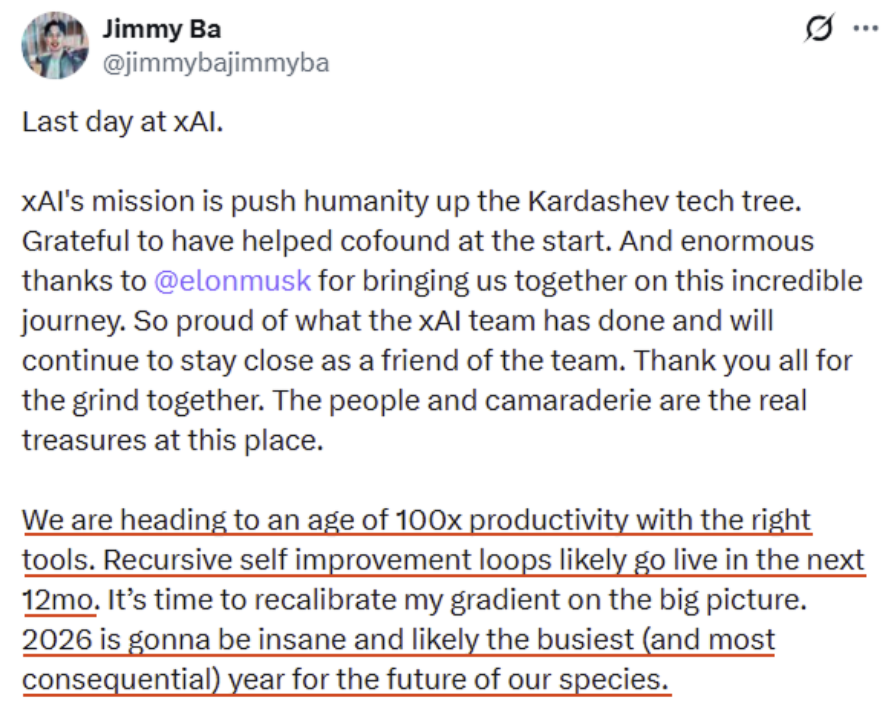
The xAI cofounder who resigned said before leaving: "Recursive self-improvement loops will likely go live within 12 months, and the right tools could unlock 100x productivity."
RSI is the point where AI systems start meaningfully improving themselves. It is the threshold most people treat as a distant theoretical concern. The xAI cofounder is saying it is a 12-month operational timeline.
Separately: OpenAI's roadmap points to an "AI research intern" — an early form of recursive self-improvement — expected around September 2026. Demis Hassabis at DeepMind has forecast AGI within five years. Multiple forecasts from multiple labs are converging on a 2027–2028 window for a fast takeoff.
These are not fringe predictions from AI doomers. These are the technical leads at the organizations building the technology.
For B2B enterprise teams, the relevant question is not whether you believe these timelines. It is what it means for your planning horizon if even one of them is close to right.
A technology that delivers 100x productivity shifts in 12–18 months does not fit inside a standard three-year technology roadmap. The teams that will benefit most are the ones already practicing the muscle of rapid reorientation.
The window is shorter than most roadmaps assume.
#AIStrategy#B2BMarketing…more
Nathan Labenz built Waymark, one of OpenAI's earliest enterprise case studies. He sold the company. Now he runs The Cognitive Revolution, one of the sharpest AI podcasts out there. https://www.cognitiverevolution.ai
His take on where we are: "My crystal ball gets real foggy more than a few months out."
This is someone who has built with AI since before it was cool. Not a pundit. Not a researcher in a lab. Someone who shipped actual products and watched the technology evolve in real time.
His point: the pace of change has made confident long-range forecasting almost meaningless. And that is not a pessimistic read. It's a tactical one.
For B2B marketing and sales teams, this matters practically. Your roadmap shouldn't be anchored to where AI "will be in 18 months." It should be built around what you can test, learn, and ship in the next 90 days.
The teams compounding fastest right now are not the ones with the most detailed 2028 strategy decks. They're the ones running tight cycles, capturing what's working, and not waiting for certainty before they move.
Plan in quarters. Move in weeks.
#AIStrategy#B2BMarketing
An OpenAI researcher on AI timelines: "I used to predict 12 months out. Now I won't go beyond 3."
That's not pessimism. That's honesty from someone building it.
You talk about 2030. Nobody knows what 2030 looks like.
Plan in quarters, not years. https://x.com/dwarkesh_sp/status/2100616332144169048/video/1#AIStrategy
Jack Clark, Anthropic co-founder:
“For years, researchers and sci-fi authors have predicted the singularity, when AI advances so fast humans can barely keep up. I believe this year has given us convincing evidence that it’s already begun.”
Note who’s saying it. Not a futurist on the podcast circuit. One of the people building the thing.
His read on what comes next: confusing and disorienting. Great wealth. Potentially great peril.
Here’s what “humans can barely keep up” looks like inside a company:
The tool you evaluated in Q1 can be outdated by Q3.
Your playbook changes faster than you can train people on it.
The gap between teams that adapt and teams that don’t compounds.
You can’t outrun the pace. You can build for it. Shorter planning cycles. Workflows that swap models without a rebuild. People whose job is to keep learning, not just keep producing.
Disorienting is the right word. The teams that win won’t be the ones who feel calm. They’ll be the ones who keep moving anyway.
Where is your team feeling it most right now?
The State of AI Report 2026 dropped this week. 244 slides. Here's what actually matters for anyone building with AI right now.
OpenAI and Anthropic combined revenue hit ~$105B run rate by August 2026. Up from ~$30B in January. That's not hype, that's adoption.
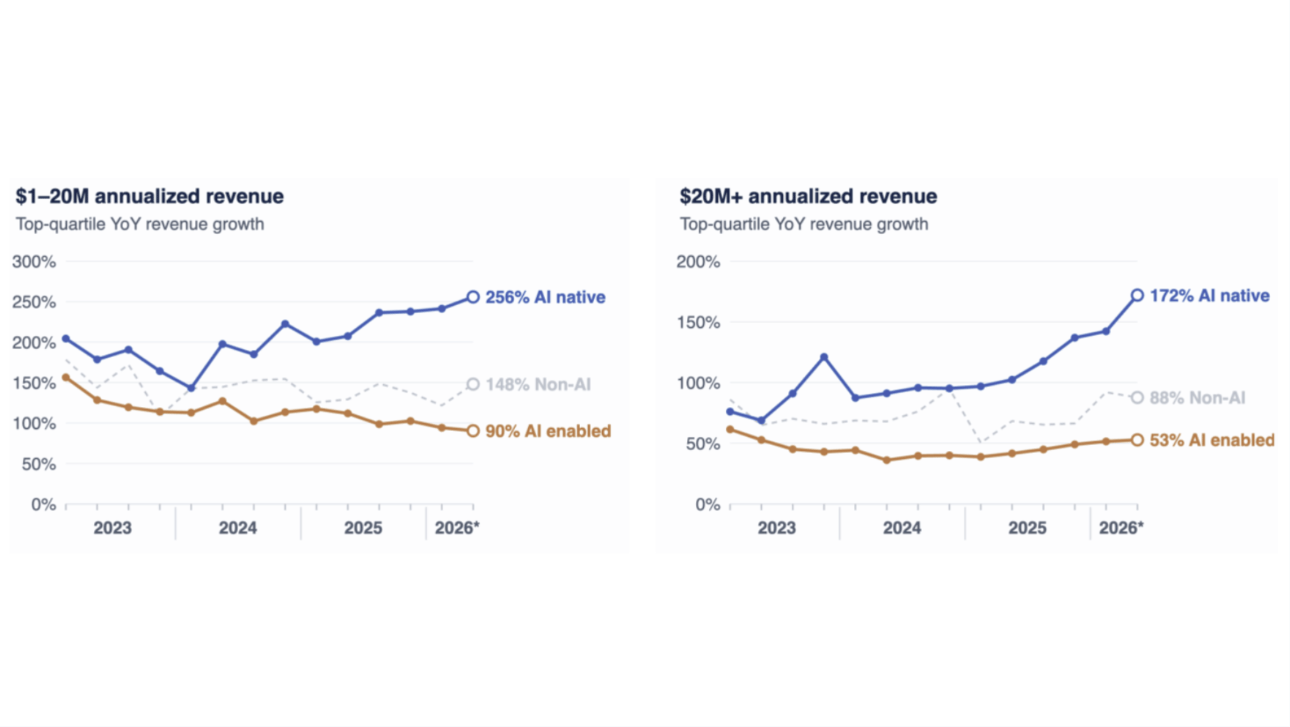
Top-quartile AI-native companies with $20M+ in revenue grew at 172% per year. Companies adding AI to existing software: 53%. The gap between building AI-native versus bolting AI on is already measurable in growth rates.
The cost to reach a given level of AI performance has halved every quarter since 2023. It's now about 13x cheaper per year than it was.
Here's the one that should change how you think about competitive advantage: better tools, context, and feedback lifted one model's success rate on coding tasks from 52.5% to 65.5% without changing the model at all.
The model is increasingly commoditized. Everyone can rent the same frontier capability. The advantage is the scaffolding you build around it. That's the part competitors can't easily copy. …more
State of AI 2026: better tools, context and feedback lifted a model's coding success from 52.5% to 65.5% without changing the model.
The model is commoditized. Everyone rents the same frontier capability.
The advantage is the scaffolding around it.
https://www.stateof.ai/State-of-AI-Report-2026.pdf
British workers are spending £958 million of their own money per year on AI tools their employers won't buy them.
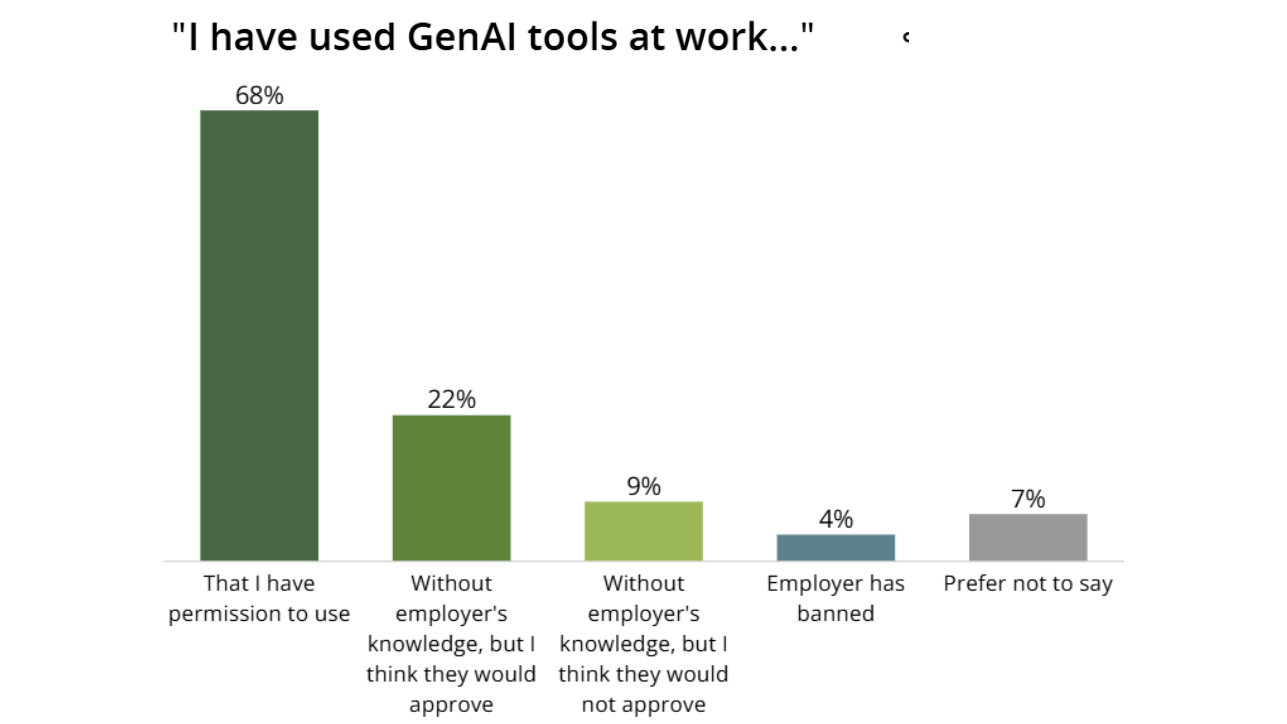
That's the headline from Deloitte's largest-ever single-country study of workplace AI use — 25,000 UK workers surveyed. But the number that should actually keep enterprise leaders up at night is the one underneath it: 31% of workers using AI at work are doing it without their employer knowing.
Shadow AI is not a future risk. It is a present reality.
The study found that 63% of UK workers have used generative AI, but half have received no training for it, and 65% say their leaders discuss AI without a clear understanding of what it actually does. Workers report saving 70 minutes a week on average — but nearly a quarter still sense a stigma attached to using it at work.
The pattern that emerges: GenAI use is widespread but shallow. People have tried it. Few use it daily. Most stick to familiar tasks like writing emails and searching for information rather than rethinking how work is done.
The implication for enterprise marketing and B2B teams is direct. If your employees are spending their own money on AI tools because your company hasn't provided sanctioned ones, two things are true simultaneously. Your people are motivated enough to self-fund productivity tools. And you have no visibility into what data is going into those tools, what outputs are being used, or what liability you're accumulating.
The technology investment conversation has shifted. The question is no longer whether your team is using AI. It's whether they're using yours.
https://www.deloitte.com/uk/en/issues/generative-ai/genai-workforce-survey.html#AIGovernance#B2BMarketing…more
Every company is building a company agent.
The more interesting question: what happens when you have a personal one?
Company agents handle workflows and ops. Personal agents handle how you specifically work. Your context. Your priorities. Your style.
A company agent optimizes the process. A personal agent optimizes you.
Token costs dropped 80% in recent months. What was too expensive to run all day is now cheap enough to leave on.
The companies that give employees personal agents, not just company-wide tools, will build a productivity gap that's hard to close from the outside.
Are you thinking about AI at the individual level, or just the workflow level?
#AIMarketing#FutureOfWork…more
Bill Gates: "Anyone who analogizes AI to other technologies is missing that this time is different — it exceeds human cognition across nearly every domain."
It's a comforting instinct, isn't it? When something big shows up, we reach for the last thing that looked like it. The internet. The smartphone. Electricity. We tell ourselves, "We've seen this movie before, we know how it ends."
But that instinct is exactly what trips us up here.
Every past technology extended what humans could do. This one steps into the thing we thought was ours alone — reasoning, judgment, the act of figuring something out. That's not a faster horse. That's a different kind of animal.
The past is comforting, but it's also there to fool you if you assume this is just another wave. The people building it won't even forecast a year out anymore. That should tell us something.
You don't have to have it all figured out. You just have to stop pretending it's familiar.
Curious how you're thinking about this moment — is AI "just another tool" to you, or something different? Tell me in the comments. 👇 #AIStrategy…more
Bill Gates: "Anyone who analogizes AI to other technologies is missing that this time is different — it exceeds human cognition across nearly every domain."
It's a comforting instinct, isn't it? When something big shows up, we reach for the last thing that looked like it. The internet. The smartphone. Electricity. We tell ourselves, "We've seen this movie before, we know how it ends."
But that instinct is exactly what trips us up here.
Every past technology extended what humans could do. This one steps into the thing we thought was ours alone — reasoning, judgment, the act of figuring something out. That's not a faster horse. That's a different kind of animal.
The past is comforting, but it's also there to fool you if you assume this is just another wave. The people building it won't even forecast a year out anymore. That should tell us something.
You don't have to have it all figured out. You just have to stop pretending it's familiar.
Curious how you're thinking about this moment — is AI "just another tool" to you, or something different? Tell me in the comments. 👇 #AIStrategy
Today's post is 318 words, a 2-minute read.
Sources: Every.to — "Our Agents, Ourselves"
1 big thing: How forward-thinking teams are turning institutional knowledge into reusable AI skills
The best thinking in your marketing organization lives in someone's head. Every.to is running an experiment to change that.
Why it matters: In B2B marketing, your most valuable asset is not your tech stack. It is the judgment of the people who know your brand, your buyers, and what actually works. That knowledge walks out the door every time someone leaves.
Driving the news:
Every.to is capturing the decision-making patterns of their best employees and encoding them as reusable AI skills.
→ Their best editor's headline instincts, their top strategist's brief methodology — documented and accessible via AI
→ One Walleye Capital CEO now requires AI use for all 400 employees — not as a suggestion, but as a baseline operational standard
Zoom in:
Companies spent months answering the same 33 questions from executives on how to roll out AI — covering strategy, tool selection, governance, and winning over skeptics.
→ Every.to published those answers publicly for the first time this week
Yes, but: Encoding institutional knowledge takes deliberate documentation most teams defer indefinitely because it does not show up in this quarter's deliverables.
Be smart: Start with your highest-leverage knowledge holder. Document how they think about one recurring decision — a content brief, a headline, a channel call — and build from there. One reusable skill that reflects real expertise beats a hundred generic prompts.
The bottom line: Your best marketer's instincts should not be a single point of failure.
https://every.to/context-window/the-case-for-cloning-your-coworkers#AIMarketing#B2BMarketing…more


 View on LinkedIn