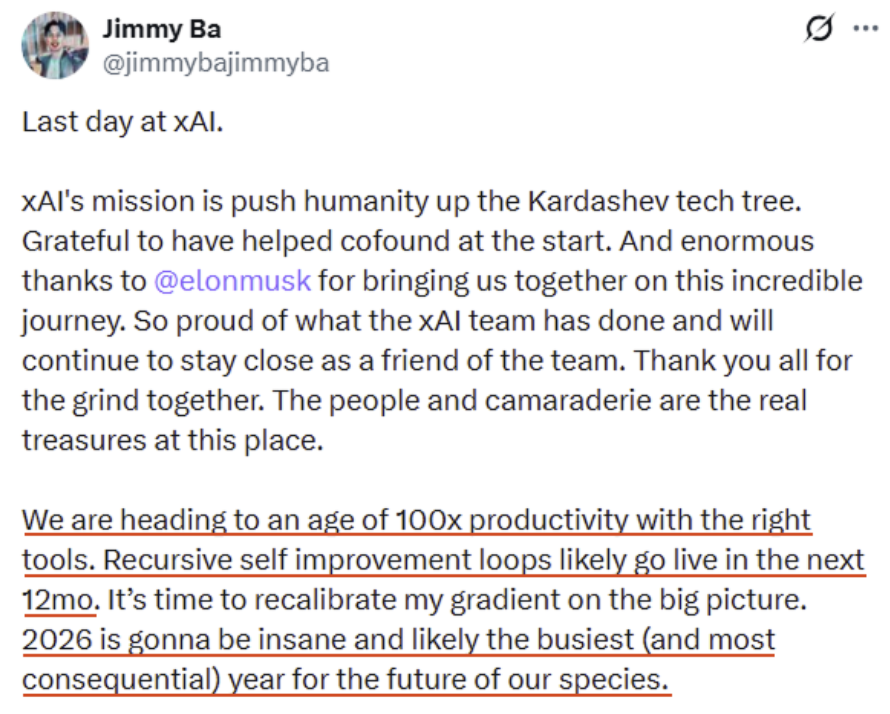
The xAI cofounder who resigned said before leaving: "Recursive self-improvement loops will likely go live within 12 months, and the right tools could unlock 100x productivity."
RSI is the point where AI systems start meaningfully improving themselves. It is the threshold most people treat as a distant theoretical concern. The xAI cofounder is saying it is a 12-month operational timeline.
Separately: OpenAI's roadmap points to an "AI research intern" — an early form of recursive self-improvement — expected around September 2026. Demis Hassabis at DeepMind has forecast AGI within five years. Multiple forecasts from multiple labs are converging on a 2027–2028 window for a fast takeoff.
These are not fringe predictions from AI doomers. These are the technical leads at the organizations building the technology.
For B2B enterprise teams, the relevant question is not whether you believe these timelines. It is what it means for your planning horizon if even one of them is close to right.
A technology that delivers 100x productivity shifts in 12–18 months does not fit inside a standard three-year technology roadmap. The teams that will benefit most are the ones already practicing the muscle of rapid reorientation.
The window is shorter than most roadmaps assume.
#AIStrategy#B2BMarketing…more
Nathan Labenz built Waymark, one of OpenAI's earliest enterprise case studies. He sold the company. Now he runs The Cognitive Revolution, one of the sharpest AI podcasts out there. https://www.cognitiverevolution.ai
His take on where we are: "My crystal ball gets real foggy more than a few months out."
This is someone who has built with AI since before it was cool. Not a pundit. Not a researcher in a lab. Someone who shipped actual products and watched the technology evolve in real time.
His point: the pace of change has made confident long-range forecasting almost meaningless. And that is not a pessimistic read. It's a tactical one.
For B2B marketing and sales teams, this matters practically. Your roadmap shouldn't be anchored to where AI "will be in 18 months." It should be built around what you can test, learn, and ship in the next 90 days.
The teams compounding fastest right now are not the ones with the most detailed 2028 strategy decks. They're the ones running tight cycles, capturing what's working, and not waiting for certainty before they move.
Plan in quarters. Move in weeks.
#AIStrategy#B2BMarketing
An OpenAI researcher on AI timelines: "I used to predict 12 months out. Now I won't go beyond 3."
That's not pessimism. That's honesty from someone building it.
You talk about 2030. Nobody knows what 2030 looks like.
Plan in quarters, not years. https://x.com/dwarkesh_sp/status/2100616332144169048/video/1#AIStrategy
Noam Brown is one of the researchers who built o1. When he says he won't predict AI timelines beyond 3 months, that sentence deserves more than a scroll-past.
A year ago, the researchers closest to the frontier felt comfortable projecting 12 months out. Now the same people won't commit to a quarter beyond the current one. Not because they've lost confidence in the technology. Because the pace has made honest forecasting nearly impossible.
This is the part of the AI conversation that most business planning ignores.
Roadmaps built on 2030 assumptions are being written by people who are more confident than the people actually building the thing. That's a problem. Not because long-term vision is useless — it isn't. But because the assumptions underneath that vision are expiring faster than the planning cycles built to review them.
The practical shift: stop anchoring your AI strategy to a 3-year horizon and start running it like a quarterly operating decision. What can we build, test, and learn in the next 90 days? What do we need to be true for this to work? What breaks if the model we're building on gets replaced in six months?
The teams that will compound the fastest aren't the ones with the most sophisticated 2030 roadmap. They're the ones that have built the muscle to reorient quickly when the ground shifts.
It shifts every quarter now. Plan accordingly. Full YouTube video here: https://radi8.it/TXa7sFd#AIStrategy…more
Noam Brown is one of the researchers who built o1. When he says he won't predict AI timelines beyond 3 months, that sentence deserves more than a scroll-past.
A year ago, the researchers closest to the frontier felt comfortable projecting 12 months out. Now the same people won't commit to a quarter beyond the current one. Not because they've lost confidence in the technology. Because the pace has made honest forecasting nearly impossible.
This is the part of the AI conversation that most business planning ignores.
Roadmaps built on 2030 assumptions are being written by people who are more confident than the people actually building the thing. That's a problem. Not because long-term vision is useless — it isn't. But because the assumptions underneath that vision are expiring faster than the planning cycles built to review them.
The practical shift: stop anchoring your AI strategy to a 3-year horizon and start running it like a quarterly operating decision. What can we build, test, and learn in the next 90 days? What do we need to be true for this to work? What breaks if the model we're building on gets replaced in six months?
The teams that will compound the fastest aren't the ones with the most sophisticated 2030 roadmap. They're the ones that have built the muscle to reorient quickly when the ground shifts.
It shifts every quarter now. Plan accordingly.
#AIStrategy
Today's post is 301 words, a 2-minute read.
Sources: Generative AI Enterprise — "McKinsey Unveils AI Profit Lessons"
1 big thing: We just entered a new phase of enterprise AI — here's what that means for B2B marketers
The question is no longer whether AI works. It is whether your organization can actually deliver on it.
Why it matters: McKinsey's 2026 State of AI confirms what most enterprise leaders already sense — AI investment is surging, individual productivity gains are real, but P&L impact remains elusive for most organizations.
Driving the news:
McKinsey surveyed 1,719 participants across 97 nations.
→ 80% say AI has improved their individual productivity
→ Only 37% attribute any EBIT impact to AI — roughly flat year over year despite surging investment
Zoom in:
Companies breaking through share two practices: they redesign workflows alongside the model rather than layering AI on top of existing ones, and they measure in business outcomes rather than accuracy metrics.
→ McKinsey anchors this with two case studies — a global manufacturer scaling with AWS and a conglomerate deploying agentic AI at speed
Yes, but: 20% of respondents say AI operating costs — tokens, infrastructure, compute — are already constraining usage. Cost management is becoming a real strategic variable, not a footnote.
Be smart: If your AI initiatives are measured in time saved or content volume produced, you are measuring the wrong things. Tie AI output to pipeline influence, conversion rate, or content-attributed revenue. That is the only measurement that survives a budget conversation.
The bottom line: Technology is rarely the binding constraint. Delivery, adoption, and measurement are.
https://www.mckinsey.com/capabilities/quantumblack/our-insights/the-state-of-ai#AIStrategy#B2BMarketing…more
SpaceX just spent $60 billion to stop relying on someone else's AI coding tools.
That number is not about productivity gains or developer convenience. It is about control.
When your engineering velocity depends on tools you do not own, you cede strategic optionality. You adopt their roadmap, their integrations, their pricing changes. If that tool is owned by a competitor, you are building your future on their terms.
SpaceX clearly decided that was unacceptable. The Cursor acquisition signals that AI coding tools are no longer supplementary software. They are infrastructure. And infrastructure owned by a third party becomes a liability at scale.
This same logic applies to B2B tech companies making platform and tooling decisions today. Marketing automation platforms, customer data infrastructure, content management systems, analytics tools. Every layer of dependency introduces risk.
The question is not whether the tool works. It is whether the company that owns it could become your competitor, shift strategy, or limit your ability to move quickly when you need to.
Vertical integration at this scale is a signal. In rapidly consolidating markets, the companies winning long-term are the ones willing to own the tools that define their velocity.
For B2B leaders navigating platform decisions in an increasingly consolidated landscape: are you building on infrastructure you control, or are you locking in dependencies that limit your future options?
If you are rethinking your content or marketing stack and want a fresh outside perspective, send me a message. I will review your approach and show you 3 things you can improve this week.
https://www.cnbc.com/2026/06/16/spacex-spcx-cursor-acquisition-ipo.html…more


 View on LinkedIn
Also on
View on LinkedIn
Also on

'/%3E%3Cpath fill='%23fff' d='M12 7.3A4.7 4.7 0 1 0 16.7 12 4.7 4.7 0 0 0 12 7.3Zm0 7.8A3.1 3.1 0 1 1 15.1 12 3.1 3.1 0 0 1 12 15.1Zm5-8a1.1 1.1 0 1 0 1.1 1.1A1.1 1.1 0 0 0 17 7.1Zm-5 1.5c-1.5 0-1.7 0-2.3.1a3.8 3.8 0 0 0-1.3.2 2.2 2.2 0 0 0-.8.5 2.2 2.2 0 0 0-.5.8 3.8 3.8 0 0 0-.2 1.3c-.1.6-.1.8-.1 2.3s0 1.7.1 2.3a3.8 3.8 0 0 0 .2 1.3 2.2 2.2 0 0 0 .5.8 2.2 2.2 0 0 0 .8.5 3.8 3.8 0 0 0 1.3.2c.6.1.8.1 2.3.1s1.7 0 2.3-.1a3.8 3.8 0 0 0 1.3-.2 2.5 2.5 0 0 0 1.3-1.3 3.8 3.8 0 0 0 .2-1.3c.1-.6.1-.8.1-2.3s0-1.7-.1-2.3a3.8 3.8 0 0 0-.2-1.3 2.2 2.2 0 0 0-.5-.8 2.2 2.2 0 0 0-.8-.5 3.8 3.8 0 0 0-1.3-.2c-.6-.1-.8-.1-2.3-.1Zm0-1.6c1.5 0 1.7 0 2.4.1a5.5 5.5 0 0 1 1.8.3 3.8 3.8 0 0 1 2.2 2.2 5.5 5.5 0 0 1 .3 1.8c.1.7.1.9.1 2.4s0 1.7-.1 2.4a5.5 5.5 0 0 1-.3 1.8 3.8 3.8 0 0 1-2.2 2.2 5.5 5.5 0 0 1-1.8.3c-.7.1-.9.1-2.4.1s-1.7 0-2.4-.1a5.5 5.5 0 0 1-1.8-.3 3.8 3.8 0 0 1-2.2-2.2 5.5 5.5 0 0 1-.3-1.8C4 13.7 4 13.5 4 12s0-1.7.1-2.4a5.5 5.5 0 0 1 .3-1.8 3.8 3.8 0 0 1 2.2-2.2 5.5 5.5 0 0 1 1.8-.3C10.3 5 10.5 5 12 5Z'/%3E%3C/svg%3E) View on Instagram
View on Instagram