
R

Ryan Swindall
· LinkedIn
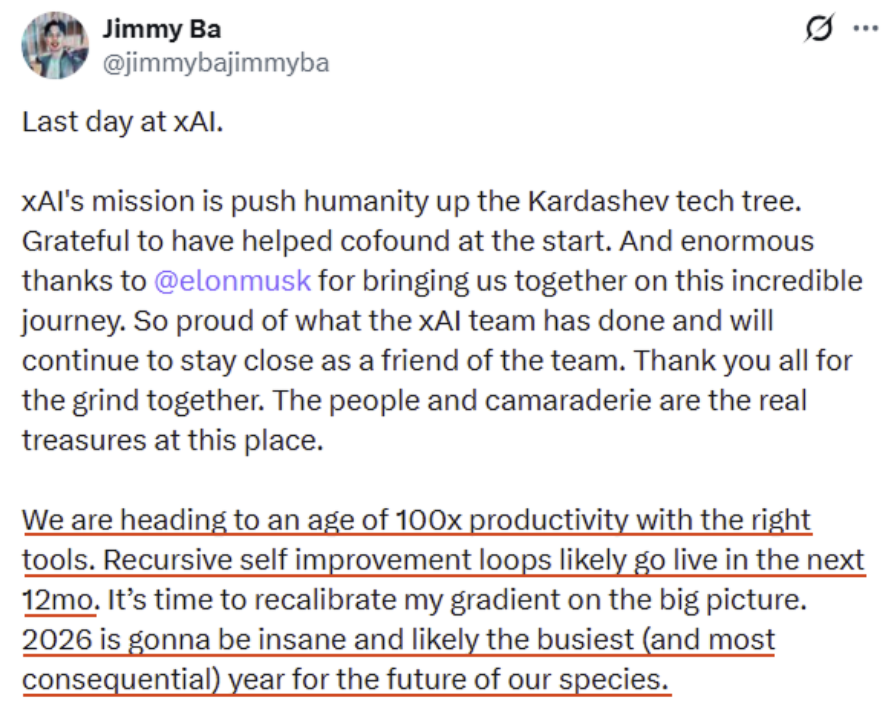
The xAI cofounder who resigned said before leaving: "Recursive self-improvement loops will likely go live within 12 months, and the right tools could unlock 100x productivity."
RSI is the point where AI systems start meaningfully improving themselves. It is the threshold most people treat as a distant theoretical concern. The xAI cofounder is saying it is a 12-month operational timeline.
Separately: OpenAI's roadmap points to an "AI research intern" — an early form of recursive self-improvement — expected around September 2026. Demis Hassabis at DeepMind has forecast AGI within five years. Multiple forecasts from multiple labs are converging on a 2027–2028 window for a fast takeoff.
These are not fringe predictions from AI doomers. These are the technical leads at the organizations building the technology.
For B2B enterprise teams, the relevant question is not whether you believe these timelines. It is what it means for your planning horizon if even one of them is close to right.
A technology that delivers 100x productivity shifts in 12–18 months does not fit inside a standard three-year technology roadmap. The teams that will benefit most are the ones already practicing the muscle of rapid reorientation.
The window is shorter than most roadmaps assume.
#AIStrategy #B2BMarketing
 View on LinkedIn
Also on

Told 4 times, Sep 22, 2026 – Nov 10, 2026
· LinkedIn · Open
Nathan Labenz built Waymark, one of OpenAI's earliest enterprise case studies. He sold the company. Now he runs The Cognitive Revolution, one of the sharpest AI podcasts out there. https://www.cognitiverevolution.ai
His take on where we are: "My crystal ball gets real foggy more than a few months out."
This is someone who has built with AI since before it was cool. Not a pundit. Not a researcher in a lab. Someone who shipped actual products and watched the technology evolve in real time.
His point: the pace of change has made confident long-range forecasting almost meaningless. And that is not a pessimistic read. It's a tactical one.
For B2B marketing and sales teams, this matters practically. Your roadmap shouldn't be anchored to where AI "will be in 18 months." It should be built around what you can test, learn, and ship in the next 90 days.
The teams compounding fastest right now are not the ones with the most detailed 2028 strategy decks. They're the ones running tight cycles, capturing what's working, and not waiting for certainty before they move.
Plan in quarters. Move in weeks.
#AIStrategy #B2BMarketing
· LinkedIn · Open
An OpenAI researcher on AI timelines: "I used to predict 12 months out. Now I won't go beyond 3."
That's not pessimism. That's honesty from someone building it.
You talk about 2030. Nobody knows what 2030 looks like.
Plan in quarters, not years. https://x.com/dwarkesh_sp/status/2100616332144169048/video/1
#AIStrategy
· LinkedIn · Open
Jack Clark, Anthropic co-founder:
“For years, researchers and sci-fi authors have predicted the singularity, when AI advances so fast humans can barely keep up. I believe this year has given us convincing evidence that it’s already begun.”
Note who’s saying it. Not a futurist on the podcast circuit. One of the people building the thing.
His read on what comes next: confusing and disorienting. Great wealth. Potentially great peril.
Here’s what “humans can barely keep up” looks like inside a company:
The tool you evaluated in Q1 can be outdated by Q3.
Your playbook changes faster than you can train people on it.
The gap between teams that adapt and teams that don’t compounds.
You can’t outrun the pace. You can build for it. Shorter planning cycles. Workflows that swap models without a rebuild. People whose job is to keep learning, not just keep producing.
Disorienting is the right word. The teams that win won’t be the ones who feel calm. They’ll be the ones who keep moving anyway.
Where is your team feeling it most right now?