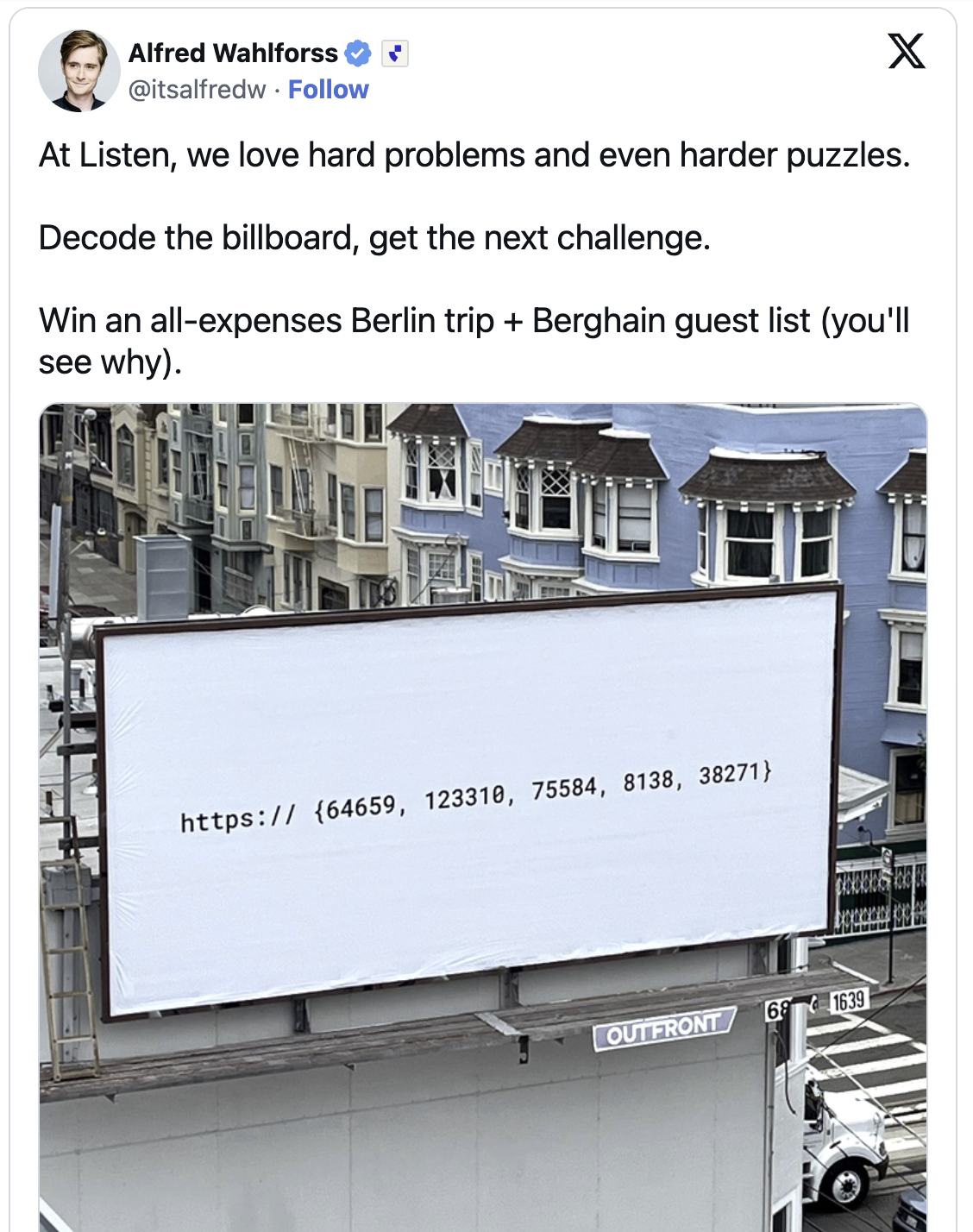
"I may have just made a $1 million mistake."
That was the scroll-stopping LinkedIn hook from Listen Labs' CEO after dropping $1M on billboards across NYC. The campaign generated 66 million views.
But the hook wasn't the interesting part. The approach behind it was.
Most B2B companies treat out-of-home advertising like a blunt instrument. You pick high-traffic locations, design something that looks good from 60 feet away, hope the right people see it, and measure nothing until the campaign is already over.
Listen Labs ran it like a software product.
Before committing a dollar to physical spend, they ran AI-moderated customer interviews to pre-test over 300 ad concepts and visual designs with real buyers. They chose what went on the billboards based on actual buyer response, not internal opinion. They measured brand awareness immediately before and after launch to calculate exact uplift rather than guessing at it. And when the campaign launched, employees synchronized on social by updating their profile pictures to a monochrome blue design and changing their job titles to "Customer Understanding Advocate" — creating a coordinated organic amplification layer that money can't replicate.
The result was a physical campaign that had the precision of a digital one.
Two things every B2B team should steal from this before the next event or OOH buy:
→ Budget $2,000–$3,000 for on-site videographers and photographers every time. Not for the event recap. For the evergreen content library. Sixty seconds of well-shot footage from a real event compounds for months.
→ Bring creator partners on-site. Let them record reaction content from the physical space. It breaks you out of the internal employee echo chamber and gets your message into feeds you don't control.
Physical and digital aren't different channels anymore. They're the same campaign.
https://venturebeat.com/technology/listen-labs-raises-usd69m-after-viral-billboard-hiring-stunt-to-scale-ai#B2BMarketing#EventMarketing…more
Air hired a CMO named Eric Tota at noon. He resigned by 6 PM.
The whole thing was a mockumentary. The "resignation" introduced Air's new AI agent for creative tasks.
On LinkedIn: 180 likes. On Instagram: 10,000+.
Most people called that a LinkedIn flop. I'd push back.
LinkedIn was where the stunt happened. Not where it spread. The like count undersells the views, and the views don't include everyone who saw it in their feed and said nothing.
More importantly: the entire marketing industry spent a day talking about Air. That's not a failure. That's the point.
The critique isn't the stunt. It's the platform split. If you design a LinkedIn moment that only works on Instagram, you've either picked the wrong platform or the wrong format.
The smarter version: a LinkedIn-native stunt that travels. The fake hire worked. The medium didn't match the message.
Would you have done the same stunt differently?
#B2BMarketing#BrandStrategy…more
Every marketer is sitting on a pile of campaign data and still guessing.
Which channel is actually driving pipeline? Which ad is converting, and which one is just burning budget? Where should I push harder, and what should I kill?
These aren't hard questions. They're just hard to answer when your data is spread across six tools and three dashboards none of your team looks at the same way.
Dreamdata AI changes that. It pulls your revenue data together and lets you just ask it things. Plain language. Real answers. No pivot tables, no BI ticket, no waiting for someone on the data team to get back to you.
What I didn't expect: I never have to leave the tools I'm already in. Dreamdata has an MCP, which means I can pull revenue attribution and campaign performance data directly inside Claude or ChatGPT. I set a reminder every morning to check in and ask what I should be prioritizing that day.
It's the first time I've felt like my data is actually working for me instead of the other way around.
If you've ever ended a campaign review still unsure what actually drove the results — this is worth a look.
Link in the comments.
https://dreamdata.io/dreamdata-ai?utm_source=chris-cunningham&utm_medium=Ryan-swindall&utm_campaign=Dreamdata%20AI%20Launch#Dreamdata#B2BMarketing…more
Today's post is 301 words, a 2-minute read.
Sources: Generative AI Enterprise — "McKinsey Unveils AI Profit Lessons"
1 big thing: We just entered a new phase of enterprise AI — here's what that means for B2B marketers
The question is no longer whether AI works. It is whether your organization can actually deliver on it.
Why it matters: McKinsey's 2026 State of AI confirms what most enterprise leaders already sense — AI investment is surging, individual productivity gains are real, but P&L impact remains elusive for most organizations.
Driving the news:
McKinsey surveyed 1,719 participants across 97 nations.
→ 80% say AI has improved their individual productivity
→ Only 37% attribute any EBIT impact to AI — roughly flat year over year despite surging investment
Zoom in:
Companies breaking through share two practices: they redesign workflows alongside the model rather than layering AI on top of existing ones, and they measure in business outcomes rather than accuracy metrics.
→ McKinsey anchors this with two case studies — a global manufacturer scaling with AWS and a conglomerate deploying agentic AI at speed
Yes, but: 20% of respondents say AI operating costs — tokens, infrastructure, compute — are already constraining usage. Cost management is becoming a real strategic variable, not a footnote.
Be smart: If your AI initiatives are measured in time saved or content volume produced, you are measuring the wrong things. Tie AI output to pipeline influence, conversion rate, or content-attributed revenue. That is the only measurement that survives a budget conversation.
The bottom line: Technology is rarely the binding constraint. Delivery, adoption, and measurement are.
https://www.mckinsey.com/capabilities/quantumblack/our-insights/the-state-of-ai#AIStrategy#B2BMarketing…more


 View on LinkedIn
Also on