Founder at Radi8 // Executive Coach // Host of the Inspiring Founders Podcast
· LinkedIn
·
When a Facebook Page connection failed in Radi8, my software told people the same thing every time: you don't have the right admin role.
It was right... sometimes. But under that one message were three different failures, and two had nothing to do with anyone's permissions. So the message sent people off to fix something that wasn't broken — and quietly told them the problem was them.
I went looking for the real cause. Now it names which of the three actually hit. Fixes like that land in hours, not release cycles.
This isn't really about software. When your process fails a client, whose fault does your language imply? "You didn't send the intake form" and "my intake form is confusing" are the same event described by two different people. Default blame is a design choice... usually one nobody examined.
Genuine question — where does your process quietly blame a client for something you could have made clearer?
Link in the first comment.
#IndependentConsultant#Coaching#Solopreneur#CustomerDiscovery#Positioning…more
Founder at Radi8 // Executive Coach // Host of the Inspiring Founders Podcast
· LinkedIn
·
It’s time for my daily dose of marketing caffeine. Today I’m talking about the customer journey and the theory of constraints. First, what is the theory of constraints? To keep it really simple, it’s a bottleneck that’s preventing you from achieving your goal. For example, if you want to pour soda from a bottle into your glass it has to pass through the bottleneck. You can’t pour it any faster because the bottleneck is small. But the interesting thing is actually how most people try to solve this problem. They get a bigger mug, they shake the bottle, they ask someone else to do it!! It doesn’t matter what you change, if you don’t deal with the bottleneck you can’t speed up the process.
Now what does that have to do with marketing and the customer journey?
Your customer is on a journey right now. First they need to become aware of your product or service. Then they can consider and compare you to arrive at a buying decision. If you’re a good fit you acquire them and take their money. Then they move to the adoption phase, they start using your product or service. If they’re happy they end up at the end of their journey in the advocate stage where they tell others.
This journey has a bottleneck. It’s different for each business, and only you know where it is. The key is for you to put all your energy into fixing the bottleneck, nothing else. If you’re successful the bottleneck will change and you can repeat the process.
Where people go wrong is they put energy into marketing that has zero impact on the bottleneck.
If nobody knows about you, it doesn’t matter how good your product is. …more
A bigger mug won't help you pour soda faster. Neither will shaking the bottle. 🥤
The bottleneck sets the speed. Same with your customer journey: awareness → consideration → purchase → adoption → advocacy.
Find your bottleneck. Put all your energy there. Repeat.
If nobody knows about you, it doesn't matter how good your product is.
Where's your bottleneck? 👇
#Marketing#CustomerJourney#TheoryOfConstraints#SmallBusiness#Entrepreneurship#Consulting
Founder at Radi8 // Executive Coach // Host of the Inspiring Founders Podcast
· LinkedIn
·
The week you go independent, the paycheck stops. So does something quieter: the organization that used to put your work in front of people. For years the brand vouched for you and the projects found you.
Now there's a list. Website, offer, pricing, posting, networking, the newsletter you keep meaning to start... and all of it feels urgent. So you work on everything, and nothing really moves.
When coaches and consultants sit down with me, the first job is figuring out which of those things actually comes first. Usually that means finding the problem under the problem. What looks like a pipeline problem might really be positioning. What looks like a content problem might be not knowing who it's for yet.
So, an offer. Give me 30 minutes. Bring the thing you keep circling, and leave knowing exactly what to do next. No sales pitch. No scripted discovery grilling.
It took me years to learn that the simplest next step is usually the right one. Happy to save you some of that time.
The link to grab 30 minutes is in the first comment.
#IndependentConsultant#Coaching#CoachingBusiness#ConsultingBusiness…more
Founder at Radi8 // Executive Coach // Host of the Inspiring Founders Podcast
· LinkedIn
·
In 25 years I've watched founders quietly kill good ideas and pour a year into bad ones — for the exact same reason. They never separated the idea from the way it was framed.
When a project stalls, the instinct is to read it as an effort problem. Work harder. Add a hire. Run one more push. But most stalled projects aren't stuck at the effort level. They're stuck at the root-problem level — and no amount of effort fixes a problem you've diagnosed wrong. You just get to the wall faster.
There are really only two reasons a project won't move, and they look identical from the inside:
The idea is wrong. There's no real problem underneath it, or no one who'll pay to solve it. Effort here is expensive theater.
The framing is wrong. The problem is real and worth solving — but you've aimed it at the wrong buyer, entered through the wrong door, or described it in words that don't match how anyone actually experiences it. Effort here isn't wasted; it's just pointed at the wrong target.
The trap is that both feel the same. Both produce silence, flat numbers, and a team that's working hard with nothing to show. So before you spend more, the question isn't "how do we push harder?" It's "which of these two am I actually looking at?"
Here's the diagnostic I run:
Does the problem exist when you're not in the room? A real problem shows up in what people already do — the workarounds, the spreadsheets, the money they're spending to cope. If the problem only appears when you pitch it, you likely have an idea problem, not a framing one. Effort won't save it.
Change the words, not the product — does the response change? Describe the same thing to the same person using their language, their trigger, their stakes. If a sharper frame suddenly gets nods where you got blank stares, the idea was never the issue. The framing was.
Follow the "no." When people pass, are they saying "I don't have that problem" or "I have it, but not like that / not from you"? The first is an idea signal. The second is a framing signal — and it's fixable without starting over.
Would a different buyer make this obvious? Sometimes the idea is right and the audience is wrong. Moving the same solution to a segment that feels the pain acutely turns a hard sell into an easy one. That's framing, not effort.
The reason this matters: the cost of confusing the two is enormous. Treat a framing problem as an effort problem and you burn a year grinding on something that only needed a repositioning. Treat an idea problem as a framing problem and you keep polishing the message on a thing the market was never going to buy.
Clarity here is cheaper than persistence. Diagnose the root before you spend the next quarter on the symptom.
So a question worth sitting with this week:
The project that's stalled right now — are you actually sure it's a bad idea, or have you just never tested whether it's a framing problem wearing a bad-idea disguise? …more
Before a client builds anything — the new website, the course, the funnel, the rebrand — I ask the same questions. Most projects don't survive them. That's the point.
Coaches and consultants are builders by nature. When growth stalls, the instinct is to make something: a new offer, a new content plan, a new brand. Building feels like progress. Building the wrong thing is the most expensive form of standing still.
So before anything gets built, I ask:
Who exactly is this for? I want a person you could name, with a problem they'd describe in their own words. A demographic doesn't count.
What evidence says they want it? Behavior is evidence: what they already do, already pay for, already work around. Encouragement from friends is not.
What are they doing about this problem today? If the answer is "nothing," be careful. People who live comfortably with a problem rarely pay to solve it.
Why you? What in your background makes you the credible one, and can a stranger see that credibility, or does it live only in your head?
What's the one constraint? If everything feels equally important, nothing is. Name the single thing that, once moved, unlocks the rest.
Clients sometimes get frustrated at this stage. They came with a solution, and I keep questioning the diagnosis. That's the job. A sharper problem definition beats more effort every time, and it costs a lot less than finding out after launch.
Which of these would be hardest for you to answer with real evidence today?
#IndependentConsultant#Coaching#CustomerDiscovery#IdealClient
Founder at Radi8 // Executive Coach // Host of the Inspiring Founders Podcast
· LinkedIn
·
If you're solving the same problem every week, you don't have a task problem. You have a structure problem.
It's one of the clearest patterns I've learned across four startups and a lot of advising rooms: recurring firefighting is almost never about the fire in front of you. The same issue keeps coming back because something in the system — how work flows, who owns what, how decisions get made — keeps producing it. You can put the fire out beautifully every single time, and it will still be there next Tuesday.
W. Edwards Deming made this point decades ago, and it still holds. In Out of the Crisis, he estimated that about 94% of the problems in any operation belong to the system, not the people — only around 6% trace to a true one-off. Read that again: the overwhelming majority of what looks like individual failure is actually structural. So when the same thing breaks over and over, blaming the person doing the task is the most expensive mistake you can make.
The fix is slower up front and far cheaper over time. Instead of solving the instance, you step back and ask what keeps generating it — then you change that. Redesign the handoff. Clarify the ownership. Remove the step that keeps failing. Do it once, at the structural level, and the symptom stops recurring instead of demanding your attention forever.
Firefighting feels productive because it's visible and urgent. But a leader's real job isn't to be the best firefighter in the building. It's to build something that stops catching fire.
What's the problem that keeps coming back no matter how many times you solve it — and what structure might be quietly producing it? …more
Deming counted: ~94% of problems belong to the system, not the people.
So when the same thing breaks every week, blaming the person doing the task is the most expensive mistake you can make.
Founder at Radi8 // Executive Coach // Host of the Inspiring Founders Podcast
· LinkedIn
·
When I built my first startup back in 2007, I had to work in a future that didn't exist yet.
It wasn't a better printing press. We took the old publishing supply chain, broke it into pieces, and rebuilt them digitally — print-on-demand, zero inventory, mass electronic distribution, and integration with the brand-new e-book world. There was no playbook. You can't optimize something that's never been done.
Peter Thiel has a useful name for this. In Zero to One he splits progress into two kinds. Going from 0 to 1 is invention — doing something genuinely new. Going from 1 to n is what he calls globalization: taking something that already works and making more of it, better and faster and cheaper. His point is that a lot of what we call progress is really the second kind, not the first.
Both matter. But they're different jobs, and they reward different people.
I did the 0→1 part. Since then, others made digital publishing better, faster, and cheaper — Amazon's Kindle platform made publishing a book so easy it's almost a crime. The people who built and scaled that are very different from me. And that's exactly how it should be. There's even research behind it: studying 200+ startups, Noam Wasserman found founders often get replaced as their company grows — not for failing, but because succeeding changes the job into a different one. Success exposes the mismatch; it doesn't remove it.
So here's the distinction I'd make after 25 years of this:
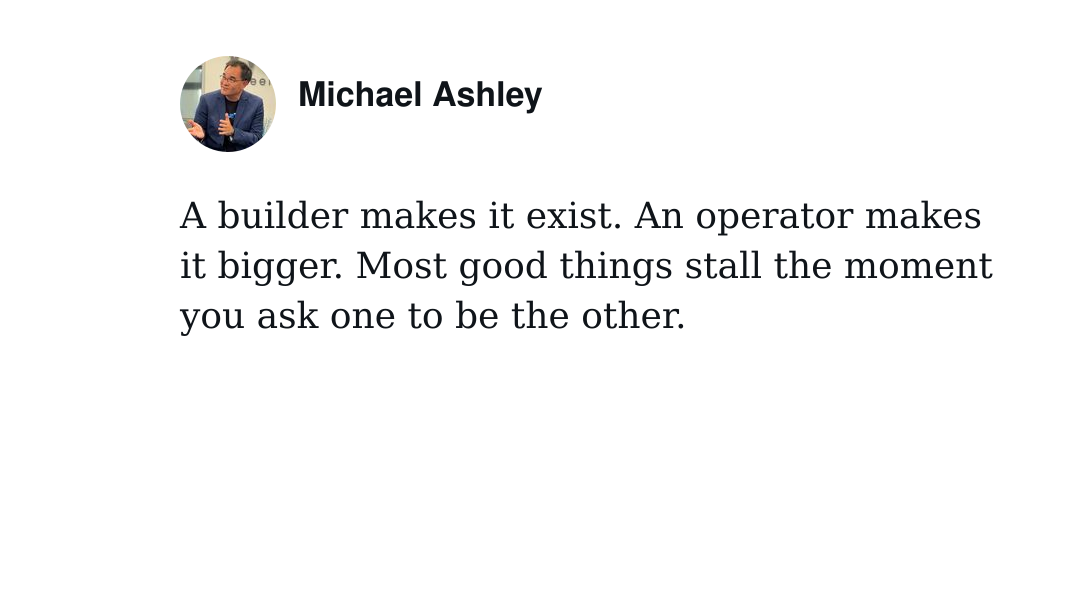
A builder makes it exist. An operator makes it bigger. Most good things stall the moment you ask one to be the other.
Two different jobs. Two different kinds of people.
Most stalls I get called into aren't talent problems. They're a mismatch — someone brilliant at one job asked to do the other, or one person trying to do both at once.
So before you hire, or beat yourself up for being stuck: name the job you actually need right now.
Which one is your initiative actually stuck on — building it, or making it bigger? …more
A quick one to close the week.
This week I've been writing about how building something and scaling it are two different jobs — a builder makes it exist, an operator makes it bigger — and how most stalls come from asking one person, or one hire, to do both.
So here's the question I'd actually like you to answer:
The initiative that's stuck right now — is it stuck on building it, or on making it bigger?
Be specific if you can. Is it a 0-to-1 problem, where the thing doesn't fully exist yet and needs someone comfortable inventing in the fog? Or a scaling problem, where it works but won't reliably repeat, and needs someone who builds systems and consistency?
Naming which one it is tends to be half the fix. Drop yours in the comments — I'll read every one and reply.
The initiative that's stuck right now — is it stuck on building it, or on making it bigger?
Building something and scaling it are two different jobs. Naming which one you're missing is usually half the fix.
So which is it?
The biggest mistake I see founders make: assuming every great builder should become an operator.
They're different jobs that reward different instincts.
A builder takes an idea everyone agrees should exist and makes it real. Ambiguity energizes them. A blank page is a playground, not a threat. But ask that same person to run a mature, optimized machine for years and they get restless and bored.
An operator is the opposite. Hand them something that works and they'll make it bigger, tighter, more profitable. They turn a foundation into a franchise. But drop them into a 0→1 mess with no map, and the lack of structure can be paralyzing.
Neither is better. Neither is a flaw. They're built for different phases of the same journey.
The trouble starts when we pretend they're interchangeable — when we promote a brilliant builder into an operating seat and call it growth, or hire a world-class operator to invent something from nothing and wonder why it stalls.
The best ventures I've seen are relay races, not solo runs. A builder gets it standing. An operator makes it soar. The handoff between them is where the real value compounds.
So before you hire — or before you judge yourself for not loving the phase you're in — ask which one you actually are. And then go find the other.
Which one are you?
Founder at Radi8 // Executive Coach // Host of the Inspiring Founders Podcast
· LinkedIn
·
"Our marketing isn't working." I've heard that in almost every company I've been part of. It's rarely where the problem actually lives.
Years ago I watched a startup tear itself apart over exactly this. Sales blamed marketing for weak leads. Marketing blamed sales for fumbling the ones they sent. Both were sure, both were loud, and both were wrong.
The real problem was two doors down, in the product.
The UX team had rolled out a new version built on a new mental model. The old product worked like email: you create a message, attach a big file, hit send. Everyone already knew how to do that. The new one worked like a shared, collaborative file system — cleaner on paper, but it asked users to think in a way they didn't yet think. They opened it and didn't get it.
That confusion didn't show up with a label that said "mental-model mismatch." It showed up as soft demos, stalled trials, and a sales team and a marketing team pointing at each other. The symptom surfaced at the front of the funnel. The cause was sitting in engineering.
Once we accepted that and reshaped the experience to feel like email again — meeting people inside the mental model they already had, instead of the one we wished they had — it unlocked everything.
This pattern shows up in the data too. When CB Insights studied hundreds of failed startups, the headline cause was "ran out of money." But they were careful to call that the final event, not the reason. The real reasons lived upstream — the product didn't fit how the market actually thought. The empty bank account was just where it finally became visible.
Marketing and sales are usually the windows, not the wound. When they're both struggling, I've learned to stop refereeing the fight at the window and go find the wound.
What's the visible problem you keep trying to fix — and what might actually be underneath it? …more
Founder at Radi8 // Executive Coach // Host of the Inspiring Founders Podcast
· LinkedIn
·
The most interesting opportunities almost never look exciting at first.
They look stuck.
Someone's been circling the same idea for years. Everyone agrees it should exist. There have been meetings, decks, maybe a failed attempt or two. And yet — nothing has moved.
That's the moment I want to walk in.
Not because I'm smarter than the people who were there before me. Usually I'm not. It's because stalled initiatives are rarely blocked by effort or talent. They're blocked by something structural: an unclear problem, too many priorities, no real owner, a foundational decision nobody's been willing to make.
Find that one thing, move it, and the whole thing starts to breathe.
After 25 years, I've stopped chasing the ideas that already have momentum. Plenty of capable people can push those forward. I'm drawn to the stuck ones — the initiatives everyone believes in but no one has been able to move.
Making those move is the most satisfying work I know.
What's the thing in your world that everyone agrees should exist — but nobody has been able to make happen yet? …more
The most interesting opportunities don't look exciting.
They look stuck.
Everyone agrees it should exist. Nobody's been able to move it.
Stalled work is rarely blocked by effort. It's blocked by structure — an unclear problem, no owner, a decision no one will make.


 View on LinkedIn