A founder asked me how to tell signal from loud customers.
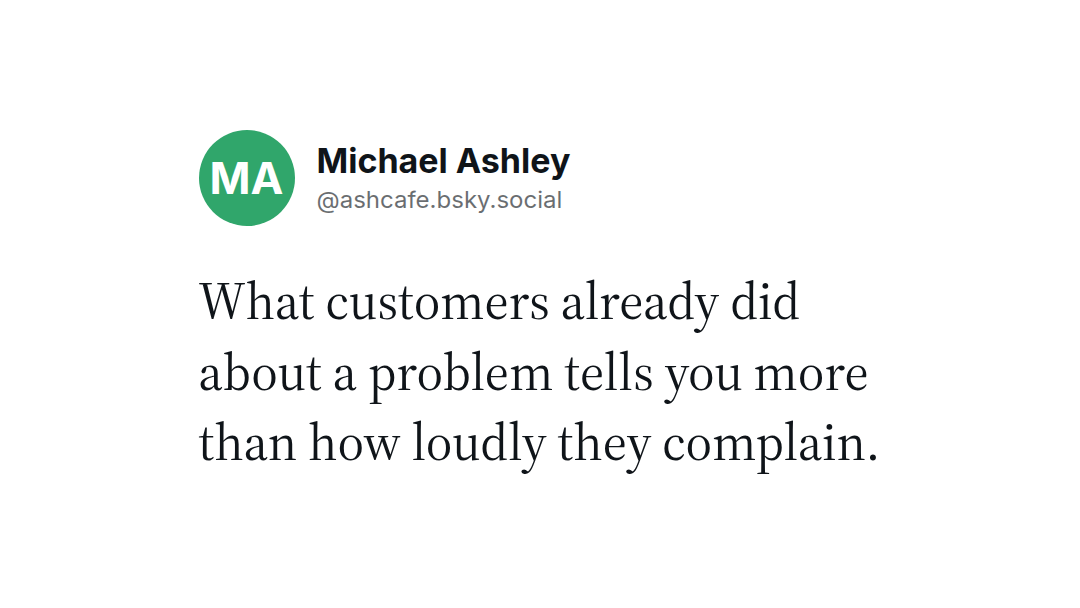
What customers already did about a problem tells you more than how loudly they complain. Before a bet, check: did they pay for a fix, build a workaround, switch? That's signal.
The deeper version: https://mashley.com…more
"I may have just made a $1 million mistake."
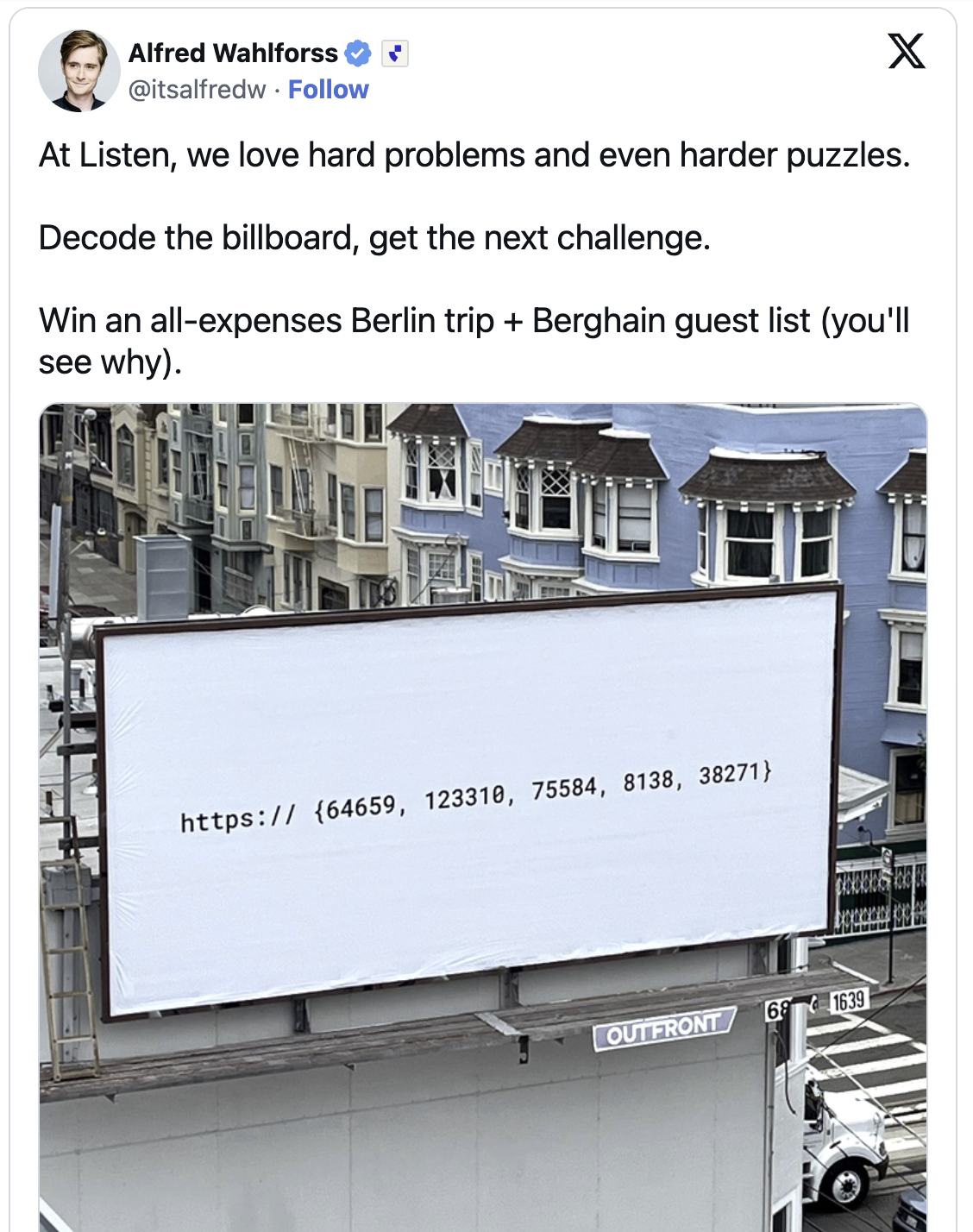
That was the scroll-stopping LinkedIn hook from Listen Labs' CEO after dropping $1M on billboards across NYC. The campaign generated 66 million views.
But the hook wasn't the interesting part. The approach behind it was.
Most B2B companies treat out-of-home advertising like a blunt instrument. You pick high-traffic locations, design something that looks good from 60 feet away, hope the right people see it, and measure nothing until the campaign is already over.
Listen Labs ran it like a software product.
Before committing a dollar to physical spend, they ran AI-moderated customer interviews to pre-test over 300 ad concepts and visual designs with real buyers. They chose what went on the billboards based on actual buyer response, not internal opinion. They measured brand awareness immediately before and after launch to calculate exact uplift rather than guessing at it. And when the campaign launched, employees synchronized on social by updating their profile pictures to a monochrome blue design and changing their job titles to "Customer Understanding Advocate" — creating a coordinated organic amplification layer that money can't replicate.
The result was a physical campaign that had the precision of a digital one.
Two things every B2B team should steal from this before the next event or OOH buy:
→ Budget $2,000–$3,000 for on-site videographers and photographers every time. Not for the event recap. For the evergreen content library. Sixty seconds of well-shot footage from a real event compounds for months.
→ Bring creator partners on-site. Let them record reaction content from the physical space. It breaks you out of the internal employee echo chamber and gets your message into feeds you don't control.
Physical and digital aren't different channels anymore. They're the same campaign.
https://venturebeat.com/technology/listen-labs-raises-usd69m-after-viral-billboard-hiring-stunt-to-scale-ai#B2BMarketing#EventMarketing…more
In 25 years I've watched founders quietly kill good ideas and pour a year into bad ones — for the exact same reason. They never separated the idea from the way it was framed.
When a project stalls, the instinct is to read it as an effort problem. Work harder. Add a hire. Run one more push. But most stalled projects aren't stuck at the effort level. They're stuck at the root-problem level — and no amount of effort fixes a problem you've diagnosed wrong. You just get to the wall faster.
There are really only two reasons a project won't move, and they look identical from the inside:
The idea is wrong. There's no real problem underneath it, or no one who'll pay to solve it. Effort here is expensive theater.
The framing is wrong. The problem is real and worth solving — but you've aimed it at the wrong buyer, entered through the wrong door, or described it in words that don't match how anyone actually experiences it. Effort here isn't wasted; it's just pointed at the wrong target.
The trap is that both feel the same. Both produce silence, flat numbers, and a team that's working hard with nothing to show. So before you spend more, the question isn't "how do we push harder?" It's "which of these two am I actually looking at?"
Here's the diagnostic I run:
Does the problem exist when you're not in the room? A real problem shows up in what people already do — the workarounds, the spreadsheets, the money they're spending to cope. If the problem only appears when you pitch it, you likely have an idea problem, not a framing one. Effort won't save it.
Change the words, not the product — does the response change? Describe the same thing to the same person using their language, their trigger, their stakes. If a sharper frame suddenly gets nods where you got blank stares, the idea was never the issue. The framing was.
Follow the "no." When people pass, are they saying "I don't have that problem" or "I have it, but not like that / not from you"? The first is an idea signal. The second is a framing signal — and it's fixable without starting over.
Would a different buyer make this obvious? Sometimes the idea is right and the audience is wrong. Moving the same solution to a segment that feels the pain acutely turns a hard sell into an easy one. That's framing, not effort.
The reason this matters: the cost of confusing the two is enormous. Treat a framing problem as an effort problem and you burn a year grinding on something that only needed a repositioning. Treat an idea problem as a framing problem and you keep polishing the message on a thing the market was never going to buy.
Clarity here is cheaper than persistence. Diagnose the root before you spend the next quarter on the symptom.
So a question worth sitting with this week:
The project that's stalled right now — are you actually sure it's a bad idea, or have you just never tested whether it's a framing problem wearing a bad-idea disguise? …more
Before a client builds anything — the new website, the course, the funnel, the rebrand — I ask the same questions. Most projects don't survive them. That's the point.
Coaches and consultants are builders by nature. When growth stalls, the instinct is to make something: a new offer, a new content plan, a new brand. Building feels like progress. Building the wrong thing is the most expensive form of standing still.
So before anything gets built, I ask:
Who exactly is this for? I want a person you could name, with a problem they'd describe in their own words. A demographic doesn't count.
What evidence says they want it? Behavior is evidence: what they already do, already pay for, already work around. Encouragement from friends is not.
What are they doing about this problem today? If the answer is "nothing," be careful. People who live comfortably with a problem rarely pay to solve it.
Why you? What in your background makes you the credible one, and can a stranger see that credibility, or does it live only in your head?
What's the one constraint? If everything feels equally important, nothing is. Name the single thing that, once moved, unlocks the rest.
Clients sometimes get frustrated at this stage. They came with a solution, and I keep questioning the diagnosis. That's the job. A sharper problem definition beats more effort every time, and it costs a lot less than finding out after launch.
Which of these would be hardest for you to answer with real evidence today?
#IndependentConsultant#Coaching#CustomerDiscovery#IdealClient
Fast Pencil didn't win because of one clever innovation. It won because four technologies grew up at exactly the same moment — and we happened to be paying attention.
Back in 2007, four enabling layers matured almost simultaneously:
— E-books went mainstream (Kindle launched)
— Print-on-demand made a single copy economical
— Digital distribution meant you didn't need a warehouse or a bookstore
— Real-time online collaboration arrived (early Google Docs)
Any one of those, on its own, was interesting. A neat feature. A "someday" bet.
All four together created a category that couldn't have existed the year before: self-publishing for everyone. Right time, right place, right convergence — and a window that opened wide and then closed fast.
That's the lesson I keep coming back to for founders evaluating a new market. Most people scan for individual trends: "AI is hot," "video is growing," "this platform is exploding." Trends are easy to spot and easy to chase. The durable businesses get built somewhere harder to see — at the intersection, where several enabling layers reach maturity at the same time and suddenly make a hard thing cheap, obvious, and possible.
As I told Julia Lucidi on her Founder Tactics podcast: "being aware of the convergence of technology is huge."
So the real skill isn't spotting the trend everyone's already talking about. It's noticing when three or four separate things quietly cross the line from "almost possible" to "possible" at once. That's the timing window. And it rarely announces itself.
What convergence are you watching right now that others are treating as separate trends? Worth thinking about.
🎙️ From my conversation with Julia Lucidi on the Founder Tactics podcast. Full episode: https://youtu.be/M58Dnn2UAlM#Founders#Startups#Entrepreneurship#GoToMarket#GrowthStrategy…more
Back in 2007 my mom wrote a book, and no one would publish it.
It's called "Butterfly Girl" — the story of a little girl lost in a storm and her long journey home. She wrote it for one reader: my daughter. She wanted her granddaughter to know where she came from, in her own words. The traditional publishers all passed. A beautiful, personal story about one family's journey wasn't a big enough market for them.
So I told her not to wait for anyone's permission. We'd do it ourselves.
What I didn't fully understand until we were in it: self-publishing back then was brutal. Formatting, printing, distribution, ISBNs, cover files — every step was manual, expensive, and built to make you quit. We pushed through it anyway, and she held her book in her hands. That moment was the whole point.
Then Christmas came. And at the table, one relative after another leaned in and said some version of the same thing: "You know, I have a book in me too. How did you do it?"
That's when it clicked. The pain I'd just spent months fighting through wasn't my mom's problem. It was everyone's problem. As I put it later:
"there's a million other moms out there hundred million other moms you know actually billions of people out there who think they have a book in them and will never publish so it was the business model"
That became FastPencil — an online writing and publishing platform. It didn't start with a market analysis or a TAM slide. It started with one person I loved, one urgent human problem, and a Christmas dinner full of people stuck behind the exact same wall.
I've come to believe this is one of the most underrated sources of a great idea: proximity. Not brainstorming what the market wants in the abstract, but solving something real for someone you actually care about — then noticing how many other people are quietly living the same frustration. The narrow, personal problem is often the universal one wearing a disguise.
So here's my question for you:
Is there a version of this in your own story — a problem you solved for someone close to you that turned out to be universal?
🎙️ From my conversation with Julia Lucidi on the Founder Tactics podcast. Full episode: https://youtu.be/M58Dnn2UAlM…more
They told me I couldn't wear shorts to school, so I invented a new kind of pants.
Dress code said no shorts, so we made something that technically wasn't: clam diggers. Everyone wanted a pair.
Build a workaround for yourself — everyone stuck behind the same wall is your market. …more
They told me I couldn't wear shorts to school. So I invented a new category of pants.
I wasn't trying to start a company. I just didn't want to stop wearing shorts. The dress code said no shorts — so my mom and I designed something that technically wasn't shorts but did the same job: clam diggers. Long enough to pass the rule, short enough to be worth wearing.
I wore them in. The school tried to send me home. I argued they didn't break the rule as written — and I won.
Here's the part I didn't see coming: every kid at school wanted a pair. The workaround turned out to be more interesting than the rebellion. So we started a little company called Surfing Samurai and made clam diggers for everyone.
That's a pattern I've watched repeat for 25 years. You hit a constraint. You build a workaround for yourself. Then you realize everyone else is stuck behind the same constraint — and that's your market. The frustration was never just yours.
What constraint have you turned into a product or opportunity? I'd love to hear it.
🎙️ From my conversation with Julia Lucidi on the Founder Tactics podcast. Full episode: https://youtu.be/M58Dnn2UAlM…more
After 4 exits, here's something I know for sure:
Most startup failures aren't caused by lack of effort. They're caused by solving a problem people don't care about enough. Everything gets easier once the problem is real.
https://www.radi8.com…more
The most interesting opportunities almost never look exciting at first.
They look stuck.
Someone's been circling the same idea for years. Everyone agrees it should exist. There have been meetings, decks, maybe a failed attempt or two. And yet — nothing has moved.
That's the moment I want to walk in.
Not because I'm smarter than the people who were there before me. Usually I'm not. It's because stalled initiatives are rarely blocked by effort or talent. They're blocked by something structural: an unclear problem, too many priorities, no real owner, a foundational decision nobody's been willing to make.
Find that one thing, move it, and the whole thing starts to breathe.
After 25 years, I've stopped chasing the ideas that already have momentum. Plenty of capable people can push those forward. I'm drawn to the stuck ones — the initiatives everyone believes in but no one has been able to move.
Making those move is the most satisfying work I know.
What's the thing in your world that everyone agrees should exist — but nobody has been able to make happen yet? …more
The most interesting opportunities don't look exciting.
They look stuck.
Everyone agrees it should exist. Nobody's been able to move it.
Stalled work is rarely blocked by effort. It's blocked by structure — an unclear problem, no owner, a decision no one will make.
I've been running founder peer groups for years. One thing I see constantly: founders who've done customer interviews but still don't know if their idea is viable.
It's not because they skipped the research. It's because they asked the wrong questions.
There's a difference between asking "Would you pay for this?" and asking "Walk me through the last time you dealt with this problem. What did you do?"
The first question gets a guess. The second gets a story. Stories are what you can actually build on.
This is the whole premise of The Mom Test — a book I recommend to every founder I work with. But even founders who've read it revert to opinion-seeking questions the moment they're in a real conversation.
So I built MomTestQuestions.com. You put in your product and your target customer. It generates a set of behavior-based interview questions you can use in your next discovery call.
Free. No account needed.
If you're still trying to figure out whether you're building something people actually need — this is a good place to start.
DM me if you want to talk through what you're hearing in your interviews. Happy to help you make sense of it. …more
The most expensive sentence in startups:
"My customers said they'd use it."
People are terrible predictors of future behavior.
Stop asking what they'll do.
Start asking what they've already done.
That's where product-market fit lives.
#startups#customerdiscovery
Your customers won't save your bad idea.
But they will help you make better decisions if you learn how to listen.
Most founders go into discovery calls hoping for validation. They ask leading questions. They get encouraging answers. They build. Then they discover nobody wanted the solution badly enough to change behavior.
What looks like a marketing problem later often starts as a customer understanding problem earlier.
The fix is learning to ask about behavior, not intent.
Not "would you buy this?"
But "what have you already tried?"
Not "does this sound useful?"
But "what is this costing you today?"
The most expensive assumption you've ever made about your customers is probably still shaping decisions somewhere in your business.
What's the most expensive assumption you've ever made about your customers?
The most common mistake I see in customer discovery isn't talking to too few people.
It's asking questions that confirm what you already believe.
"Do you think this would be useful?" is not a customer interview. It's a poll.
And the founders who get stuck are rarely suffering from a marketing problem.
They're suffering from a decision-making problem.
They're making product, positioning, and go-to-market decisions using opinions instead of evidence.
The Mom Test by Rob Fitzpatrick is still the best framework I know for fixing this. Ask questions your mom couldn't lie to you about. Not "would you use this," but "what do you currently do when this problem comes up?"
I put that framework into MomTestQuestions.com because I wanted founders to get to better decisions faster.
What's the most surprising thing a customer has ever told you?
Most founders I work with avoid customer discovery. Not because they don't understand the theory. Because it surfaces uncomfortable truths.
When you sit down with a potential customer and ask the right questions, you're not just testing assumptions. You're inviting reality to challenge the story you've been telling yourself about your product, your positioning, and your market.
That's hard.
It's easier to keep building. Easier to refine the pitch. Easier to convince yourself that more features, better messaging, or a bigger launch will solve the problem.
But avoidance has a cost. You burn months building something nobody wants. You misread demand signals. You position yourself in a crowded space because you never learned what makes you different in the eyes of the people who matter.
I've seen this across four startups and dozens of advisory engagements. The founders who get traction fastest are not the ones with the best ideas. They're the ones willing to hear that their assumptions are wrong and adjust accordingly.
Customer discovery is not a validation exercise. It's a correction mechanism. The goal is not to hear what you want to hear. The goal is to learn what you need to know before you make expensive decisions.
That means asking questions that expose gaps in your thinking. It means listening to what customers are actually trying to solve, not what you hope they need. It means being willing to abandon ideas you were excited about yesterday.
The discomfort is the signal. If the conversation doesn't make you rethink something, you're probably asking the wrong questions.
After 25 years of building and advising startups, the pattern is clear. The founders who embrace this discomfort early save themselves time, money, and wasted opportunity. The ones who avoid it pay for it later in slower growth, misaligned product decisions, and go-to-market strategies that never gain traction.
What assumption did customer discovery force you to abandon? …more
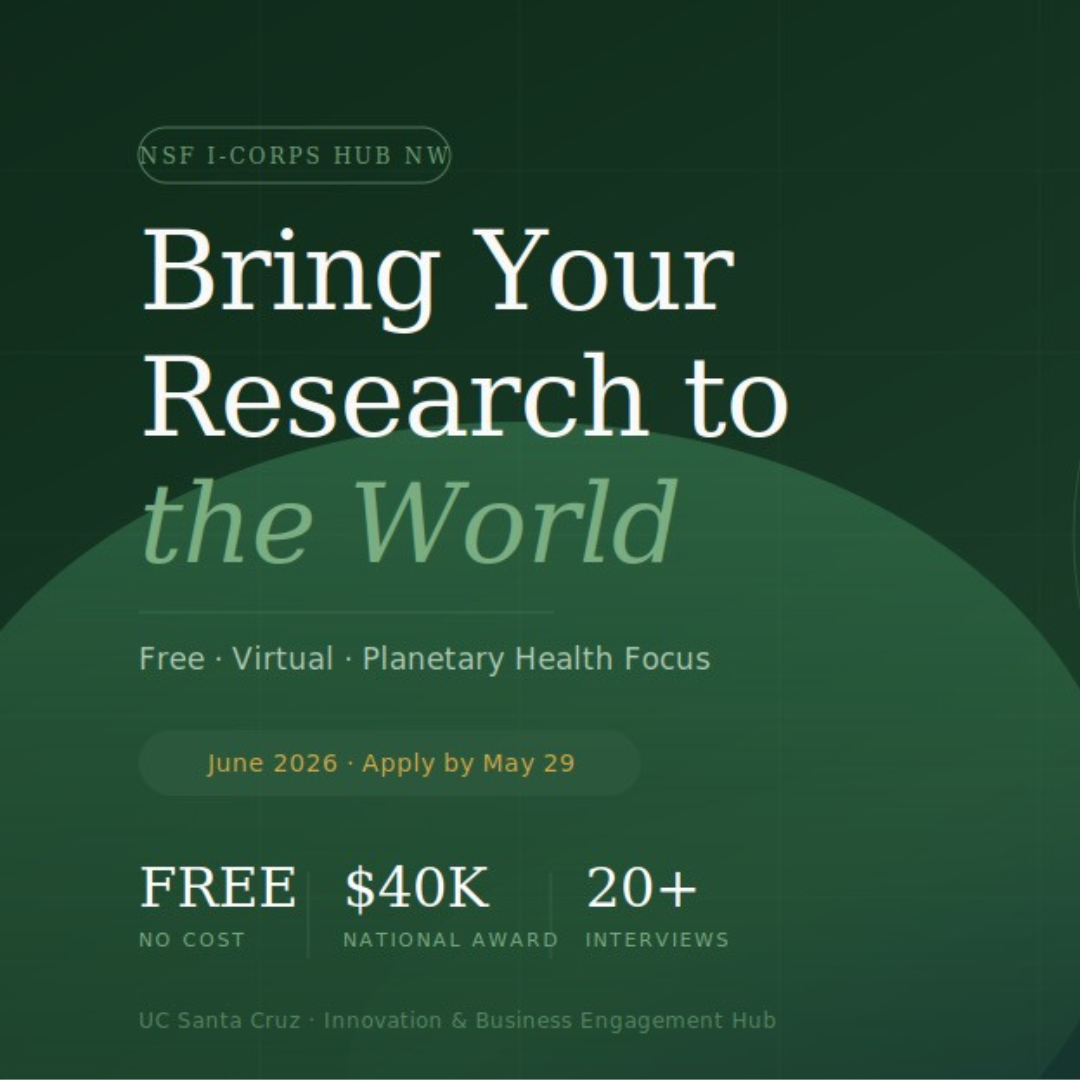
NSF I-Corps is the gold standard for customer discovery. If you have ever wanted to understand how innovation actually moves from the lab to the market, this is your chance to see the methodology up close.
The NSF I-Corps Hub Northwest is offering a free, virtual course focused on planetary health technologies. Applications are open through May 29, 2026.
Customer discovery is the single most underestimated skill in early-stage startups. Most founders skip it or do it halfway because they are eager to build. Then they spend months or years building something nobody will buy.
I-Corps teaches you how to test assumptions, talk to potential customers before you commit to a roadmap, and validate whether a real market exists for what you are building. It is structured, repeatable, and grounded in evidence.
Even if planetary health is not your focus, the frameworks and rigor you learn here apply to nearly any technology or market. The program forces you to get out of the building and run real interviews. You leave with clarity on who your customer is, what problem you are solving, and whether your solution has legs.
This is especially valuable if you are a solo founder or running a small team without access to formal mentorship or accelerator support. You get expert coaching, a proven process, and a cohort of other founders working through the same challenges.
If you are serious about bringing a new technology to market and want to build something people will actually pay for, apply. The course is free, the methodology is tested, and the insight you gain can save you years of wasted effort.
Applications close May 29. Send me a message if you want to talk through whether this is a fit for where you are in your journey.
https://www.santacruzworks.org/news/nsf-i-corps-hub-planetary-course-applications-open…more


 View on Bluesky
Also on

 View on LinkedIn
Also on