The most underrated skill in B2B marketing isn't writing. It's listening.
I've spent years marketing complex technical products across five enterprise tech companies, and the pattern holds every time: the best messaging I ever shipped didn't start in a doc. It started in a conversation I almost didn't slow down enough to have.
A support engineer describing the call they dread. A customer explaining, in their own words, the moment your product stopped being "a tool" and started being "the reason I slept last night." That language is gold. And most of us walk right past it because we're in a hurry to produce.
In the Army, we were taught that you never brief a mission you don't understand from the ground up. You listen first—to the terrain, to the people who've walked it, to what's actually at stake. Then you speak. The order lands because it's rooted in reality, not assumption.
Marketing complex products works the same way. Curiosity isn't a soft skill here. It's the discipline that separates content people scroll past from content people feel seen by.
So before you write the next campaign, try this: have one real conversation with someone who lives your customer's problem. Don't pitch. Just listen. You'll leave with a sentence better than anything a blank page could give you.
The teams pulling ahead aren't the loudest. They're the most curious.
Want a fresh take on your B2B content strategy? DM me and let's schedule a 30-minute consultation—I'll show you 3 things you can improve this week.
#B2BMarketing#ContentStrategyhttps://www.generativeaipub.com/p/the-urgent-call-for-ai-slowdown-has…more
The best marketing doesn't shout. It listens first.
People don't want to be sold to. They want to be understood.
Lead with their story, not your product. Trust follows.
What's one thing your audience wishes you'd say out loud?
#B2B#ContentStrategyhttps://www.generativeaipub.com/p/the-urgent-call-for-ai-slowdown-has
Founder at Radi8 // Executive Coach // Host of the Inspiring Founders Podcast
· LinkedIn
·
My friend Joao de Brito is an artist, and he's the reason I rebuilt a page in Radi8 last week.
I showed him the new Create feature. It makes images, you can touch up a photo or drop your work into a different gallery with AI, and Joao started using it right away. Then he kept pasting his photo captions in as prompts and couldn't understand why the thing was behaving so strangely.
He wasn't doing it wrong. Create meant something different to him than I had intended it to mean. He read it as where you go to create a post, which is an entirely reasonable thing to read it as, and once I saw it happen in front of me I started seeing it everywhere, the same wrong turn at the same spot.
For about a week before that I'd been treating it as a labeling problem. Clearer heading, better button. People kept doing it anyway.
That's the moment that used to cost me months. You know what you designed, you can explain it, the explanation is even correct... and being correct is completely beside the point, because the people using it have already decided what it's for.
So I stopped defending the design and rebuilt the page to do the whole job.
This is why you talk to customers regularly, and why you shouldn't be afraid to let them complain! Joao never filed a bug report. He just got confused in front of me, which is about the most valuable thing a customer can do for you.
The signal is rarely in what people say, it's in what they keep trying to do after you've told them not to.
Where are your clients repeatedly trying to use you for something that isn't on your services page?
#IndependentConsultant#Coaching#CustomerDiscovery#Positioning…more
Founder at Radi8 // Executive Coach // Host of the Inspiring Founders Podcast
· LinkedIn
·
Tom Shen said something in our conversation that I keep coming back to.
He drew a line between answers and questions. Answers, he said — everybody's got one:
"answers. Everybody's got one sometimes. And we've all worked with people like that. They got two or three. But questions,"
That last word hangs there for a reason. Good questions are rare. And the person who asks the right one often adds more value than the person with the ready answer.
I think about this a lot with coaches and consultants. There's a quiet pressure to prove you belong in the room by having every answer, deck loaded, solutions ready before the client finishes talking. It feels like expertise. Often it's the opposite.
The sharper move is to show up curious. A good question does more than fill a silence — it shows you already know what actually matters here. That's not uncertainty. That's judgment made visible.
Tom Shen made this point better than I can, in Episode 7 of the Inspiring Founders podcast. Worth a watch — link in the first comment.
So I'll ask you one: what's the best question you've been asked in a client conversation — one that changed how you saw the problem?
#IndependentConsultant#Coaching#ThoughtLeadership#GoingIndependent…more
Founder at Radi8 // Executive Coach // Host of the Inspiring Founders Podcast
· LinkedIn
·
When a coach or consultant tells me their positioning is fuzzy, they usually want to fix the words. A better tagline. A sharper sentence. A cleverer hook. That almost never works, because vague positioning isn't a writing problem.
It's a customer-understanding gap.
You can't describe who you help clearly when you're not yet clear on who they are. No amount of wordsmithing rescues a message you haven't earned by knowing the person on the other end. Positioning is an output of customer discovery, not a copywriting exercise.
So when someone's stuck, I don't ask "what do you do?" That question sends people straight back into their own head — to titles, methods, and adjectives. I ask two different ones instead.
Who is this actually for? Not a demographic. A person you could name, with a problem they'd describe in their own words.
And what were they doing about it before they found you? The workarounds, the half-measures, the thing they already tried that didn't stick. That's where the real language lives — the words your best clients use for their own problem, before you dress them up.
Answer those two honestly and the positioning tends to write itself. You stop reaching for clever and start repeating what you've actually heard. Evidence beats invention. A sentence built from a real client's words lands because someone already lived it.
The clever version impresses you. The accurate version gets remembered by the person it's for.
So here's the question I'd genuinely like you to answer: what's the one client you do your best work for — and what were they doing before they found you?
#IndependentConsultant#Coaching#Positioning#CustomerDiscovery#IdealClient…more
Founder at Radi8 // Executive Coach // Host of the Inspiring Founders Podcast
· LinkedIn
·
In 25 years I've watched founders quietly kill good ideas and pour a year into bad ones — for the exact same reason. They never separated the idea from the way it was framed.
When a project stalls, the instinct is to read it as an effort problem. Work harder. Add a hire. Run one more push. But most stalled projects aren't stuck at the effort level. They're stuck at the root-problem level — and no amount of effort fixes a problem you've diagnosed wrong. You just get to the wall faster.
There are really only two reasons a project won't move, and they look identical from the inside:
The idea is wrong. There's no real problem underneath it, or no one who'll pay to solve it. Effort here is expensive theater.
The framing is wrong. The problem is real and worth solving — but you've aimed it at the wrong buyer, entered through the wrong door, or described it in words that don't match how anyone actually experiences it. Effort here isn't wasted; it's just pointed at the wrong target.
The trap is that both feel the same. Both produce silence, flat numbers, and a team that's working hard with nothing to show. So before you spend more, the question isn't "how do we push harder?" It's "which of these two am I actually looking at?"
Here's the diagnostic I run:
Does the problem exist when you're not in the room? A real problem shows up in what people already do — the workarounds, the spreadsheets, the money they're spending to cope. If the problem only appears when you pitch it, you likely have an idea problem, not a framing one. Effort won't save it.
Change the words, not the product — does the response change? Describe the same thing to the same person using their language, their trigger, their stakes. If a sharper frame suddenly gets nods where you got blank stares, the idea was never the issue. The framing was.
Follow the "no." When people pass, are they saying "I don't have that problem" or "I have it, but not like that / not from you"? The first is an idea signal. The second is a framing signal — and it's fixable without starting over.
Would a different buyer make this obvious? Sometimes the idea is right and the audience is wrong. Moving the same solution to a segment that feels the pain acutely turns a hard sell into an easy one. That's framing, not effort.
The reason this matters: the cost of confusing the two is enormous. Treat a framing problem as an effort problem and you burn a year grinding on something that only needed a repositioning. Treat an idea problem as a framing problem and you keep polishing the message on a thing the market was never going to buy.
Clarity here is cheaper than persistence. Diagnose the root before you spend the next quarter on the symptom.
So a question worth sitting with this week:
The project that's stalled right now — are you actually sure it's a bad idea, or have you just never tested whether it's a framing problem wearing a bad-idea disguise? …more
Before a client builds anything — the new website, the course, the funnel, the rebrand — I ask the same questions. Most projects don't survive them. That's the point.
Coaches and consultants are builders by nature. When growth stalls, the instinct is to make something: a new offer, a new content plan, a new brand. Building feels like progress. Building the wrong thing is the most expensive form of standing still.
So before anything gets built, I ask:
Who exactly is this for? I want a person you could name, with a problem they'd describe in their own words. A demographic doesn't count.
What evidence says they want it? Behavior is evidence: what they already do, already pay for, already work around. Encouragement from friends is not.
What are they doing about this problem today? If the answer is "nothing," be careful. People who live comfortably with a problem rarely pay to solve it.
Why you? What in your background makes you the credible one, and can a stranger see that credibility, or does it live only in your head?
What's the one constraint? If everything feels equally important, nothing is. Name the single thing that, once moved, unlocks the rest.
Clients sometimes get frustrated at this stage. They came with a solution, and I keep questioning the diagnosis. That's the job. A sharper problem definition beats more effort every time, and it costs a lot less than finding out after launch.
Which of these would be hardest for you to answer with real evidence today?
#IndependentConsultant#Coaching#CustomerDiscovery#IdealClient
Founder at Radi8 // Executive Coach // Host of the Inspiring Founders Podcast
· LinkedIn
·
When your customer research keeps contradicting itself, the problem usually isn't the research. It's that you're talking to two different people and treating them as one.
I see this constantly. A founder runs a dozen conversations, and the signal is all over the map. One group swears the onboarding is the dealbreaker; another barely notices it and cares only about price. Half describe the product as a time-saver; half call it a status thing. The founder concludes "customers are confused" or "the market is fragmented," and goes hunting for a cleverer message to paper over the noise.
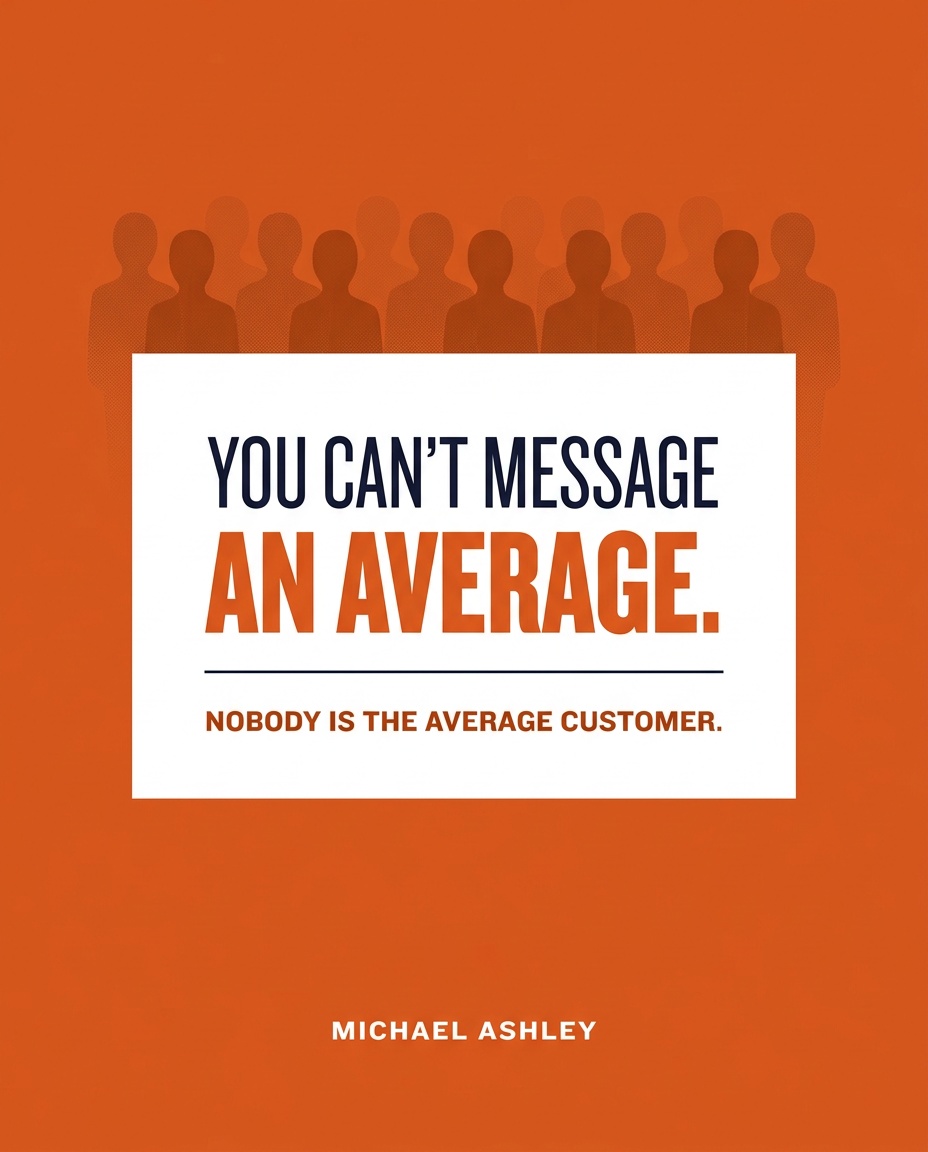
But the noise is the finding. Contradictory insights are what a blended audience sounds like. You're not hearing one confused market — you're hearing two or three coherent ones averaged into mush. And you can't message an average. Nobody is the average customer.
The reason this stalls companies is subtle: an average feels like data. It has quotes, a deck, a ring of rigor. So you make product and go-to-market bets on it — and the bets keep missing, because you're aiming at a person who doesn't exist.
The fix is in how you structure discovery, before you ever synthesize:
Segment on the way in, not on the way out. Decide the cuts that might explain different behavior — job to be done, trigger event, stage, buying context — and tag every conversation as you go. If you only segment after the fact, you've already blended.
Recruit on purpose, not on availability. A convenient sample is a blended sample. Deliberately fill each segment so a pattern in one group can't hide inside the average of all of them.
Read patterns within a segment, never across the pile. The question isn't "what did customers say?" It's "did this segment say the same thing to each other?" Agreement inside a clean segment is a signal. Agreement across a blended pile is a coincidence you'll pay for later.
Here's the bar I hold: an insight is decision-grade only when it's consistent inside a segment you could actually go acquire. Anything short of that isn't evidence — it's an anecdote wearing a percentage sign.
The uncomfortable part is that this makes your findings messier before it makes them clearer. Two sharp, opposing truths are worth more than one blurry consensus. Consensus is comfortable. It's also where stalled companies go to feel productive.
So a question worth sitting with this week:
The last time your customer insights contradicted each other — did you treat it as noise to resolve, or as a sign you were listening to more than one audience at once?
#Founders#Startups#Entrepreneurship#CustomerDiscovery#VoiceOfCustomer…more
Founder at Radi8 // Executive Coach // Host of the Inspiring Founders Podcast
· LinkedIn
·
Back in 2007 my mom wrote a book, and no one would publish it.
It's called "Butterfly Girl" — the story of a little girl lost in a storm and her long journey home. She wrote it for one reader: my daughter. She wanted her granddaughter to know where she came from, in her own words. The traditional publishers all passed. A beautiful, personal story about one family's journey wasn't a big enough market for them.
So I told her not to wait for anyone's permission. We'd do it ourselves.
What I didn't fully understand until we were in it: self-publishing back then was brutal. Formatting, printing, distribution, ISBNs, cover files — every step was manual, expensive, and built to make you quit. We pushed through it anyway, and she held her book in her hands. That moment was the whole point.
Then Christmas came. And at the table, one relative after another leaned in and said some version of the same thing: "You know, I have a book in me too. How did you do it?"
That's when it clicked. The pain I'd just spent months fighting through wasn't my mom's problem. It was everyone's problem. As I put it later:
"there's a million other moms out there hundred million other moms you know actually billions of people out there who think they have a book in them and will never publish so it was the business model"
That became FastPencil — an online writing and publishing platform. It didn't start with a market analysis or a TAM slide. It started with one person I loved, one urgent human problem, and a Christmas dinner full of people stuck behind the exact same wall.
I've come to believe this is one of the most underrated sources of a great idea: proximity. Not brainstorming what the market wants in the abstract, but solving something real for someone you actually care about — then noticing how many other people are quietly living the same frustration. The narrow, personal problem is often the universal one wearing a disguise.
So here's my question for you:
Is there a version of this in your own story — a problem you solved for someone close to you that turned out to be universal?
🎙️ From my conversation with Julia Lucidi on the Founder Tactics podcast. Full episode: https://youtu.be/M58Dnn2UAlM…more
Founder at Radi8 // Executive Coach // Host of the Inspiring Founders Podcast
· X
·
They told me I couldn't wear shorts to school, so I invented a new kind of pants.
Dress code said no shorts, so we made something that technically wasn't: clam diggers. Everyone wanted a pair.
Build a workaround for yourself — everyone stuck behind the same wall is your market. …more
Founder at Radi8 // Executive Coach // Host of the Inspiring Founders Podcast
· X
·
Founders spend weeks building campaigns.
Then discover the message doesn't resonate.
I've learned to do the opposite.
Test the message first.
5 conversations will teach you more than 50 hours of campaign planning. …more
Founder at Radi8 // Executive Coach // Host of the Inspiring Founders Podcast
· X
·
What's the most expensive assumption you've ever made about your customers?
Not the biggest mistake.
The assumption you believed for months that turned out to be completely wrong.
Mine cost me nearly a year.
Curious what yours was. …more
Founder at Radi8 // Executive Coach // Host of the Inspiring Founders Podcast
· LinkedIn
·
I've been running founder peer groups for years. One thing I see constantly: founders who've done customer interviews but still don't know if their idea is viable.
It's not because they skipped the research. It's because they asked the wrong questions.
There's a difference between asking "Would you pay for this?" and asking "Walk me through the last time you dealt with this problem. What did you do?"
The first question gets a guess. The second gets a story. Stories are what you can actually build on.
This is the whole premise of The Mom Test — a book I recommend to every founder I work with. But even founders who've read it revert to opinion-seeking questions the moment they're in a real conversation.
So I built MomTestQuestions.com. You put in your product and your target customer. It generates a set of behavior-based interview questions you can use in your next discovery call.
Free. No account needed.
If you're still trying to figure out whether you're building something people actually need — this is a good place to start.
DM me if you want to talk through what you're hearing in your interviews. Happy to help you make sense of it. …more
The most expensive sentence in startups:
"My customers said they'd use it."
People are terrible predictors of future behavior.
Stop asking what they'll do.
Start asking what they've already done.
That's where product-market fit lives.
#startups#customerdiscovery
Your customers won't save your bad idea.
But they will help you make better decisions if you learn how to listen.
Most founders go into discovery calls hoping for validation. They ask leading questions. They get encouraging answers. They build. Then they discover nobody wanted the solution badly enough to change behavior.
What looks like a marketing problem later often starts as a customer understanding problem earlier.
The fix is learning to ask about behavior, not intent.
Not "would you buy this?"
But "what have you already tried?"
Not "does this sound useful?"
But "what is this costing you today?"
The most expensive assumption you've ever made about your customers is probably still shaping decisions somewhere in your business.
What's the most expensive assumption you've ever made about your customers?
The most common mistake I see in customer discovery isn't talking to too few people.
It's asking questions that confirm what you already believe.
"Do you think this would be useful?" is not a customer interview. It's a poll.
And the founders who get stuck are rarely suffering from a marketing problem.
They're suffering from a decision-making problem.
They're making product, positioning, and go-to-market decisions using opinions instead of evidence.
The Mom Test by Rob Fitzpatrick is still the best framework I know for fixing this. Ask questions your mom couldn't lie to you about. Not "would you use this," but "what do you currently do when this problem comes up?"
I put that framework into MomTestQuestions.com because I wanted founders to get to better decisions faster.
What's the most surprising thing a customer has ever told you?


 View on LinkedIn