

Here's a practical way to handle customer input without being led around by it: treat what you hear as raw material, not instructions.
I built a feature in Radi8 to surface the real questions people were asking online, so coaches and consultants could answer them publicly and get seen. I shipped it and watched it work.
It worked, and it was wrong. The questions came back the wrong shape... too specific, too tangled in one person's context to actually build a post on. So I rebuilt it to generate questions from your own audience and positioning instead of scraping them. Under 24 hours from shipping to changing course.
"Go talk to customers" is right. But raw input is raw material, not a spec. The skill is knowing which part of what you heard to build on. Ignore it and you're guessing; follow it literally and you build the wrong thing.
Genuine question — what's something a client asked you for that you were right not to give them exactly?
More on how we chew on this inside Inspiring Founders. Link in the first comment.
#Coaching #IndependentConsultant #GoingIndependent #CustomerDiscovery …more
Product-Market Fit
“Vitamin or pain killer?” - advisors love to ask this question about your product. And they love to tell you it has to be a pain killer, because it’s easier to sell. But the truth is less about pain and more about understanding your customer.
When I was 23 I worked at Threshold, one of the largest distributors of vitamins and supplements to the industry. They easily sold hundreds of millions of dollars every year into supplement stores all over the country.
What made them special wasn’t their inventory. It was their sales organization.
Every sales rep would spend time on the phone with their customers, they knew them by name, they talked like old friends. But more than that they spent time educating. And in turn their customers, the shop owners, educated their own customers.
What they created was an environment of conscious empathy and learning for people who didn’t want pain killers.
So here’s the question for your business: Are you chasing the same customers as all your competitors? The ones looking for pain killers?
Or are you building a community that’s tired of popping pills and wants a real, long-term solution?
Selling “vitamins” isn’t bad, it’s just very different from selling “pain killers” …more
Fast Pencil didn't win because of one clever innovation. It won because four technologies grew up at exactly the same moment — and we happened to be paying attention.
Back in 2007, four enabling layers matured almost simultaneously:
— E-books went mainstream (Kindle launched)
— Print-on-demand made a single copy economical
— Digital distribution meant you didn't need a warehouse or a bookstore
— Real-time online collaboration arrived (early Google Docs)
Any one of those, on its own, was interesting. A neat feature. A "someday" bet.
All four together created a category that couldn't have existed the year before: self-publishing for everyone. Right time, right place, right convergence — and a window that opened wide and then closed fast.
That's the lesson I keep coming back to for founders evaluating a new market. Most people scan for individual trends: "AI is hot," "video is growing," "this platform is exploding." Trends are easy to spot and easy to chase. The durable businesses get built somewhere harder to see — at the intersection, where several enabling layers reach maturity at the same time and suddenly make a hard thing cheap, obvious, and possible.
As I told Julia Lucidi on her Founder Tactics podcast: "being aware of the convergence of technology is huge."
So the real skill isn't spotting the trend everyone's already talking about. It's noticing when three or four separate things quietly cross the line from "almost possible" to "possible" at once. That's the timing window. And it rarely announces itself.
What convergence are you watching right now that others are treating as separate trends? Worth thinking about.
🎙️ From my conversation with Julia Lucidi on the Founder Tactics podcast. Full episode: https://youtu.be/M58Dnn2UAlM
#Founders #Startups #Entrepreneurship #GoToMarket #GrowthStrategy …more
"Our marketing isn't working." I've heard that in almost every company I've been part of. It's rarely where the problem actually lives.
Years ago I watched a startup tear itself apart over exactly this. Sales blamed marketing for weak leads. Marketing blamed sales for fumbling the ones they sent. Both were sure, both were loud, and both were wrong.
The real problem was two doors down, in the product.
The UX team had rolled out a new version built on a new mental model. The old product worked like email: you create a message, attach a big file, hit send. Everyone already knew how to do that. The new one worked like a shared, collaborative file system — cleaner on paper, but it asked users to think in a way they didn't yet think. They opened it and didn't get it.
That confusion didn't show up with a label that said "mental-model mismatch." It showed up as soft demos, stalled trials, and a sales team and a marketing team pointing at each other. The symptom surfaced at the front of the funnel. The cause was sitting in engineering.
Once we accepted that and reshaped the experience to feel like email again — meeting people inside the mental model they already had, instead of the one we wished they had — it unlocked everything.
This pattern shows up in the data too. When CB Insights studied hundreds of failed startups, the headline cause was "ran out of money." But they were careful to call that the final event, not the reason. The real reasons lived upstream — the product didn't fit how the market actually thought. The empty bank account was just where it finally became visible.
Marketing and sales are usually the windows, not the wound. When they're both struggling, I've learned to stop refereeing the fight at the window and go find the wound.
What's the visible problem you keep trying to fix — and what might actually be underneath it? …more

Told 2 times, Jul 3, 2026
· X · Open
Marketing and sales are the windows, not the wound. When both are struggling, stop refereeing at the window — go find the wound.
After 4 exits, here's something I know for sure:
Most startup failures aren't caused by lack of effort. They're caused by solving a problem people don't care about enough. Everything gets easier once the problem is real.
https://www.radi8.com …more
I've been running founder peer groups for years. One thing I see constantly: founders who've done customer interviews but still don't know if their idea is viable.
It's not because they skipped the research. It's because they asked the wrong questions.
There's a difference between asking "Would you pay for this?" and asking "Walk me through the last time you dealt with this problem. What did you do?"
The first question gets a guess. The second gets a story. Stories are what you can actually build on.
This is the whole premise of The Mom Test — a book I recommend to every founder I work with. But even founders who've read it revert to opinion-seeking questions the moment they're in a real conversation.
So I built MomTestQuestions.com. You put in your product and your target customer. It generates a set of behavior-based interview questions you can use in your next discovery call.
Free. No account needed.
If you're still trying to figure out whether you're building something people actually need — this is a good place to start.
DM me if you want to talk through what you're hearing in your interviews. Happy to help you make sense of it. …more
Told 4 times, Jun 4, 2026 – Jun 18, 2026
· X · Open
The most expensive sentence in startups:
"My customers said they'd use it."
People are terrible predictors of future behavior.
Stop asking what they'll do.
Start asking what they've already done.
That's where product-market fit lives.
#startups #customerdiscovery
· LinkedIn · Open
Your customers won't save your bad idea.
But they will help you make better decisions if you learn how to listen.
Most founders go into discovery calls hoping for validation. They ask leading questions. They get encouraging answers. They build. Then they discover nobody wanted the solution badly enough to change behavior.
What looks like a marketing problem later often starts as a customer understanding problem earlier.
The fix is learning to ask about behavior, not intent.
Not "would you buy this?"
But "what have you already tried?"
Not "does this sound useful?"
But "what is this costing you today?"
The most expensive assumption you've ever made about your customers is probably still shaping decisions somewhere in your business.
What's the most expensive assumption you've ever made about your customers?
· LinkedIn · Open
The most common mistake I see in customer discovery isn't talking to too few people.
It's asking questions that confirm what you already believe.
"Do you think this would be useful?" is not a customer interview. It's a poll.
And the founders who get stuck are rarely suffering from a marketing problem.
They're suffering from a decision-making problem.
They're making product, positioning, and go-to-market decisions using opinions instead of evidence.
The Mom Test by Rob Fitzpatrick is still the best framework I know for fixing this. Ask questions your mom couldn't lie to you about. Not "would you use this," but "what do you currently do when this problem comes up?"
I put that framework into MomTestQuestions.com because I wanted founders to get to better decisions faster.
What's the most surprising thing a customer has ever told you?
Most founders I work with avoid customer discovery. Not because they don't understand the theory. Because it surfaces uncomfortable truths.
When you sit down with a potential customer and ask the right questions, you're not just testing assumptions. You're inviting reality to challenge the story you've been telling yourself about your product, your positioning, and your market.
That's hard.
It's easier to keep building. Easier to refine the pitch. Easier to convince yourself that more features, better messaging, or a bigger launch will solve the problem.
But avoidance has a cost. You burn months building something nobody wants. You misread demand signals. You position yourself in a crowded space because you never learned what makes you different in the eyes of the people who matter.
I've seen this across four startups and dozens of advisory engagements. The founders who get traction fastest are not the ones with the best ideas. They're the ones willing to hear that their assumptions are wrong and adjust accordingly.
Customer discovery is not a validation exercise. It's a correction mechanism. The goal is not to hear what you want to hear. The goal is to learn what you need to know before you make expensive decisions.
That means asking questions that expose gaps in your thinking. It means listening to what customers are actually trying to solve, not what you hope they need. It means being willing to abandon ideas you were excited about yesterday.
The discomfort is the signal. If the conversation doesn't make you rethink something, you're probably asking the wrong questions.
After 25 years of building and advising startups, the pattern is clear. The founders who embrace this discomfort early save themselves time, money, and wasted opportunity. The ones who avoid it pay for it later in slower growth, misaligned product decisions, and go-to-market strategies that never gain traction.
What assumption did customer discovery force you to abandon? …more
I love seeing this.
West Sacramento just cut the ribbon on community-funded EV charging infrastructure. Not a government grant. Not a big utility play. Grassroots clean energy, funded by the people who will use it.
Here's what caught my attention: they didn't wait for permission or perfect conditions. They validated demand with the community first, then built the solution.
That's exactly how early traction works.
Most founders think they need all the resources lined up before they can make a move. Full budget. Perfect messaging. Complete product. But momentum doesn't start that way.
It starts when you validate a real problem with the people who feel it most, then build the smallest version that solves it.
The West Sacramento project didn't need top-down approval or a five-year roadmap. They identified a local gap, rallied the people who needed the solution, and moved forward with what they had.
If you're stuck waiting for the perfect conditions to launch your next campaign, refine your positioning, or start building visibility, this is your reminder: traction comes from action, not preparation.
Find the smallest group that feels your solution. Validate that it matters to them. Build for that group first.
The infrastructure comes after the momentum, not before.
If you're wrestling with early go-to-market strategy or how to build traction before you have all the resources, let's talk. I run free 15-minute marketing audits for founders. Comment below and I'll send you the link.
https://www.santacruzworks.org/news/powered-by-climatize-community-funded-ev-charging-comes-to-west-sacramento …more

 View on LinkedIn
Also on

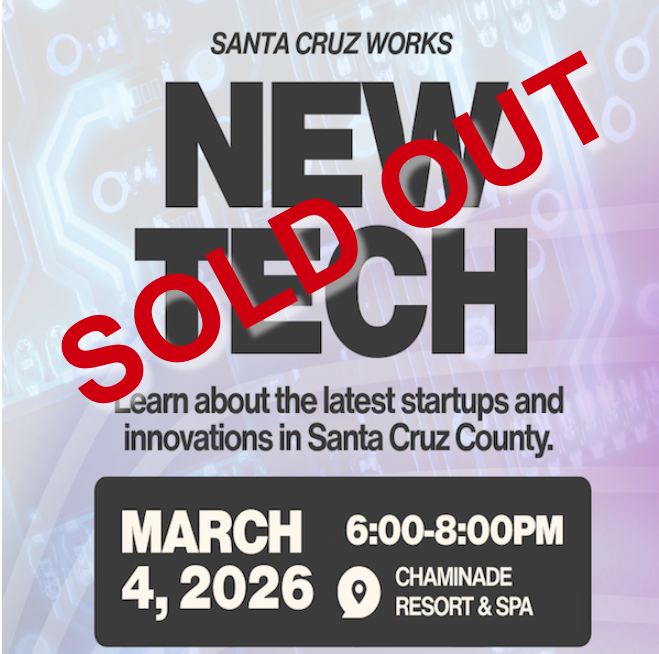
Great night at Santa Cruz Works New Tech, sold out on March 4. I pitched Radi8 and heard rapid-fire demos from Innovation Within, BrandCapsule, Activity Ally, and The Host Mindset. Thanks to Comcast Business and Wynn Capital for sponsoring.
Two quick takeaways: focus your demo on the customer problem and one clear outcome; use events to recruit pilot partners and collect direct feedback. If you are working on early product-market fit or want pilot introductions, send me a message. #startups
https://www.santacruzworks.org/news/santa-cruz-works-new-tech-march-4-2026-6yx5p …more
Channel names and logos are trademarks of their respective owners.