Saeed Amidi calls parts of his story lucky.
The rug merchant who happened to offer him a room. The chance meetings that opened doors. He tells it like the breaks just showed up.
Listen closer and there's more to it. He planned to stay in Jeddah two weeks. He stayed 45 days. He put himself where the opportunity was, and he didn't leave until he understood the problem he was there to solve. When the break came, he was already in the building, ready to take the next step.
It took me years to really get this. Luck isn't something you schedule... but you can put yourself where it tends to happen, keep taking the simplest next step, and be ready to act when it shows up.
For first-time founders, that might be the most useful thing to know about luck.
What's one step this week that would put you in the room?
Watch Saeed tell it himself: https://youtu.be/bb9n-CnDGVA
#Founders #FirstTimeFounders #Startups #Entrepreneurship …more
Founder Stories
Work by Michael Ashley · Everyone on Founder Stories
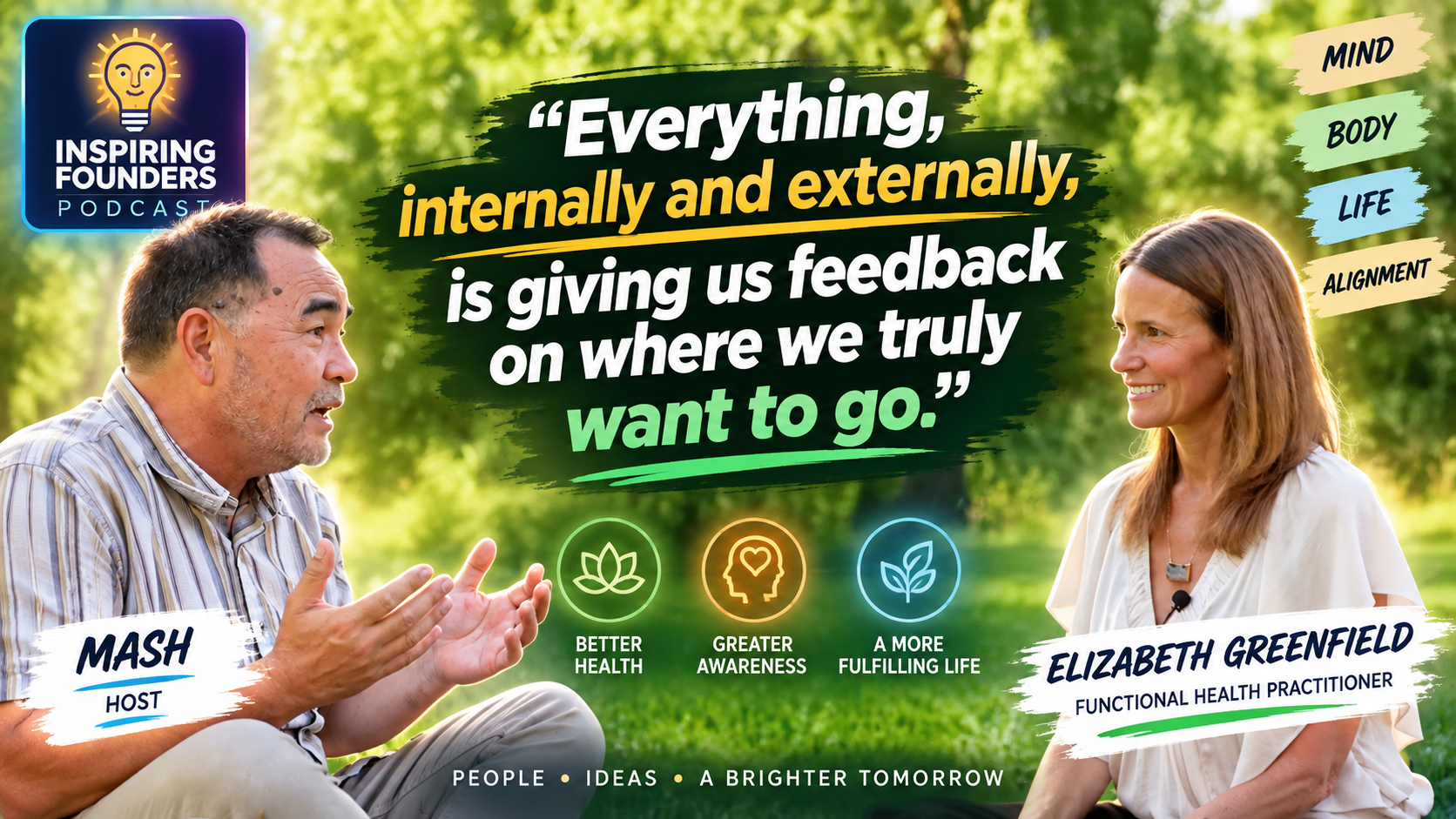
"I didn't know how to run a business."
Liz Greenfield, after 25 years as a nurse, in her first stretch out on her own.
She's honest on this episode about all of it. The morning she rolled out of bed and realized the paycheck had stopped. Undervaluing herself. A speaking coach telling her, point blank, that she wasn't ready.
None of that is a nursing problem. It's the half nobody teaches you inside an organization.
Watch the episode:
https://youtu.be/vXDMfaJVcNQ
Like it, comment, subscribe... it genuinely helps the show reach the next person who needs to hear it. All episodes at inspiringfounders.com
#IndependentConsultant #GoingIndependent #Positioning #CoachingBusiness …more
"I can't work here anymore!!"
That's the moment Liz Greenfield knew.
25 years as a nurse. Fifteen of them as a nurse anesthetist. A job she genuinely loved.
She was running marathons, working 24-hour shifts, raising two small kids... and her own health was falling apart. Every lab came back normal.
The answer never came from the system she worked inside. It came from a chiropractor who took a different approach, and who told her she already had the credentials to do this work herself.
So she left, and built her own functional medicine practice.
Full conversation is up now:
https://youtu.be/vXDMfaJVcNQ
Watch it, like it, and leave Liz a comment. Subscribe to the Inspiring Founders channel while you're there. Every episode lives at inspiringfounders.com
#GoingIndependent #IndependentConsultant #Coaching #InspiringFounders …more
The demo happened on his watch.
He raised his wrist mid-conversation and talked to ConscioussAI to book an Uber.
Shiven, and his cousin Manas, turned ConscioussAI from a bedroom project that read wind tunnel data to a Plug and Play funded startup. ConscioussAI is now 12 people shipping an AI agent that runs your whole phone.
New episode of the Inspiring Founders Podcast is live. …more
How much did you really know the first time you called yourself the expert?
Saeed Amidi didn't know much. On his first pitch, he says it plainly: "I honestly didn't know business, but I said to Sabola, Saudi vegetable oil... if I get it to you the same quality or better at 680, would you buy from me?"
He didn't arrive an expert. He landed in Jeddah, committed to one specific problem for specific buyers, and didn't leave until he understood it. The knowing followed the commitment. Today he exports $400M of polyethylene from ExxonMobil... all from that one first trip.
I keep telling coaches and consultants who are waiting on more credentials: you don't wait until you feel ready. You go deep on one problem until the market sees you as the answer.
Hear Saeed tell it himself: https://youtu.be/bb9n-CnDGVA?is=ozsXzdXjyqbYgj1L
Then come build your reputation next to people making the same leap — join the free Inspiring Founders community at https://inspiringfounders.com.
What's the one specific problem you could go deep on, even before you feel fully ready?
#GoingIndependent #IndependentConsultant #Positioning …more
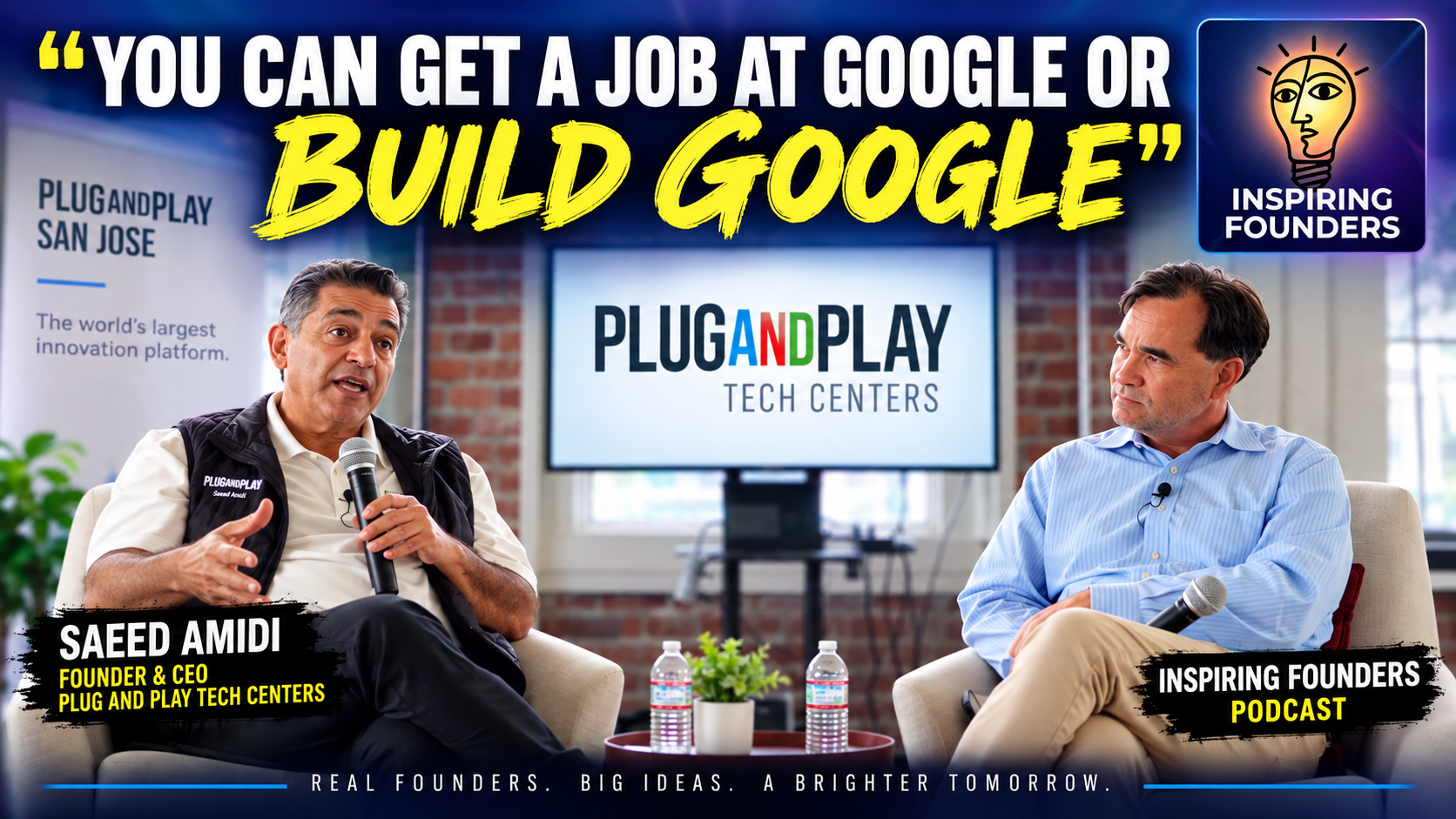
I sat across from Saeed Amidi in San Jose, a live audience in the room with us.
Saeed founded Plug and Play Tech Centers. He also, almost as an aside, runs a plastics and bottled-water company that does a billion dollars a year... which he still calls his "day job."
He told us about a building on University Avenue in Palo Alto. His first tenant there was Peter Thiel. His third was Andy Rubin. And in that same stretch, Larry and Sergey were building Google. He calls it the lucky building, the one that got him into PayPal.
Now Plug and Play invests in about 100 startups a year. He's building an AI Center of Excellence in San Jose. He thinks the AI revolution is 10 to 20 times bigger than mobile... and still only the tip of the iceberg.
But the part that stayed with me wasn't the numbers.
It was when he talked about pressure as a prerequisite. And why he won't back a founder who has a Plan B.
Then he closed with a line, and the whole room lit up:
"You can either get a job at Google, or BUILD Google!"
Full conversation with Saeed is on the Inspiring Founders Podcast. Watch it on YouTube, or listen on Spotify.
#IndependentConsultant #GoingIndependent #Coaching #ThoughtLeadership …more
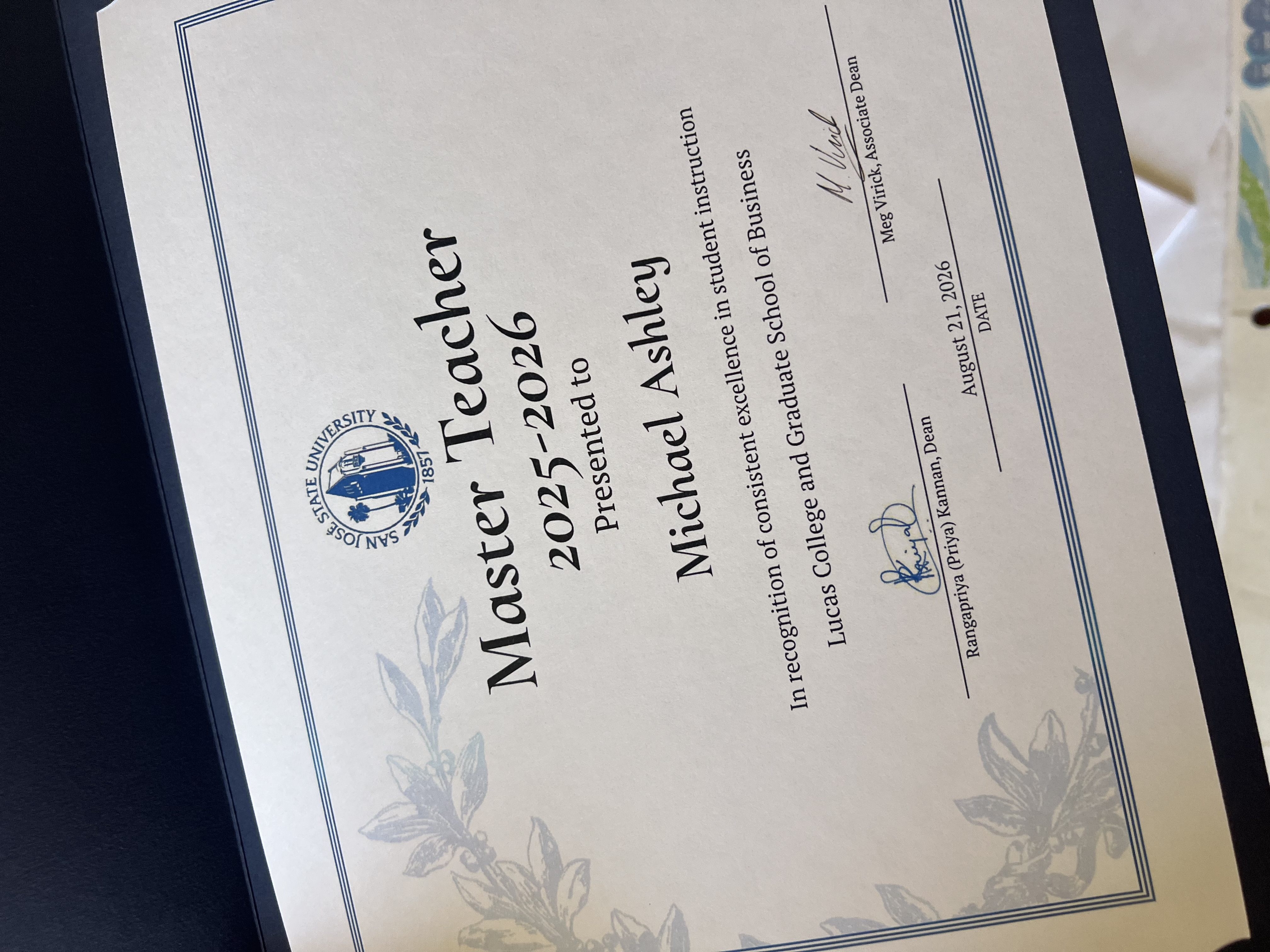
I got a Master Teacher award from SJSU.
Thank you to SJSU, to the College of Business, and especially to the students who made the classroom worth showing up to.
#ThoughtLeadership #Reputation …more
Back in 2007 my mom wrote a book, and no one would publish it.
It's called "Butterfly Girl" — the story of a little girl lost in a storm and her long journey home. She wrote it for one reader: my daughter. She wanted her granddaughter to know where she came from, in her own words. The traditional publishers all passed. A beautiful, personal story about one family's journey wasn't a big enough market for them.
So I told her not to wait for anyone's permission. We'd do it ourselves.
What I didn't fully understand until we were in it: self-publishing back then was brutal. Formatting, printing, distribution, ISBNs, cover files — every step was manual, expensive, and built to make you quit. We pushed through it anyway, and she held her book in her hands. That moment was the whole point.
Then Christmas came. And at the table, one relative after another leaned in and said some version of the same thing: "You know, I have a book in me too. How did you do it?"
That's when it clicked. The pain I'd just spent months fighting through wasn't my mom's problem. It was everyone's problem. As I put it later:
"there's a million other moms out there hundred million other moms you know actually billions of people out there who think they have a book in them and will never publish so it was the business model"
That became FastPencil — an online writing and publishing platform. It didn't start with a market analysis or a TAM slide. It started with one person I loved, one urgent human problem, and a Christmas dinner full of people stuck behind the exact same wall.
I've come to believe this is one of the most underrated sources of a great idea: proximity. Not brainstorming what the market wants in the abstract, but solving something real for someone you actually care about — then noticing how many other people are quietly living the same frustration. The narrow, personal problem is often the universal one wearing a disguise.
So here's my question for you:
Is there a version of this in your own story — a problem you solved for someone close to you that turned out to be universal?
🎙️ From my conversation with Julia Lucidi on the Founder Tactics podcast. Full episode: https://youtu.be/M58Dnn2UAlM …more

I've built a handful of companies. The ones that actually worked all followed the same shape — and it's close to the opposite of what most founders are told to do.
Build the thing. Set a foundation under it. Hand it to someone who can scale it. Then go do it again.
For years I thought the handoff was me failing. You start something, pour yourself into it, and then… you leave? It felt like abandonment. Now I think it's the whole point. My job is to make something exist and make it stand on its own — not to be the reason it keeps standing.
There's research that reframed this for me. Studying 200+ startups, Noam Wasserman found that founders are most likely to be pushed out right after their biggest wins. Not their failures — their wins. Because hitting the milestone changes the job underneath them. Inventing and scaling reward different instincts, and the thing that made you great at the first often makes you the bottleneck in the second.
So I stopped treating my exit as a threat and started treating it as a design requirement. If I build it right, it shouldn't need me. Durability doesn't come from a founder's presence — it comes from the people, process, and structure that outlast any one person.
The test I use now is simple: if I stepped away for 90 days, what would quietly break? Wherever the answer is "everything," that's not a vacation problem. It's a design problem.
If you stepped away for 90 days — what would quietly break first? …more
Told 2 times, Jul 12, 2026
· X · Open
I build companies so they don't need me.
Build it. Set a foundation. Hand it to someone who can scale it. Repeat.
For years I thought the handoff was me failing. It's the whole point — something standing on its own is the win.
They told me I couldn't wear shorts to school. So I invented a new category of pants.
I wasn't trying to start a company. I just didn't want to stop wearing shorts. The dress code said no shorts — so my mom and I designed something that technically wasn't shorts but did the same job: clam diggers. Long enough to pass the rule, short enough to be worth wearing.
I wore them in. The school tried to send me home. I argued they didn't break the rule as written — and I won.
Here's the part I didn't see coming: every kid at school wanted a pair. The workaround turned out to be more interesting than the rebellion. So we started a little company called Surfing Samurai and made clam diggers for everyone.
That's a pattern I've watched repeat for 25 years. You hit a constraint. You build a workaround for yourself. Then you realize everyone else is stuck behind the same constraint — and that's your market. The frustration was never just yours.
What constraint have you turned into a product or opportunity? I'd love to hear it.
🎙️ From my conversation with Julia Lucidi on the Founder Tactics podcast. Full episode: https://youtu.be/M58Dnn2UAlM …more
My first business got me sent to the principal's office.
I was a kid, and my mom taught me a trick that felt like magic: buy a pack of Hubba Bubba at the grocery store for 25 cents, break it into individual pieces, and sell each piece for 25 cents. A quarter's worth of gum became a dollar twenty-five.
I ran the whole operation out of my school locker. I had regulars. I had a supply chain. I understood distribution before I'd ever heard the word.
Then a teacher noticed a kid moving product out of a locker with a steady line of customers and came to the obvious conclusion: I was dealing drugs. It was Hubba Bubba. I got hauled in to explain myself.
Looking back, that little gum hustle taught me the thing I still believe about entrepreneurship: it's not some rarefied skill you learn in a boardroom. It's just noticing where you can add value and bringing something a little closer to the people who want it. That instinct shows up early — usually before you have a word for it.
What was your first "business"? Drop it in the comments — I bet it started earlier than you think.
🎙️ From my conversation with Julia Lucidi on the Founder Tactics podcast. Full episode: https://youtu.be/M58Dnn2UAlM …more
I understood distribution before I'd ever heard the word. I was a kid selling gum out of a locker.
Entrepreneurship isn't a boardroom skill. It's noticing where you can add value — and most founders were doing it long before they had a name for it. …more
Channel names and logos are trademarks of their respective owners.