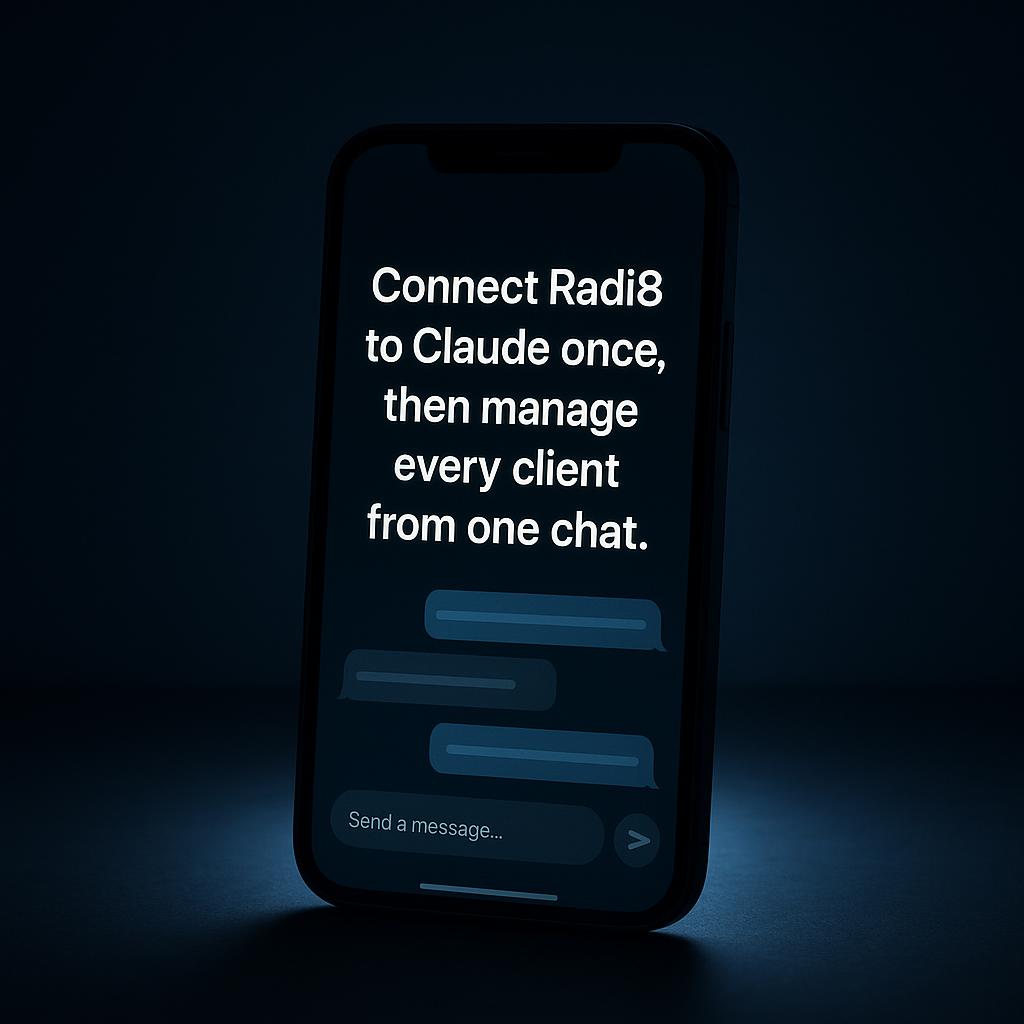
I'm building Radi8 inside ChatGPT and Claude, not behind a dashboard.
I use it every day, and somewhere along the way I noticed what I actually want from software... I don't want another dashboard. I don't want another login, another menu, another screen to learn.
I want to say what I need in a sentence and have it done.
The sentence is the interface.
That changes what the product is for. General AI brings the intelligence. The specialized software has to bring everything the AI can't: who you are, what happened last time, where things stand, and the ability to actually take action.
I might be wrong about how fast this arrives. I'm testing it on myself first, which is the only way I know how to learn anything.
For founders and CEOs launching a product right now, it might be worth asking: if your customers never opened your app again, what would they still pay you for?
#Founders#GoToMarket#AI…more
We still picture software as screens to learn. When people can just type what they want, the sentence becomes the interface.
Building Radi8 inside ChatGPT and Claude showed me this... and it took me longer than I'd like to admit to notice.
Startup founders, that might change what's worth building. I'm still testing it, and I could be wrong about how fast it arrives.
#Founders#Startups#FirstTimeFounder#StartupFounder#BuildInPublic#AI#ProductStrategy#GoToMarket#Entrepreneurship
I'm building Radi8 to live inside ChatGPT and Claude.
The chat is smart. It can write, reason, and talk you through almost anything. But start a new conversation and it doesn't know your voice, your offers, who you're writing for, or what you posted last week.
That part has to live somewhere. In Radi8 it lives in the app... the brand context, the strategy, the posts already published, and the ability to actually save a draft instead of just talking about one.
So the chat brings the intelligence, and the app brings the memory, the context, and the ability to act. Nobody has to learn another dashboard. You say what you want in a sentence, and the sentence becomes the interface.
I'm still figuring out how far this goes, and I could be wrong about parts of it.
Founders building software right now, it might be worth asking what your app knows that the chat never will... that might be the part worth building.
If you're building or using AI tools, what's something you'd rather describe in a sentence than click through?
#Founders#AI
My AI writes well. It just doesn't remember who I'm writing for.
The writing part is mostly solved. Ask ChatGPT or Claude for a post and you'll get clean sentences in seconds.
What it doesn't have is everything around the sentence... who you help, what you offer, how you sound, what you said last week, what's already on the calendar. Start a new chat and most of that is gone. So you explain it all again, or you settle for something generic.
What looks like a writing problem might really be a context problem.
That's a big part of why I'm building Radi8 the way I am. I think chat may become the interface for a lot of software, and the specialized app's job is to supply what general AI can't hold on to by itself: memory, context, state, and the ability to actually do things, like save a draft or line up a week of posts.
You describe the outcome in a sentence. The app brings what it knows about you. Fewer dashboards to learn.
I'm still testing this thesis, and I might be wrong about how fast it happens... but I'd rather build toward it and learn from what breaks.
If you use AI in your business, what do you find yourself re-explaining every single time?
#Founders#Startups#AI#AINativeSoftware#ProductDesign#BuildingInPublic#Entrepreneurship#SmallBusinessOwner#IndependentConsultant#Coaching…more
I don't think anyone needs a better AI writer anymore.
ChatGPT and Claude already write well. Clean sentences, decent structure, fast. When a post still comes out sounding off, I don't think the writing is what broke.
What looks like a writing problem might really be a context problem. The AI doesn't know who you help, the problem you solve for them, why they'd care, what you said last week, or what you're actually offering. So every new chat starts from zero... and you either explain yourself all over again, or settle for something that sounds like everybody else.
My bet is that the chat becomes the interface. You describe the outcome you want instead of learning another dashboard. The specialized apps underneath supply what a general AI can't hold onto by itself: what it knows about you, a memory of what's already happened, where things stand right now, and the ability to actually get it done.
That's the bet I'm testing while building Radi8 inside ChatGPT and Claude. I don't have it all figured out... I'm learning as I go, same as everyone building with this stuff.
So I'm curious. When AI writes something for you and it misses, what's it usually missing?
#Founders#AI
Two places I've been building Radi8 to live... ChatGPT and Claude.
Building inside a chat, the question became... what would someone actually type?
The sentence is the interface.
I don't always have a good answer to that question yet, and I've come to think that's useful information. If I can't write the sentence a person would type to ask for something, I might not understand what they want well enough.
First-time founders, you can try this on whatever you're building, with or without AI anywhere near it. Write the sentence your customer would type to ask for it. If it comes out vague, the problem might be upstream of the product... in how well you know the customer.
mashiam's Substack walks through how Radi8 works inside ChatGPT and Claude. If you'd rather see it than read about it, there's a video of how it works in the first comment.
What sentence would your customer type?
#FirstTimeFounder#Founders#CustomerDiscovery#Startups…more
A lot of coaches and consultants I talk to are brilliant in the room and invisible in the market. Not because they have nothing to say. Because showing up means wrestling with software they never signed up to learn, and that wrestling wins most days.
I think about this one a lot. You left a senior role to build a practice of your own. You're great at the work. And now the thing standing between you and a steady stream of the right clients is... a scheduler, a calendar tool, a content app, four tabs and a login.
That's the quiet tax on going independent. The work found you before, the brand vouched for you. Now you own the whole business, including being seen, and the tools make being seen feel like a project.
Radi8 is now a connector in Claude and ChatGPT, and we got into the Claude for Startups program this week. Here's the part that matters for you: it meets you in the chat you already use. You say what you want to put out, it already knows your voice and your audience, and it drafts and schedules it. No new app to learn. Nothing goes out without your approval.
It won't make you want to be visible. That part's still yours. But it takes away the excuse that showing up is too much friction on a busy week.
What's the one thing that keeps you from posting as often as you know you should? …more
The tool that gets used is the one that comes to where you already work.
I keep relearning this. I spent 25 years around software, and most of it asks the same thing of you first: learn the tool. Find the menu. Remember where the setting lives. Click through four screens to do the one thing you came to do.
Radi8 is now a connector inside Claude and ChatGPT, and getting into the Claude for Startups program this week made me look hard at why that matters, beyond the badge.
It's this. When the work happens in chat, and the chat already has your voice, your audience, your plan, and your channels behind it, there's no second place to go. "Draft a post about my next workshop and schedule it for Thursday" is a sentence, not a software session. The sentence is the interface.
For an independent consultant or fractional exec, that's not a small convenience. Most tools quietly hand you a second job: you were great at the work, and now you're also supposed to master the software to do the work. Every tab between you and the client is friction, and friction is where consistency goes to die.
The connector doesn't add a place. It removes one.
Where does your work actually happen now, in the apps, or in the chat? …more
“I don’t want another dashboard.”
I suspect we’re going to hear some version of that sentence a lot more.
For twenty years, software has mostly been somewhere you go. Need CRM? Go to the CRM. Need analytics? Open analytics. Need social media? Open the scheduler.
But if ChatGPT or Claude is already where I’m thinking, writing, researching and making decisions, why should I leave it just to operate another piece of software?
New subscribers are using Radi8 specifically because it works inside ChatGPT and Claude.
The connector isn’t merely convenient distribution, it IS the product.
AI becomes the interface and Radi8 becomes the specialized application underneath it.
This changes everything.
The demo happened on his watch.
He raised his wrist mid-conversation and talked to ConscioussAI to book an Uber.
Shiven, and his cousin Manas, turned ConscioussAI from a bedroom project that read wind tunnel data to a Plug and Play funded startup. ConscioussAI is now 12 people shipping an AI agent that runs your whole phone.
New episode of the Inspiring Founders Podcast is live. …more
I wrote this with Claude, who scheduled it with Radi8, all from one chat on my iPhone… in bed.
That sentence used to be impossible.
In the last hour, from this exact chat, I drafted and scheduled three LinkedIn posts across two different brands — one for Radi8 and two for my personal account. Different audiences. Different voices. Different goals. All from one Claude conversation. On my phone. Under the covers.
No app-switching. No logging in and out. No copy-paste between tools. I told Claude what I wanted, it pulled the right brand context for each account, drafted the posts in the right voice, and scheduled them at the times I asked for.
This is what we built Radi8's MCP server for.
For an agency managing 10 or 20 client brands, this is the difference between social media being a desk job and it being something you can actually run from anywhere. Waiting for a flight. Between meetings. Sunday night clearing the week ahead. Monday morning before you've even had coffee.
Each brand stays fully isolated — its own voice, its own context, its own connected channels — but every one of them is reachable from a single Claude chat on whatever device you happen to have with you.
The operational chaos that used to require a desk and six browser tabs now fits in your pocket.
If you run an agency and this sounds like the unlock you've been waiting for, try Radi8 free for 14 days. Connect it to Claude once, and start managing every client from one chat.
https://www.Radi8.com…more
Quick ask for the agency folks in my network.
I posted yesterday about connecting Radi8 to Claude through our new MCP server, and the response from agencies has been the most fired-up part of building this so far. Turns out a lot of you are drowning in tabs and credential-swapping, and the idea of running every client brand from a single Claude chat lands hard.
So I want to show it to you directly.
If you run an agency or freelance for multiple brands, send me a DM and I'll set up a quick demo. Fifteen minutes. I'll walk you through how it works, connect it live to Claude, and you can see for yourself what it feels like to draft, schedule, and manage posts across all your clients without ever opening a separate app.
No pitch deck. No sales script. Just the product.
If it's useful, great — you can start a free 14-day trial that day. If not, you'll have seen something genuinely new in how AI and social tooling can work together, and that's worth fifteen minutes either way.
DM me to grab a slot.
I've been heads-down building Radi8 for a while now, and last week we had one of those founder moments where something big clicked.
We've been building Radi8 as an AI-native social media platform for small business owners, founders, and the agencies that support them. As part of that work, I built an MCP server for it.
If you're not deep in AI tooling, MCP (Model Context Protocol) is what lets Claude and ChatGPT actually do things in other apps — not just talk about them. Wiring Radi8 in meant our customers could now manage their entire social presence directly from a Claude conversation.
Then we tested it with agencies. That's when it clicked.
An agency managing 5, 10, 20 client brands can now run all of them from a single Claude chat. Switch from one client's content plan to another by just asking. Draft a LinkedIn post for one, schedule an X post for another, check what's queued across every account — without ever opening a tab.
Each brand stays fully isolated. Its own voice. Its own context. Its own channels. But all reachable from the same place.
For agencies that have been juggling fifteen browser tabs and six logins, this changes the math entirely. No more credential-swapping. No more accidentally posting Brand A's update to Brand B's account. No more brand bleed.
This is what we're building Radi8 for — to take the operational chaos out of social so our customers can spend their time on the work that actually matters.
If your agency manages multiple brands and you're tired of the tab chaos, give us a try. Free for 14 days.
https://www.Radi8.com
Brian Solis argued at SXSW that augmentation is the new productivity: most people use AI to do what they already know. For founders this matters because the biggest gains come from changing how decisions are made, not just automating tasks.
Three practical steps I use with startups:
1) Map core decisions and the inputs that drive them.
2) Prototype one augmented workflow in two weeks and measure decision speed and quality.
3) Standardize prompts, tests, and handoffs so the capability scales.
If you want templates or pilot intros, send me a message. #AIhttps://briansolis.com/2026/03/worth-magazine-covers-brian-solis-keynote-at-sxsw-2026-augmentation-is-the-new-productivity/…more
Spent today in a workshop with Kent Kaufman, Manoj, and their Silicon Valley AI team. Farooq walked us through Spec Driven Development with AI Agents and how it produces stronger, more reliable code.
The session reinforced something I've been thinking about: the best tools don't just automate tasks. They change how we approach the work itself.
For founders building products while also trying to stay visible and engaged with customers, that shift matters. You need systems that help you think clearly, not just move faster.
If you're wrestling with how to stay consistent with marketing without it consuming all your time, send me a message.
Silicon Valley’s new frontier isn’t writing every line of code. It’s deciding what AI agents should do and how to evaluate them. From building startups and running accelerator programs, I’ve learned three practical rules for being agentic:
1) Define the objective, success metrics, and hard constraints up front.
2) Decompose work into discrete agent tasks with clear inputs and outputs.
3) Instrument feedback loops and human checkpoints to catch drift and control cost.
If you’re rethinking roles or workflows for agents, send me a message. #AIhttps://www.wired.com/story/silicon-valley-agentic-individuals-future-of-work/…more
How do you automate marketing with AI?
AI will handle repeatable execution: content variants, email follow-ups, ad creative tests, and performance monitoring. The real constraint is strategy. Without a clear go-to-market hypothesis and prioritized early growth channels, automation amplifies noise, not traction.
Practical path: pick one channel, design simple experiments, automate the repeatable steps, measure lift, and iterate.
With 20 years building and scaling startups, I help founders convert unclear go-to-market strategies into operational growth systems at Radi8. Send me a message to schedule a free marketing audit. #startup
My point of view on content marketing is simple.
Founders often treat content as a brand or traffic play. It delivers fastest when built as a repeatable acquisition engine: a defined buyer, a single, measurable offer, formats mapped to that buyer, and a small channel pilot to validate economics.
With 20 years of building and scaling startups, I use that framework at Radi8 to remove guesswork in early growth. If your go-to-market feels unclear, start with a testable acquisition hypothesis. Send me a message for a free marketing audit.
Are You ‘Agentic’ Enough for the AI Era?
Wired reports AI agents are taking on much of the grunt work. The most valuable skill today is deciding what those agents should do. I agree. For early-stage founders that means shifting from pure execution to designing clear agent workflows: name the outcome, define the success metric, and build a fast feedback loop. Start by automating one repeatable task—content drafts, user outreach, or ad copy—and specify the outcome, the KPI you’ll watch, and how often the agent reports back. Without that structure, automation increases overhead instead of removing it.
Send me a message to schedule a free marketing audit.
Michael Ashley, Founder & CEO, Radi8 | Startup advisor, investor, mentor
https://www.wired.com/story/silicon-valley-agentic-individuals-future-of-work/
The objection I keep hearing about automating marketing with AI, and why I still disagree
Objection: We can’t automate because our go-to-market is unclear and early channels are unproven. That mistakes automation for strategy. With 20 years of building and scaling startups, I use AI to accelerate learning, not replace decision making. In early GTM tests I use AI to run rapid channel experiments, generate audience hypotheses, automate creative and reporting, and keep validated channels running without heavy oversight. The result is shorter feedback loops so founders can make faster, better decisions.
If you are an early-stage founder testing GTM, send me a message to schedule a free marketing audit.
As founder of Radi8, I see how many small business owners dislike posting but know they must stay visible. Today Radi8 introduced CMO Agent, an AI agent that builds your digital marketing strategy, coordinates content creation, and schedules posts. It turns marketing from a time sink into a reliable system so you can stay engaged without extra hours. See for yourself at https://www.radi8.com#smallbusiness…more
As covered in Forbes, Joe McKendrick summarizes Brian Solis' ServiceNow research on human + AI. The core mistake I see is treating AI agents only as task replacers instead of partners. From building startups and launching programs I learned three practical steps: map workflows to define human/agent decision points; measure quality and trust, not just speed; run small frontline pilots with clear handoffs and governance. Send me a message to discuss pilot designs. #AIhttps://briansolis.com/2026/03/forbes-publishes-brian-solis-latest-ai-research-the-biggest-mistake-companies-are-making-with-ai-agents/…more
A recent piece from Santa Cruz Works flipped the AI debate: instead of replacing people, some bots are now hiring humans for on-site tasks. From program launches I worked on, two practical lessons stand out: 1) prioritize skills that require presence and judgment, like operations and customer-facing problem solving; 2) practice turning manual work into repeatable processes that pair with automation. Want help mapping concrete projects to build those skills? Send me a message. #careershttps://www.santacruzworks.org/news/rent-a-human-because-the-future-finally-realized-it-still-needs-legs…more


 View on LinkedIn
Also on
'/%3E%3Cpath fill='%23fff' d='M12 7.3A4.7 4.7 0 1 0 16.7 12 4.7 4.7 0 0 0 12 7.3Zm0 7.8A3.1 3.1 0 1 1 15.1 12 3.1 3.1 0 0 1 12 15.1Zm5-8a1.1 1.1 0 1 0 1.1 1.1A1.1 1.1 0 0 0 17 7.1Zm-5 1.5c-1.5 0-1.7 0-2.3.1a3.8 3.8 0 0 0-1.3.2 2.2 2.2 0 0 0-.8.5 2.2 2.2 0 0 0-.5.8 3.8 3.8 0 0 0-.2 1.3c-.1.6-.1.8-.1 2.3s0 1.7.1 2.3a3.8 3.8 0 0 0 .2 1.3 2.2 2.2 0 0 0 .5.8 2.2 2.2 0 0 0 .8.5 3.8 3.8 0 0 0 1.3.2c.6.1.8.1 2.3.1s1.7 0 2.3-.1a3.8 3.8 0 0 0 1.3-.2 2.5 2.5 0 0 0 1.3-1.3 3.8 3.8 0 0 0 .2-1.3c.1-.6.1-.8.1-2.3s0-1.7-.1-2.3a3.8 3.8 0 0 0-.2-1.3 2.2 2.2 0 0 0-.5-.8 2.2 2.2 0 0 0-.8-.5 3.8 3.8 0 0 0-1.3-.2c-.6-.1-.8-.1-2.3-.1Zm0-1.6c1.5 0 1.7 0 2.4.1a5.5 5.5 0 0 1 1.8.3 3.8 3.8 0 0 1 2.2 2.2 5.5 5.5 0 0 1 .3 1.8c.1.7.1.9.1 2.4s0 1.7-.1 2.4a5.5 5.5 0 0 1-.3 1.8 3.8 3.8 0 0 1-2.2 2.2 5.5 5.5 0 0 1-1.8.3c-.7.1-.9.1-2.4.1s-1.7 0-2.4-.1a5.5 5.5 0 0 1-1.8-.3 3.8 3.8 0 0 1-2.2-2.2 5.5 5.5 0 0 1-.3-1.8C4 13.7 4 13.5 4 12s0-1.7.1-2.4a5.5 5.5 0 0 1 .3-1.8 3.8 3.8 0 0 1 2.2-2.2 5.5 5.5 0 0 1 1.8-.3C10.3 5 10.5 5 12 5Z'/%3E%3C/svg%3E) View on Instagram


 View on Facebook