"The Folder Is the Agent" https://every.to/source-code/the-folder-is-the-agent-rerun
1 big thing: How this engineer is running 44 AI agents — and the surprisingly simple architecture behind it
The industry is spending enormous energy on autonomous swarms. One engineer spent three months there, then found the answer was a folder.
Why it matters: Most B2B teams building AI workflows are overcomplicating the architecture and underinvesting in the context. The folder-as-agent model flips that. The sophistication is in the context you build over time — not in the orchestration layer on top.
Driving the news:
Kieran Klaassen, GM of Every's AI email product Cora, runs 44 specialized AI agents across multiple projects. Each one is just a model pointed at a folder — a project directory with a CLAUDE.md file, skill definitions, institutional knowledge, and accumulated context built through months of use.
→ A different folder creates a different agent — same model, completely different specialist
→ A dispatch layer routes work between them; two slash commands replace 20 terminal tabs
Zoom in:
Anthropic's own research backs the pattern: an Opus lead agent with Sonnet sub-agents outperformed a single Opus agent by 90% on research tasks.
→ But multi-agent systems burn 15x more tokens than single-agent setups — most coding tasks have fewer parallelizable steps than research
Yes, but: You cannot vibe orchestrate. Build the folder, use it yourself, trust it, then hand it off. Skip that step and agents file duplicate issues and open pull requests for work already finished.
Be smart: Look at your current AI project folder. Is it a specialist or a generic setup? If your CLAUDE.md is boilerplate from someone's blog post, spend 30 minutes making it yours. That investment compounds every time an agent uses it.
The bottom line: The agent is not the model. The agent is the context. Build accordingly.
https://every.to/source-code/the-folder-is-the-agent-rerun#AIMarketing#B2BMarketing…more
Your old prompts might be slowing your AI agents down.
OpenAI dropped guidance this week saying that instructions written for older, weaker models can actually hurt GPT-4o agent performance. All that scaffolding you built to babysit a less capable model? It's now dead weight that wastes memory and triggers the wrong behaviors.
Three things to fix right now:
Skills — the prompt files that load for specific tasks — need narrow, precise trigger descriptions. If they're too broad, your agent grabs the wrong one.
Your AGENTS.md file loads on every single task. Strip out anything that tells the agent to do things it already does on its own — check tests, follow conventions, run reviews. The smarter the model, the more redundant that instruction becomes.
Task prompts should clearly define what "done" looks like, so the agent knows when to stop rather than pause and ask for clarification.
The broader pattern worth internalizing: as models get smarter, the scaffolding we built around dumber ones becomes the bottleneck. Less hand-holding. Leaner prompts. More trust in the model's own judgment.
OpenAI even suggests asking the agent itself to audit your existing skills and AGENTS.md for dead weight. That's the move.
https://alphasignal.ai/newsletter/openai-gpt-4o-agent-tips#AIMarketing#B2BMarketing…more
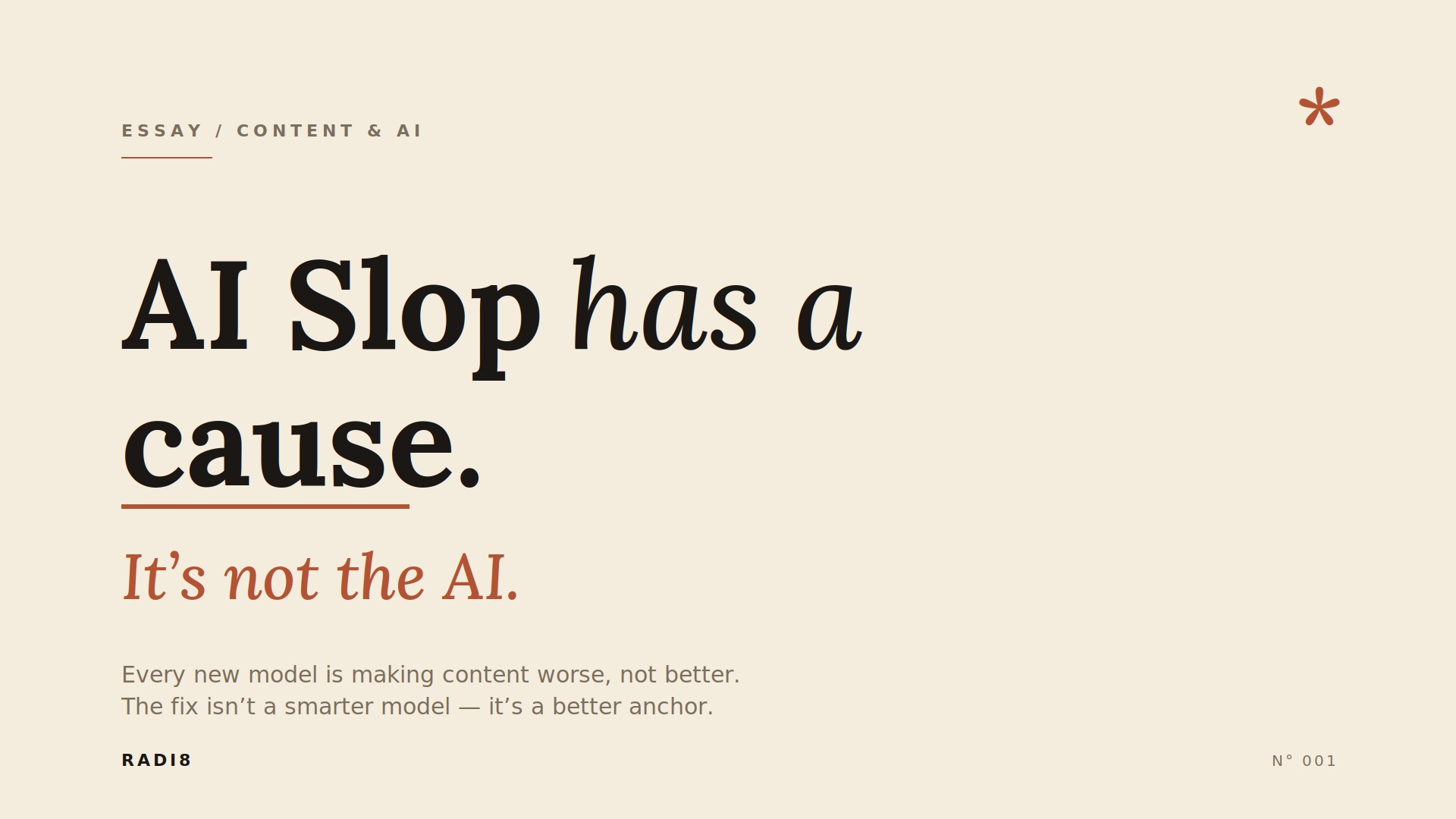
Every new AI content tool promises to save time and scale content production. Yet the feed keeps filling up with the same generic posts. You know the ones—vague insights, buzzwords stacked on buzzwords, nothing that actually sounds like it came from a human with specific experience.
The problem is not the AI. The problem is that most AI tools have nothing to anchor to.
When you feed prompts into a blank interface, the AI does exactly what it's designed to do: generate statistically probable language. It pulls from the aggregate of everything it's been trained on. That aggregate is safe, generic, and indistinguishable from the last 50 posts in your feed.
Brand context as the foundation changes this completely.
When AI has actual context to work from—your positioning, your voice principles, your proof points, the specific pains your audience faces—it stops producing slop. It starts producing content that reflects how you actually think and communicate. Content that carries your credibility instead of diluting it.
I've seen this across multiple enterprise tech companies. The marketers who win are not the ones using AI as a shortcut. They're the ones who build the right inputs first. They document what makes their brand distinct. They define voice principles that reflect real experience, not aspirational marketing speak. Then they use AI to scale that foundation, not replace it.
If your AI-generated content feels generic, ask yourself: what context did I give it? A one-off prompt in a chat window, or a documented system that captures how your brand actually shows up?
The tools matter less than the setup. Start with brand context. Everything else gets easier from there.
Want a fresh take on your B2B content strategy? DM me and let's schedule a 30-minute consultation—I'll show you 3 things you can improve this week.
https://www.radi8.com/blog/ai-slop-has-a-cause-its-not-the-ai…more
Most AI failures aren't model failures. They're context failures.
The AI doesn't know you or what good looks like. It produces the internet's average.
Better context beats a better model.
Doer to architect. That's the shift. https://buildingasecondbrain.com/ai-second-brain#AIMarketing#B2B
Today's post is 312 words, a 2-minute read.
Sources: Forte Labs — "From Doer to Architect"
1 big thing: What just changed in how B2B marketers should use AI?
Most AI underperformance is not a model problem. It is a context problem.
Why it matters: B2B marketers investing in AI tooling without investing in context architecture are scaling mediocrity. The output is only as good as what you give it to work from.
Driving the news:
Recent research shows LLMs begin to fail when their context window hits 30–40% capacity — a phenomenon called "context rot."
→ AI starts missing connections, forgetting key details, and producing generic output
→ The fix is not a better model. It is curated, modular context built deliberately over time
Zoom in:
Tiago Forte calls the required mindset shift going from "doer to architect" — you stop executing tasks and start designing the systems that execute them.
→ For B2B marketers, that means documented voice principles, structured brand inputs, and defined quality standards your AI collaborators can actually use
Yes, but: Building context architecture takes real upfront investment. Most marketing teams are under enough pressure that "documenting how we think" never makes the sprint.
Be smart: Start with a Master Prompt — one document that tells your AI who you are, how you work, and what good looks like. That single input closes more of the quality gap than any model upgrade.
The bottom line: The marketers pulling ahead are not using better AI. They are giving their AI better inputs.
https://buildingasecondbrain.com/ai-second-brain#AIMarketing#B2BMarketing
Founder at Radi8 // Executive Coach // Host of the Inspiring Founders Podcast
· LinkedIn
·
A lot of founders ask me how I use Claude and Radi8 together. Here's the honest answer: I don't really "use Claude" anymore. Not the way most people think.
I don't write prompts. I don't paste in context. I don't explain my audience or my voice or my offers every time I sit down to create content.
Radi8 handles all of that.
My brand context, my strategy, my campaign plan, my voice, my proof points — it's all stored in Radi8. When Claude works inside Radi8, it already knows everything it needs to know. It's not starting from scratch. It's starting from me.
The workflow:
1. Open Radi8 and pull up my campaign plan for the month
2. Pick the piece of content I'm working on — the brief is already there
3. Generate — Claude writes from my brief, my brand, my voice
4. One quick edit pass, maybe 5 minutes
5. Schedule
That's it. No prompt engineering. No re-explaining yourself every session. No output that sounds like it could have come from anyone.
The insight most people miss about AI content tools: the problem was never the AI. It was the setup. When the AI knows your business as well as you do, it stops feeling like a tool and starts feeling like a collaborator.
That's what I built Radi8 to do.
DM me "workflow" and I'll show you how it works. …more
Most people think AI content sounds generic because AI isn't good enough.
Wrong.
AI sounds generic because you're giving it generic context.
The quality of the output is usually a reflection of the quality of the input.
Context > prompts.
After 25+ years building and exiting startups, I've noticed a pattern.
The founders who stay visible and grow aren't spending more time on marketing. They've built better systems and made better strategic decisions.
Here's something most people miss about AI marketing tools: the output quality has nothing to do with the tool and everything to do with the input.
If you paste a blank prompt into Claude and ask it to write a LinkedIn post, you'll get something generic. That's not an AI problem. That's a context problem.
What changed for me was building my brand context into Radi8 first — my audience, my voice, my offers, what I never say. Now when I generate content, it sounds like I wrote it. Because in a real sense, I did. I just did it once, systematically, instead of re-explaining myself every time.
The lesson isn't "use AI."
It's that better tools rarely fix a strategy problem.
Whether it's AI, marketing, sales, or customer acquisition, the quality of the outcome is usually constrained by the quality of the thinking that comes before it.
How much context are you giving AI before you ask it to create content?


 View on LinkedIn
Also on
View on LinkedIn
Also on