The best content doesn't try to sound smart. It sounds human.
We overcomplicate to prove we belong. But clarity is the real flex: saying the hard thing simply, so people actually feel it.
Warmth isn't weakness. It's where trust begins.
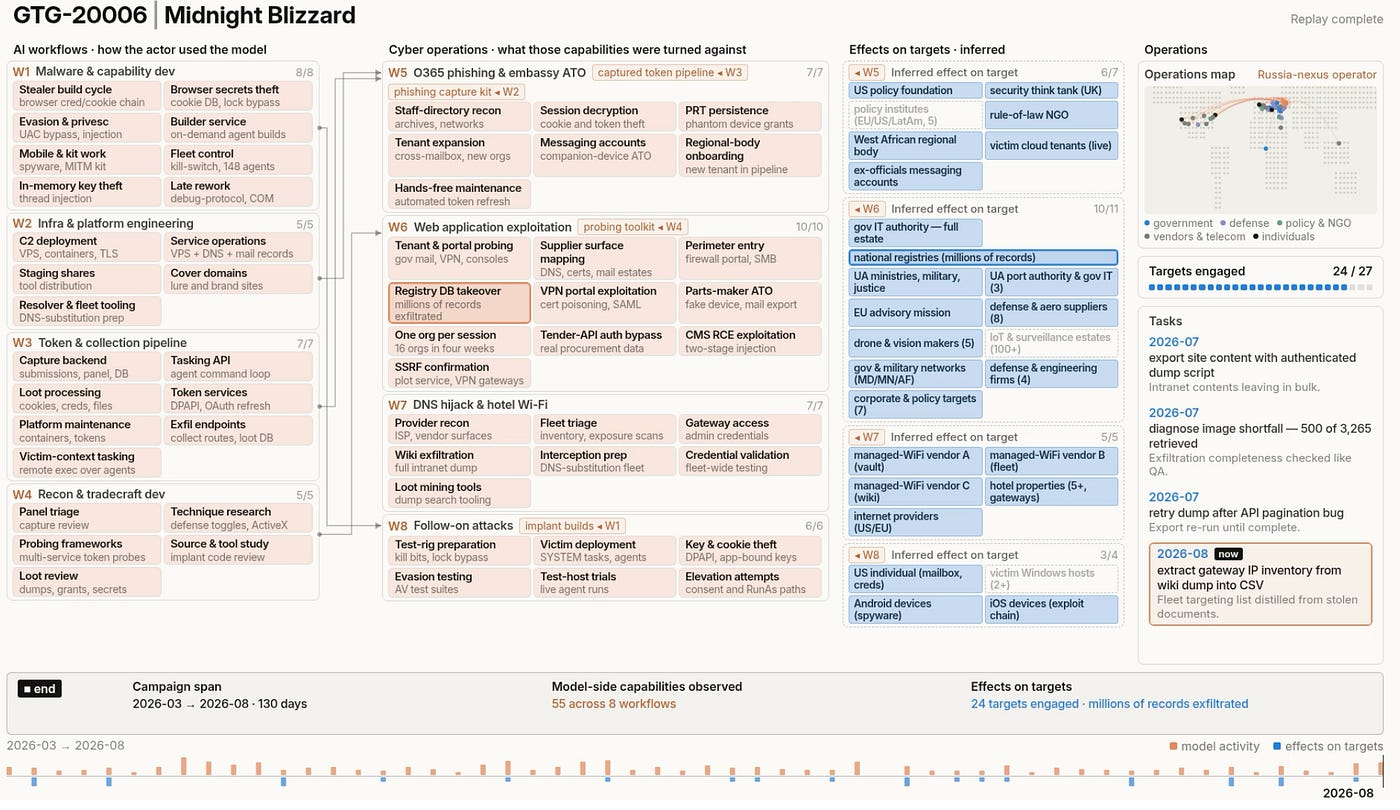
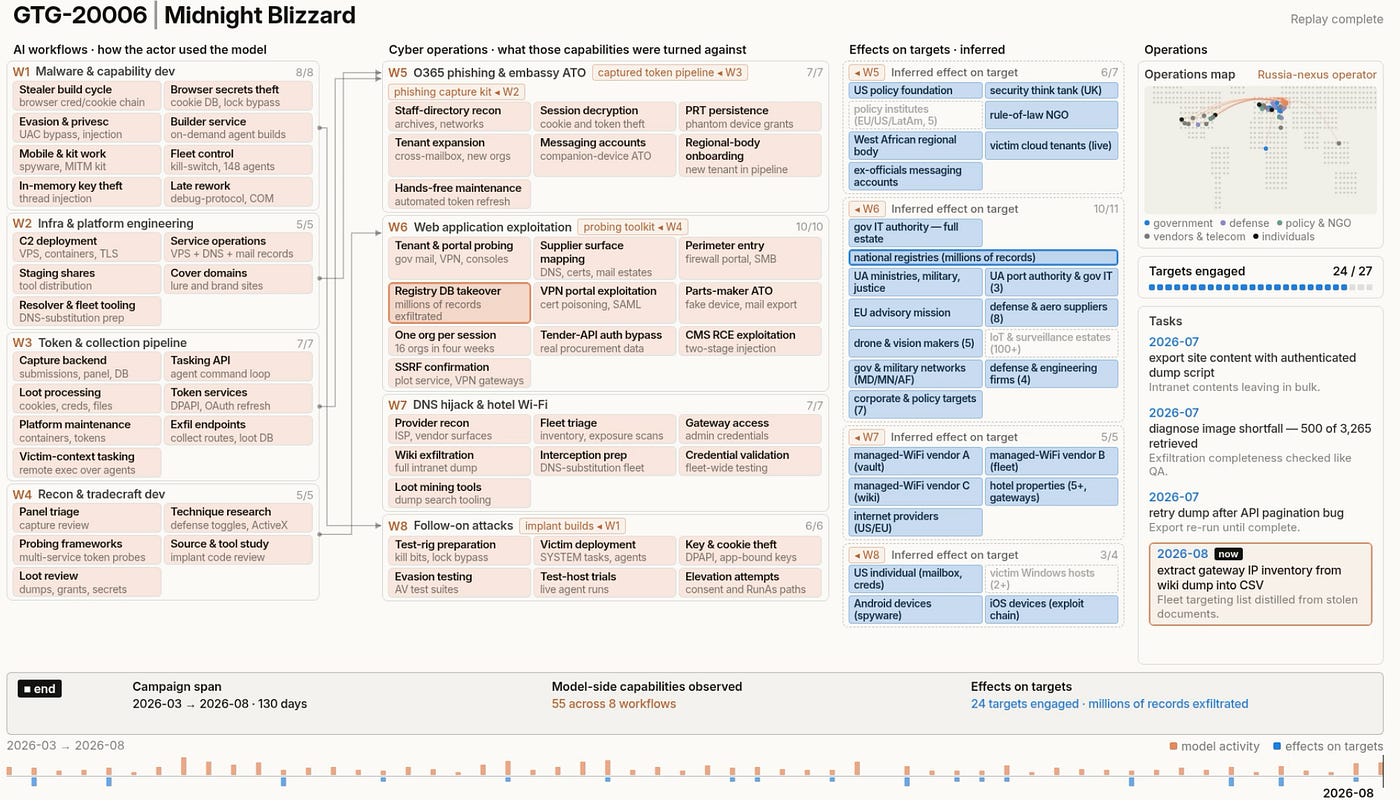
#B2Bhttps://www.generativeaipub.com/p/anthropics-new-ai-threat-report-is…more
Samsung's instinct when Apple announced the iPhone Duo foldable was exactly right. Capitalize on a competitor's weak moment. They've been selling foldables since 2019, Apple just joined — "Let us know when you're done reheating our leftovers" wrote itself.
The execution missed.
"Reheating our leftovers" reads like it was written by someone who is not in the room with the people they're trying to reach. Clever on paper. Doesn't land. The follow-up posts were more of the same — four tweets that felt like a brief was checked rather than a reaction that was felt.
What they should have done: an actor in a studio within 30 minutes of the announcement, filming a fake Apple keynote, making the whole thing so absurd that anyone holding an iPhone Duo felt the joke. Make it visual. Make it shareable. Make it something people forward into group chats. That's the move.
The brand banter playbook is not "post a witty line." It is "move faster than anyone expected, with something that genuinely makes people laugh rather than nod politely."
Whenever you have a moment to take market share from a competitor, you have to jump on it. Samsung knew the moment was there. They just didn't hit it hard enough.
For B2B brands watching competitor moves, the lesson is the same. It's not enough to react. You have to react in a way that makes the other side look like they're playing in your leftovers — not you.
https://rollingout.com/2026/09/10/samsung-trolls-apple-foldable-iphone-duo/#B2BMarketing#ContentStrategy…more
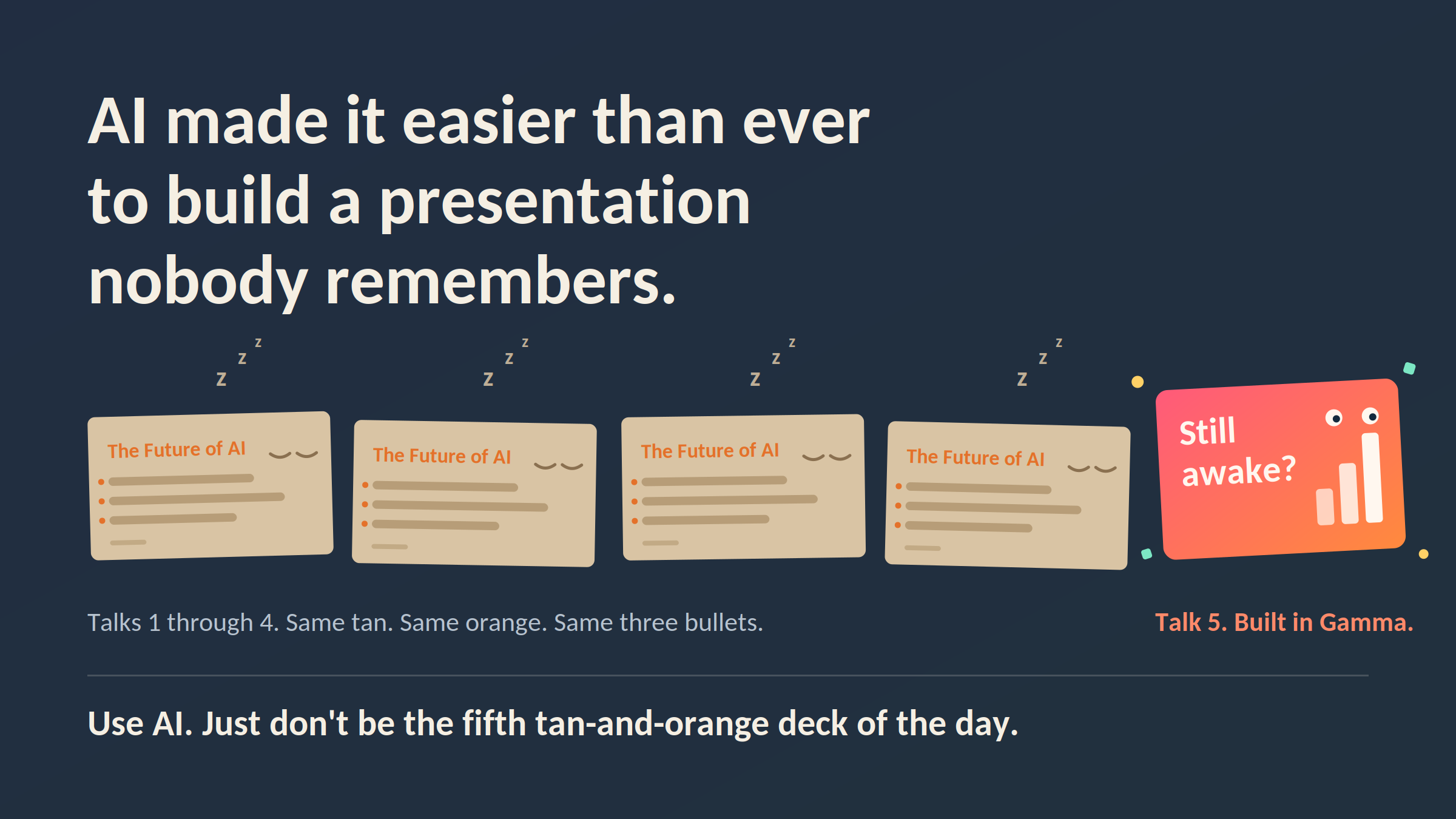
AI made it easier than ever to build a presentation nobody remembers.
I just got back from a major AI conference, and nearly every speaker walked in with the same deck.
Same tan background. Same orange headers. Same bolded phrases. Same three bullets nobody read.
By the third session, most of the room had stopped looking at the screen. The slides had become wallpaper.
Here's the thing. I've tested nearly every AI presentation tool on the market. The ones that spit out a deck in thirty seconds. The ones that promise "designer quality." The ones that look great in the demo and fall apart the moment you touch a slide.
Most of them produce exactly what I saw at that conference. Fast, generic, forgettable.
Gamma is the one I kept.
I can load my brand colors and fonts, save them, test different themes, and restyle the entire deck until it looks like something I actually made. Then I export to PowerPoint or Google Slides and keep moving. No fighting the tool. No settling for the first draft.
When you're presenting to a full room, a good chunk of the audience is already hunting for an excuse to check their phone. Your slides should hold their attention, not hand them the excuse.
If your deck looks like the four talks before yours, you won't stand out. You'll blend in.
Use AI. Just don't be the fifth tan-and-orange deck of the day. Pick a tool that was built for the job.
https://gamma.app#AIMarketing#Presentations…more
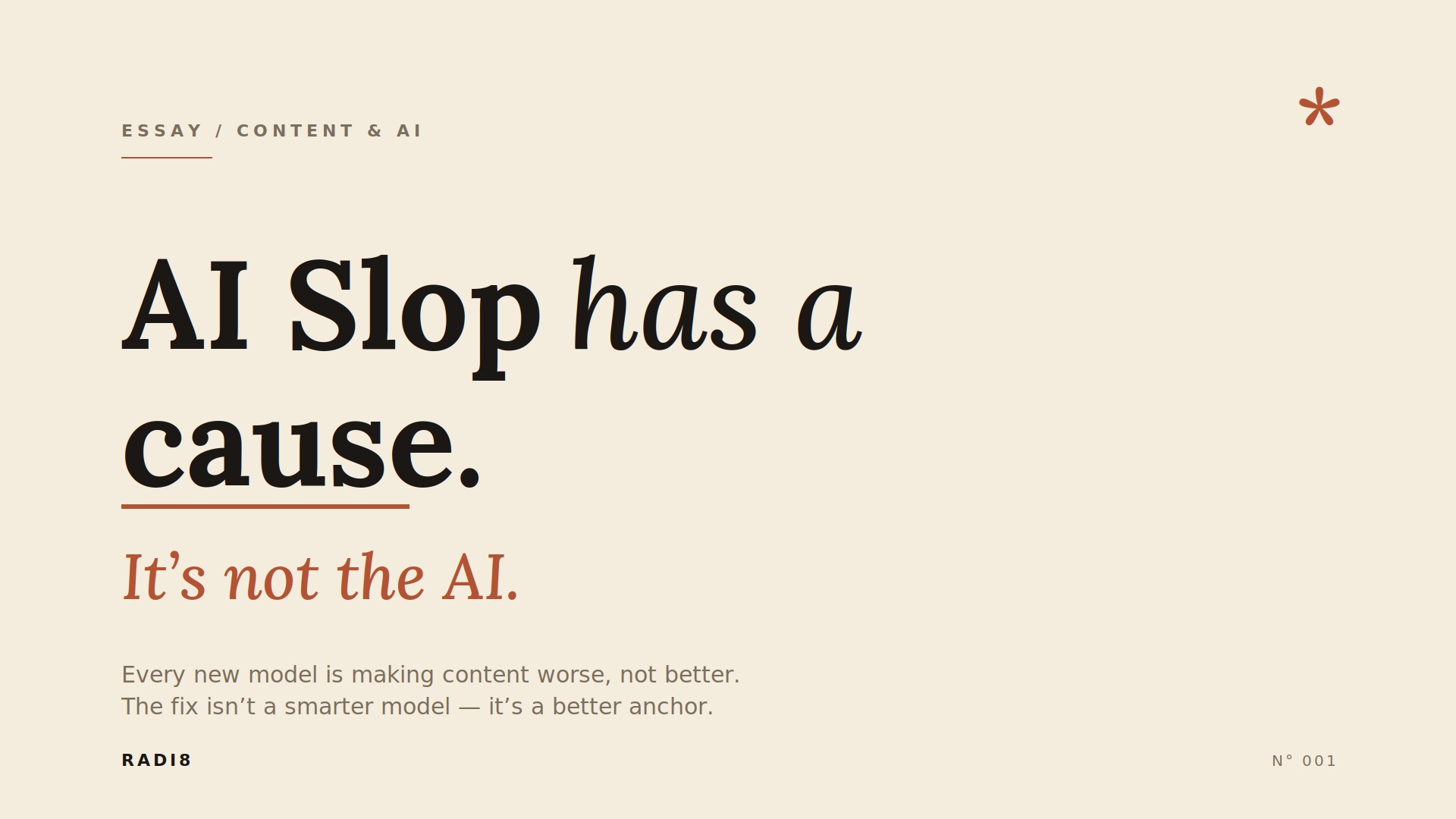
Every new AI content tool promises to save time and scale content production. Yet the feed keeps filling up with the same generic posts. You know the ones—vague insights, buzzwords stacked on buzzwords, nothing that actually sounds like it came from a human with specific experience.
The problem is not the AI. The problem is that most AI tools have nothing to anchor to.
When you feed prompts into a blank interface, the AI does exactly what it's designed to do: generate statistically probable language. It pulls from the aggregate of everything it's been trained on. That aggregate is safe, generic, and indistinguishable from the last 50 posts in your feed.
Brand context as the foundation changes this completely.
When AI has actual context to work from—your positioning, your voice principles, your proof points, the specific pains your audience faces—it stops producing slop. It starts producing content that reflects how you actually think and communicate. Content that carries your credibility instead of diluting it.
I've seen this across multiple enterprise tech companies. The marketers who win are not the ones using AI as a shortcut. They're the ones who build the right inputs first. They document what makes their brand distinct. They define voice principles that reflect real experience, not aspirational marketing speak. Then they use AI to scale that foundation, not replace it.
If your AI-generated content feels generic, ask yourself: what context did I give it? A one-off prompt in a chat window, or a documented system that captures how your brand actually shows up?
The tools matter less than the setup. Start with brand context. Everything else gets easier from there.
Want a fresh take on your B2B content strategy? DM me and let's schedule a 30-minute consultation—I'll show you 3 things you can improve this week.
https://www.radi8.com/blog/ai-slop-has-a-cause-its-not-the-ai…more
Most AI failures aren't model failures. They're context failures.
The AI doesn't know you or what good looks like. It produces the internet's average.
Better context beats a better model.
Doer to architect. That's the shift. https://buildingasecondbrain.com/ai-second-brain#AIMarketing#B2B
Today's post is 312 words, a 2-minute read.
Sources: Forte Labs — "From Doer to Architect"
1 big thing: What just changed in how B2B marketers should use AI?
Most AI underperformance is not a model problem. It is a context problem.
Why it matters: B2B marketers investing in AI tooling without investing in context architecture are scaling mediocrity. The output is only as good as what you give it to work from.
Driving the news:
Recent research shows LLMs begin to fail when their context window hits 30–40% capacity — a phenomenon called "context rot."
→ AI starts missing connections, forgetting key details, and producing generic output
→ The fix is not a better model. It is curated, modular context built deliberately over time
Zoom in:
Tiago Forte calls the required mindset shift going from "doer to architect" — you stop executing tasks and start designing the systems that execute them.
→ For B2B marketers, that means documented voice principles, structured brand inputs, and defined quality standards your AI collaborators can actually use
Yes, but: Building context architecture takes real upfront investment. Most marketing teams are under enough pressure that "documenting how we think" never makes the sprint.
Be smart: Start with a Master Prompt — one document that tells your AI who you are, how you work, and what good looks like. That single input closes more of the quality gap than any model upgrade.
The bottom line: The marketers pulling ahead are not using better AI. They are giving their AI better inputs.
https://buildingasecondbrain.com/ai-second-brain#AIMarketing#B2BMarketing
Founder at Radi8 // Executive Coach // Host of the Inspiring Founders Podcast
· X
·
Most founders are more compelling in conversation than they are in writing.
Why?
Because when they write, they try to sound professional.
When they talk, they sound human.
Your audience wants the second version. …more
Founder at Radi8 // Executive Coach // Host of the Inspiring Founders Podcast
· LinkedIn
·
A lot of founders ask me how I use Claude and Radi8 together. Here's the honest answer: I don't really "use Claude" anymore. Not the way most people think.
I don't write prompts. I don't paste in context. I don't explain my audience or my voice or my offers every time I sit down to create content.
Radi8 handles all of that.
My brand context, my strategy, my campaign plan, my voice, my proof points — it's all stored in Radi8. When Claude works inside Radi8, it already knows everything it needs to know. It's not starting from scratch. It's starting from me.
The workflow:
1. Open Radi8 and pull up my campaign plan for the month
2. Pick the piece of content I'm working on — the brief is already there
3. Generate — Claude writes from my brief, my brand, my voice
4. One quick edit pass, maybe 5 minutes
5. Schedule
That's it. No prompt engineering. No re-explaining yourself every session. No output that sounds like it could have come from anyone.
The insight most people miss about AI content tools: the problem was never the AI. It was the setup. When the AI knows your business as well as you do, it stops feeling like a tool and starts feeling like a collaborator.
That's what I built Radi8 to do.
DM me "workflow" and I'll show you how it works. …more
Most people think AI content sounds generic because AI isn't good enough.
Wrong.
AI sounds generic because you're giving it generic context.
The quality of the output is usually a reflection of the quality of the input.
Context > prompts.
After 25+ years building and exiting startups, I've noticed a pattern.
The founders who stay visible and grow aren't spending more time on marketing. They've built better systems and made better strategic decisions.
Here's something most people miss about AI marketing tools: the output quality has nothing to do with the tool and everything to do with the input.
If you paste a blank prompt into Claude and ask it to write a LinkedIn post, you'll get something generic. That's not an AI problem. That's a context problem.
What changed for me was building my brand context into Radi8 first — my audience, my voice, my offers, what I never say. Now when I generate content, it sounds like I wrote it. Because in a real sense, I did. I just did it once, systematically, instead of re-explaining myself every time.
The lesson isn't "use AI."
It's that better tools rarely fix a strategy problem.
Whether it's AI, marketing, sales, or customer acquisition, the quality of the outcome is usually constrained by the quality of the thinking that comes before it.
How much context are you giving AI before you ask it to create content?
Founder at Radi8 // Executive Coach // Host of the Inspiring Founders Podcast
· LinkedIn
·
We just released Radi8 with Claude.
If you already use Claude for writing or research, you can now run your entire social media workflow without leaving the chat.
Create posts. Generate images. Schedule. Publish. All through Claude Code.
Most small business owners I talk to don't want to spend hours switching between tools or staring at social platforms. You know you need to stay visible with prospects and customers, but the process takes time you don't have.
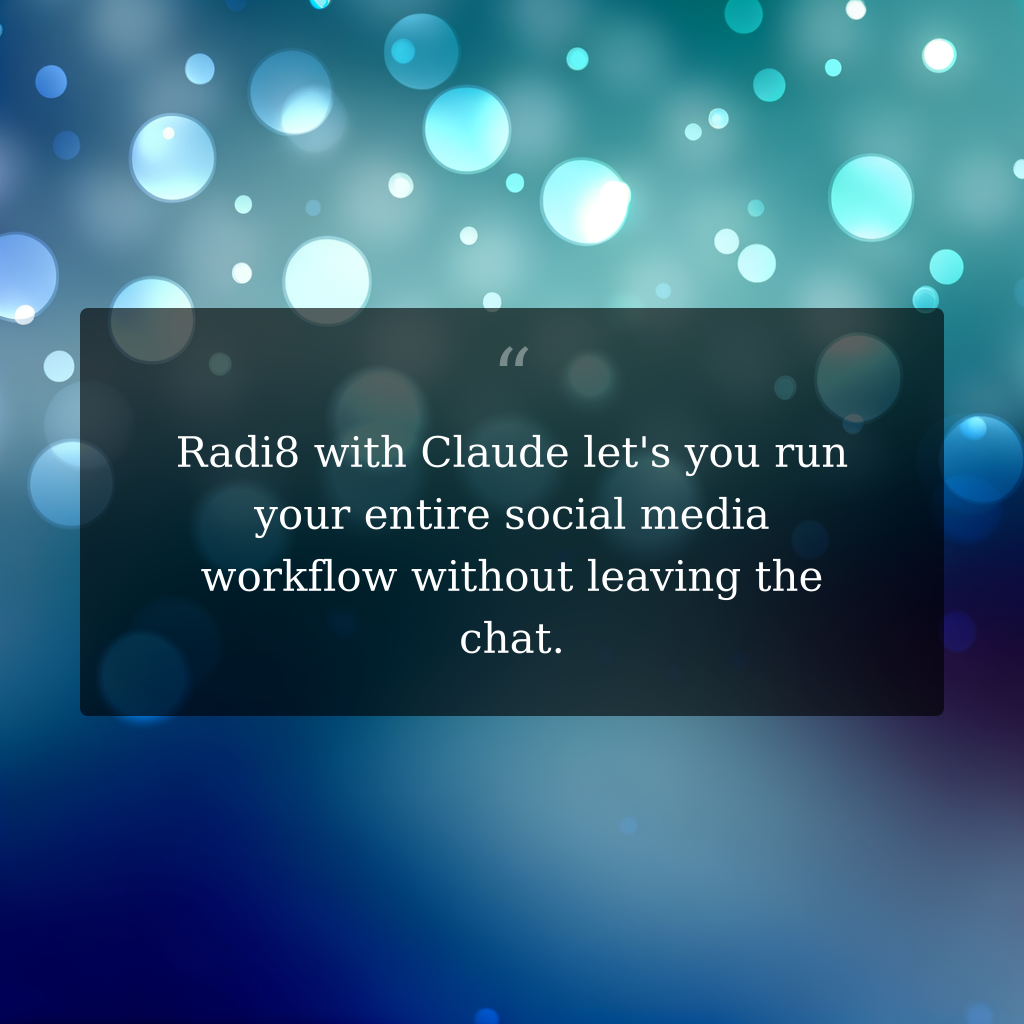
Radi8 with Claude let's you run your entire social media workflow without leaving the chat.
Connect Radi8 to your own Claude instance. From there, ask Claude to draft a post, create supporting visuals, and schedule it to go live. The entire workflow happens in one conversation.
No separate design tool. No separate scheduler. No context-switching your way through content creation.
If you're already paying for Claude and handling your own marketing, this is the simplest way to stay consistent without living on social media.
Radi8 with Claude is live now. Want to see how it fits into your workflow? Send me a message and I'll walk you through it. …more
Just shipped something I'm really excited about.
The Radi8 MCP Connector is now live for Claude users. 🎉
What that means for you:
→ Connect Radi8 to Claude once
→ Claude gets access to your brand, strategy, content plan, and image generation tools
→ Ask Claude to write and schedule a post — it handles it, in your voice, aligned to your strategy
No more jumping between tools. No more losing your brand voice in AI-generated content.
Want to get set up? DM me or book a free audit at radi8.com/free-audit and I'll walk you through everything.
Three tools. One chat. Zero tabs.
Here's what I just did in Claude in about 3 minutes:
→ Asked Claude to design a LinkedIn graphic in Canva
→ Picked my favorite option
→ Had Claude write the copy using my brand voice from Radi8
→ Scheduled the post to LinkedIn — all in one conversation
This is the post you're reading right now.
If you're a small business owner or founder doing your own marketing, this is the kind of workflow that actually saves you hours a week. No switching between tools. No "I'll finish it tomorrow."
Comment "workflow" and I'll send you the setup.
Most small business owners don't have time to figure out AI tools — let alone connect them to their marketing stack.
That's exactly why we built Radi8-with-Claude AI.
Here's what it means practically: instead of jumping between tools, writing from scratch, or staring at a blank content calendar, you can now work with Radi8 directly inside ChatGPT or Claude AI — pulling your brand context, your content plan, and your strategy into every post you create.
No prompt engineering. No copy-pasting. Just a faster, more consistent way to create content that actually sounds like you.
If you're a founder or small business owner doing your own marketing and you want to see how this works for your business — DM me and I'll walk you through it.
I'm doing a live demo right now — and the demo *is* the post.
Inside a Claude chat, I pulled my Radi8 brand context (voice, audience, pillars), drafted this post in my tone, and spun up a Canva graphic to match. All in one window. No tab-switching. No copy-paste relay race.
This is what "handle your own marketing without living on social media" actually looks like in 2026:
→ Radi8 knows your brand, audience, and strategy
→ Claude drafts in your voice using that context
→ Canva designs the visual without leaving the chat
→ You review, tweak, publish
The whole thing — idea to scheduled post — in the time it used to take to find the right stock photo.
Small business owners and founders: this is the unlock. You don't need a marketing team. You need the right stack talking to each other.
Want to see it run on your brand? Book a free 15-minute audit — link in comments. Or just DM me and I'll walk you through it.
I'm doing a live demo right now — and the demo *is* the post.
Inside a Claude chat, I pulled my Radi8 brand context (voice, audience, pillars), drafted this post in my tone, and spun up a Canva graphic to match. All in one window. No tab-switching. No copy-paste relay race.
This is what "handle your own marketing without living on social media" actually looks like in 2026:
→ Radi8 knows your brand, audience, and strategy
→ Claude drafts in your voice using that context
→ Canva designs the visual without leaving the chat
→ You review, tweak, publish
The whole thing — idea to scheduled post — in the time it used to take to find the right stock photo.
Small business owners and founders: this is the unlock. You don't need a marketing team. You need the right stack talking to each other.
Want to see it run on your brand? Book a free 15-minute audit — link in comments. Or just DM me and I'll walk you through it.
Founder at Radi8 // Executive Coach // Host of the Inspiring Founders Podcast
· LinkedIn
·
Marketers are hitting an AI content wall. Feeds are full of generic, unoriginal posts and attention is eroding. The only way to break through is deep brand context.
I’ve been building a comprehensive brand context engine into Radi8 to make sure the content you create is authentic and aligned with your actual brand.
I’m running pilots with small marketing teams right now. If you’re interested in boosting your content marketing outcomes, send me a message. #contentstrategy…more


 View on LinkedIn
Also on
View on LinkedIn
Also on