The State of AI Report 2026 dropped this week. 244 slides. Here's what actually matters for anyone building with AI right now.
OpenAI and Anthropic combined revenue hit ~$105B run rate by August 2026. Up from ~$30B in January. That's not hype, that's adoption.
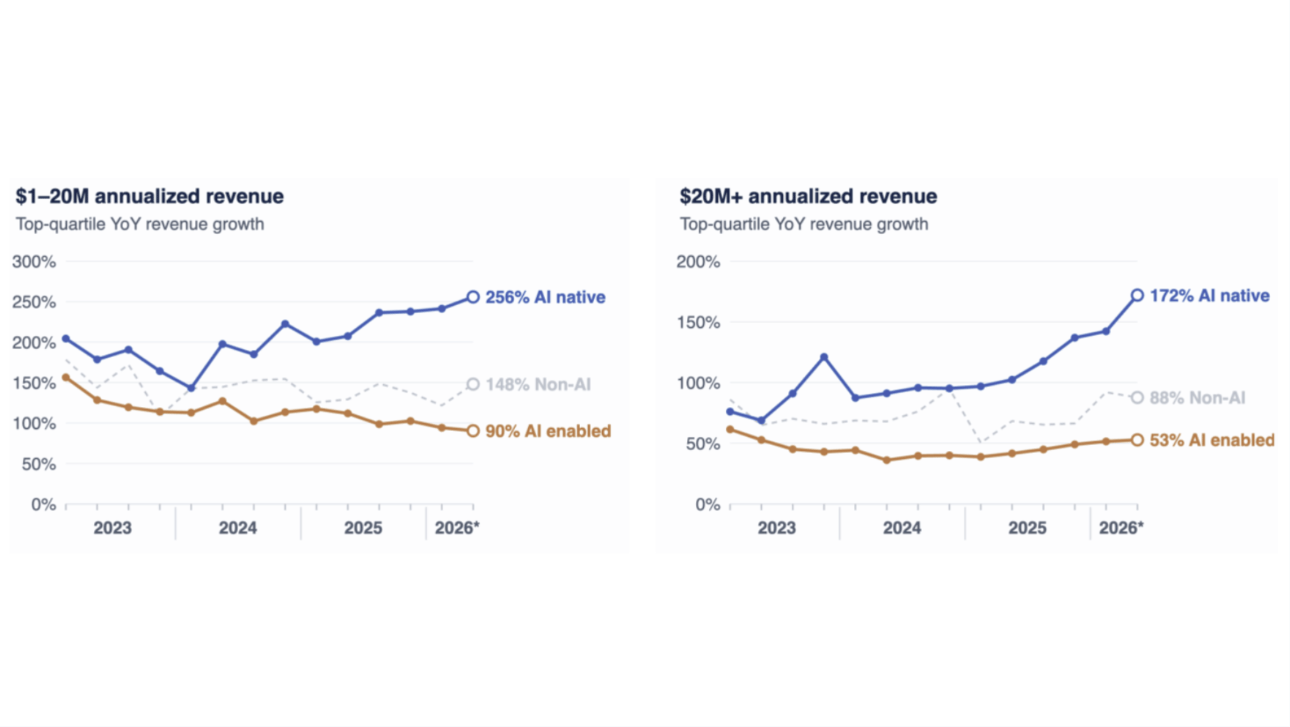
Top-quartile AI-native companies with $20M+ in revenue grew at 172% per year. Companies adding AI to existing software: 53%. The gap between building AI-native versus bolting AI on is already measurable in growth rates.
The cost to reach a given level of AI performance has halved every quarter since 2023. It's now about 13x cheaper per year than it was.
Here's the one that should change how you think about competitive advantage: better tools, context, and feedback lifted one model's success rate on coding tasks from 52.5% to 65.5% without changing the model at all.
The model is increasingly commoditized. Everyone can rent the same frontier capability. The advantage is the scaffolding you build around it. That's the part competitors can't easily copy. …more
State of AI 2026: better tools, context and feedback lifted a model's coding success from 52.5% to 65.5% without changing the model.
The model is commoditized. Everyone rents the same frontier capability.
The advantage is the scaffolding around it.
https://www.stateof.ai/State-of-AI-Report-2026.pdf
Lex Fridman asked who's winning the AI race.
Sebastian Raschka: no company has exclusive access to any technology.
The moat isn't the model. It's how fast you build before competitors do.
Models converge. Implementation gaps widen.
https://www.youtube.com/watch?v=dGqhTpsu_5Y#AIStrategy…more
Jensen Huang gave the AI buildout its cleanest definition yet: "We now need a new type of infrastructure — an AI factory. Energy comes in; intelligence comes out."
His math is the part worth sitting with. Out of a $100 trillion economy, roughly $15 trillion is work that would benefit from more intelligence. Every company will tap into it. That's the real reason data centers are going up everywhere — not hype, but demand for a raw material almost every business now wants.
Here's the shift for those of us marketing complex technical products.
For years we sold intelligence as a scarce, premium thing. Something you bought carefully, deployed slowly, and defended in the budget. Huang is describing a world where intelligence behaves more like electricity — a utility you plug into, metered and abundant.
When the input gets commoditized, the story can't be "we have the smart thing." Everyone will have the smart thing.
The differentiation moves to judgment: what problem you point that intelligence at, how well you understand the human on the other end of it, and whether you can explain — in plain language — why it matters to their work this quarter.
The factory produces intelligence. It doesn't decide what's worth building. That part is still ours.
Want a fresh take on your B2B content strategy? DM me and let's schedule a 30-minute consultation — I'll show you 3 things you can improve this week.
#B2BMarketing#AIStrategy…more


 View on LinkedIn
Also on
 View on X