The Multilingual Mind helps schools and education teams close the gap between what they know they want to do and what their people actually have the time, training, tools, systems, and support to impl
· LinkedIn
·
More feedback is not always more support.
A teacher can receive five completely reasonable pieces of feedback and still leave less clear about what to do next.
Especially if those five things come from different people, point in different directions, or all quietly become "urgent."
That is where feedback becomes a cognitive-load problem.
What is the highest-leverage thing to work on first?
What can wait?
What are we reinforcing across coaching and evaluation?
What will we actually look for next time?
If we want implementation, the goal is not to prove how many things we noticed.
The goal is to help someone know what to practice next, try it, get feedback, and build from there.
How does your team keep feedback coherent instead of simply adding more of it? …more
The Multilingual Mind helps schools and education teams close the gap between what they know they want to do and what their people actually have the time, training, tools, systems, and support to impl
· Facebook
·
I was thinking today about how different the exact same training feels depending on who you are when you walk into the room.
I remember being brand-new and sitting in beginning-of-year PD with about seventeen tabs open in my brain.
What do I need to turn in?
Where do people get the materials?
Who do I ask?
Am I supposed to know this already?
Who do I sit next to?
Why does everyone else look like they know what’s happening? 😂
And then years later, I’ve been the person sitting in almost the same kind of training, but now I already know the vocabulary, I know what questions to ask, I know which things are probably important later, and I can fill in the gaps.
Same room. Totally different experience.
It made me realize how much easier learning gets when you already know enough to know what you don’t know. …more
The Multilingual Mind helps schools and education teams close the gap between what they know they want to do and what their people actually have the time, training, tools, systems, and support to impl
· LinkedIn
·
Sometimes the most useful intervention is waiting long enough to actually see what is happening.
Observation is one of the Montessori ideas I keep carrying into coaching too.
Adults can be very quick to step in because something looks inefficient, imperfect, uncomfortable, or simply different from what we expected.
But if I intervene before I understand what I am seeing, I may solve the wrong problem.
What happens if I watch for another moment?
What is the child already trying?
What is the teacher noticing?
What changes without my help?
Observation is not passivity. It is information gathering.
And then, when intervention is actually needed, we have a much better chance of choosing one that fits.
What helps you decide when to step in and when to keep watching? …more
The Multilingual Mind helps schools and education teams close the gap between what they know they want to do and what their people actually have the time, training, tools, systems, and support to impl
· X
·
Before planning a PLC, I'd ask who wanted it.
Teachers? Leadership? Someone responding to a resource they read?
That answer changes the invitation, the agenda, and even whether a new meeting is useful.
I'd want to know before picking a framework. …more
The Multilingual Mind helps schools and education teams close the gap between what they know they want to do and what their people actually have the time, training, tools, systems, and support to impl
· LinkedIn
·
An instructional coach, one year into the role, might ask:
“I've been coaching the same teacher for six weeks and I can see her understanding improving in our conversations, but when I visit her classroom, almost none of it shows up. What's the gap I'm missing?”
My first response would be: before deciding there is a gap, make sure there really is one.
Start by naming what I see.
“I can tell your understanding of this has really grown in our conversations. Are you noticing changes in your actual practice too?”
Because maybe they are. Maybe it is happening at a different time of day.
Maybe I keep observing during the same twenty-minute window and I am missing it.
Maybe the growth is smaller than what I was hoping to see, so I am unconsciously filtering for the finished version and overlooking the early version.
Maybe I am carrying pressure from somewhere else about what this teacher “should” be doing by now, and that expectation is shaping what I notice.
Before I decide the learning has not transferred, I need more data.
And I want the teacher’s interpretation too.
Do they think it is showing up?
Where?
When?
What feels easier now?
What still feels hard?
Do they already know what is getting in the way?
Because people vary enormously in their ability to reflect on their own practice, make sense of new learning, and translate understanding into action.
Some people need a long processing runway before implementation.
Some can implement quickly but struggle with consistenct.
Some understand exactly what to do but freeze when the real classroom gets noisy, unpredictable, emotionally charged, or overloaded.
Sometimes the barrier is not the teacher at all.
Maybe I have been too theoretical.
Maybe they need concrete examples.
Maybe we need to role-play it.
Maybe they need to see me do it with their actual students.
Maybe the classroom routine itself needs to change to make the new practice possible.
Maybe another adult in the room needs clearer responsibilities.
Maybe the teacher is carrying so much cognitive and physical load that there simply is not enough capacity left to add something new consistently.
There are so many possibilities.
That's why I get nervous when we move quickly from:
“I’m not seeing it”
to
“They aren’t implementing.”
Those are not necessarily the same thing.
Even when we determine that the change genuinely is not happening, I still want to ask:
What is blocking the flow?
Is it mental?
Emotional?
Practical?
Structural?
Relational?
A lack of modeling?
A lack of practice?
A lack of time?
A lack of support?
Sometimes growth is already there, but it is coming through as a trickle when we hoped for a river.
My job as a coach is not to stand downstream asking why there is not more water.
I need to look upstream.
Where is the dam?
And once we find it, what can we move, redesign, practice, clarify, or support so that the learning has somewhere to go?
That is the real work of implementation. …more
Something I keep thinking about after writing about professional development:
How many things in schools get treated as “we already taught that” when what actually happened was “we already said that”?
Those are not always the same thing.
Sometimes people need the reminder.
Sometimes they need an example.
Sometimes they need someone next to them while they try it.
Sometimes they need to come back to the idea three weeks later, after they have enough real experience for the question to make sense.
I am becoming much more interested in the gap between hearing something and being able to use it consistently.
What is something you learned professionally that only really clicked once you had a chance to try it?
“We told them four times.”
Maybe.
But repetition is not necessarily reteaching.
The same message can appear in an email, a staff meeting, a weekly brief, and a slide deck without anyone becoming more capable of doing the thing.
Sometimes repetition is exactly what helps.
But sometimes people do not need to hear the words again.
They need to see an example.
Try it.
Ask a question.
Make a mistake.
Get feedback.
See how someone else handled the same situation.
Or return to the idea after enough time has passed for them to realize what they did not understand the first time.
There is a difference between repeating information and revisiting learning.
I think schools need both.
But they are not interchangeable.
A teacher tells you they're having trouble getting a child started on independent work.
Is that a training problem?
Maybe. But I don't know that yet.
I might watch what happens, talk it through with the teacher, and practice a response together:
“I see you haven't started yet. Show me where you're stuck.”
We can rehearse the words, the tone, the pause, and what happens next. Then the teacher can try it and we can reflect on what actually happened.
But what if the directions weren't clear? What if the materials weren't ready? What if the teacher has two other responsibilities at exactly that moment?
More practice with the sentence won't fix those problems.
This is why I don't like prescribing PD before I understand what people are trying to do and what keeps getting in the way. Sometimes it's a skill. Sometimes it's time, clarity, tools, or an agreement that hasn't been made. Often it's more than one thing.
And if we do coach the skill, I'd want follow-up that helps the teacher develop, not another score attached to a single moment.
When something isn't improving after another training, what are we missing about the actual work?
The Multilingual Mind helps schools and education teams close the gap between what they know they want to do and what their people actually have the time, training, tools, systems, and support to impl
· LinkedIn
·
What genuinely has to be mastered before the first day of school?
I think we sometimes treat “important” and “must be fully learned before students arrive” as though they mean the same thing.
They do not.
Before Day 1, people absolutely need enough clarity for the school to be safe, functional, and coherent.
But not every instructional practice, curriculum feature, communication routine, or schoolwide initiative needs to become mastery during the same August window.
Some things need to be known now.
Some need to be searchable.
Some need to be practiced.
Some will make much more sense after teachers have actual students, actual questions, and actual friction to attach the learning to.
I keep thinking about the idea of minimum viable readiness:
What must be functional now?
What can be introduced now and deepened later?
What should wait until there is enough context for the learning to mean something?
That feels like a much more humane and useful planning question than “How much can we fit into pre-service week?” …more
The Multilingual Mind helps schools and education teams close the gap between what they know they want to do and what their people actually have the time, training, tools, systems, and support to impl
· LinkedIn
·
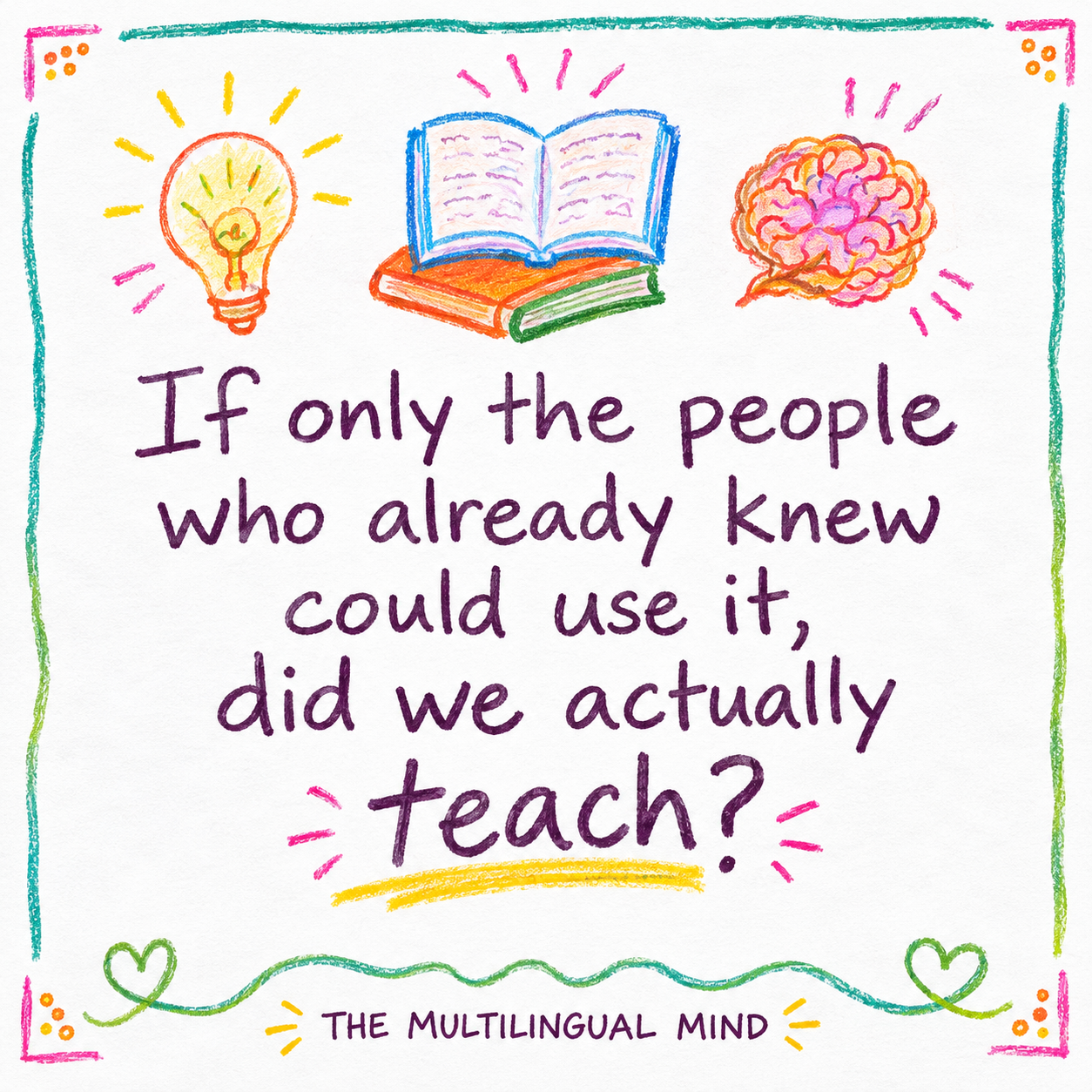
A professional development session can look successful because the strongest, most experienced people in the room know what to do with it.
But that can hide a design problem.
If the people who already had the background knowledge, confidence, vocabulary, or prior training were the only ones able to translate the session into practice...
what exactly did the training accomplish?
Sometimes the people who appear to have “learned fastest” were actually filling in gaps from years of previous experience.
That is not a criticism of them.
It is a question about the learning design.
Did the training make the practice accessible?
Or did it work because some people already knew enough to compensate for what was missing?
I think that distinction matters whenever we evaluate professional learning by looking only at who succeeded afterward. …more
The Multilingual Mind helps schools and education teams close the gap between what they know they want to do and what their people actually have the time, training, tools, systems, and support to impl
· LinkedIn
·
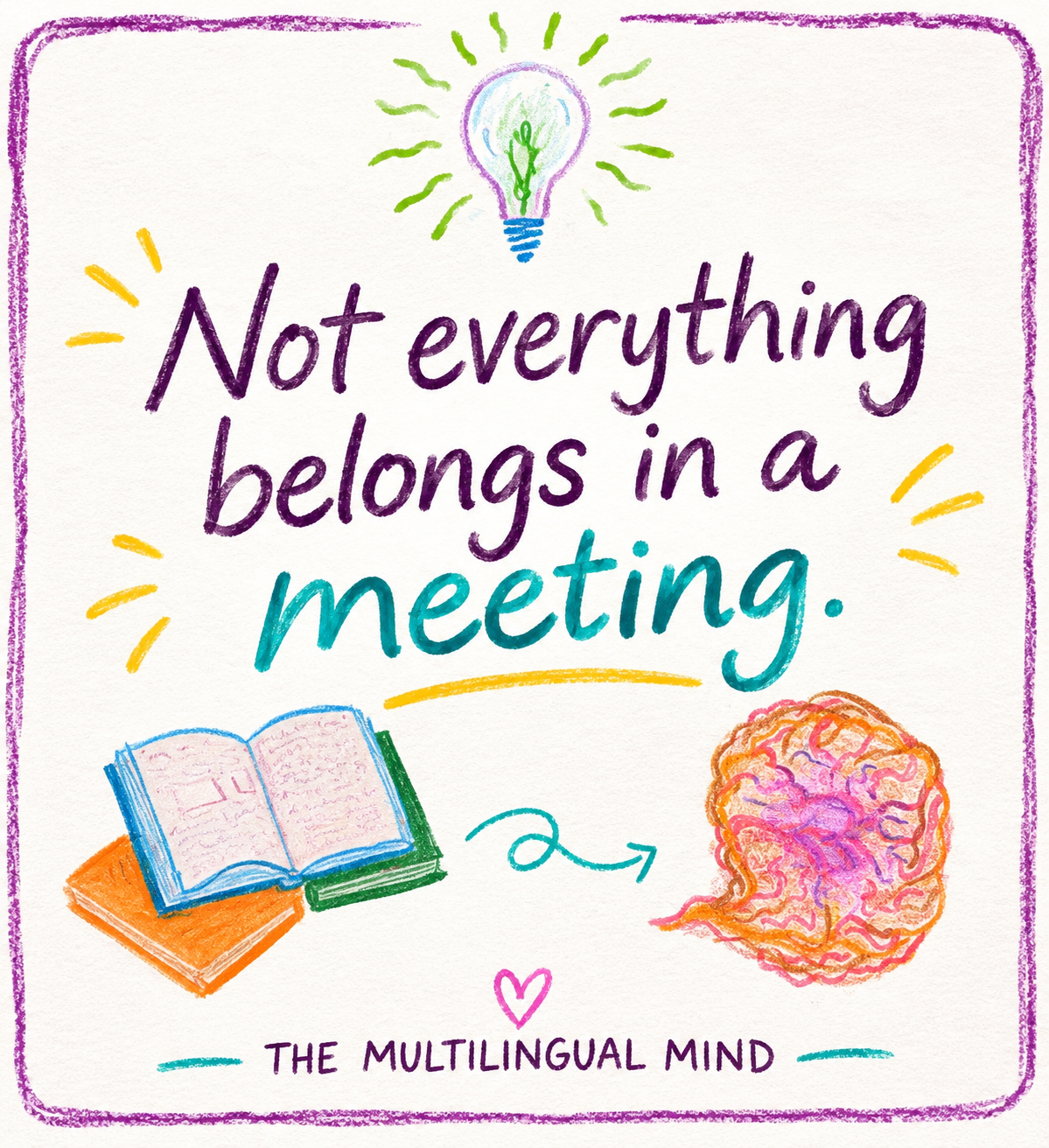
Not everything people need to know belongs in a meeting.
Some things are reference information.
Some things require discussion.
Some things require rehearsal.
Some things require coordination.
Some things require feedback after we have actually tried them.
But schools often use the same container for all of them: a meeting.
That can make the calendar look efficient while the learning itself becomes much less efficient.
If I need to know where a form lives, I probably need something searchable.
If I need to learn how to respond to a dysregulated child, I probably need modeling, practice, feedback, and another chance to try.
If two adults need to coordinate responsibility, they probably need clarity about who owns what and what happens when the plan changes.
Those are very different learning needs.
One question I am trying to ask more often is:
What kind of learning does this actually require?
Because once we know that, we can choose a better container for it. …more
The Multilingual Mind helps schools and education teams close the gap between what they know they want to do and what their people actually have the time, training, tools, systems, and support to impl
· LinkedIn
·
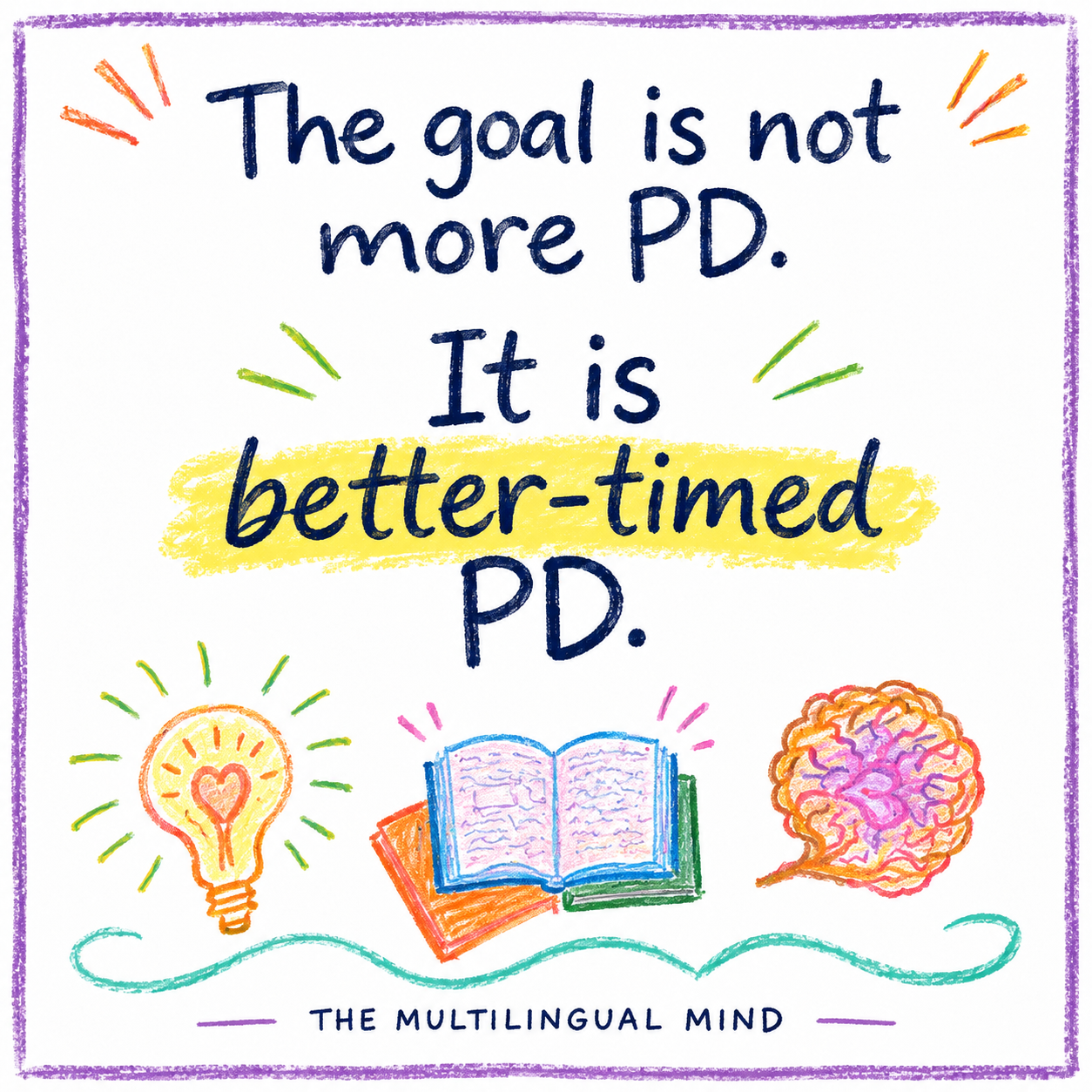
I do not think schools necessarily need more professional development.
I think we often need better-timed professional development.
There are things that make almost no sense in August because teachers have not yet encountered the problem the training is supposed to help them solve.
Then three weeks later, the same idea could land completely differently.
Now there is a student in mind.
A routine that is breaking down.
A curriculum question.
A team tension.
A real example.
The teacher has something to attach the learning to.
So instead of trying to front-load everything, what if some professional learning intentionally followed this rhythm?
Introduce.
Try.
Notice.
Return.
Model.
Practice.
Get feedback.
Adjust.
Try again.
The goal is not to stretch PD endlessly across the year.
It is to place learning closer to the moments when people can actually use it. …more
The Multilingual Mind helps schools and education teams close the gap between what they know they want to do and what their people actually have the time, training, tools, systems, and support to impl
· Instagram
·
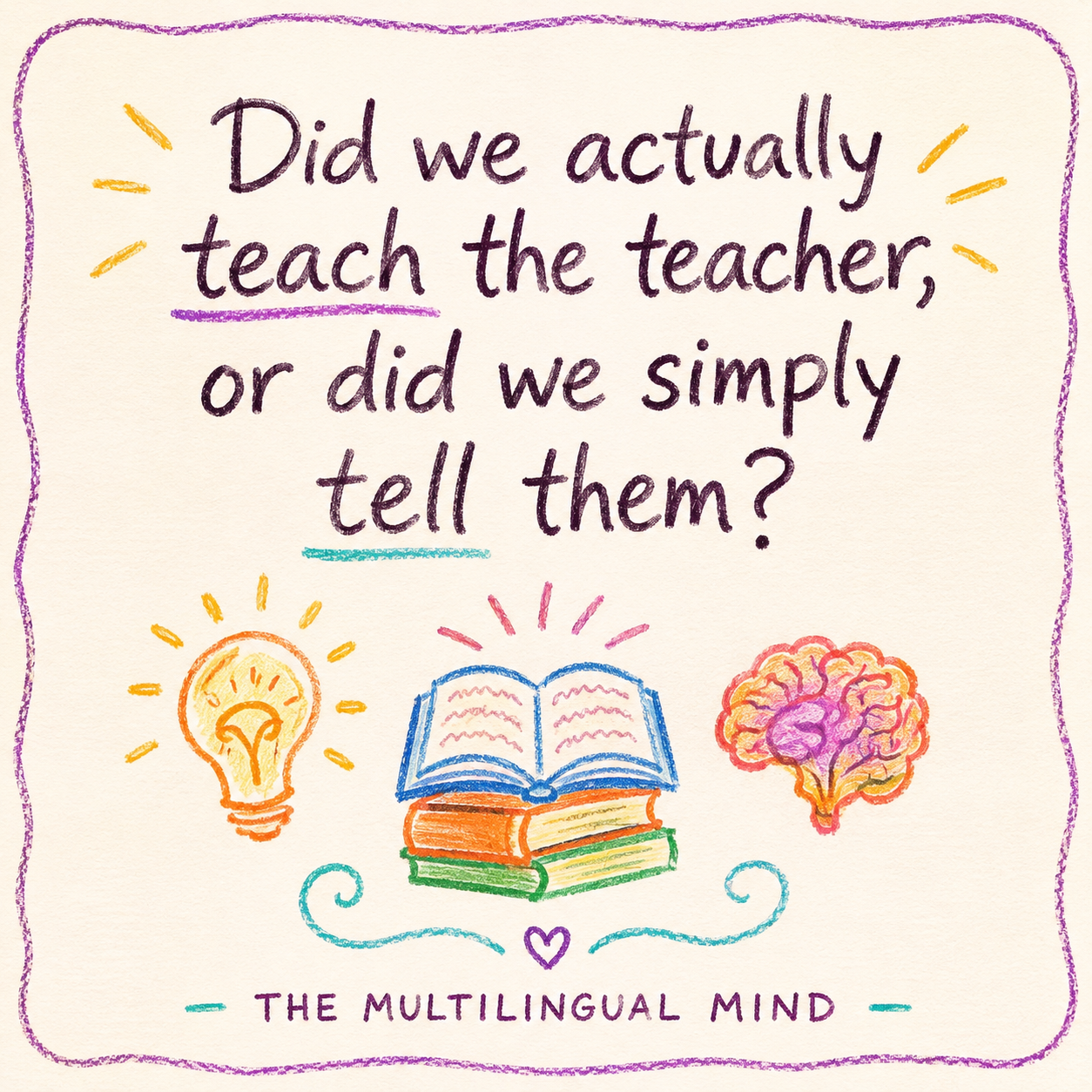
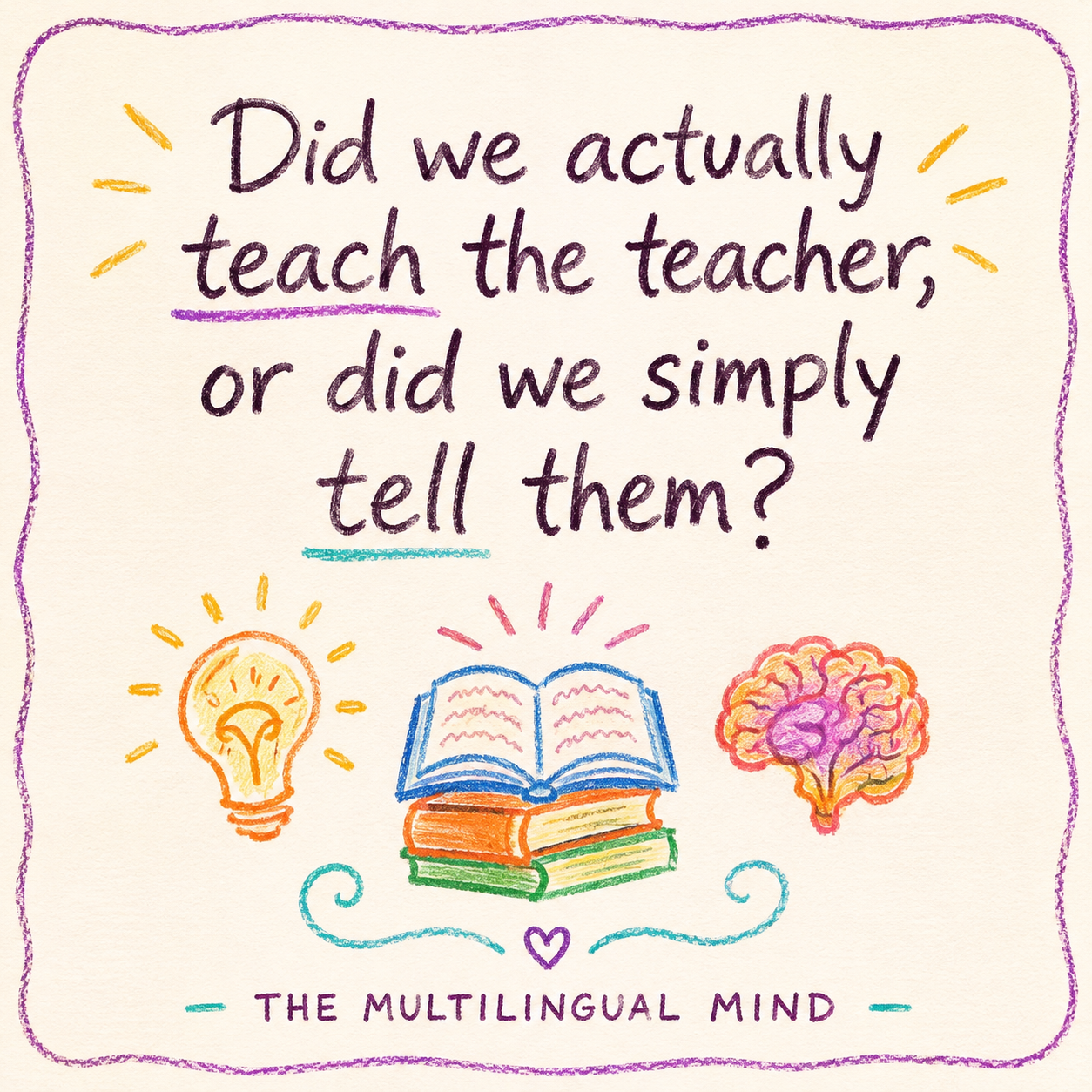
Did we actually teach the teacher,
or did we simply tell them?
Professional learning does not end when the presentation ends.
Understanding, practice, feedback, reflection, and another chance to try are part of the learning too.
New on The Multilingual Mind.
#ProfessionalLearning#TeacherDevelopment#InstructionalCoaching#AdultLearning#TheMultilingualMind…more
The Multilingual Mind helps schools and education teams close the gap between what they know they want to do and what their people actually have the time, training, tools, systems, and support to impl
· LinkedIn
·
A coach who has spent years working one-on-one gets handed group facilitation, and almost immediately the worry starts: do I actually know how to facilitate a PLC? Do I have the right skills for this?
It is an understandable question. It is also, usually, the wrong one to ask first.
Because the coach already knows how to have a good conversation. That part is not missing. What is missing is information. Before learning a single framework, the more useful move is to find out the parameters and what this PLC is actually for. Where did the idea come from in the first place? Was it an ask from teachers? A suggestion from a resource? Does the principal have an intended goal, or an interest in how it should be used? Was there a theme, topic, or setup they were hoping the coach would run with?
There are plenty of frameworks for starting and leading PLCs, across all kinds of topics in the field. So the coach is not starting from nothing. But knowing which framework fits, or whether one is even needed, depends on knowing the context first. The technical how-to is not the beginning of the work.
And here is the piece most likely to get skipped. Before anything else, it is worth knowing whether this PLC is going to add unnecessary burden onto teachers and onto the coach, or whether it is something teachers actually want and need and will want to engage in. That distinction changes everything. If it is something that comes from or is wanted by the teachers, the coach can channel that WITHness into the spirit and planning and logistics.
There is a practical version of this too. If time is already protected and interest already exists, a whole category of logistics and marketing steps are simply off the coach's plate, the steps that otherwise have to be figured out at the same time as the technical how-to's of facilitation. That is a lot to carry at once. Finding out it is already handled, or already wanted, is not a small thing.
So if a new facilitation role just landed on your desk, maybe the first question is not whether you have the right skills. Maybe it is what this is for, and who it is actually coming from.
What would change if you asked that one first? …more
A coach who has spent years working one-on-one gets handed group facilitation, and almost immediately the worry starts: do I actually know how to facilitate a PLC? Do I have the right skills for this?
It is an understandable question. It is also, usually, the wrong one to ask first.
Because the coach already knows how to have a good conversation. That part is not missing. What is missing is information. Before learning a single framework, the more useful move is to find out the parameters and what this PLC is actually for. Where did the idea come from in the first place? Was it an ask from teachers? A suggestion from a resource? Does the principal have an intended goal, or an interest in how it should be used? Was there a theme, topic, or setup they were hoping the coach would run with?
There are plenty of frameworks for starting and leading PLCs, across all kinds of topics in the field. So the coach is not starting from nothing. But knowing which framework fits, or whether one is even needed, depends on knowing the context first. The technical how-to is not the beginning of the work.
And here is the piece most likely to get skipped. Before anything else, it is worth knowing whether this PLC is going to add unnecessary burden onto teachers and onto the coach, or whether it is something teachers actually want and need and will want to engage in. That distinction changes everything. If it is something that comes from or is wanted by the teachers, the coach can channel that WITHness into the spirit and planning and logistics.
There is a practical version of this too. If time is already protected and interest already exists, a whole category of logistics and marketing steps are simply off the coach's plate, the steps that otherwise have to be figured out at the same time as the technical how-to's of facilitation. That is a lot to carry at once. Finding out it is already handled, or already wanted, is not a small thing.
So if a new facilitation role just landed on your desk, maybe the first question is not whether you have the right skills. Maybe it is what this is for, and who it is actually coming from.
What would change if you asked that one first?
The Multilingual Mind helps schools and education teams close the gap between what they know they want to do and what their people actually have the time, training, tools, systems, and support to impl
· LinkedIn
·
I was reading the U.S. Government Accountability Office's March 2026 review of K–12 professional development, and what caught my attention was the uncertainty.
The meta-analyses it reviewed generally linked professional development with better student test scores. But the evidence was mixed on which specific components were driving those outcomes. Even coaching didn't show the same association across every review.
Meanwhile, 67% of teachers in the nationally representative survey cited in the report said collaborative learning with other teachers improved their teaching or their students' learning. That's a report of perceived usefulness, not proof that every PLC works.
For me, that is a reminder to stop prescribing a particular format before diagnosing the conditions.
What are teachers trying to do differently? What support will they have when they attempt it? And how will we know if the learning is transferring into practice?
I'd rather ask those questions first than declare that one PD model is the answer. …more


 View on LinkedIn
 View on Facebook


'/%3E%3Cpath fill='%23fff' d='M12 7.3A4.7 4.7 0 1 0 16.7 12 4.7 4.7 0 0 0 12 7.3Zm0 7.8A3.1 3.1 0 1 1 15.1 12 3.1 3.1 0 0 1 12 15.1Zm5-8a1.1 1.1 0 1 0 1.1 1.1A1.1 1.1 0 0 0 17 7.1Zm-5 1.5c-1.5 0-1.7 0-2.3.1a3.8 3.8 0 0 0-1.3.2 2.2 2.2 0 0 0-.8.5 2.2 2.2 0 0 0-.5.8 3.8 3.8 0 0 0-.2 1.3c-.1.6-.1.8-.1 2.3s0 1.7.1 2.3a3.8 3.8 0 0 0 .2 1.3 2.2 2.2 0 0 0 .5.8 2.2 2.2 0 0 0 .8.5 3.8 3.8 0 0 0 1.3.2c.6.1.8.1 2.3.1s1.7 0 2.3-.1a3.8 3.8 0 0 0 1.3-.2 2.5 2.5 0 0 0 1.3-1.3 3.8 3.8 0 0 0 .2-1.3c.1-.6.1-.8.1-2.3s0-1.7-.1-2.3a3.8 3.8 0 0 0-.2-1.3 2.2 2.2 0 0 0-.5-.8 2.2 2.2 0 0 0-.8-.5 3.8 3.8 0 0 0-1.3-.2c-.6-.1-.8-.1-2.3-.1Zm0-1.6c1.5 0 1.7 0 2.4.1a5.5 5.5 0 0 1 1.8.3 3.8 3.8 0 0 1 2.2 2.2 5.5 5.5 0 0 1 .3 1.8c.1.7.1.9.1 2.4s0 1.7-.1 2.4a5.5 5.5 0 0 1-.3 1.8 3.8 3.8 0 0 1-2.2 2.2 5.5 5.5 0 0 1-1.8.3c-.7.1-.9.1-2.4.1s-1.7 0-2.4-.1a5.5 5.5 0 0 1-1.8-.3 3.8 3.8 0 0 1-2.2-2.2 5.5 5.5 0 0 1-.3-1.8C4 13.7 4 13.5 4 12s0-1.7.1-2.4a5.5 5.5 0 0 1 .3-1.8 3.8 3.8 0 0 1 2.2-2.2 5.5 5.5 0 0 1 1.8-.3C10.3 5 10.5 5 12 5Z'/%3E%3C/svg%3E) View on Instagram