
Y Combinator filled the Chase Center. Sam Altman. Jensen Huang. Jeff Dean. Alexandr Wang. Six thousand founders selected from 30,000 applicants. You couldn't pay to get in. Everyone who made it walked out with over $25,000 in compute credits from OpenAI, Anthropic, Cursor, xAI, AWS, and Azure.
People online called it the MegaChurch of Tech. That's not a criticism — it's a signal.
Jensen Huang's talk already has 200,000 views three weeks after being posted. The asset they created is enormous. And yet — no dedicated videographer for the individual speakers. No coordinated influencer seeding before the event. No clear criteria for who got accepted.
Here's what I keep coming back to: in-person events right now are not just about the room. They're about the content machine they create after. Every panel, every conversation, every moment on stage is potential fuel for months of social. If you're spending to put on an event and not spending to capture it, you're leaving most of the value on the floor.
And the bigger point: as AI makes it easier for anyone to build anything, in-person becomes your moat. The brands people feel close to are the ones they keep paying. You can vibe-code a feature. You can't vibe-code trust.
If you don't have in-person in your strategy, start building it now.
https://startupfortune.com/y-combinator-fills-an-nba-arena-with-ai-founders-as-sam-altman-and-jensen-huang-tell-6000-applicants-the-window-is-now/#B2BMarketing#EventMarketing…more
Grokbot shot 3 days of content building a company live. https://beincrypto.com/grok-bot-livestream-72-hour-startup/
Posted it once on X. Clipped none of it.
Big stunt. No afterplay.
Same mistake Ramp made with Bill Pay the Musical.
Spend big. Go dark.
#B2BMarketing
Rockstar isn't advertising GTA 6.
It turned Miami into Vice City. Police Lamborghinis. A blimp. A $1M rooftop sign. Zero traditional ads, millions of views.
Fans became the distribution. Most brands run ads about experiences. Rockstar created one.
https://archive.superhuman.ai/2110898507448254774
"Our buyers are too technical for storytelling." https://melaniegoodmanlinkedinconsultant.substack.com/p/3-2m-linkedin-impressions-5-post-formats
I hear this constantly in B2B tech marketing. It's one of the most expensive assumptions a team can make.
The belief goes: engineers, architects, and security leaders evaluate on specs, so narrative is fluff. Give them the feature list and let the product speak for itself.
But here's what actually happens in the buying room. Your technical buyer builds a business case they have to defend to a CFO who has never touched your product. They forward your content to a colleague who reads two lines before deciding whether it's worth their time. They sit through six vendor demos that all blur together by Friday.
Specs don't survive that process. Story does.
A narrative isn't the opposite of technical depth. It's the structure that makes depth memorable. The best technical content I've built across five enterprise tech companies never dumbed anything down. It gave the complexity a shape: here's the problem, here's why the obvious fix fails, here's what changes when you solve it correctly.
Technical buyers aren't immune to story. They're just allergic to story that has nothing real underneath it. Respect their intelligence and give them a narrative worth defending, and you don't lose credibility. You earn it.
If your technical content is accurate but forgettable, the gap isn't your product. It's the frame around it.
Want a fresh take on your B2B content strategy? DM me and let's schedule a 30-minute consultation—I'll show you 3 things you can improve this week.
#B2BMarketing#ContentStrategy…more
No one buys a feature. They buy what the feature lets them stop worrying about.
I've spent years marketing complex technical products across five enterprise tech companies, and the hardest habit to break is this: teams describe what a product does instead of what it changes for the person using it.
Specs don't move buyers. Stakes do. https://leadershipinchange.com/p/shadow-ai-audit
The security platform isn't "sub-second threat detection." It's the engineer who finally sleeps through the night because the 2am page stopped coming. The data infrastructure isn't "petabyte-scale throughput." It's the team that ships the analysis before the board meeting instead of apologizing for the delay.
The technical depth still matters. In fact, in B2B tech it matters more than most marketers admit, because your buyers are smart and can smell a hollow pitch instantly. But depth without human stakes is just a datasheet. And nobody remembers a datasheet.
The best content I've built didn't choose between the two. It earned credibility with precision, then made you feel why that precision mattered to a real person with a real problem.
In the Army, we briefed missions with the objective first, then the details that served it. Same discipline applies here: lead with what's at stake for the human, then prove you can deliver it.
If your product is technically strong but your marketing isn't landing, that gap is usually the story, not the tactics.
Want a fresh take on your B2B content strategy? DM me and let's schedule a 30-minute consultation—I'll show you 3 things you can improve this week.
#B2BMarketing#ContentStrategy
Your buyers don't remember your feature list. They remember the story that made the feature matter. https://excellentprompts.substack.com/p/openclaw-2-testing-plan-7-projects-local-ai-agent
I've spent years marketing complex technical products across five enterprise tech companies, and the pattern is always the same: the engineering is brilliant, the spec sheet is airtight, and the messaging still lands flat.
The gap isn't technical. It's narrative.
Skeptical technical buyers don't want to be sold. They want to recognize their own problem in what you say, and trust that you actually understand it. That recognition doesn't come from more detail. It comes from connecting the complexity to something human: the risk they're carrying, the decision they're afraid to get wrong, the outcome they'll be judged on.
Three shifts that consistently move the needle:
Lead with the stakes, not the spec. Tell people why the problem matters before you explain how you solve it.
Respect their intelligence. Make complexity clear instead of dumbing it down. Smart buyers trust brands that treat them as smart.
Anchor every claim to an outcome they care about. "Faster" means nothing. "Ship the release without the 2 a.m. incident call" means everything.
In the Army we learned that the mission only succeeds when everyone understands the "why" behind the order. Marketing complex products works the same way. The technology earns attention. The story earns belief.
Want a fresh take on your B2B content strategy? DM me and let's schedule a 30-minute consultation—I'll show you 3 things you can improve this week.
#B2BMarketing#ContentStrategy
Most B2B tech brands explain the product. Almost none explain why it matters to a human.
Features tell buyers what it does. Story tells them what changes. In technical markets, story is what earns trust. https://leadershipinchange.com/p/shadow-ai-audit#B2BMarketing#BrandStorytelling
Here's something I've learned after years of marketing complex technical products: nobody falls in love with a feature list.
We think the hard part of B2B is the technology. It isn't. The hard part is helping a real person see themselves in what you've built — the engineer buried in tickets, the marketer defending a budget, the leader who just wants to make one confident decision this week.
The best technical brands don't dumb their story down. They do something harder. They find the human standing behind the problem and speak to that person with warmth, clarity, and respect.
Three things I keep coming back to:
→ Start with a person, not a product. "Who is quietly frustrated right now?" is a better opening question than "What does our platform do?"
→ Translate, don't simplify. Your audience is smart. They're just busy. Meet them with clarity, not condescension.
→ Let the story carry the proof. Specifics earn trust. A single honest example beats ten adjectives.
The most technical thing you sell still gets bought by a human who wants to feel understood. Build for that person, and the complexity takes care of itself.
Want a fresh take on your B2B content strategy? DM me and let's schedule a 30-minute consultation — I'll show you 3 things you can improve this week.
#B2BMarketing#ContentStrategy#Storytellinghttps://leadershipinchange.com/p/ai-race-fools-errand
Your product is technically brilliant. That's exactly why nobody remembers it. https://excellentprompts.substack.com/p/best-gemini-notebook-infographic-design-prompts
In B2B tech, we're trained to lead with specs. Throughput, uptime, architecture diagrams. And to a skeptical technical buyer, those details matter—they're how trust gets earned.
But specs aren't what people repeat.
The mistake I see across enterprise tech marketing isn't a lack of substance. It's the assumption that substance markets itself. It doesn't. Buyers don't wake up thinking about your feature set. They wake up thinking about the problem that kept them at their desk late last night.
The brands that break through do two things at once:
They respect the intelligence of a technical audience—no dumbing down, no hand-waving.
And they wrap that rigor in a human narrative: who's stuck, what's at stake, and what changes when the problem finally gets solved.
In the Army, we didn't brief a mission by listing equipment. We briefed the objective, the terrain, and why it mattered. The details supported the story—they never replaced it.
Complex products still need a reason to care. Give the specs a narrative to live inside, and suddenly your best engineering becomes something people can actually pass along.
Want a fresh take on your B2B content strategy? DM me and let's schedule a 30-minute consultation—I'll show you 3 things you can improve this week.
#B2BMarketing#BrandStorytelling
The best B2B marketing I've ever seen didn't start with the product.
It started with a person.
In technical environments, we're taught to lead with specs — throughput, latency, uptime, the feature matrix. And those things matter. But nobody has ever lost sleep over a feature. They lose sleep over the problem the feature solves: the outage they can't explain to leadership, the deadline slipping, the trust they're trying to earn back.
Here's what I've learned across five enterprise tech companies and a decade of leadership before that: the technical detail is the proof, not the story. The story is human. It's about the engineer who finally got their weekend back. The team that stopped firefighting and started building. The leader who walked into the board meeting with an answer instead of an apology.
When you bridge the complex product and the human narrative, two things happen. Skeptical technical buyers actually lean in — because you respected their intelligence. And the people around them, the ones who sign off but don't speak the jargon, finally understand why it matters.
You don't have to choose between substance and story. The best marketing earns trust by holding both.
So before your next campaign, ask one question: whose life gets better because this exists? Start there. The specs will have their moment.
Want a fresh take on your B2B content strategy? DM me and let's schedule a 30-minute consultation — I'll show you 3 things you can improve this week.
#B2BMarketing#Storytelling#ContentStrategyhttps://www.generativeaipub.com/p/anthropics-new-ai-threat-report-is
Meta's launch playbook for Muse is worth studying regardless of whether you care about AI agents.
Ten days after launch, Muse is the number one free iPhone app in America, ahead of ChatGPT, Gemini, Claude, and Instagram. That did not happen because Meta outspent everyone on traditional advertising. It happened because Meta's chief AI officer Alexandr Wang and his Superintelligence Labs team flooded X with sometimes 30-plus posts a day, without any of the corporate guardrails a Fortune 100 company would normally put in place. User wins spread alongside them — flight refunds, lower phone bills, real results from real people.
This is the playbook. And Meta did not invent it. OpenAI and Anthropic employees do the same thing every time a major model ships. Even newcomers like Instinct, a Muse competitor that is three weeks old, ran waitlists, referral codes, and VC influencers on X to build serious word of mouth without a fraction of Meta's budget.
The lesson for B2B brands is not "spend more." It is the opposite. Spending money scales. Creativity does not always. But micro-creators posting for $100 to $200 can still go if the post is genuinely good. A distributed network of real voices talking about real use cases will outlast any single splashy campaign.
There is a harder question underneath the launch numbers: does Muse have the depth to hold those downloads? One massive day of buzz is not a strategy if there is no reason to keep using the product. The real retention work starts now.
For B2B marketers, the model is clear. Build your employee network. Let people talk without the corporate script. Then earn the user stories by actually building something worth sharing.
https://www.forbes.com/sites/codyluongo/2026/09/20/employeeand-user-generated-content-are-winning-attention-users-for-ai-products-on-x/#B2BMarketing#ContentStrategy…more
In 2026, 45% of B2B influencer marketing spend is going to creators under 20,000 followers. In 2021, that number was 19%.
That's not a trend. That's a structural reallocation of budget — and the reasons behind it are more interesting than the stat.
Macro-influencer deals feel safe because the audience numbers look impressive in a deck. But spending $50,000 on one creator with 500,000 followers is a single high-risk bet. One bad month for that creator, one off-brand take, one campaign that doesn't land — and your entire influencer budget is gone.
Spreading that same $50,000 across 20 micro-creators at roughly $400 per post does something different. It hedges your risk, drives higher feed saturation across multiple communities, and lowers your whitelisting ad costs because smaller audiences are cheaper to promote behind.
The deeper reason this is working: creators under 20,000 followers have fewer sponsored brand deals cluttering their feed. Their audience trusts them more per impression. Engagement per view is higher. The signal-to-noise ratio is better.
But the most interesting reason isn't about trust. It's about Answer Engine Optimization.
B2B CMOs are now using distributed networks of micro-creators across LinkedIn and X to post targeted keyword content at scale. That text footprint — dozens of posts across dozens of accounts hitting the same topics — is what gets brands cited inside AI answer engines like Claude, ChatGPT, and Gemini. AEO isn't just an SEO play anymore. It's an influencer play.
The allocation that's working right now: 50% of budget to macro-creators to anchor baseline brand awareness, 50% to micro-creators to drive repeated trust signals and keyword saturation across feeds.
The audience size that matters isn't the biggest one. It's the right one, repeated enough times.
#B2BMarketing#InfluencerMarketing…more
"I may have just made a $1 million mistake."
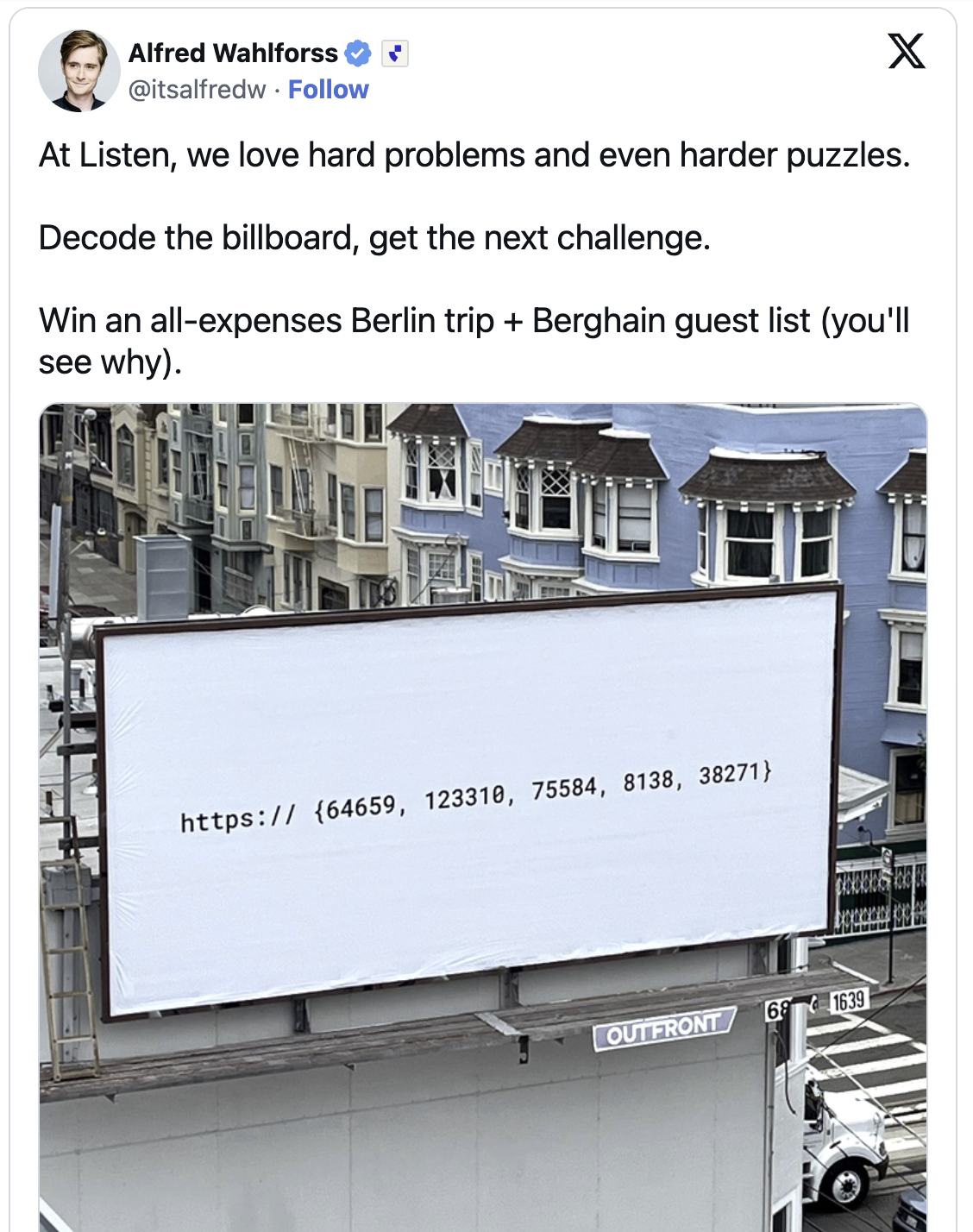
That was the scroll-stopping LinkedIn hook from Listen Labs' CEO after dropping $1M on billboards across NYC. The campaign generated 66 million views.
But the hook wasn't the interesting part. The approach behind it was.
Most B2B companies treat out-of-home advertising like a blunt instrument. You pick high-traffic locations, design something that looks good from 60 feet away, hope the right people see it, and measure nothing until the campaign is already over.
Listen Labs ran it like a software product.
Before committing a dollar to physical spend, they ran AI-moderated customer interviews to pre-test over 300 ad concepts and visual designs with real buyers. They chose what went on the billboards based on actual buyer response, not internal opinion. They measured brand awareness immediately before and after launch to calculate exact uplift rather than guessing at it. And when the campaign launched, employees synchronized on social by updating their profile pictures to a monochrome blue design and changing their job titles to "Customer Understanding Advocate" — creating a coordinated organic amplification layer that money can't replicate.
The result was a physical campaign that had the precision of a digital one.
Two things every B2B team should steal from this before the next event or OOH buy:
→ Budget $2,000–$3,000 for on-site videographers and photographers every time. Not for the event recap. For the evergreen content library. Sixty seconds of well-shot footage from a real event compounds for months.
→ Bring creator partners on-site. Let them record reaction content from the physical space. It breaks you out of the internal employee echo chamber and gets your message into feeds you don't control.
Physical and digital aren't different channels anymore. They're the same campaign.
https://venturebeat.com/technology/listen-labs-raises-usd69m-after-viral-billboard-hiring-stunt-to-scale-ai#B2BMarketing#EventMarketing…more
I’m not that great at making LinkedIn videos… but I’m getting better.
I’m trying to do the selfie video thing so I can have content that’s clearly not AI - and since AI creates mostly perfect images and even video now, I figured seeing my amateur attempts will add some HUMAN to your day.
If you’re up for it, I’d love to see your videos too. Don’t worry if they suck. It’s way more interesting than a perfectly written manifesto on getting rich quick. …more
Today's post is 298 words, a 2-minute read.
Sources: Superhuman Marketing — "Reddit's ChatGPT Citation Collapse Worries Marketers"
1 big thing: What just changed in AI visibility for B2B marketers?
Reddit's share of ChatGPT citations dropped 86% in mid-August. Brands that built their AI visibility strategy around it are scrambling.
Why it matters: Platform-dependent AI visibility strategies carry the same risk as platform-dependent social strategies. When the citation model shifts, everything built on top of it shifts with it.
Driving the news:
ChatGPT reduced how often it credits Reddit in final answers — but it is still consulting the platform behind the scenes.
→ Brand websites are now being credited more frequently in ChatGPT's final responses
→ Brands that treated Reddit as their primary AI visibility channel saw immediate exposure drops
Zoom in:
Experts now recommend treating social platforms as audience-insight channels rather than citation engines.
→ The brands gaining AI visibility are publishing authoritative, original content on their own domains — content that gets cited regardless of where the question is asked
Yes, but: Most B2B marketing teams do not yet have a defined AI visibility strategy. The brands hurt most by this shift are the ones who had one built on a single platform.
Be smart: Diversify where your brand authority lives. Original thought leadership on your own domain, consistent voice, and documented expertise are the assets AI models surface — not social posts optimized for one platform's algorithm.
The bottom line: Platforms are channels. Brand authority is the asset. Build accordingly.
https://www.businessinsider.com/what-reddit-chatgpt-citation-decline-means-for-cmos-2026-8#AIMarketing#B2BMarketing…more
Marketing and branding consultant with over 20 years of experience helping purpose-driven and socially responsible companies launch their products and build their brands
· LinkedIn
·
Small businesses are tired of posting into the void.
Lately, I keep hearing it from clients: their organic social media isn't converting. I'm hearing it from creators too, including an Instagram influencer facing the same challenge.
The numbers back them up.
First, people are tired. Not of your brand, but because of digital fatigue. In a June 2026 Incogni survey, 55% of Americans post less than they did five years ago, and 51% say social media is starting to feel like work.
Second, reach has become something you rent, not something you own. Facebook business pages now reach about 1.25% of their followers per post organically (Socialinsider, 2026).
Third, the algorithm isn't against you. It's indifferent. Meta says its systems rank posts by how likely someone is to engage, based on what they've engaged with before. Your story doesn't factor in unless they already want it.
So where does trust travel now? Back to person-to-person.
That's why two of my clients are going back to the most tried-and-true method of marketing: word of mouth (WOM). Neither business has scaled yet. They're building on real relationships, starting with their very first customer. I backed their plan right away, and encouraged them to add partnership co-marketing to the mix.
This doesn't mean abandoning social. It means being honest about what each channel can carry, and building the kind of trust that people want to repeat out loud.
Here's what makes WOM work:
→ It's free, and it multiplies with efforts. The return is trust.
→ Find your sneezers. Seth Godin's name for the people who can't help but tell others what they love.
→ Give them a story worth repeating. People pass along stories, not products.
→ Engage them with care. Ask their opinion. A handwritten thank-you note goes a long way.
→ Let them in. When people feel ownership and valued, they speak up with pride.
→ Listen. Their words become your messaging.
Next: how partnership complements word of mouth.
Who's the best sneezer for your business? Tag them below.
Full blog and sources in the comments.
#WordOfMouthMarketing#AnalogMarketing#SmallBusinessMarketing#CustomerAdvocacy#PurposeDrivenBrands…more
Facebook business pages reach about 1.25% of their followers per post (Socialinsider). No wonder two of my clients are going back to word of mouth. People don't pass along products. They pass along stories. Give yours one worth repeating. #WordOfMouth#SmallBusiness
We've covered word of mouth. We've covered partnership. Here's where it all comes together.
These two tools can show you who your people really are. Once you know that, social media and AI stop being a guessing game. You build profiles from real customers, then find more people just like them.
Analog first. Digital second.
In a crowded digital world, a real conversation is a breath of fresh air.
If your posts have stopped working and you've been feeling that fatigue too, you're not imagining it, and you're not behind.
I help purpose-driven founders rethink exactly this shift. Send me a message or drop a comment below. I read every one, and I'd love to get to know your business.
Over my last two posts, I've made the case for two analog tools: word of mouth and partnership marketing.
Here's why they belong at the heart of an early-stage marketing strategy. They teach you who your people are, faster and more honestly than any dashboard.
And that's exactly what makes them the bridge to digital.
Remember that 1.25% reach? That's why you don't start with the feed. You start with the people already talking about you, then use social to find more of them.
Once you've found your customer tribe, you know the formula that has attracted them. Carry that formula onto social media:
→ Build customer profiles based on real people, not guesses.
→ Use AI to find similar businesses and audiences who want what you offer.
→ Decide what results count as success before you spend on ads.
With a real tribe in hand, AI and social media finally have clear direction.
So go do your analog marketing. In a crowded digital world, a real conversation stands out.
If your posts have stopped working and you've been feeling that fatigue too, you're not imagining it, and you're not behind.
I help purpose-driven founders rethink exactly this shift. If it's time to talk, send me a message or drop a comment below. I read every one.
#AnalogMarketing#WordOfMouthMarketing#SmallBusinessMarketing#AIForSmallBusiness#EntrepreneurJourney
I'll be honest: I've never been someone who enjoys scrolling LinkedIn or crafting the perfect post.
But I've built four companies, and I know that consistent visibility is not optional if you're trying to build pipeline without a big marketing budget.
So a few years ago I stopped trying to enjoy it and started trying to systematize it.
Here's what changed everything: I stopped thinking in posts and started thinking in presence.
The insight is this — you don't need to post every day to build an audience. You need to post consistently on a rhythm your audience can predict. Two high-quality posts a week, every week, will outperform seven mediocre ones every time. Consistency at a sustainable cadence compounds. Intensity that burns out doesn't.
My system:
- One Monday morning session per week, about an hour
- I pick a theme for the week (one idea, not five)
- I draft all posts from that theme while I'm in "planning mode"
- I schedule everything before I close the laptop
- I don't touch it again until next Monday
The key is separating thinking from writing from scheduling. When you collapse them into one frantic "I need to post something" moment, it feels hard every single time.
How often are you actually posting vs. how often you think you should be? Curious what that gap looks like for people — drop it in the comments. …more
After 25+ years building companies, here's a lesson I wish I'd learned sooner:
Consistency beats intensity.
Two good posts every week for a year will outperform a burst of daily posting followed by silence.
Visibility compounds. Burnout doesn't.
How do you stay visible without posting every single day?
A client asked me that this week. She's a coach, brilliant at the work, and convinced consistency meant a daily grind she couldn't keep up around real client work.
Here's what I told her. It looks like a volume problem. It's actually a system problem. Showing up consistently isn't about posting more. It's about setting your voice once, planning a few weeks ahead, and drafting in minutes so a busy stretch doesn't knock you off the map. Consistency beats frequency. Three good posts a week you can sustain will always outrun a daily sprint you abandon by Thursday.
That's the reason Radi8 exists for solo experts: to make showing up practical instead of exhausting.
Want to map a cadence that actually fits your practice? Book 30 minutes with me and we'll work it out, no pitch: https://calendly.com/foclarity/30min
What's your realistic cadence — and what makes it stick when you're busy with client work?
#PersonalBrand#Coaching#IndependentConsultant#ThoughtLeadership#AIforBusiness
Coaches and consultants: does staying visible really mean posting daily? It doesn't. Clients trust judgment they see over time, not volume. See how peers keep it consistent in my community: https://inspiringfounders.com
I don't think AI can do your marketing for you.
A client asked me this week if they should use AI to do their marketing. Fair question, and I'm building an AI tool myself, so I'm not here to talk anyone out of it.
I read an honest comparison recently on hiring a social media manager vs. using AI. My answer starts one step earlier... do you want to hand your marketing off, or run it yourself and stay in control? Either can work. Neither one does the thinking for you.
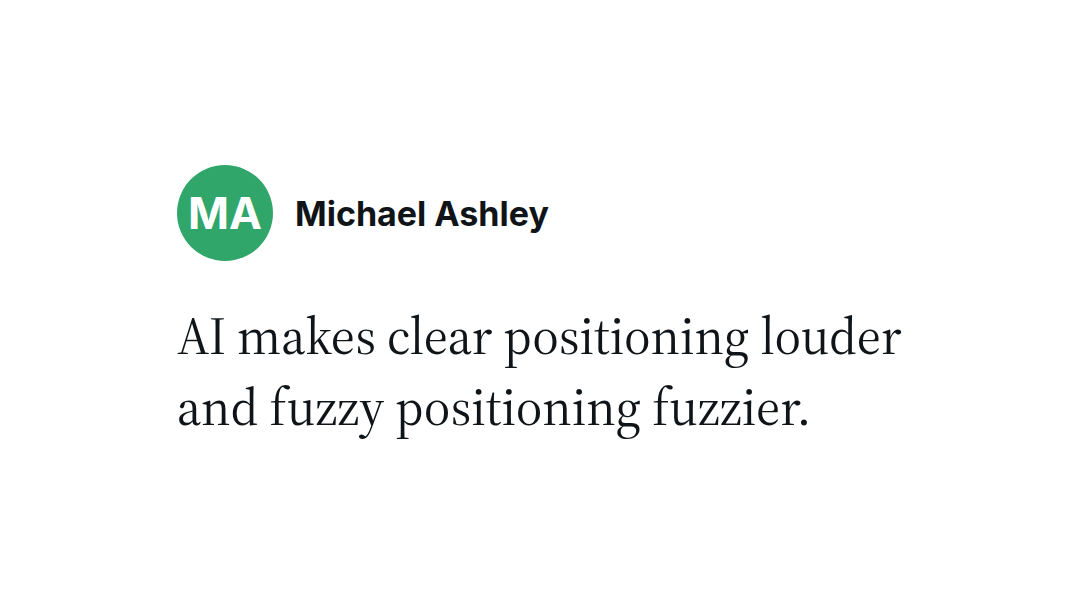
AI makes clear positioning louder and fuzzy positioning fuzzier.
So for coaches and consultants, the first job might not be picking a tool at all. It might be getting clear on who you help, the problem you solve for them, and what they actually care about. Get the thinking right first, then let AI amplify it. I catch myself reaching for the tool before the thinking too.
There's a video in the first comment for anyone weighing this right now.
Where has AI actually helped your practice... and where did it just make more noise?
#Coaching#IndependentConsultant#Positioning#Marketing…more
I've worked with hundreds of founders through my accelerator and peer groups. And when I look at why their marketing isn't converting, it almost always comes down to the same thing.
They built the campaign before they validated the message.
Here's what that looks like in practice: they spend two or three weeks building out a content calendar, designing assets, writing emails, setting up scheduling. Then they launch. And then they find out — through low engagement, no clicks, no replies — that the message doesn't resonate.
All of that work, wasted. Not because the campaign was bad. Because the message was untested.
The fix is simpler than most people think.
Before you build a campaign, send 5 DMs or have 3 sales conversations using your core message. Pay attention to the responses. Do people light up? Do they ask follow-up questions? Do they forward it to someone else?
Or do they politely change the subject?
What you learn in those conversations is worth more than any A/B test you'll run later. Real humans responding to a real message in real time will tell you everything you need to know about whether your campaign is worth building.
Build the conversation first. Build the campaign second.
Book a free audit with me — I'll look at your current messaging and tell you exactly where I'd focus first. …more