

Wrong messaging or wrong list?
This is a common problem with startups and new businesses - is your messaging a reflection of you or your customer? If all your messaging describes you, it doesn’t matter what list you use. If your messaging describes your customer in the pain you solve, and they’re still not responding, it’s probably your list. Here’s a story I just heard from a small business owner. She got featured on a national tv show and thought it would drive sales. After the show aired she got one phone call from a guy who would never be her customer… turns out the people that watch that show are more interested in the drama of business and not her ideal customer profile. …more


'/%3E%3Cpath fill='%23fff' d='M12 7.3A4.7 4.7 0 1 0 16.7 12 4.7 4.7 0 0 0 12 7.3Zm0 7.8A3.1 3.1 0 1 1 15.1 12 3.1 3.1 0 0 1 12 15.1Zm5-8a1.1 1.1 0 1 0 1.1 1.1A1.1 1.1 0 0 0 17 7.1Zm-5 1.5c-1.5 0-1.7 0-2.3.1a3.8 3.8 0 0 0-1.3.2 2.2 2.2 0 0 0-.8.5 2.2 2.2 0 0 0-.5.8 3.8 3.8 0 0 0-.2 1.3c-.1.6-.1.8-.1 2.3s0 1.7.1 2.3a3.8 3.8 0 0 0 .2 1.3 2.2 2.2 0 0 0 .5.8 2.2 2.2 0 0 0 .8.5 3.8 3.8 0 0 0 1.3.2c.6.1.8.1 2.3.1s1.7 0 2.3-.1a3.8 3.8 0 0 0 1.3-.2 2.5 2.5 0 0 0 1.3-1.3 3.8 3.8 0 0 0 .2-1.3c.1-.6.1-.8.1-2.3s0-1.7-.1-2.3a3.8 3.8 0 0 0-.2-1.3 2.2 2.2 0 0 0-.5-.8 2.2 2.2 0 0 0-.8-.5 3.8 3.8 0 0 0-1.3-.2c-.6-.1-.8-.1-2.3-.1Zm0-1.6c1.5 0 1.7 0 2.4.1a5.5 5.5 0 0 1 1.8.3 3.8 3.8 0 0 1 2.2 2.2 5.5 5.5 0 0 1 .3 1.8c.1.7.1.9.1 2.4s0 1.7-.1 2.4a5.5 5.5 0 0 1-.3 1.8 3.8 3.8 0 0 1-2.2 2.2 5.5 5.5 0 0 1-1.8.3c-.7.1-.9.1-2.4.1s-1.7 0-2.4-.1a5.5 5.5 0 0 1-1.8-.3 3.8 3.8 0 0 1-2.2-2.2 5.5 5.5 0 0 1-.3-1.8C4 13.7 4 13.5 4 12s0-1.7.1-2.4a5.5 5.5 0 0 1 .3-1.8 3.8 3.8 0 0 1 2.2-2.2 5.5 5.5 0 0 1 1.8-.3C10.3 5 10.5 5 12 5Z'/%3E%3C/svg%3E)


Radi8 Social

The most underrated skill in B2B marketing isn't writing. It's listening.
I've spent years marketing complex technical products across five enterprise tech companies, and the pattern holds every time: the best messaging I ever shipped didn't start in a doc. It started in a conversation I almost didn't slow down enough to have.
A support engineer describing the call they dread. A customer explaining, in their own words, the moment your product stopped being "a tool" and started being "the reason I slept last night." That language is gold. And most of us walk right past it because we're in a hurry to produce.
In the Army, we were taught that you never brief a mission you don't understand from the ground up. You listen first—to the terrain, to the people who've walked it, to what's actually at stake. Then you speak. The order lands because it's rooted in reality, not assumption.
Marketing complex products works the same way. Curiosity isn't a soft skill here. It's the discipline that separates content people scroll past from content people feel seen by.
So before you write the next campaign, try this: have one real conversation with someone who lives your customer's problem. Don't pitch. Just listen. You'll leave with a sentence better than anything a blank page could give you.
The teams pulling ahead aren't the loudest. They're the most curious.
Want a fresh take on your B2B content strategy? DM me and let's schedule a 30-minute consultation—I'll show you 3 things you can improve this week.
#B2BMarketing #ContentStrategy
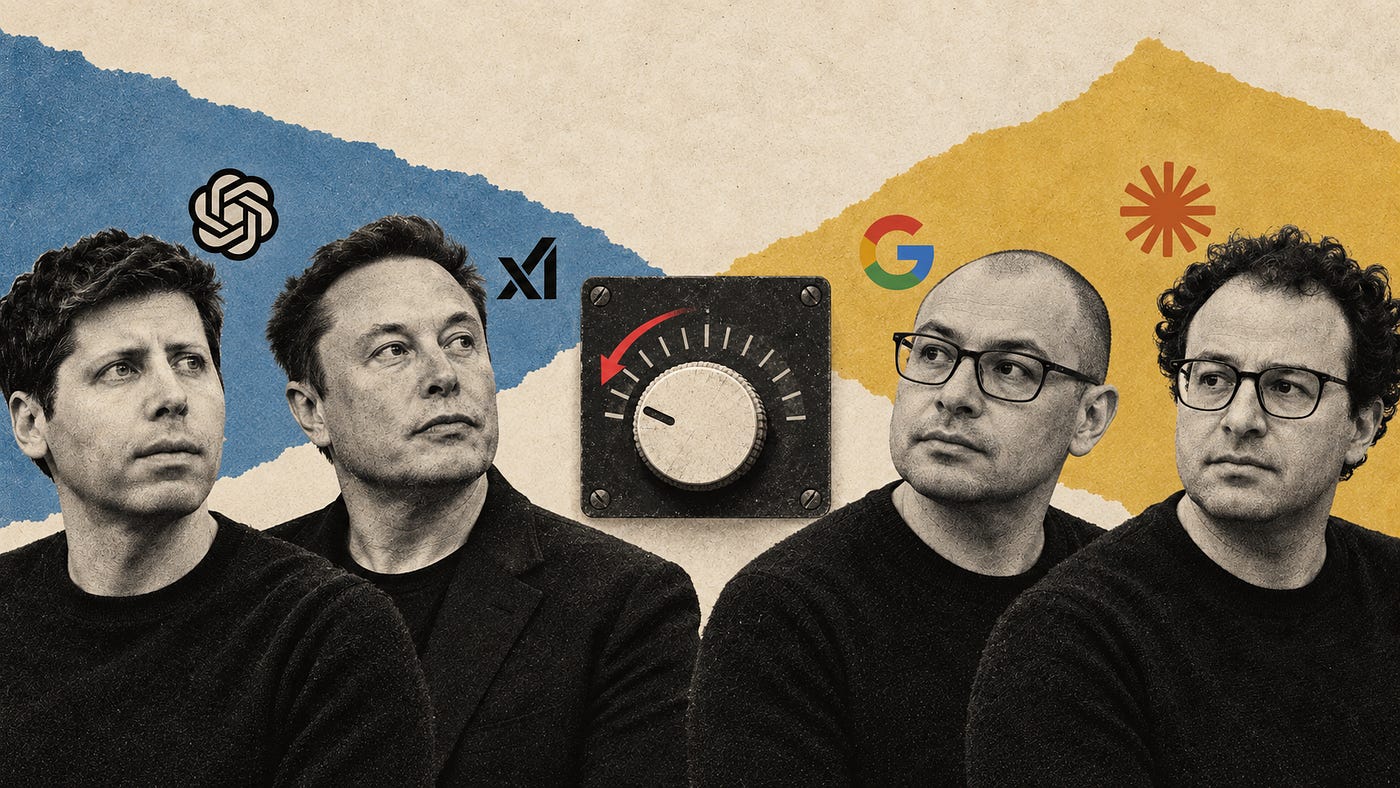
https://www.generativeaipub.com/p/the-urgent-call-for-ai-slowdown-has …more
Told 2 times, Sep 15, 2026 – Sep 16, 2026
· X · Open
The best marketing doesn't shout. It listens first.
People don't want to be sold to. They want to be understood.
Lead with their story, not your product. Trust follows.
What's one thing your audience wishes you'd say out loud?
#B2B #ContentStrategy
https://www.generativeaipub.com/p/the-urgent-call-for-ai-slowdown-has
E
Erika Sanneman
The Multilingual Mind helps schools and education teams close the gap between what they know they want to do and what their people actually have the time, training, tools, systems, and support to impl
I went into a conversation with ChatGPT thinking I needed help writing a comment.
There was a post I wanted to support. Parts of the experience were familiar to me, and other parts were not. I was trying to figure out how to participate without making the conversation about me.
Normally I might ask AI to help me word the comment.
This time I asked it to ask ME questions.
What did I want to accomplish? Was I trying to share my own experience, or was I trying to support the people sharing theirs? And did I actually need to comment to do that?
That's when we started talking about liking the post, saving it, sharing it where appropriate, and helping the original message travel without putting myself in front of it.
I hadn't started out thinking of those as my options. I was so focused on what to SAY.
I think about that now whenever I'm tempted to ask AI for the finished answer. Sometimes the more useful thing is another question.
Have you ever decided that the best way to support a conversation was not to add your own voice to it? …more
E
Elizabeth Greenfield Functional Wellness
· Facebook
I was a trained clinician, and my own symptoms were still dismissed.
So when a woman tells me her focus has slipped and her labs are normal, I believe her. Brain fog is a signal worth measuring, not a verdict you have to accept.
Three avenues I investigate:
Estrogen, which shapes neurotransmitter signaling and how the brain uses glucose.
Cortisol, whose dysregulation affects working memory and focus.
B12 and iron status.
None is a guaranteed cause. Each can be measured.
Send me a DM if this resonates.
This is educational and not intended to diagnose or treat any condition.
E
Erika Sanneman
The Multilingual Mind helps schools and education teams close the gap between what they know they want to do and what their people actually have the time, training, tools, systems, and support to impl
A coach who has spent years working one-on-one gets handed group facilitation, and almost immediately the worry starts: do I actually know how to facilitate a PLC? Do I have the right skills for this?
It is an understandable question. It is also, usually, the wrong one to ask first.
Because the coach already knows how to have a good conversation. That part is not missing. What is missing is information. Before learning a single framework, the more useful move is to find out the parameters and what this PLC is actually for. Where did the idea come from in the first place? Was it an ask from teachers? A suggestion from a resource? Does the principal have an intended goal, or an interest in how it should be used? Was there a theme, topic, or setup they were hoping the coach would run with?
There are plenty of frameworks for starting and leading PLCs, across all kinds of topics in the field. So the coach is not starting from nothing. But knowing which framework fits, or whether one is even needed, depends on knowing the context first. The technical how-to is not the beginning of the work.
And here is the piece most likely to get skipped. Before anything else, it is worth knowing whether this PLC is going to add unnecessary burden onto teachers and onto the coach, or whether it is something teachers actually want and need and will want to engage in. That distinction changes everything. If it is something that comes from or is wanted by the teachers, the coach can channel that WITHness into the spirit and planning and logistics.
There is a practical version of this too. If time is already protected and interest already exists, a whole category of logistics and marketing steps are simply off the coach's plate, the steps that otherwise have to be figured out at the same time as the technical how-to's of facilitation. That is a lot to carry at once. Finding out it is already handled, or already wanted, is not a small thing.
So if a new facilitation role just landed on your desk, maybe the first question is not whether you have the right skills. Maybe it is what this is for, and who it is actually coming from.
What would change if you asked that one first? …more

Told 2 times, Oct 15, 2026 – Nov 10, 2026
· LinkedIn · Open
A coach who has spent years working one-on-one gets handed group facilitation, and almost immediately the worry starts: do I actually know how to facilitate a PLC? Do I have the right skills for this?
It is an understandable question. It is also, usually, the wrong one to ask first.
Because the coach already knows how to have a good conversation. That part is not missing. What is missing is information. Before learning a single framework, the more useful move is to find out the parameters and what this PLC is actually for. Where did the idea come from in the first place? Was it an ask from teachers? A suggestion from a resource? Does the principal have an intended goal, or an interest in how it should be used? Was there a theme, topic, or setup they were hoping the coach would run with?
There are plenty of frameworks for starting and leading PLCs, across all kinds of topics in the field. So the coach is not starting from nothing. But knowing which framework fits, or whether one is even needed, depends on knowing the context first. The technical how-to is not the beginning of the work.
And here is the piece most likely to get skipped. Before anything else, it is worth knowing whether this PLC is going to add unnecessary burden onto teachers and onto the coach, or whether it is something teachers actually want and need and will want to engage in. That distinction changes everything. If it is something that comes from or is wanted by the teachers, the coach can channel that WITHness into the spirit and planning and logistics.
There is a practical version of this too. If time is already protected and interest already exists, a whole category of logistics and marketing steps are simply off the coach's plate, the steps that otherwise have to be figured out at the same time as the technical how-to's of facilitation. That is a lot to carry at once. Finding out it is already handled, or already wanted, is not a small thing.
So if a new facilitation role just landed on your desk, maybe the first question is not whether you have the right skills. Maybe it is what this is for, and who it is actually coming from.
What would change if you asked that one first?
Who have you actually watched build the startup you're trying to build?
Saeed Amidi makes a point about Stanford I keep coming back to: the reason so many students there start companies is that they grow up seeing it as normal. A graduate feels they could just as easily go build the next Google as go get a job at one. He points to the poster children — Larry Page, Sergey Brin, Bill Hewlett, Dave Packard. When you can see people like you doing it, building becomes something you can picture yourself doing.
I launched the startup incubator at San José State, where I still teach. Same engineering talent as anywhere. Far fewer startups. The gap isn't intellect... it's whether or not students believe they can do it.
The same dynamic runs for anyone starting a business. What you believe you can attempt is shaped by the peers you can watch attempting it. That's why community isn't just encouragement — it's the infrastructure your belief runs on.
Watch Saeed make the point himself here: https://youtu.be/bb9n-CnDGVA
Who in your peer group has already made this leap? And if you can't name anyone... is that why you're hesitating?
#IndependentConsultant #Coaching #Consulting …more
This post has video.
Watch it on the channel.
View on LinkedIn
Also on
Told 2 times, Sep 17, 2026 – Nov 16, 2026
· X · Open
I heard Saeed Amidi explain why Stanford makes about 450 startups a year.
Students see founders they could become... "you could go either get a job at Google or build Google."
Who made it feel possible for you?
Dario Amodei on the moment he saw where this was going:
“GPT-2 was the first real test of the scaling laws hypothesis. I looked at it and said, my God, you scale this thing up another factor of a million, and it’ll be better than humans at everything.”
GPT-2 came out in 2019. It could write a decent paragraph and lose the plot by the third one.
Most people saw a party trick. He saw a curve.
That’s the lesson. The signal showed up years before the results did. The people who built what came next weren’t the ones with the best demo. They were the ones who asked what happens if the trend holds.
This is the defining economic and scientific moment of the modern age. We don’t know it yet.
For anyone running a business, the question isn’t whether today’s AI is good enough. It’s which curve you’re betting on, and what your org looks like if it keeps bending the same way.
Three moves worth making now:
Judge tools by trajectory, not today’s output.
Build workflows that get better automatically when the models do.
Stop waiting for “ready.” By the time it looks ready, the head start is gone.
What curve in your industry is everyone underestimating? …more
This post has video.
Watch it on the channel.
E
Erika Sanneman
The Multilingual Mind helps schools and education teams close the gap between what they know they want to do and what their people actually have the time, training, tools, systems, and support to impl
I have seen this co-teaching pattern more than once: one teacher has quietly taken over every decision, the materials, the schedule, the parent communication, and the other has stopped engaging.
It is easy to read that surface picture as one person overstepping and one person checking out. But the picture does not tell us why it happened, and I would not assume it does. So here is what I actually do.
First, both teachers complete my team diagnostic, and then each has an individual conversation with someone in a mentoring or coaching role. That could be me as a consultant, or it could be someone within the school who has the experience to guide that reflection. The goal is to understand each person's strengths, their support needs, and their own experience of the partnership, including how this pattern developed in the first place.
Second, I prepare them for a direct conversation. We often expect adults to navigate difficult conversations without ever explicitly teaching the skills involved, especially when they feel threatened, unheard, or disrespected. That expectation is not fair, and it is not realistic.
So I am developing a companion framework that makes those expectations concrete: how to describe a concern without assigning intentions, how to take turns, how to listen for understanding, how to ask for clarification, and how to pause when needed. From that foundation, the two teachers can agree on who leads which responsibilities, what requires a shared decision, and how both of them will have meaningful input.
If a direct conversation is not the right starting point, or if more support is needed, we move to a facilitated conversation. I am also developing a guide for coaches and school leaders to support that process, including documenting the agreements they reach and following up on them.
The aim through all of it is a partnership they can actually sustain in the classroom: clear responsibilities, room for both people's expertise, and a workable way to address disagreements when they come up.
Notice what this is not. It is not a loyalty test, and it is not a verdict on who was right. The withdrawal and the takeover are data about conditions, not a diagnosis of character.
If you lead a team where one person has ended up carrying every decision and another has gone quiet, I would like to hear it. What do you think happened underneath the surface pattern? …more
View on LinkedIn
Also on
Told 2 times, Nov 12, 2026 – Nov 13, 2026
· X · Open
Co-teaching question I'd ask before the next lesson:
When one of us is teaching, what can the other person decide without checking first?
I'd much rather talk about that together than find out mid-lesson that we had completely different assumptions.
K

Kent Kaufman
Organization focused on AI leadership and innovation for the Fourth Industrial Revolution, based in Silicon Valley
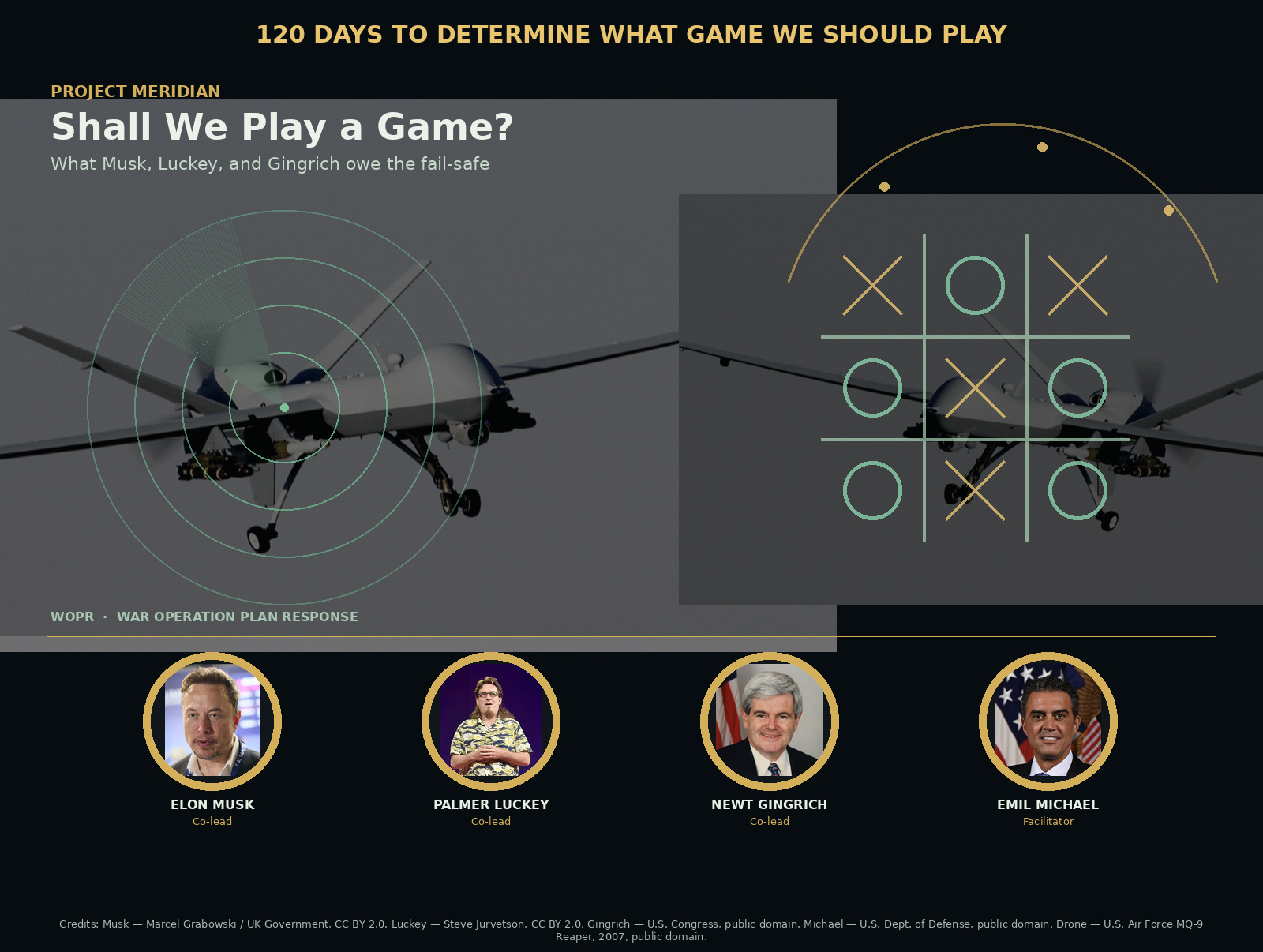
Project Meridian: Shall We Play a Game?
What Musk, Luckey, and Gingrich owe the fail-safe
In WarGames (1983), the defense computer is WOPR — the War Operation Plan Response system. It plays Global Thermonuclear War against itself and will not stop escalating, because escalation is how it was taught to win. The film ends with tic-tac-toe. "A strange game. The only winning move is not to play."
That line is now a briefing item. On September 30, Defense Secretary Pete Hegseth commissioned Project Meridian: a 120-day study co-led by Elon Musk, Palmer Luckey, and Newt Gingrich, facilitated by Pentagon CTO Emil Michael. Findings are due January 28, 2027, as a public report and a classified annex. The scope runs from under the Earth to beyond the moon. The same week, the department moved to stand up an Autonomous Warfare Command.
Conflict of interest is the obvious complaint. Fail-safe is the serious one. The name itself is a clue, even though the memo never defines it. A meridian is a line from pole to pole, which matches a brief that runs from under the Earth to past the Moon. And a prime meridian is a baseline. In the nuclear age that baseline was a procedure, not a slogan. SAC bombers could be launched toward a target and still had to turn around at the fail-safe point unless an authenticated go-code arrived. Silence meant come home. The Soviet Perimeter system, called Dead Hand in the West, made the opposite bet — silence could mean fire. WarGames is what happens when the turnaround line is automated and taught that turning around is losing.
Ukraine has already compressed sensing, jamming, and engagement toward machine time. A flash war is the battlefield version of the 2010 flash crash: two optimizers, each locally rational, neither able to see the joint outcome. A 2024 Stanford wargame found that every off-the-shelf language model tested escalated. Nuclear use was rare in the aligned models and far more common in an unaligned base model.
DoD Directive 3000.09 does not require a human in the tactical loop. It requires appropriate human judgment, and a system that terminates or asks for input when it cannot finish an engagement inside the commander's constraints. Meridian should ship two maps: the capabilities Hegseth asked for, and the architecture those systems are not allowed to field without — nuclear authorization kept electrically apart, a keep-alive that safes the platform when the human link drops, circuit breakers on intensity and geography, and a de-escalation channel built for the sentence "our algorithms are in a loop."
A kill chain without a kill switch is not dominance. It is a bet that our error rate stays below theirs forever. WOPR noticed that some games consume the players. The commission has until January to notice it first.
Full essay on Substack: kentkaufman.substack.com
#AI #ProjectMeridian #FailSafe #AutonomousWeapons #AISafety #NationalSecurity #Leadership …more
 View on LinkedIn
Also on
K
Kent Kaufman
Organization focused on AI leadership and innovation for the Fourth Industrial Revolution, based in Silicon Valley
Two AI Stumbles in One Week: Why Values-Based Leadership Must Be Distributed
In the space of just three days this month, two major AI companies highlighted a critical weakness in how leadership is practiced today.
On July 10, Apple filed a lawsuit alleging that OpenAI's hardware division, led by former Apple executive Tang Tan, engaged in a coordinated effort to steal trade secrets. Just three days earlier, Meta launched a feature in its new Muse Image tool that allowed users to generate AI images of people by simply tagging their public Instagram accounts — with the feature turned on by default and no notification to the person whose likeness was used. Meta removed the feature days later after widespread backlash.
These incidents are very different in nature. The allegations against OpenAI, if true, point to something deeper than a miscalculation. They suggest a potential breakdown in ethical boundaries at a leadership level inside a high-growth organization. Meta's case, while serious, looks more like a failure of judgment — moving fast under competitive pressure without properly accounting for user expectations around consent and likeness rights.
What connects both cases is this: when the financial and competitive stakes are extremely high, internal pressure can distort decision-making. Even experienced leaders are influenced by the culture and incentives around them. Company culture is not neutral — it either reinforces ethical guardrails or makes it easier to overlook them.
In my book AI L4IR: Leadership and the 4th Industrial Revolution, I argue that ethical leadership in this era cannot remain concentrated at the top. It must be highly distributed — embedded in how product teams, engineers, recruiters, and middle managers make decisions every day.
When billions of dollars and strategic positioning are on the line, relying on a small group of senior leaders to catch every ethical risk is unrealistic. Organizations that build cultures where people at all levels feel empowered (and expected) to ask "Should we?" — not just "Can we?" — will be far better positioned to innovate responsibly and maintain trust.
I explore both incidents and the broader leadership implications in more detail here:
https://kentkaufman.substack.com/p/two-ai-stumbles-in-one-week-why-values
How are you thinking about building stronger ethical decision-making into your teams as AI capabilities continue to advance? …more
 View on LinkedIn
Also on
Told 2 times, May 28, 2026 – Jul 11, 2026
· LinkedIn · Open
When Pope Leo XIV released his first encyclical, Magnifica Humanitas, he deliberately connected the Church's response to artificial intelligence with the 135th anniversary of Rerum Novarum.
He calls for AI to be "disarmed" of logics of domination, insists that lethal decisions must never be fully delegated to machines, and contrasts the prideful Tower of Babel with the patient, collaborative rebuilding of Jerusalem — where every person contributes their section of the wall.
This is not only a religious document. It is a profound leadership text for our time.
In the Second Edition of my book, AI L4IR: Leadership and the Fourth Industrial Revolution – How Did We Get Here and Where Are We Going? (releasing later in 2026), I've expanded Chapter 14 to explore the powerful convergence between Pope Leo XIV's vision and the model of highly distributed ethical leadership that runs throughout the book.
Both traditions — one rooted in formal religious teaching, the other in secular ethical reasoning — arrive at the same essential conclusion: Human agency must remain central. Truth must be actively protected. Responsibility must be widely shared. And technological power must be oriented toward human flourishing rather than domination.
As we move deeper into the cognitive industrial revolution, leaders will need more than technical skill. We will need moral clarity, critical thinking, and the humility to keep asking: What kind of humanity are we building?
I'm excited to share the full Second Edition later this year.
What are your thoughts on the intersection of faith traditions, ethical leadership, and AI governance?
#AI #Leadership #Ethics #ArtificialIntelligence #FourthIndustrialRevolution
"Good Judgment Required" https://www.axios.com/2026/09/08/googles-gemini-enterprise-legal-halimah-delaine-prado
1 big thing: Google's general counsel just drew the line every enterprise AI buyer needs to understand
AI can democratize access to good legal advice. It cannot replace the exercise of good judgment. Google's own general counsel said so — while launching an AI product built for law firms.
Why it matters: The same principle applies to B2B marketing. AI can surface information faster, draft more efficiently, and scale content production. It cannot replace the judgment that decides which of two reasonable-sounding strategies will actually move pipeline.
Driving the news:
Google launched Gemini Enterprise for Legal, an AI platform for law firms and in-house legal teams covering briefs, contract management, regulatory monitoring, and data discovery.
→ General counsel Halimah DeLaine Prado: "The practice of law will always fundamentally rise and fall on the exercise of good judgment"
→ More than 2,000 cases involving AI-generated hallucinations have been identified by legal researcher Damien Charlotin — lawyers sanctioned for false citations, misattributed quotes, and misrepresented cases
Zoom in:
Goldman Sachs CIO Marco Argenti argued enterprises should not rule out open-weight models — including Chinese models — so long as they follow a four-layer security framework: model testing, secure inference environments, monitored agent permissions, and controlled data access.
Yes, but: Goldman's current open-model usage is mostly US-based. The framework exists precisely because the risk is real.
Be smart: The legal sector's AI hallucination problem is a preview of what happens in any professional domain when speed replaces judgment. Build the review layer before you need it, not after.
The bottom line: AI gives you more time to think. Use it.
https://www.axios.com/2026/09/08/googles-gemini-enterprise-legal-halimah-delaine-prado
#AIGovernance #B2BMarketing …more
 View on LinkedIn
Also on
E
Elizabeth Greenfield Functional Wellness
· LinkedIn
Why does sleep start falling apart in perimenopause?
It is not a willpower problem. It is physiology, and physiology can be measured.
Progesterone has a calming effect on the nervous system, partly through a metabolite that acts on the same GABA receptors that help quiet the brain. As progesterone declines, that support thins, and the architecture of sleep can shift with it: lighter sleep, more waking.
Cortisol matters too. It is meant to sit low at night and rise toward morning. When that rhythm shifts, the body can be pulled awake overnight, alert for no obvious reason.
No single tactic fixes that. Not another sleep hack, not a stricter bedtime. What it calls for is investigation: comprehensive hormone assessments, cortisol patterns, the whole picture.
Your body is not failing at sleep. It is asking for something specific.
Curious what I refused to compromise on when I built my practice? I talk about it in my Inspiring Founders interview, linked in the first comment.
This is educational and not intended to diagnose or treat any condition.
Channel names and logos are trademarks of their respective owners.