Founder at Radi8 // Executive Coach // Host of the Inspiring Founders Podcast
· LinkedIn
·
A short one to close the month.
I've spent July writing about positioning, focus, and what it takes to turn what you know into a business that wins clients. So here's the question I'd actually like you to answer:
What did you have to unlearn when you went out on your own?
The habits that made you great inside an organization — trusting the work to find you, staying modest about your wins, letting the company's brand do the talking — are often the exact habits that stall an independent practice.
I'll go first: I had to unlearn building quietly. For years my work spoke through companies and products. On my own, invisible good work is just invisible.
Your turn. What did you have to unlearn — or what are you still unlearning? I'll read and reply to every answer.
#IndependentConsultant#Coaching#GoingIndependent#PersonalBrand…more
Founder at Radi8 // Executive Coach // Host of the Inspiring Founders Podcast
· LinkedIn
·
Reading CarbonBridge’s 2026 forecast, I’m encouraged by their shift from R&D to early commercialization. Two practical lessons for founders: secure non-dilutive reimbursements or early contracts to fund operations, and start pilot-site planning well before you expect to raise. Their first product sales to Lawrence Berkeley Lab validate the path, while fundraising and pilot timing remain bottlenecks. If you’re building pilots or need introductions, send me a message.
https://www.santacruzworks.org/news/carbonbridge-2026-forecast-emerging-revenues-clearing-product-salesnbsp…more
Founder at Radi8 // Executive Coach // Host of the Inspiring Founders Podcast
· LinkedIn
·
What did you actually keep from the last program you paid to be in?
For me it wasn't the degree. Years after my MBA, the thing that still pays off is a handful of relationships I made there, not any single lecture.
One of them started with a guest speaker. He came in, presented, and most of the room took notes and left. I introduced myself. Then I did the part almost nobody bothers with... I stayed in touch, for years. That one relationship went on to matter more to my business than anything on the syllabus.
The curriculum has a shelf life. A relationship you actually tend can compound for decades.
If you're building a practice of your own, treat the people you meet now as the asset. Positioning gets you in the room; the relationships you keep are what pay you back for years.
That's the work I help with. See how on my site, linked in the first comment.
#IndependentConsultant#Coaching#GoingIndependent#PersonalBrand#ThoughtLeadership…more
Founder at Radi8 // Executive Coach // Host of the Inspiring Founders Podcast
· LinkedIn
·
You think the thing holding your practice back is that you don't have enough. Enough budget. Enough network. Enough runway to survive a mistake.
I've told myself that story too.
Then I listened to Saeed Amidi, founder of Plug and Play. Early on, he flew to Jeddah with a borrowed suit, his father's credit card, and money for exactly one trip. No safety net. No plan to come home empty-handed. In his words: "I'm not coming back till I sell something."
Having no Plan B didn't slow him down. It focused him. He stretched that one trip into 45 days and closed his first two deals.
Comfort never makes you that sharp. Constraint does.
Watch Saeed tell it himself here: https://youtu.be/bb9n-CnDGVA. It's the clearest case I've seen for why fewer resources can make you more resourceful, not less.
What constraint have you been treating as an obstacle that might actually be your edge?
#IndependentConsultant#Coaching#GoingIndependent…more
Founder at Radi8 // Executive Coach // Host of the Inspiring Founders Podcast
· LinkedIn
·
Busy founders and stalled founders often look identical from the outside. Both are working constantly. The difference is what happens to all that effort.
Here's the pattern I've watched for 25 years: activity that isn't built on a system doesn't compound. You do the outreach, the post, the follow-up, the demo — and then next week you start from zero and do them all again. It feels like progress because it's exhausting. But nothing accumulates. You're not building an engine; you're pushing the car.
A system is just the opposite. It's a motion you run once, learn from, and improve — so the next turn is a little sharper than the last. That's what compounding actually is: the same effort producing more each time because the thing underneath it is getting better.
The trap for a stalled founder isn't laziness. It's the opposite. There's so much motion that you can't tell which of it is worth turning into a system and which is just noise burning the hours.
Here's the filter I use. One question separates the signal from the noise:
Which single motion, if it got 20% better every time we ran it, would change the trajectory of the business?
That's the one to systematize. Not the ten things that feel urgent — the one whose improvement curve actually bends the outcome. Usually it's unglamorous: how you talk to customers, how a lead becomes a conversation, how you decide what to build next. Almost never the thing that's loudest on your calendar.
Then be honest about the rest. Most of what fills a stalled founder's week is motion that will never compound no matter how well you execute it. That's not a productivity problem you fix with a better tool or another hire. It's a focus problem. Cutting it isn't losing ground — it's freeing the attention the one motion needs to become a real system.
The uncomfortable part: you can't systematize everything, and trying to is its own form of noise. Compounding demands you pick.
So the question worth sitting with this week:
Of everything you're doing right now, which one motion is actually worth turning into a system — and what would you have to stop doing to give it the attention it needs?
#Founders#Startups#Entrepreneurship#FounderLessons#GrowthStrategy…more
Across four companies and 25 years, my go-to-market got better every time. Here's the most important thing I learned.
Stop trying to do everything at once.
Most growth problems look like marketing problems.
But when I dig in with founders, the issue is usually lack of focus.
Too many audiences.
Too many messages.
Too many priorities.
Too many opportunities.
What actually works: one audience segment, one message, one channel, one objective. Run it long enough to learn something.
The lesson isn't about marketing.
It's about decision-making.
The companies that grow fastest are often the ones that say no most often.
What's one thing you're working on right now that you know should probably wait?
Most stuck practices aren't under-resourced. They're over-complicated.
I see it with almost every coach and consultant I advise. Three audiences. Five offers. Two newsletters, a podcast idea, a course half-built, a website redesign in progress. Everything is "almost working," which is another way of saying nothing is.
When growth stalls, the instinct is to add more: channels, offers, effort. After 25 years of building companies, I trust the opposite pattern. Momentum comes from removing decisions. A few things running well compound faster than many things running at half strength.
A practice has one engine: a clear person, with a clear problem, hearing a clear promise, through one reliable channel. Everything beyond that is optional until the engine runs. Most of what fills a stuck practice-owner's week is complexity that will never compound no matter how well it's executed.
Here's the exercise I run with clients. List everything you're doing to grow. Then ask one question of each item: if this got 20% better every month, would it change the trajectory of my business? Most items fail the test immediately. The one or two that pass — that's the business. The rest is noise wearing a to-do list.
Cutting will feel like retreat. Give it two weeks and it starts to feel like focus.
What's the one decision that, if you made it this week, would unblock everything else in your practice?
#IndependentConsultant#Coaching#ConsultingBusiness#GoToMarket
Founder at Radi8 // Executive Coach // Host of the Inspiring Founders Podcast
· LinkedIn
·
Which room are you the most knowledgeable person in?
Passion isn't enough anymore. AI already knows the generalist version of what you know, and it answers instantly, which means the floor just rose for everyone. Broad knowledge is a commodity now, and the coaches and consultants who trade only on enthusiasm and general competence are getting squeezed between a search bar and a subscription.
What AI can't replicate is genuine mastery. Saeed Amidi put the bar where it belongs: "you have to be the most knowledgeable person in the room for sure more knowledge than my and George's 150 people." Not the most passionate. The most knowledgeable... deeper on your specific domain than a large, capable team.
That's the moat. Passion gets you started, depth is what a market can't get anywhere else, and it's the one thing you can defend.
Want help sharpening exactly that positioning? Click the link in the first comment to visit my site.
#IndependentConsultant#Coaching#Positioning#GoingIndependent…more
Founder at Radi8 // Executive Coach // Host of the Inspiring Founders Podcast
· LinkedIn
·
The most interesting opportunities almost never look exciting at first.
They look stuck.
Someone's been circling the same idea for years. Everyone agrees it should exist. There have been meetings, decks, maybe a failed attempt or two. And yet — nothing has moved.
That's the moment I want to walk in.
Not because I'm smarter than the people who were there before me. Usually I'm not. It's because stalled initiatives are rarely blocked by effort or talent. They're blocked by something structural: an unclear problem, too many priorities, no real owner, a foundational decision nobody's been willing to make.
Find that one thing, move it, and the whole thing starts to breathe.
After 25 years, I've stopped chasing the ideas that already have momentum. Plenty of capable people can push those forward. I'm drawn to the stuck ones — the initiatives everyone believes in but no one has been able to move.
Making those move is the most satisfying work I know.
What's the thing in your world that everyone agrees should exist — but nobody has been able to make happen yet? …more
The most interesting opportunities don't look exciting.
They look stuck.
Everyone agrees it should exist. Nobody's been able to move it.
Stalled work is rarely blocked by effort. It's blocked by structure — an unclear problem, no owner, a decision no one will make.
Co-Founder at Cora Nexus AI | Startup Ops | Force Multiplier | Project Manager | Strategic Planning | Cross-Functional Systems
· LinkedIn
·
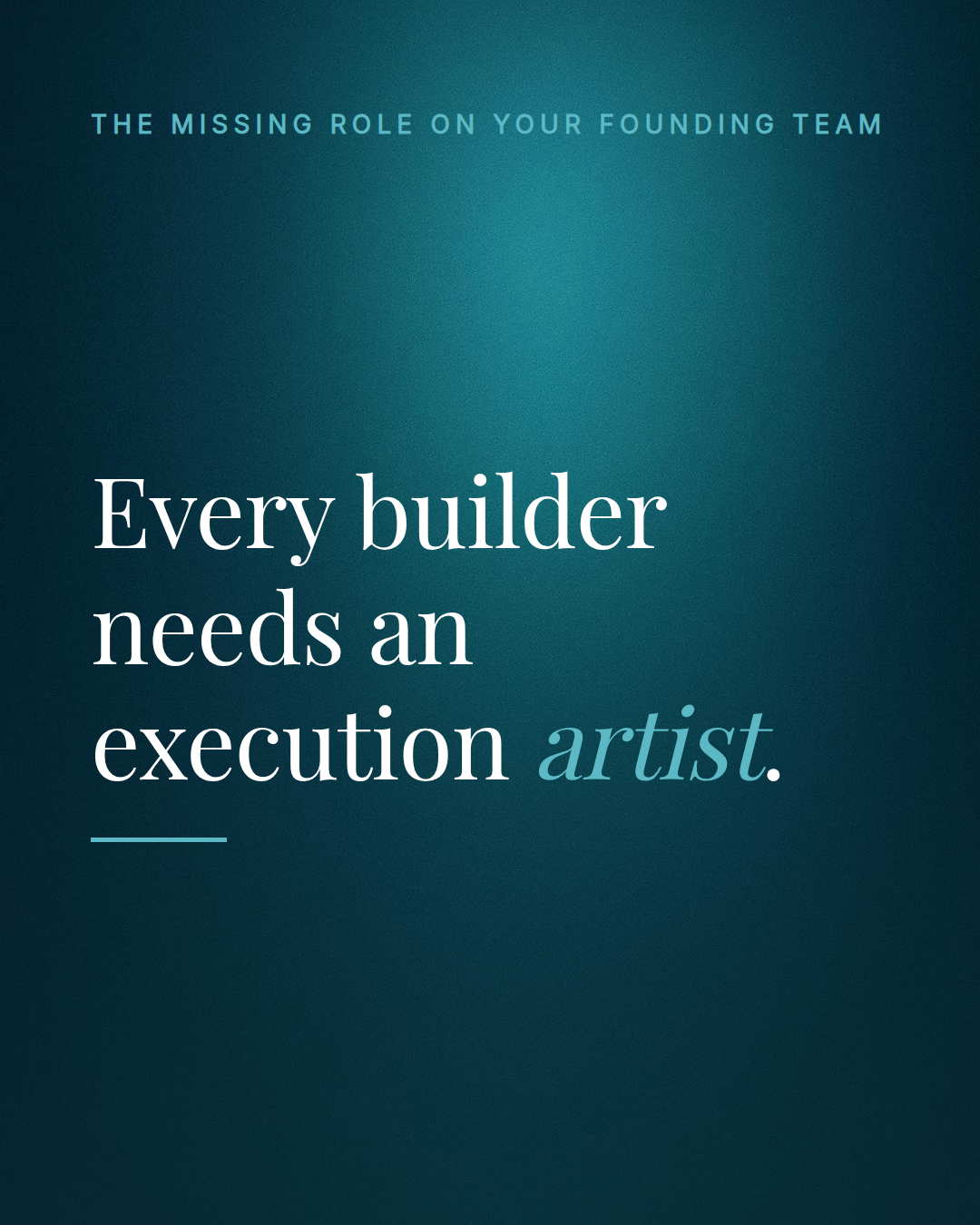
The best co-founders aren't two builders - they're a builder and an execution artist.
I've noticed the teams that struggle early often have the same problem: everyone wants to build. Nobody wants to build the systems around the building.
Which makes sense. Especially in the early stages, momentum feels like everyone sprinting in the same direction. But building the product and building the business are two different jobs.
One person is asking, "What's possible?"
The other is asking, "How do we do this 100 more times without everything catching fire?"
You don't always need another co-founder for that. Sometimes you need someone who can step in, build the operational foundation, and hand owners and founders back the time they're spending putting out fires.
That's my favorite part of the job. Ops isn't known to be glamorous - but dang, it is to me.
P.S. Did I just make up "execution artist"? I'm keeping it. It's either a COO or a Bond villain. Either way, I'm here for it and just wish it looked less sinister on a business card. …more
Founder at Radi8 // Executive Coach // Host of the Inspiring Founders Podcast
· LinkedIn
·
Talent, timing, network — none of it matters if you quit before the moment arrives.
After building several companies and advising a lot of people who've struck out on their own, if you asked me for the one trait that separates the people who make it from the people who don't, it wouldn't be intelligence, or connections, or perfect timing. It's perseverance.
And I don't mean the motivational-poster version. Most people who go independent don't stop because they've failed. They stop because they haven't succeeded yet — and in a hard moment, those two things feel identical. They're not.
Real perseverance isn't blind stubbornness. It's staying in motion, adapting, and keeping the door open long enough for something to actually happen. The hardest stretch is never the leap. It's the long middle — when you've left the title behind, you're doing the work, and the clients aren't showing up yet.
What I've come to believe is that the distance between wanting to quit and the breakthrough is usually shorter than it feels in the moment — but you only find that out if you're still standing there when it comes.
If you're in that middle right now, growing a coaching or consulting business of your own: what's keeping you in the game? What would help you stay?
🎙️ From my conversation with Julia Lucidi on the Founder Tactics podcast — full episode linked in the first comment.
#IndependentConsultant#Coaching#Solopreneur#GoingIndependent#PersonalBrand…more
Founder at Radi8 // Executive Coach // Host of the Inspiring Founders Podcast
· LinkedIn
·
Most founders I work with avoid customer discovery. Not because they don't understand the theory. Because it surfaces uncomfortable truths.
When you sit down with a potential customer and ask the right questions, you're not just testing assumptions. You're inviting reality to challenge the story you've been telling yourself about your product, your positioning, and your market.
That's hard.
It's easier to keep building. Easier to refine the pitch. Easier to convince yourself that more features, better messaging, or a bigger launch will solve the problem.
But avoidance has a cost. You burn months building something nobody wants. You misread demand signals. You position yourself in a crowded space because you never learned what makes you different in the eyes of the people who matter.
I've seen this across four startups and dozens of advisory engagements. The founders who get traction fastest are not the ones with the best ideas. They're the ones willing to hear that their assumptions are wrong and adjust accordingly.
Customer discovery is not a validation exercise. It's a correction mechanism. The goal is not to hear what you want to hear. The goal is to learn what you need to know before you make expensive decisions.
That means asking questions that expose gaps in your thinking. It means listening to what customers are actually trying to solve, not what you hope they need. It means being willing to abandon ideas you were excited about yesterday.
The discomfort is the signal. If the conversation doesn't make you rethink something, you're probably asking the wrong questions.
After 25 years of building and advising startups, the pattern is clear. The founders who embrace this discomfort early save themselves time, money, and wasted opportunity. The ones who avoid it pay for it later in slower growth, misaligned product decisions, and go-to-market strategies that never gain traction.
What assumption did customer discovery force you to abandon? …more
Founder at Radi8 // Executive Coach // Host of the Inspiring Founders Podcast
· X
·
Founders spend weeks building campaigns.
Then discover the message doesn't resonate.
I've learned to do the opposite.
Test the message first.
5 conversations will teach you more than 50 hours of campaign planning. …more
Founder at Radi8 // Executive Coach // Host of the Inspiring Founders Podcast
· LinkedIn
·
A resume is a list of claims. A body of work is evidence. The market has quietly stopped trusting the first and started reading the second.
For most of your career, your judgment was vouched for by things around you. The title said you were senior. The company's name meant the work found you and the brand stood behind it. Your reputation lived inside the building, in the heads of the people who watched you do the work. A resume was enough because it pointed back to institutions that carried the weight for you.
Then you left. The title, the brand, the internal reputation — that whole apparatus stayed behind. And a resume, on its own, is a set of assertions a stranger has no reason to believe.
Here's the shift underneath it. Professional identity moved from private to public. People used to bring you in on the strength of where you'd been. Now they want to see how you think before they ever reach out. Not a claim that you're good. Evidence, out in the open, that they can read for themselves.
That's what a body of work is. A post that walks through how you'd approach a messy problem. A talk. A teardown of something in your field. Each one is a small piece of proof, and over time they add up to something a resume can't produce: a picture of your judgment that the right client can study before they spend a dollar.
This is why visibility isn't vanity. You're not performing. You're building the evidence that used to be someone else's job to provide, so the right people can see how you think and decide they want you in the room.
What's one piece of work that brought you a client — a post, a talk, a teardown? And what made it land?
#IndependentConsultant#Coaching#GoingIndependent#PersonalBrand#ThoughtLeadership…more



 View on LinkedIn
 View on X