

In 2011, Courier Corp acquired FastPencil, the company I founded.
That's one of my four exits... one as a founder, three as a longtime advisor to startups that reached billion-dollar exits.
Across all four, the lesson that stuck is a quiet one. A business that only works when the founder is in the room is fragile, no matter how good that founder is. The handoff is the win.
Coaches and consultants, this applies to a practice of one too.
If you stepped away for 60 to 90 days, what would break? The follow-ups only you remember? The offer that lives in your head? The first-session process you've never written down?
I don't always get this right myself. But what you know is worth more once it can be handed off... even if the person you hand it to is future you.
What in your practice would break if you stepped away for a month?
(If you'd rather think it through out loud, my calendar is in the first comment.)
#Coaching #IndependentConsultant #Solopreneur …more
Founder Bottleneck
A quick way to tell whether you're out of energy... or just carrying too much.
A piece on guykawasaki.substack.com makes the case that energy is the resource nobody budgets. I agree it matters. When founders tell me they're tired, I believe them.
But I'd look one layer under it.
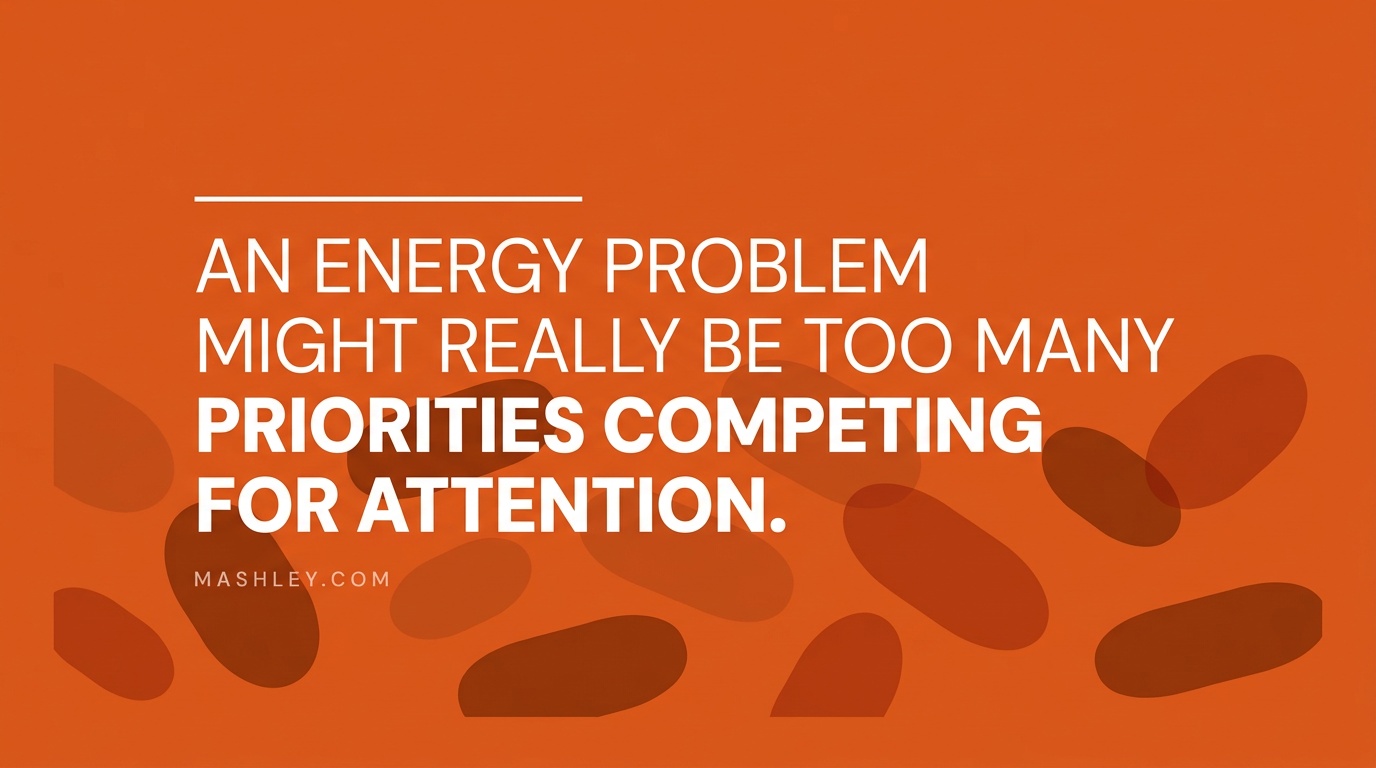
An energy problem might really be too many priorities competing for attention.
So try this. Write down everything you're holding right now... every project, every promise, every "I should really." Then ask the same question of each one: if this moved forward, would anything else get easier? Often only one or two will. Park the rest on purpose, written down and out of your head.
Then notice how you feel. Sometimes the tiredness has less to do with the hours and more to do with holding too many things at once.
If showing up and posting is one of the things on your list, that's the piece I'm building Radi8 to make simpler. Link in the first comment.
#Founders #Startups #Entrepreneurship …more
 View on LinkedIn
Also on


'/%3E%3Cpath fill='%23fff' d='M12 7.3A4.7 4.7 0 1 0 16.7 12 4.7 4.7 0 0 0 12 7.3Zm0 7.8A3.1 3.1 0 1 1 15.1 12 3.1 3.1 0 0 1 12 15.1Zm5-8a1.1 1.1 0 1 0 1.1 1.1A1.1 1.1 0 0 0 17 7.1Zm-5 1.5c-1.5 0-1.7 0-2.3.1a3.8 3.8 0 0 0-1.3.2 2.2 2.2 0 0 0-.8.5 2.2 2.2 0 0 0-.5.8 3.8 3.8 0 0 0-.2 1.3c-.1.6-.1.8-.1 2.3s0 1.7.1 2.3a3.8 3.8 0 0 0 .2 1.3 2.2 2.2 0 0 0 .5.8 2.2 2.2 0 0 0 .8.5 3.8 3.8 0 0 0 1.3.2c.6.1.8.1 2.3.1s1.7 0 2.3-.1a3.8 3.8 0 0 0 1.3-.2 2.5 2.5 0 0 0 1.3-1.3 3.8 3.8 0 0 0 .2-1.3c.1-.6.1-.8.1-2.3s0-1.7-.1-2.3a3.8 3.8 0 0 0-.2-1.3 2.2 2.2 0 0 0-.5-.8 2.2 2.2 0 0 0-.8-.5 3.8 3.8 0 0 0-1.3-.2c-.6-.1-.8-.1-2.3-.1Zm0-1.6c1.5 0 1.7 0 2.4.1a5.5 5.5 0 0 1 1.8.3 3.8 3.8 0 0 1 2.2 2.2 5.5 5.5 0 0 1 .3 1.8c.1.7.1.9.1 2.4s0 1.7-.1 2.4a5.5 5.5 0 0 1-.3 1.8 3.8 3.8 0 0 1-2.2 2.2 5.5 5.5 0 0 1-1.8.3c-.7.1-.9.1-2.4.1s-1.7 0-2.4-.1a5.5 5.5 0 0 1-1.8-.3 3.8 3.8 0 0 1-2.2-2.2 5.5 5.5 0 0 1-.3-1.8C4 13.7 4 13.5 4 12s0-1.7.1-2.4a5.5 5.5 0 0 1 .3-1.8 3.8 3.8 0 0 1 2.2-2.2 5.5 5.5 0 0 1 1.8-.3C10.3 5 10.5 5 12 5Z'/%3E%3C/svg%3E)
When a small business owner tells me they need more marketing, the first thing I want to know is where their customers are getting stuck.
The theory of constraints, in plain terms: every process has a bottleneck, and nothing you do anywhere else speeds it up. Pour soda from a bottle and the neck sets the pace. A bigger glass doesn't help. Shaking it definitely doesn't help!
Your customers move along a path too. They find out you exist, they compare you, they buy, they start using what you sell, and if it goes well they tell people. Somewhere on that path is your bottleneck... and it's different for every business.
If nobody knows you exist, a better website won't fix it. If people visit but never call, more posts won't fix it. If customers buy once and disappear, more ads just pour more people into a leaky step.
It's easy to spend months on the stage that feels productive instead of the one that's stuck. I've done it. Find the stuck one first, then put everything there.
Where do your customers drop off?
#SmallBusiness #Marketing …more
Told 2 times, Oct 20, 2026 – Oct 23, 2026
· X · Open
SBDC advisors: before a client spends on marketing, ask if their numbers are real and where customers drop off. Cheaper fix.
B

Beth Kukla
Co-Founder at Cora Nexus AI | Startup Ops | Force Multiplier | Project Manager | Strategic Planning | Cross-Functional Systems
Every decision routes through you. And it feels like being needed.
It isn't really, though. It's the system failing quietly.
I call it founder-as-bottleneck, and once you can see it, you can't unsee it.
The tells:
Approvals stack up on your desk while everyone waits.
The team stalls the second you're heads-down or out.
Nothing ships without your sign-off, even the small stuff.
That's not a sign you're indispensable. It's a sign the work has nowhere else to go.
Here's why it happens. No one owns ops. Nothing is written down. So the process lives in your head, and your head becomes the only door every decision has to walk through. You're not the leader in that setup. You're the choke point.
The reframe that changes everything: this is a systems gap, not a work-harder problem.
You can't out-hustle a missing structure. Longer hours don't fix an undocumented process, they just make you the bottleneck for more hours a day. The fix isn't you doing more. It's the decision having somewhere to go that isn't you. An owner. A documented path. A default that doesn't require your name on it.
Being needed for everything and being trapped by everything look identical from the inside. That's the part nobody warns you about.
Drop your take in the comments. Which of the tells hit closest to home. …more
B
Beth Kukla
Co-Founder at Cora Nexus AI | Startup Ops | Force Multiplier | Project Manager | Strategic Planning | Cross-Functional Systems
"Too early for ops" is the most expensive thing you'll believe.
Not because it feels expensive right now. It doesn't. That's the trap. Right now it feels responsible. You're conserving. You're focused on the product, the raise, the next milestone, and ops reads like a bigger-company problem you'll get to once you're a bigger company.
The bill just doesn't come due right now. It compounds.
It shows up later as rework, the same decision made three different ways by three different people. It shows up as misalignment, where everyone's moving fast in slightly different directions and nobody notices until it costs you a quarter. It shows up as you, the founder, being the only place certain things can happen, which means the business can't move faster than you can personally answer Slack.
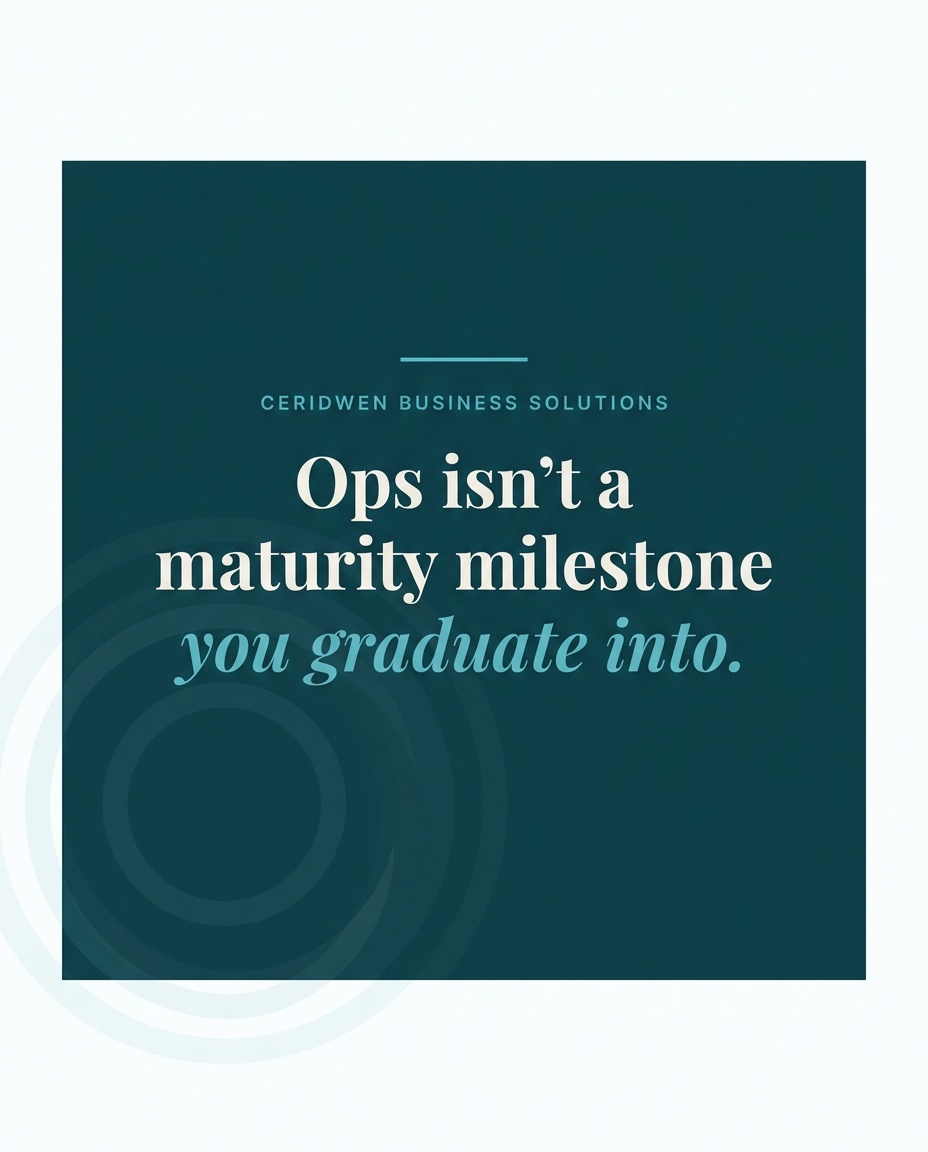
Ops isn't a maturity milestone you graduate into. It's not a reward for surviving long enough. It's the layer that decides whether growth makes you stronger or just heavier.
Building it right while you're small is cheap. Rebuilding it under load, while you're growing and everything's already on fire, is not. Same foundation. Very different price tag depending on when you pay for it.
The moment you're convinced you're too early is usually the exact moment it's cheapest to get right. …more
"How do I keep from being the bottleneck?"
Most founders think they're the bottleneck because of how much they do. They're actually the bottleneck because of what only they're allowed to decide.
It's a subtle difference, and it's the one that keeps stalled companies stalled. You can hire more people, delegate more tasks, clear your calendar — and still be the single point of failure. Because the work moved, but the authority didn't. Every real decision still routes back to your desk for a yes. The team isn't waiting on capacity. They're waiting on permission.
I've watched this for 25 years across four startups. A founder offloads the doing and keeps the deciding, then wonders why nothing moves when they're heads-down or out of the room. It looks like a delegation problem. It's a decision-rights problem. You gave away the tasks but kept the steering wheel, and a car with one driver can only go one place at a time.
The builders I most respect design the opposite way — on purpose, early, before it's comfortable. They treat decision-rights as something you architect, not something that accumulates by default around whoever started the company. Two questions do most of the work:
For any recurring decision, who owns it — not who advises, who decides? If the honest answer is "me, eventually," you've found a place the company can only move at your speed.
And what does this person need to decide well without me — the context, the constraints, the definition of a good outcome? Authority without judgment is just a faster way to make bad calls. The transfer isn't handing over a decision. It's handing over the thinking behind it, so the call gets made the way you'd make it, whether you're there or not.
Here's the reframe I've come to believe: a venture that can't make decisions without its founder isn't a company yet. It's a talented person with help. The moment it can decide well without you is the moment it becomes durable — something built to outlive your involvement instead of depending on it.
That's not abandonment. It's the point. You're not designing yourself out because you're leaving. You're doing it because a company that needs you for every decision is fragile in exactly the place that looks like strength.
So a question worth sitting with this week:
What's one recurring decision that still routes through you by default — and what would the person closest to it need in order to own it outright?
#Founders #Startups #Entrepreneurship #VentureBuilding #FounderLessons …more
View on LinkedIn
Also on
Most people I work with are trying to become indispensable. I spend my time trying to become unnecessary.
That sounds backwards, so let me explain the difference — because it's also the difference between me and the operators and agencies a founder might hire instead.
An agency is designed to keep you as a client. An operator is often measured by how much runs through them. Both, by design, make you a little more dependent every month. That's not a criticism of their intent — it's the incentive built into the arrangement. The longer you need them, the better it works for them.
My job is the opposite. I get handed a hard, ambiguous problem, I build the thing, I set a real foundation under it — and then the win is when a capable operator can take it over and scale it without me in the room. I'm not building a dependency. I'm building something that no longer needs me.
Here's why that matters even if you never hire anyone: dependency on a single person is a hidden fragility. It feels like control. It reads like importance. But it's the crack that doesn't show until the load shifts. In M&A, buyers actually price this — a business that leans too heavily on its founder gets discounted, sometimes steeply, versus one that runs on people, process, and structure. The market is telling you something founders don't want to hear: your irreplaceability is a liability on the balance sheet.
The fix isn't heroics. It's two disciplines most builders skip.
First: document the decisions, not just the outcomes. Anyone can inherit a result. Almost no one can inherit the reasoning — why you chose this customer over that one, why you killed the feature everyone loved, what you'd do if the number moved the wrong way. Outcomes tell your successor what happened. Decisions tell them how to think when you're gone. That's the part that actually transfers.
Second: treat the handoff as the test, not the goodbye. A clean handoff is the only honest proof the foundation is solid. If the thing wobbles the moment you step back, you didn't build a company — you built a role, and you're standing in it. The transfer is where you find out whether the structure was ever real.
I've come to believe the strongest thing you can build is something that outlives your involvement in it. Not because you're leaving tomorrow. Because durability and dependency are opposites, and you have to choose which one you're actually building.
So here's the question worth sitting with:
Is your company built to outgrow you — or to need you?
#Founders #Startups #VentureBuilding #ScalingUp #FounderLessons …more
Told 2 times, Jul 15, 2026
· X · Open
Most people try to become indispensable. I try to become unnecessary.
Founder-dependency feels like control. But in M&A it's priced as a liability — buyers discount it.
Document the decisions, not just the outcomes.
Is your company built to outgrow you — or to need you?
I've built a handful of companies. The ones that actually worked all followed the same shape — and it's close to the opposite of what most founders are told to do.
Build the thing. Set a foundation under it. Hand it to someone who can scale it. Then go do it again.
For years I thought the handoff was me failing. You start something, pour yourself into it, and then… you leave? It felt like abandonment. Now I think it's the whole point. My job is to make something exist and make it stand on its own — not to be the reason it keeps standing.
There's research that reframed this for me. Studying 200+ startups, Noam Wasserman found that founders are most likely to be pushed out right after their biggest wins. Not their failures — their wins. Because hitting the milestone changes the job underneath them. Inventing and scaling reward different instincts, and the thing that made you great at the first often makes you the bottleneck in the second.
So I stopped treating my exit as a threat and started treating it as a design requirement. If I build it right, it shouldn't need me. Durability doesn't come from a founder's presence — it comes from the people, process, and structure that outlast any one person.
The test I use now is simple: if I stepped away for 90 days, what would quietly break? Wherever the answer is "everything," that's not a vacation problem. It's a design problem.
If you stepped away for 90 days — what would quietly break first? …more
Told 2 times, Jul 12, 2026
· X · Open
I build companies so they don't need me.
Build it. Set a foundation. Hand it to someone who can scale it. Repeat.
For years I thought the handoff was me failing. It's the whole point — something standing on its own is the win.
Silicon Valley’s new frontier isn’t writing every line of code. It’s deciding what AI agents should do and how to evaluate them. From building startups and running accelerator programs, I’ve learned three practical rules for being agentic:
1) Define the objective, success metrics, and hard constraints up front.
2) Decompose work into discrete agent tasks with clear inputs and outputs.
3) Instrument feedback loops and human checkpoints to catch drift and control cost.
If you’re rethinking roles or workflows for agents, send me a message. #AI
https://www.wired.com/story/silicon-valley-agentic-individuals-future-of-work/ …more

Told 5 times, Feb 28, 2026 – Apr 9, 2026
· LinkedIn · Open
How do you automate marketing with AI?
AI will handle repeatable execution: content variants, email follow-ups, ad creative tests, and performance monitoring. The real constraint is strategy. Without a clear go-to-market hypothesis and prioritized early growth channels, automation amplifies noise, not traction.
Practical path: pick one channel, design simple experiments, automate the repeatable steps, measure lift, and iterate.
With 20 years building and scaling startups, I help founders convert unclear go-to-market strategies into operational growth systems at Radi8. Send me a message to schedule a free marketing audit. #startup
· LinkedIn · Open
My point of view on content marketing is simple.
Founders often treat content as a brand or traffic play. It delivers fastest when built as a repeatable acquisition engine: a defined buyer, a single, measurable offer, formats mapped to that buyer, and a small channel pilot to validate economics.
With 20 years of building and scaling startups, I use that framework at Radi8 to remove guesswork in early growth. If your go-to-market feels unclear, start with a testable acquisition hypothesis. Send me a message for a free marketing audit.
· LinkedIn · Open
Are You ‘Agentic’ Enough for the AI Era?
Wired reports AI agents are taking on much of the grunt work. The most valuable skill today is deciding what those agents should do. I agree. For early-stage founders that means shifting from pure execution to designing clear agent workflows: name the outcome, define the success metric, and build a fast feedback loop. Start by automating one repeatable task—content drafts, user outreach, or ad copy—and specify the outcome, the KPI you’ll watch, and how often the agent reports back. Without that structure, automation increases overhead instead of removing it.
Send me a message to schedule a free marketing audit.
Michael Ashley, Founder & CEO, Radi8 | Startup advisor, investor, mentor
https://www.wired.com/story/silicon-valley-agentic-individuals-future-of-work/
· LinkedIn · Open
The objection I keep hearing about automating marketing with AI, and why I still disagree
Objection: We can’t automate because our go-to-market is unclear and early channels are unproven. That mistakes automation for strategy. With 20 years of building and scaling startups, I use AI to accelerate learning, not replace decision making. In early GTM tests I use AI to run rapid channel experiments, generate audience hypotheses, automate creative and reporting, and keep validated channels running without heavy oversight. The result is shorter feedback loops so founders can make faster, better decisions.
If you are an early-stage founder testing GTM, send me a message to schedule a free marketing audit.
Channel names and logos are trademarks of their respective owners.