A client asked me this week: how do I explain what I do? The fix is rarely fancier words. Name the problem you solve, and who it's for... not your process. Clarity beats clever. Want to sharpen yours? https://calendly.com/foclarity/30min …more
mashley.com ↗
I’ve spent the better part of 25 years trying to understand two things: which problems are worth solving, and what is the simplest way to solve them. That pursuit has led me to start companies, build products, teach entrepreneurship, coach hundreds of founders, and participate in four startup exits—one as a founder and three as an advisor. Along the way, I noticed a pattern. Founders are usually very good at solving problems. The trouble is that we’re often solving the wrong ones. What looks like a sales problem might really be positioning. A marketing problem might begin with not understanding the customer. An execution problem might simply be too many priorities competing for attention. I came to think of this as finding the problem under the problem. When you find it, complicated decisions get simpler, teams align, and a surprising amount of work disappears. Today I coach founders and startup teams around the world to do exactly that. Sometimes it’s a team scaling a company worth billions. Sometimes it’s one person turning what they know into a consulting business. The scale changes, but the work is remarkably similar. Find the problem worth solving. Find the simplest way through it. Then get on with the work that matters.
You think the thing holding your practice back is that you don't have enough. Enough budget. Enough network. Enough runway to survive a mistake.
I've told myself that story too.
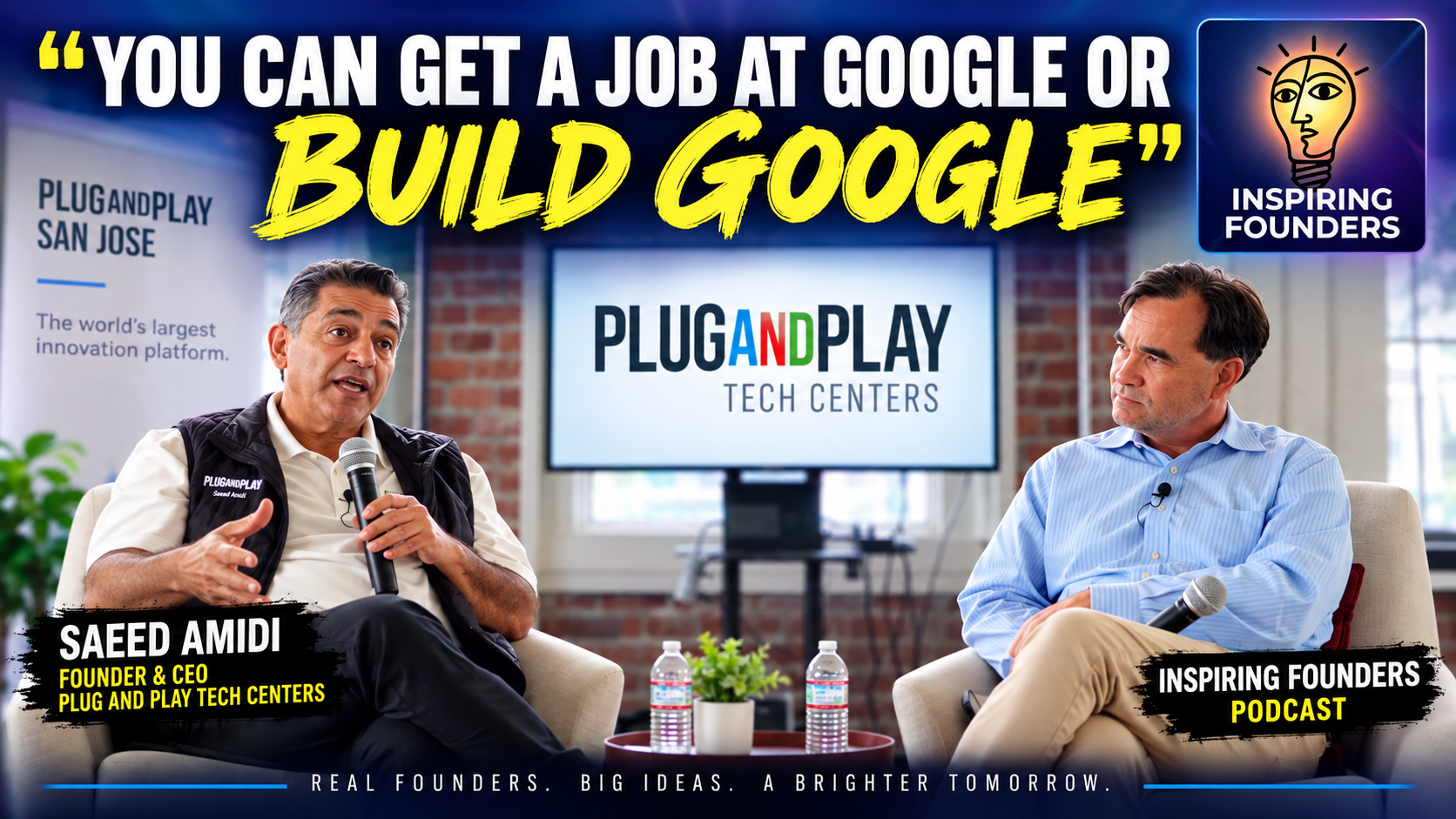
Then I listened to Saeed Amidi, founder of Plug and Play. Early on, he flew to Jeddah with a borrowed suit, his father's credit card, and money for exactly one trip. No safety net. No plan to come home empty-handed. In his words: "I'm not coming back till I sell something."
Having no Plan B didn't slow him down. It focused him. He stretched that one trip into 45 days and closed his first two deals.
Comfort never makes you that sharp. Constraint does.
Watch Saeed tell it himself here: https://youtu.be/bb9n-CnDGVA. It's the clearest case I've seen for why fewer resources can make you more resourceful, not less.
What constraint have you been treating as an obstacle that might actually be your edge?
#IndependentConsultant #Coaching #GoingIndependent …more
I sat across from Saeed Amidi in San Jose, a live audience in the room with us.
Saeed founded Plug and Play Tech Centers. He also, almost as an aside, runs a plastics and bottled-water company that does a billion dollars a year... which he still calls his "day job."
He told us about a building on University Avenue in Palo Alto. His first tenant there was Peter Thiel. His third was Andy Rubin. And in that same stretch, Larry and Sergey were building Google. He calls it the lucky building, the one that got him into PayPal.
Now Plug and Play invests in about 100 startups a year. He's building an AI Center of Excellence in San Jose. He thinks the AI revolution is 10 to 20 times bigger than mobile... and still only the tip of the iceberg.
But the part that stayed with me wasn't the numbers.
It was when he talked about pressure as a prerequisite. And why he won't back a founder who has a Plan B.
Then he closed with a line, and the whole room lit up:
"You can either get a job at Google, or BUILD Google!"
Full conversation with Saeed is on the Inspiring Founders Podcast. Watch it on YouTube, or listen on Spotify.
#IndependentConsultant #GoingIndependent #Coaching #ThoughtLeadership …more
"What's the deal with DeepSeek... should I be worried?"
DeepSeek just released another model that it says rivals the big names at a fraction of the price. So here's my plain version.
There are two kinds of AI models in this fight. Let's call them Closed and Open.
Closed AI says: "You can talk to my brain, but I keep the brain." You send it a question, it sends back an answer, and the model itself stays locked inside the company. (ChatGPT, Claude)
Open-weight AI says: "Here's a copy of my brain. Do what you want with your copy." The model gets handed over, and you run it however you like. (DeepSeek, Llama)
With closed AI, the company has more control over what the model can do. With open-weight AI, the world has more control over what the model can do.
That tension isn't new. DeepSeek just makes it concrete, because it's cheap, it's close to the best models out there, and once it's downloaded, nobody can see who's running it or what for. That part deserves attention.
But here's what most headlines blur together.
Using DeepSeek's app and using DeepSeek's model are two different things. The app is a closed service like any other... your questions go to DeepSeek's servers. The downloadable model is different. Run it on hardware you control and your data stays with you.
So if you're a consultant wondering whether to worry, the first question isn't open vs. closed. It's where your client's data goes when you hit enter.
Noticing is right. Panicking isn't.
What's the AI headline that's had you most unsettled lately? Drop it in the comments and I'll give you the plain version.
#IndependentConsultant #AIforBusiness #DataPrivacy #Coaching …more
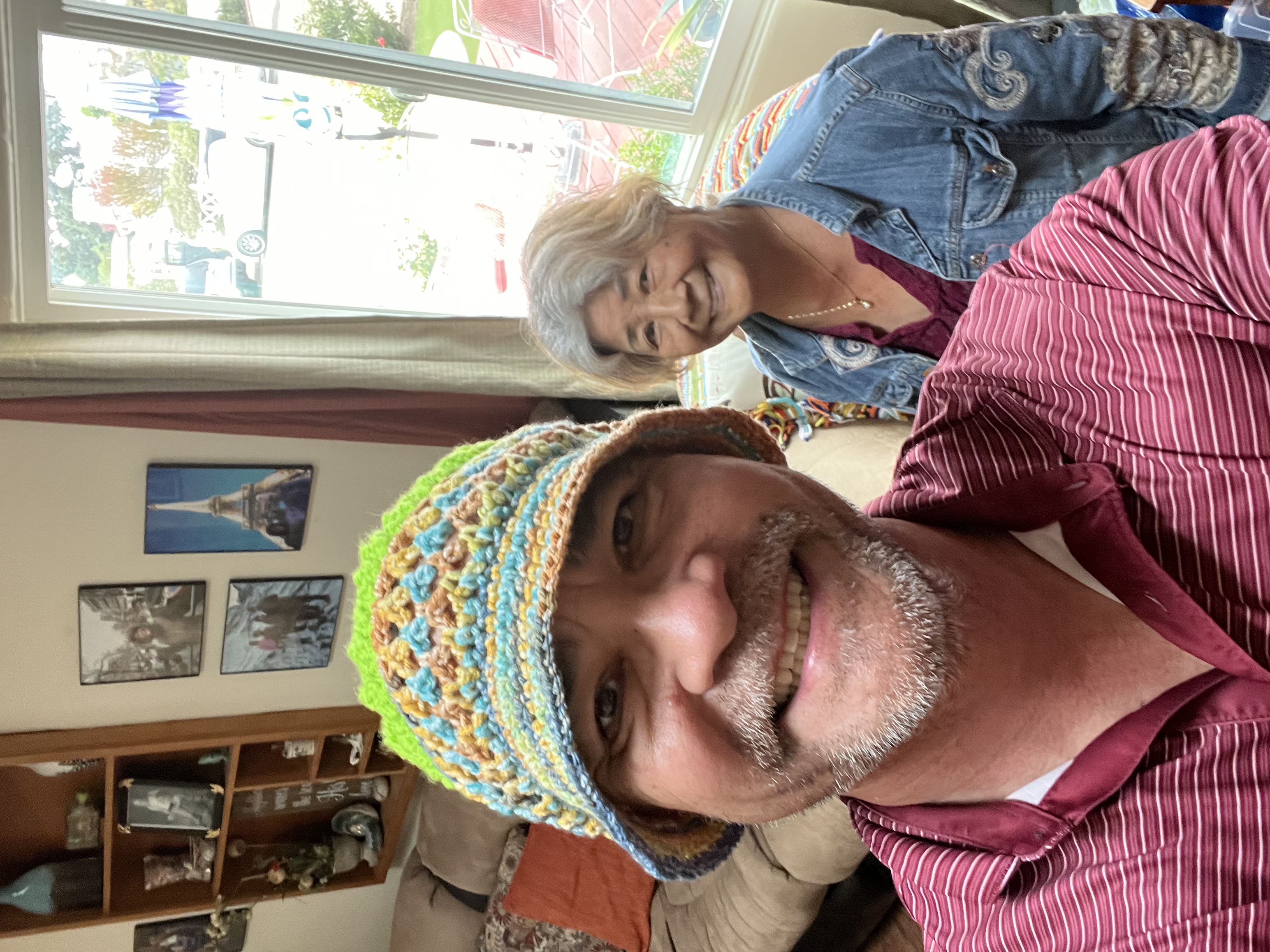
My mom crochets hats. She calls them Mombreros.
She's retired. She doesn't need the money, so every dollar of profit goes to charity. What she loves is the making and the giving.
She came from Vietnam and raised five kids, always with a bit of the entrepreneur in her. Of all of us, I'm the one who caught the bug.
So I posted about her hats.
I put them on Facebook — three friends bought one that same day. I put them on Instagram — an old friend I hadn't heard from in years went and ordered one.
I kept asking myself why it moved so fast. Here's my read: the post was honest about what it was for. It was mission-clear. And the people who aligned with that just showed up.
I'm surrounded by people who want to help each other out.
That's the whole thing, really. A business built on love and service, supported by people who share your ideals. Starting one is hard and slow — there's no shortcut — but doing it with purpose is what makes the time worth it. …more
People ask what the catch is on the free 30 minutes. Fair question. So here's exactly how it goes.
You talk. I listen. That's most of it, honestly.
Bring one specific challenge let's spend the time on that. I'll give you honest feedback, including the parts that are hard to hear, and together we find one or two concrete moves you can make this week.
Why free? Because the best conversations tend to lead somewhere for both of us, and I genuinely like helping people. If it turns out you're a fit for my coaching program, we can talk about it, but that follows the conversation, it doesn't drive it.
You'll get the most out of it by coming prepared: a real challenge, a clear top priority, and a willingness to act on what we land on. The people who get huge value come with something specific and go do the thing we talked about.
That's it. No pitch, no catch.
So here's my genuine question... if you had thirty minutes with someone who'd just listen and give you a straight read, what's the one thing you'd want to work through?
Book it whenever you're ready — link in the first comment.
#IndependentConsultant #Coaching #GoingIndependent #Positioning …more
What happens when you actually check whether your clicks are people?
I build Radi8, and it tracks link clicks, so one afternoon I went and looked under the number. Of 1,791 clicks across 177 links, 624 came from a human. The rest were bots, crawlers, preview-fetchers, the quiet machinery of the internet pinging a link so it can draw a little card. And here's the humbling part, a bot only gets counted as a bot when it politely announces itself, LinkedInBot, Googlebot, facebookexternalhit, which means the real human count sits somewhere below 624, never above it.
Then it got worse for my assumptions. The channel I'd have sworn was carrying me on raw clicks turned out to be mostly sending machines, while a quieter one was sending far more actual people. I almost optimized straight toward the emptier number.
Every figure on your dashboard is counting something. Make sure it's counting the thing you care about, before you spend a month acting on the wrong one. …more

I’m not that great at making LinkedIn videos… but I’m getting better.
I’m trying to do the selfie video thing so I can have content that’s clearly not AI - and since AI creates mostly perfect images and even video now, I figured seeing my amateur attempts will add some HUMAN to your day.
If you’re up for it, I’d love to see your videos too. Don’t worry if they suck. It’s way more interesting than a perfectly written manifesto on getting rich quick. …more
This post has video.
Watch it on the channel.
What's actually being evaluated when someone decides to hire you?
It isn't your resume. A resume is a list of claims, and everyone's list reads impressive. What people trust is evidence... the posts, the talks, the work they can watch you do before they ever pay you. That's the part that compounds. A good piece keeps working a year later, sitting next to the next one, and the next.
I learned this the slow way. For years I trusted the work to find me, because inside a company it did. On your own, nobody vouches for you but the body of work you've made public.
If you're building a practice and you want to be in a room with people making the same leap, click through and see who's inside Inspiring Founders: https://inspiringfounders.com
It's the room where the reputations get built out loud. Come start yours. …more
This post has video.
Watch it on the channel.
I got a new mount for my iPhone that makes it really super easy to record these Teleprompter videos now. It’s the one that has the round magnet on it so you can just slap the phone right on the mount and start reading from the Radi8 Teleprompter so this is an example. I’m doing it as we speak. …more
This post has video.
Watch it on the channel.
“Vitamin or pain killer?” - advisors love to ask this question about your product. And they love to tell you it has to be a pain killer, because it’s easier to sell. But the truth is less about pain and more about understanding your customer.
When I was 23 I worked at Threshold, one of the largest distributors of vitamins and supplements to the industry. They easily sold hundreds of millions of dollars every year into supplement stores all over the country.
What made them special wasn’t their inventory. It was their sales organization.
Every sales rep would spend time on the phone with their customers, they knew them by name, they talked like old friends. But more than that they spent time educating. And in turn their customers, the shop owners, educated their own customers.
What they created was an environment of conscious empathy and learning for people who didn’t want pain killers.
So here’s the question for your business: Are you chasing the same customers as all your competitors? The ones looking for pain killers?
Or are you building a community that’s tired of popping pills and wants a real, long-term solution?
Selling “vitamins” isn’t bad, it’s just very different from selling “pain killers” …more
Why isn't more content winning you more clients? Often it's not a marketing gap... it's fuzzy positioning nobody can repeat. See how I'd untangle it: https://mashley.com …more
Channel names and logos are trademarks of their respective owners.