
Today's post is 318 words, a 2-minute read.
Sources: Every.to — "Our Agents, Ourselves"
1 big thing: How forward-thinking teams are turning institutional knowledge into reusable AI skills
The best thinking in your marketing organization lives in someone's head. Every.to is running an experiment to change that.
Why it matters: In B2B marketing, your most valuable asset is not your tech stack. It is the judgment of the people who know your brand, your buyers, and what actually works. That knowledge walks out the door every time someone leaves.
Driving the news:
Every.to is capturing the decision-making patterns of their best employees and encoding them as reusable AI skills.
→ Their best editor's headline instincts, their top strategist's brief methodology — documented and accessible via AI
→ One Walleye Capital CEO now requires AI use for all 400 employees — not as a suggestion, but as a baseline operational standard
Zoom in:
Companies spent months answering the same 33 questions from executives on how to roll out AI — covering strategy, tool selection, governance, and winning over skeptics.
→ Every.to published those answers publicly for the first time this week
Yes, but: Encoding institutional knowledge takes deliberate documentation most teams defer indefinitely because it does not show up in this quarter's deliverables.
Be smart: Start with your highest-leverage knowledge holder. Document how they think about one recurring decision — a content brief, a headline, a channel call — and build from there. One reusable skill that reflects real expertise beats a hundred generic prompts.
The bottom line: Your best marketer's instincts should not be a single point of failure.
https://every.to/context-window/the-case-for-cloning-your-coworkers
#AIMarketing #B2BMarketing …more
Radi8 Social
M
Michael Ashley
Founder at Radi8 // Executive Coach // Host of the Inspiring Founders Podcast
It’s time for my daily dose of marketing caffeine. Today I’m talking about the customer journey and the theory of constraints. First, what is the theory of constraints? To keep it really simple, it’s a bottleneck that’s preventing you from achieving your goal. For example, if you want to pour soda from a bottle into your glass it has to pass through the bottleneck. You can’t pour it any faster because the bottleneck is small. But the interesting thing is actually how most people try to solve this problem. They get a bigger mug, they shake the bottle, they ask someone else to do it!! It doesn’t matter what you change, if you don’t deal with the bottleneck you can’t speed up the process.
Now what does that have to do with marketing and the customer journey?
Your customer is on a journey right now. First they need to become aware of your product or service. Then they can consider and compare you to arrive at a buying decision. If you’re a good fit you acquire them and take their money. Then they move to the adoption phase, they start using your product or service. If they’re happy they end up at the end of their journey in the advocate stage where they tell others.
This journey has a bottleneck. It’s different for each business, and only you know where it is. The key is for you to put all your energy into fixing the bottleneck, nothing else. If you’re successful the bottleneck will change and you can repeat the process.
Where people go wrong is they put energy into marketing that has zero impact on the bottleneck.
If nobody knows about you, it doesn’t matter how good your product is. …more
This post has video.
Watch it on the channel.
Told 2 times, Oct 2, 2026
· Instagram · Open
A bigger mug won't help you pour soda faster. Neither will shaking the bottle. 🥤
The bottleneck sets the speed. Same with your customer journey: awareness → consideration → purchase → adoption → advocacy.
Find your bottleneck. Put all your energy there. Repeat.
If nobody knows about you, it doesn't matter how good your product is.
Where's your bottleneck? 👇
#Marketing #CustomerJourney #TheoryOfConstraints #SmallBusiness #Entrepreneurship #Consulting
M
Michael Ashley
Founder at Radi8 // Executive Coach // Host of the Inspiring Founders Podcast
Most founders I work with are genuinely compelling in conversation. They can hold a room, tell a story, make you lean in.
Then they sit down to write a post and it becomes a press release.
Here's the framework I keep coming back to — I use it in my peer groups, in my advisory work, and in my own content.
Three parts:
1. The moment you identified the problem. Not "I noticed a gap in the market." The actual moment — specific, concrete, a little uncomfortable. That's where people trust you.
2. What you tried that didn't work. This is the part most founders skip. It's also where the trust gets built. Showing your failed attempts tells people you arrived at your answer honestly, not theoretically.
3. What you discovered that did work. Not "here's the solution." Here's what I found, tested, and now actually use.
The reason this works: it's the structure of every good story ever told. Problem, struggle, resolution. Your audience has heard a thousand "here's a tip" posts. They haven't heard your specific version of steps 1 and 2.
Try it on your next post. Start with the moment, not the lesson.
Comment "voice" and I'll send you the full one-page framework I share with founders. …more
M
Michael Ashley
Founder at Radi8 // Executive Coach // Host of the Inspiring Founders Podcast
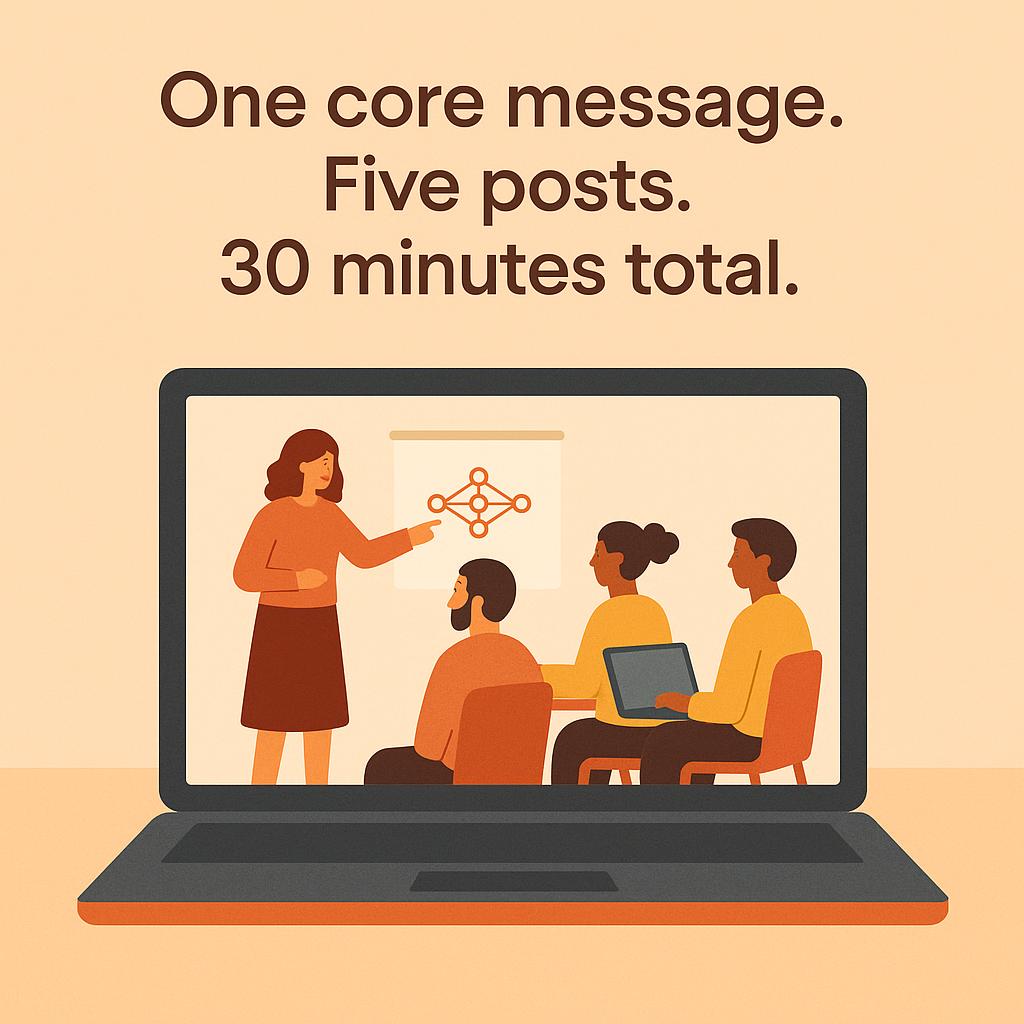
Here's a workflow you can steal. One core message → five LinkedIn posts in 30 minutes.
Step 1 (5 min): Pick one thing you believe about your industry. Not a tip. A point of view. Example: "Most marketing advice for small business owners is wrong because it assumes you have a marketing team."
Step 2 (5 min): Write it as a single declarative sentence. That's your core message.
Step 3 (10 min): Generate five angles on it with AI. Story angle (a moment this was true). Contrarian angle (what people get wrong). Tactical angle (one thing to do differently). Mistake angle (what you used to do). Persona angle (who specifically this hurts).
Step 4 (10 min): For each angle, write the first two lines yourself — that's the hook. Let AI fill in the middle. Edit the ending so the CTA sounds like you.
That's it. Five posts. Same core idea, five different doors into it. Your audience won't feel repetition because each post leads with a different shape of thought.
I'm walking through this workflow plus two more — competitor research in 10 minutes, and an editorial system that runs in 15 minutes a day — at my workshop on May 28th in San Jose at the MLK Library, hosted by the Silicon Valley Small Business Development Center.
If you can't make it, book a free 15 to 20 minute marketing audit and I'll run this workflow with you on your business.
https://www.radi8.com/free-audit?utm_source=linkedin&utm_campaign=free_audit&utm_content=post_id
DM me if you want the workshop link. …more
Told 14 times, Apr 10, 2026 – May 25, 2026
· LinkedIn · Open
Simple, outcome-focused positioning beats clever complexity.
Winning brands choose one customer problem, one distinct approach, and one measurable early growth channel.
If your go-to-market or early channels feel unclear, start with three things:
- a one-sentence positioning statement,
- two content themes mapped to buyer stages,
- and one channel to test for 90 days with a single KPI.
I launched three startups (one major acquisition) and advised three that reached billion-dollar exits. Sign up for a free marketing audit and consultation.
https://www.radi8.com/free-audit
#SMB #Marketing #AI
· LinkedIn · Open
Big news: Radi8 is now on Claude. 🎉
We just launched our official MCP server — which means small business owners can now access Radi8 directly inside Claude, Anthropic's AI assistant.
Your marketing plan. Your brand voice. Your content calendar. All of it, live inside your AI assistant.
Here's what that actually means in practice:
→ Ask Claude to draft content straight from your Radi8 plan
→ Get copy that already knows your campaign goals and brand voice
→ Go from strategy to published content in minutes, not hours
No more re-explaining your business to an AI every time you sit down to write. No more switching between tabs and copy-pasting context. Claude now knows what you're trying to accomplish — because it's connected to the plan you already built.
For small business owners doing marketing without a team, this is the gap-closer you've been waiting for.
If you want to see what this could look like for your business, I'm offering a free 15–20 minute marketing audit this month. Just a real conversation about where you are and what's possible.
👉 Book your free audit: https://www.radi8.com/free-audit?utm_source=linkedin&utm_campaign=free_audit&utm_content=test
This is just the beginning. More to come. 🚀
· LinkedIn · Open
I used to spend 3–4 hours a week on marketing. Now it's closer to 45 minutes.
The difference? I stopped doing it manually.
AI-assisted workflows have changed the game for small business owners — not because AI does your thinking, but because it eliminates the busywork: the formatting, the repurposing, the "how do I say this?" moments.
I'm also running a free workshop on May 28th in San Jose where I'll walk through exactly how I do this — live demos, real templates, no fluff.
But if you can't wait until May (or aren't in the Bay Area), I'm doing free 15–20 minute marketing audits this month. We'll look at where you're wasting time and what an AI-assisted workflow could look like for your business.
👉 Learn more about the workshop: https://www.radi8.com/blog/workshop-may-28th-marketing-with-ai
Or book a free audit directly: https://www.radi8.com/free-audit?utm_source=linkedin&utm_campaign=free_audit&utm_content=apr_plan
Comment below or DM me — happy to chat.
· LinkedIn · Open
One lesson the recent conversation around brand strategy and positioning keeps reinforcing: clarity wins.
Define who you serve, the problem you solve, and the outcome you deliver. Those three answers turn go-to-market decisions into tests, reveal the single repeatable early-growth channel to focus on, and create messaging that converts.
Proof: I launched three startups (one acquisition exit) and advised three that reached billion-dollar exits: an IPO, a merger, and a private equity sale.
If an unclear GTM or uncertainty about early channels is holding you back, send me a message. I’ll run a free marketing audit and map one high-impact channel plus 30-day priorities. I lead Radi8, where we help SMBs run practical, repeatable marketing.
· X · Open
I just had a full conversation with my laptop and it ran my entire marketing operation. Built a custom MCP server connected to Claude. This isn't AI helping me write. It's AI running the workflow. Free 15–20 min audit this month → https://www.radi8.com/free-audit?utm_source=x&utm_campaign=free_audit&utm_content=fun_post
· LinkedIn · Open
I just had a full conversation with my laptop and it ran my entire marketing operation.
No clicking. No tab-switching. No copy-pasting between 6 tools.
I built a custom MCP server — think of it as a direct nerve connection between me and Claude. I talk to it. It drafts posts, builds briefs, schedules content, pulls my strategy. Done.
This isn't "AI helping me write." This is AI running the workflow.
Small business owners are out here spending 10+ hours a week on marketing busywork. I just compressed that into a conversation.
Want to see what that looks like for your business? I'm doing free 15–20 min audits this month. We'll find your quick wins and build you a system that actually runs.
Book here → https://www.radi8.com/free-audit?utm_source=linkedin&utm_campaign=free_audit&utm_content=fun_post
· LinkedIn · Open
Most small business owners don't have a marketing problem.
They have a *time* problem.
You already know what you should be doing — staying in front of prospects, posting consistently, following up. But between running operations, serving clients, and putting out fires, marketing is always the first thing that gets pushed.
The fix isn't hiring an agency or spending more money. It's having a simple, repeatable workflow you can actually stick to.
Here's what that looks like in practice:
→ A content template you fill in once a week (30 min max)
→ A short list of topics you rotate through — no blank page syndrome
→ A posting schedule that doesn't require you to live on LinkedIn
I've helped founders build systems like this from scratch. Once it's in place, staying visible stops feeling like a chore.
If your marketing feels inconsistent or overwhelming, I offer a free 15–20 minute audit to help you see exactly where the gaps are and what to fix first.
No pitch. Just clarity.
DM me or grab a spot here → https://www.radi8.com/free-audit?utm_source=linkedin&utm_campaign=free_audit&utm_content=test
· LinkedIn · Open
Most small business owners want to use AI for marketing but don't know which task to automate first.
On May 28 in San Jose, I'm running a free workshop where you'll see live demos, get templates you can use the next day, and walk away with a repeatable workflow for content planning and post creation.
I've launched three startups with one acquisition exit and advised three more through billion-dollar exits. I know what it's like to handle your own marketing with no team and no time.
Seats are limited. Read the full details and register on my blog here https://www.radi8.com/blog/workshop-may-28th-marketing-with-ai
· LinkedIn · Open
Most small business owners don't need a bigger marketing budget. You need a repeatable system that doesn't eat up hours every week.
I'm now offering a free marketing audit for small business owners who need clarity on what to post and how to build a system.
Sign up for a spot https://www.radi8.com/free-audit
· LinkedIn · Open
The #1 thing I hear from small business owners about marketing: "I just don't have time."
Here's what I've found: it's rarely a time problem. It's a system problem.
When you have to start from scratch every week — staring at a blank post, figuring out what to write, editing, scheduling — of course it takes forever. But when you have templates, a simple workflow, and a few AI tools doing the repetitive work? It takes 30–45 minutes a week.
That's what I'll be showing at my free workshop on May 28th in San Jose. Live demos, real templates, and a workflow you can plug in the next day.
Comment "workshop" below and I'll send you the link, or grab a spot here → https://www.radi8.com/blog/workshop-may-28th-marketing-with-ai
· LinkedIn · Open
Most small business owners I talk to aren't bad at marketing.
They're just exhausted by it.
They spend hours staring at a blank screen, posting inconsistently, then going quiet for weeks because life got busy.
The fix isn't more willpower — it's a repeatable workflow.
When you have a simple system: what to post, when to post, how to write it fast — marketing stops feeling like a second job.
I've built and exited three startups, and the one thing that always separated growing companies from stalled ones was whether marketing was a habit or a hustle.
If you're a small business owner and you're not sure where to start — or you've been "meaning to get consistent" for a while now — I'm offering free 15–20 minute marketing audits this month.
No pitch. Just a real conversation about where you are and what would actually help.
👉 Book yours here: https://www.radi8.com/free-audit?utm_source=linkedin&utm_campaign=free_audit&utm_content=apr_plan
DM me if you have questions first.
· LinkedIn · Open
If you're a consultant or solo founder, you have a problem most marketing advice ignores: you are the product.
You can't hand your sales calls to someone else. You can't outsource your point of view. And you can't go quiet for two months without watching your inbound dry up — because nobody else can show up as you.
That's why "just hire a marketing person" doesn't work for solo operators. The voice has to be yours. The thinking has to be yours. The relationships have to be yours.
But that doesn't mean marketing has to eat your week.
What works for solo founders and consultants I advise is a tight, repeatable workflow: one prep block on Monday, posts queued for the week, 15 minutes a day on engagement. AI handles the heavy lifting on drafts. You handle the hooks, the point of view, and the relationships. The system runs even when client work is slammed.
That's what I'm teaching at my workshop on May 28th in San Jose at the MLK Library, hosted by the Silicon Valley Small Business Development Center. Built specifically for people who can't outsource being the face of the business.
If you can't make it, book a free 15 to 20 minute marketing audit. I'll look at how you're showing up now and help you build a workflow that doesn't compete with your billable hours.
https://www.radi8.com/free-audit?utm_source=linkedin&utm_campaign=free_audit&utm_content=post_id
DM me if you want the workshop link.
· Instagram · Open
I rebuilt my entire product in 30 days using AI.
Not because I wanted to move fast.
Because I had to prove something to myself.
Could AI actually do the work founders avoid because it feels too repetitive, too time-consuming, or just not worth the mental energy?
I picked the hardest problem I know.
Marketing content.
Most founders I work with know they should post more. They understand consistency builds trust. But they're not writers. They don't have time to research topics. And the idea of planning a month of posts sounds exhausting.
So they don't do it.
Or they do it once, burn out, and stop.
I wanted to see if Claude could handle the parts that slow people down: finding what to say, drafting it in your voice, keeping a calendar full without starting from scratch every week.
The result surprised me.
Not because it replaced judgment. It didn't.
But because it removed the friction. The blank page problem. The decision fatigue.
What used to take me two hours now takes twenty minutes.
And the quality is better because I'm editing and refining instead of grinding through first drafts.
We're launching Radi8 in March. It's built for founders who want to stay visible but refuse to live on social media.
If this resonates, follow along. I'll be sharing what I'm learning as we go.
And if you want to talk through your own marketing workflow, send me a message. Happy to walk you through what's working.
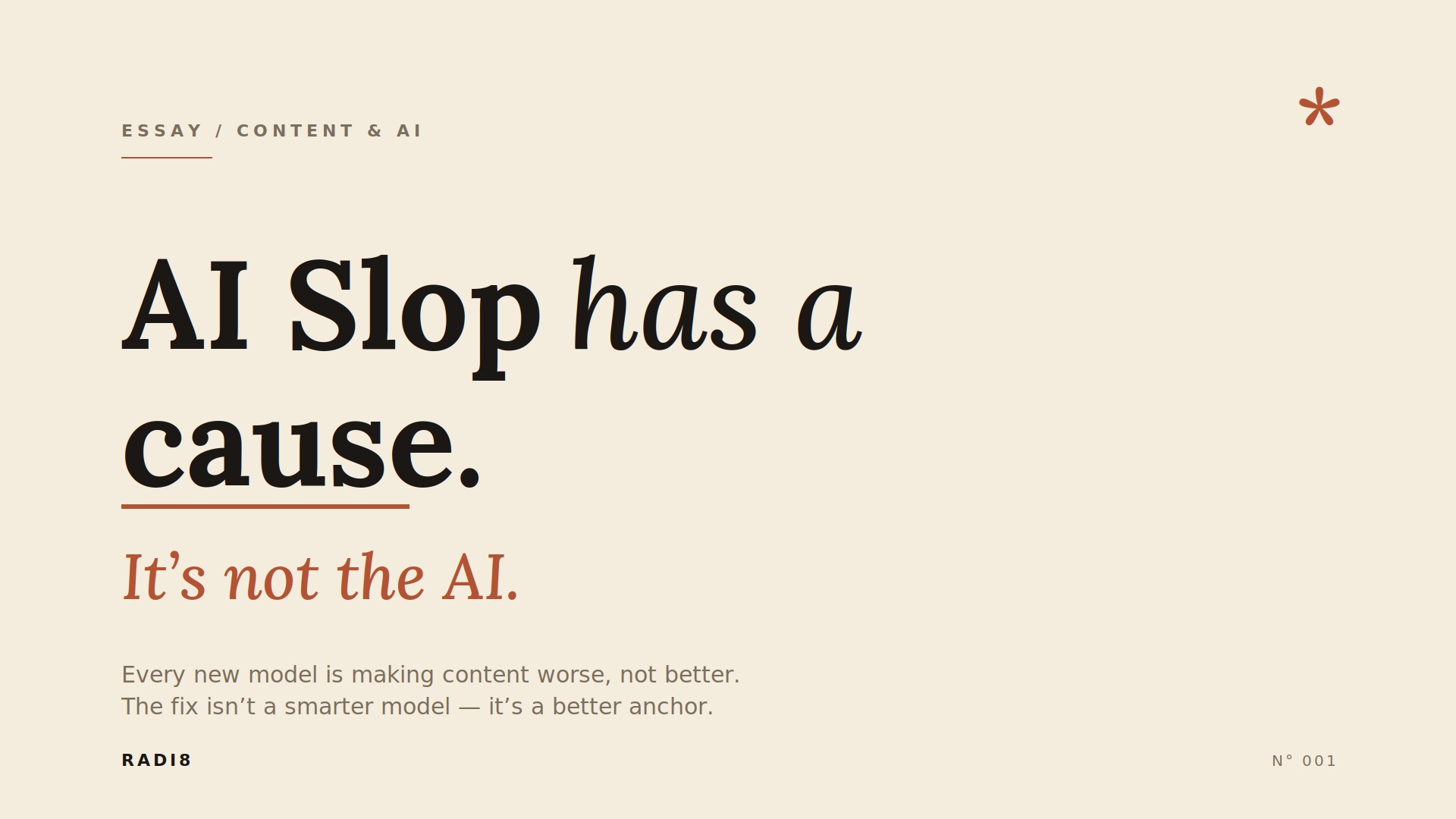
Every new AI content tool promises to save time and scale content production. Yet the feed keeps filling up with the same generic posts. You know the ones—vague insights, buzzwords stacked on buzzwords, nothing that actually sounds like it came from a human with specific experience.
The problem is not the AI. The problem is that most AI tools have nothing to anchor to.
When you feed prompts into a blank interface, the AI does exactly what it's designed to do: generate statistically probable language. It pulls from the aggregate of everything it's been trained on. That aggregate is safe, generic, and indistinguishable from the last 50 posts in your feed.
Brand context as the foundation changes this completely.
When AI has actual context to work from—your positioning, your voice principles, your proof points, the specific pains your audience faces—it stops producing slop. It starts producing content that reflects how you actually think and communicate. Content that carries your credibility instead of diluting it.
I've seen this across multiple enterprise tech companies. The marketers who win are not the ones using AI as a shortcut. They're the ones who build the right inputs first. They document what makes their brand distinct. They define voice principles that reflect real experience, not aspirational marketing speak. Then they use AI to scale that foundation, not replace it.
If your AI-generated content feels generic, ask yourself: what context did I give it? A one-off prompt in a chat window, or a documented system that captures how your brand actually shows up?
The tools matter less than the setup. Start with brand context. Everything else gets easier from there.
Want a fresh take on your B2B content strategy? DM me and let's schedule a 30-minute consultation—I'll show you 3 things you can improve this week.
https://www.radi8.com/blog/ai-slop-has-a-cause-its-not-the-ai …more
Told 3 times, Aug 31, 2026 – Sep 4, 2026
· X · Open
Most AI failures aren't model failures. They're context failures.
The AI doesn't know you or what good looks like. It produces the internet's average.
Better context beats a better model.
Doer to architect. That's the shift. https://buildingasecondbrain.com/ai-second-brain
#AIMarketing #B2B
· LinkedIn · Open
Today's post is 312 words, a 2-minute read.
Sources: Forte Labs — "From Doer to Architect"
1 big thing: What just changed in how B2B marketers should use AI?
Most AI underperformance is not a model problem. It is a context problem.
Why it matters: B2B marketers investing in AI tooling without investing in context architecture are scaling mediocrity. The output is only as good as what you give it to work from.
Driving the news:
Recent research shows LLMs begin to fail when their context window hits 30–40% capacity — a phenomenon called "context rot."
→ AI starts missing connections, forgetting key details, and producing generic output
→ The fix is not a better model. It is curated, modular context built deliberately over time
Zoom in:
Tiago Forte calls the required mindset shift going from "doer to architect" — you stop executing tasks and start designing the systems that execute them.
→ For B2B marketers, that means documented voice principles, structured brand inputs, and defined quality standards your AI collaborators can actually use
Yes, but: Building context architecture takes real upfront investment. Most marketing teams are under enough pressure that "documenting how we think" never makes the sprint.
Be smart: Start with a Master Prompt — one document that tells your AI who you are, how you work, and what good looks like. That single input closes more of the quality gap than any model upgrade.
The bottom line: The marketers pulling ahead are not using better AI. They are giving their AI better inputs.
https://buildingasecondbrain.com/ai-second-brain
#AIMarketing #B2BMarketing
M
Michael Ashley
Founder at Radi8 // Executive Coach // Host of the Inspiring Founders Podcast
Busy founders and stalled founders often look identical from the outside. Both are working constantly. The difference is what happens to all that effort.
Here's the pattern I've watched for 25 years: activity that isn't built on a system doesn't compound. You do the outreach, the post, the follow-up, the demo — and then next week you start from zero and do them all again. It feels like progress because it's exhausting. But nothing accumulates. You're not building an engine; you're pushing the car.
A system is just the opposite. It's a motion you run once, learn from, and improve — so the next turn is a little sharper than the last. That's what compounding actually is: the same effort producing more each time because the thing underneath it is getting better.
The trap for a stalled founder isn't laziness. It's the opposite. There's so much motion that you can't tell which of it is worth turning into a system and which is just noise burning the hours.
Here's the filter I use. One question separates the signal from the noise:
Which single motion, if it got 20% better every time we ran it, would change the trajectory of the business?
That's the one to systematize. Not the ten things that feel urgent — the one whose improvement curve actually bends the outcome. Usually it's unglamorous: how you talk to customers, how a lead becomes a conversation, how you decide what to build next. Almost never the thing that's loudest on your calendar.
Then be honest about the rest. Most of what fills a stalled founder's week is motion that will never compound no matter how well you execute it. That's not a productivity problem you fix with a better tool or another hire. It's a focus problem. Cutting it isn't losing ground — it's freeing the attention the one motion needs to become a real system.
The uncomfortable part: you can't systematize everything, and trying to is its own form of noise. Compounding demands you pick.
So the question worth sitting with this week:
Of everything you're doing right now, which one motion is actually worth turning into a system — and what would you have to stop doing to give it the attention it needs?
#Founders #Startups #Entrepreneurship #FounderLessons #GrowthStrategy …more
Told 3 times, Jun 15, 2026 – Jul 27, 2026
· LinkedIn · Open
Across four companies and 25 years, my go-to-market got better every time. Here's the most important thing I learned.
Stop trying to do everything at once.
Most growth problems look like marketing problems.
But when I dig in with founders, the issue is usually lack of focus.
Too many audiences.
Too many messages.
Too many priorities.
Too many opportunities.
What actually works: one audience segment, one message, one channel, one objective. Run it long enough to learn something.
The lesson isn't about marketing.
It's about decision-making.
The companies that grow fastest are often the ones that say no most often.
What's one thing you're working on right now that you know should probably wait?
· LinkedIn · Open
Most stuck practices aren't under-resourced. They're over-complicated.
I see it with almost every coach and consultant I advise. Three audiences. Five offers. Two newsletters, a podcast idea, a course half-built, a website redesign in progress. Everything is "almost working," which is another way of saying nothing is.
When growth stalls, the instinct is to add more: channels, offers, effort. After 25 years of building companies, I trust the opposite pattern. Momentum comes from removing decisions. A few things running well compound faster than many things running at half strength.
A practice has one engine: a clear person, with a clear problem, hearing a clear promise, through one reliable channel. Everything beyond that is optional until the engine runs. Most of what fills a stuck practice-owner's week is complexity that will never compound no matter how well it's executed.
Here's the exercise I run with clients. List everything you're doing to grow. Then ask one question of each item: if this got 20% better every month, would it change the trajectory of my business? Most items fail the test immediately. The one or two that pass — that's the business. The rest is noise wearing a to-do list.
Cutting will feel like retreat. Give it two weeks and it starts to feel like focus.
What's the one decision that, if you made it this week, would unblock everything else in your practice?
#IndependentConsultant #Coaching #ConsultingBusiness #GoToMarket
M
Michael Ashley
Founder at Radi8 // Executive Coach // Host of the Inspiring Founders Podcast
Your credentials aren't what win the client. They help. They're just not the thing that tips the decision.
I learned this slowly, against my own instincts. My brain always wants to go to the facts and the data... and I miss the story completely. Every single time.
Nobody buys an outcome in the abstract. People buy themselves into a story they can see themselves in. A prospect doesn't need your framework first... they need to meet someone who started right where they're standing now.
The method is simpler than it sounds: ask a real client, with their permission, where they were when you started, what changed in the middle, and where they landed. Capture it in their own words. That's the most useful marketing you'll ever do.
Your data earns the trust. Their story is what gets someone to reach out.
If you want help finding and shaping that story, grab 30 minutes with me... link in the first comment.
#IndependentConsultant #Coaching #Solopreneur #Messaging #PersonalBrand …more
M
Michael Ashley
Founder at Radi8 // Executive Coach // Host of the Inspiring Founders Podcast
Most people going independent think visibility is a numbers game. It isn't. It's a memory game.
Your brand is a promise, and a promise only means something once someone has watched you keep it. That's the part the follower count misses. Likes and impressions tell you a post traveled. They say nothing about whether anyone now trusts how you think. Those are two different accomplishments, and only one of them wins clients.
Here's what I've seen over 25 years of building companies and advising people who are great at the work: reach is a symptom, judgment is the asset. When you left the org, you didn't just lose the title. You lost the thing that used to vouch for your judgment — the brand behind you, the internal reputation that meant the work found you. Now you're building that proof from scratch, in public, one decision at a time.
So the goal isn't to be seen more. It's to be seen thinking. When you share how you'd approach a messy client situation, the question you'd ask before a big call, what a project taught you the hard way — you're not chasing attention. You're compounding evidence. A prospect who has watched you reason through six real problems doesn't need a sales pitch. They already know how you'd handle theirs.
That's why the vanity metrics are a poor scoreboard. A post that reaches 10,000 strangers and changes no one's mind is worth less than one that reaches 200 of the right people and makes three of them think, "I want this person in the room when I decide." Demonstrated judgment, consistently, over time — that's a reputation the market can actually see, and it's the one that outlasts any single post.
So a question worth sitting with: when you look back at what you've shared this year, does it show people how you think — or just prove that you posted?
#IndependentConsultant #Coaching #PersonalBrand #ThoughtLeadership #GoingIndependent …more
Told 2 times, Jul 23, 2026 – Aug 22, 2026
· X · Open
People don't buy when they trust you. They buy when they've already seen how you think. What have you let them see lately?
Jensen Huang gave the AI buildout its cleanest definition yet: "We now need a new type of infrastructure — an AI factory. Energy comes in; intelligence comes out."
His math is the part worth sitting with. Out of a $100 trillion economy, roughly $15 trillion is work that would benefit from more intelligence. Every company will tap into it. That's the real reason data centers are going up everywhere — not hype, but demand for a raw material almost every business now wants.
Here's the shift for those of us marketing complex technical products.
For years we sold intelligence as a scarce, premium thing. Something you bought carefully, deployed slowly, and defended in the budget. Huang is describing a world where intelligence behaves more like electricity — a utility you plug into, metered and abundant.
When the input gets commoditized, the story can't be "we have the smart thing." Everyone will have the smart thing.
The differentiation moves to judgment: what problem you point that intelligence at, how well you understand the human on the other end of it, and whether you can explain — in plain language — why it matters to their work this quarter.
The factory produces intelligence. It doesn't decide what's worth building. That part is still ours.
Want a fresh take on your B2B content strategy? DM me and let's schedule a 30-minute consultation — I'll show you 3 things you can improve this week.
#B2BMarketing #AIStrategy …more
This post has video.
Watch it on the channel.
M
Michael Ashley
Founder at Radi8 // Executive Coach // Host of the Inspiring Founders Podcast
If you're solving the same problem every week, you don't have a task problem. You have a structure problem.
It's one of the clearest patterns I've learned across four startups and a lot of advising rooms: recurring firefighting is almost never about the fire in front of you. The same issue keeps coming back because something in the system — how work flows, who owns what, how decisions get made — keeps producing it. You can put the fire out beautifully every single time, and it will still be there next Tuesday.
W. Edwards Deming made this point decades ago, and it still holds. In Out of the Crisis, he estimated that about 94% of the problems in any operation belong to the system, not the people — only around 6% trace to a true one-off. Read that again: the overwhelming majority of what looks like individual failure is actually structural. So when the same thing breaks over and over, blaming the person doing the task is the most expensive mistake you can make.
The fix is slower up front and far cheaper over time. Instead of solving the instance, you step back and ask what keeps generating it — then you change that. Redesign the handoff. Clarify the ownership. Remove the step that keeps failing. Do it once, at the structural level, and the symptom stops recurring instead of demanding your attention forever.
Firefighting feels productive because it's visible and urgent. But a leader's real job isn't to be the best firefighter in the building. It's to build something that stops catching fire.
What's the problem that keeps coming back no matter how many times you solve it — and what structure might be quietly producing it? …more
Told 4 times, Jul 8, 2026 – Jul 10, 2026
· X · Open
Deming counted: ~94% of problems belong to the system, not the people.
So when the same thing breaks every week, blaming the person doing the task is the most expensive mistake you can make.
· X · Open
If you're solving the same problem every week, you don't have a task problem. You have a structure problem.
· X · Open
If you're fixing the same thing every week, it's not a task problem. It's a structure problem. Fix what keeps producing it.
M
Michael Ashley
Founder at Radi8 // Executive Coach // Host of the Inspiring Founders Podcast
The most interesting opportunities almost never look exciting at first.
They look stuck.
Someone's been circling the same idea for years. Everyone agrees it should exist. There have been meetings, decks, maybe a failed attempt or two. And yet — nothing has moved.
That's the moment I want to walk in.
Not because I'm smarter than the people who were there before me. Usually I'm not. It's because stalled initiatives are rarely blocked by effort or talent. They're blocked by something structural: an unclear problem, too many priorities, no real owner, a foundational decision nobody's been willing to make.
Find that one thing, move it, and the whole thing starts to breathe.
After 25 years, I've stopped chasing the ideas that already have momentum. Plenty of capable people can push those forward. I'm drawn to the stuck ones — the initiatives everyone believes in but no one has been able to move.
Making those move is the most satisfying work I know.
What's the thing in your world that everyone agrees should exist — but nobody has been able to make happen yet? …more
Told 2 times, Jun 29, 2026
· X · Open
The most interesting opportunities don't look exciting.
They look stuck.
Everyone agrees it should exist. Nobody's been able to move it.
Stalled work is rarely blocked by effort. It's blocked by structure — an unclear problem, no owner, a decision no one will make.
M
Michael Ashley
Founder at Radi8 // Executive Coach // Host of the Inspiring Founders Podcast
In every founder peer group I run, someone says some version of this: "I know I need to be posting more, but I don't want to sound like I'm just selling all the time."
I hear this constantly. And I understand it. Nobody wants to be that person.
Here's what I tell them.
Salesy content isn't caused by selling. It's caused by skipping the value step.
Look at your last 10 posts. How many of them taught something, shared a hard-won lesson, or gave your audience something they could use today? How many were asking for something — a click, a follow, a demo?
The ratio matters more than the message.
When your feed is mostly valuable, your promotional posts don't feel like interruptions. They feel like a natural next step from someone your audience already trusts.
The rule I follow: for every post that promotes something, publish two that teach or share something genuinely useful. Not rephrased common knowledge. Something specific to your experience.
It's not about being less promotional. It's about earning the right to promote.
What's your biggest challenge when it comes to showing up consistently? Comment or DM me — I'm genuinely curious. …more
Channel names and logos are trademarks of their respective owners.