
Entrepreneurship

A founder asked me how to tell signal from loud customers.
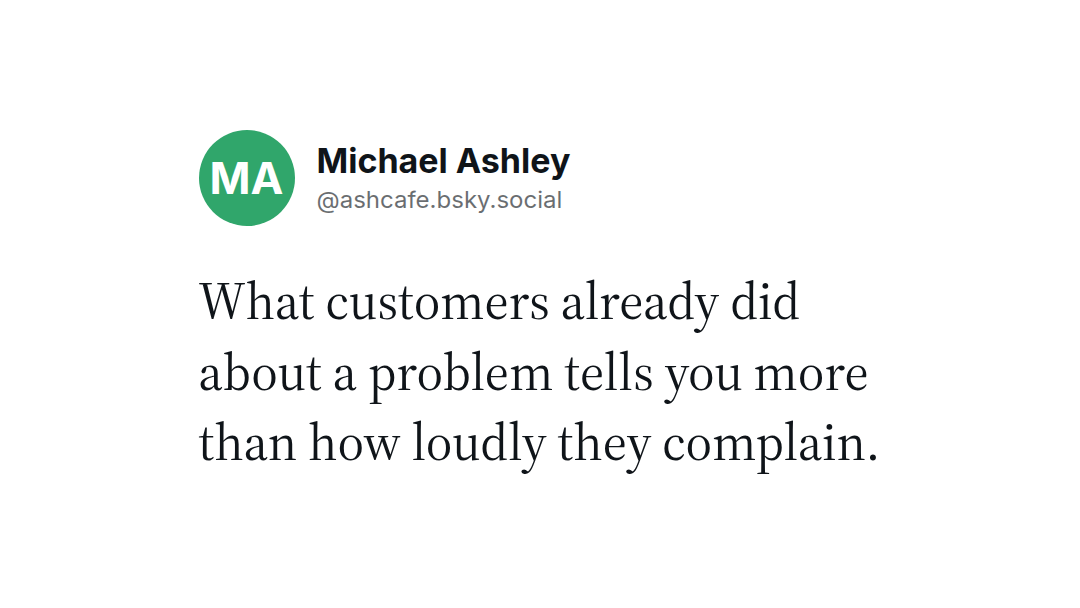
What customers already did about a problem tells you more than how loudly they complain. Before a bet, check: did they pay for a fix, build a workaround, switch? That's signal.
The deeper version: https://mashley.com …more
 View on Bluesky
Also on

"I need more leads."
That's often the first thing a consultant says to me when we sit down. It sounds like the right problem... honestly, I'd probably start there too.
So the funnel gets tweaked. The LinkedIn profile gets rewritten. The sales call gets rehearsed, again.
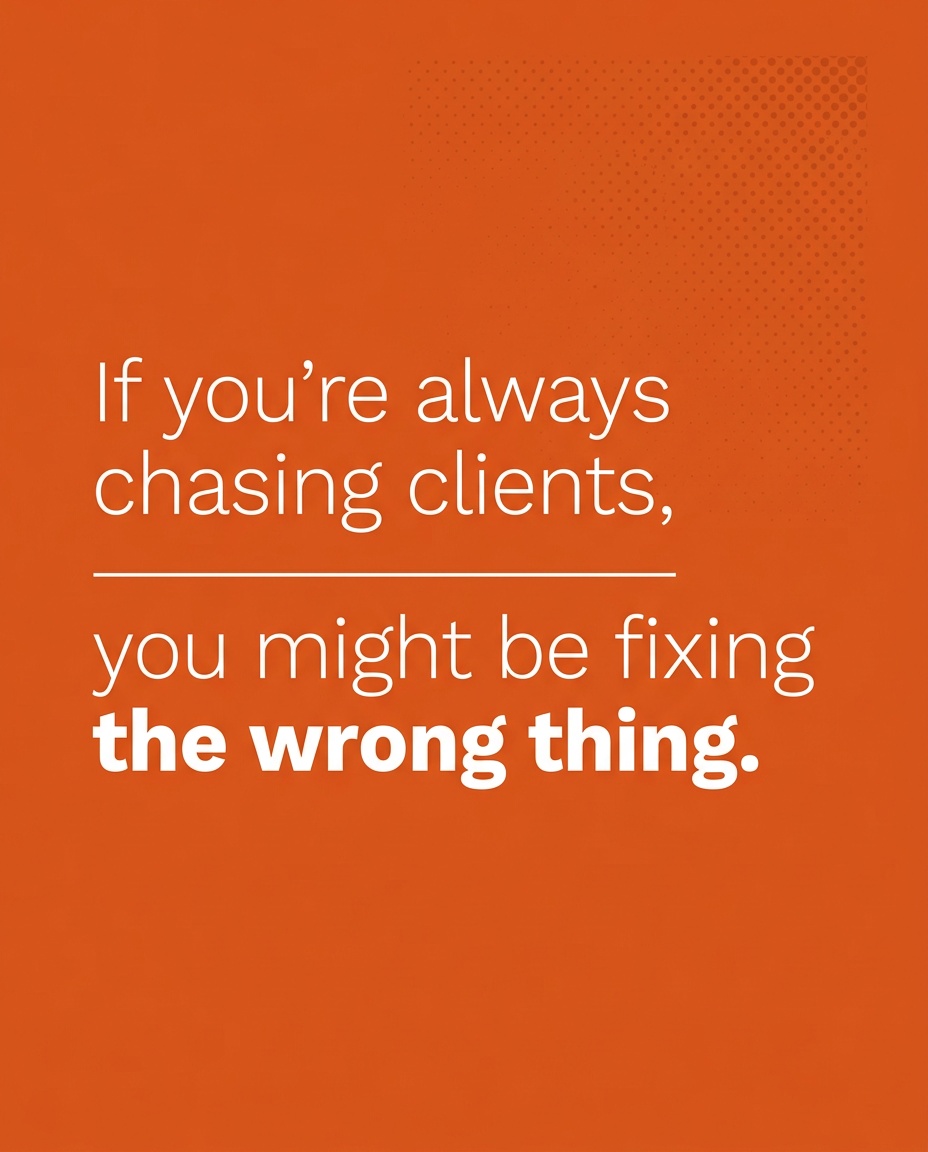
If you're always chasing clients, you might be fixing the wrong thing.
The marketing, the network, the sales call, the funnel... those might be symptoms. What looks like a lead problem might really be the offer underneath all of it: what you're selling and how it's structured.
When the offer describes an outcome someone already wants, the right buyers tend to find you more easily, and the chasing starts to quiet down.
So before you touch the funnel again, ask one question: does my offer describe an outcome... or a list of what I can do?
If you're not sure which one yours is, my booking page is in the first comment. Bring your offer, and in 30 minutes we'll read it the way a buyer would.
#IndependentConsultant #Consulting #Positioning #GoToMarket …more
 View on LinkedIn
Also on
Told 17 times, Jul 22, 2026 – Nov 19, 2026
· Bluesky · Open
I've watched founders rebuild the funnel and rewrite the sales call... and still chase every deal.
If you have to chase every customer, the problem might be the offer, not the marketing.
· LinkedIn · Open
When a coach or consultant tells me their marketing isn't working, the marketing is almost never the problem.
I hear it weekly. "I'm posting. I'm networking. I redid the website. Nothing's landing." The instinct is to fix the visible thing — better content, a new funnel, more activity. But activity was never the issue.
Here's the pattern I've seen across 25 years of building companies and advising businesses. Weak results almost always trace to something upstream. Fuzzy positioning, so you can't say what you do and who it's for in one sentence that lands. Thin customer understanding, so you describe your work in your words instead of your client's. No focus, so you speak to everyone and reach no one.
Marketing amplifies whatever you feed it. Feed it a blurry message and you get blurry results, faster.
Try this test. Describe what you do to a stranger in one sentence. If their next question is "so, what do you actually do?" then you don't have a marketing problem. You have a positioning problem. More posting won't fix that. It just makes the confusion more visible.
The good news: positioning is fixable, and usually fixable fast. It's one clear decision about who you serve and what changes for them, made with real customer evidence instead of guesses. Once that decision is sharp, the same marketing effort starts working, because it finally has something clear to carry.
So a question worth sitting with: if I asked your last three clients what you do, would their answers match each other? And would they match yours?
#IndependentConsultant #Coaching #Positioning #Messaging
· X · Open
"I just need more marketing" rarely fixes a feast-or-famine pipeline. Revenue and followers are downstream... they look fine right up until they don't. The root is usually positioning or a misaligned offer. I dig into it here: https://youtu.be/bb9n-CnDGVA
· Bluesky · Open
A founder tells me they need more marketing. I ask who it's for... and the answer often takes a while.
That pause might be the real problem, and it isn't one you can hand off.
What's your one line for who you help?
· Bluesky · Open
When a consultant says they need more leads, I read their offer first.
What looks like a lead problem might really be the offer: does it describe an outcome, or a list of what you can do?
Check yours before you fix the funnel.
· X · Open
I've sat with leaders who fixed the funnel, the network, the sales call... and were still chasing every client.
Constant client-chasing might be an offer problem sitting under the marketing.
Why I look there first: https://youtu.be/M58Dnn2UAlM?is=hzrAl7LB9vuXVJ7U
· LinkedIn · Open
When the clients aren't coming yet, the first move is almost always cosmetic. A new logo. A cleaner website. Fresh business cards. I did the same thing early on... convinced the next redesign was the one that would finally land it.
It almost never is. A website is where your positioning becomes visible to the market, and that's the real work it's quietly doing. When a first site falls flat, it usually isn't the design. It's that the message underneath is still fuzzy, you can't yet say in one plain sentence what you do and who it's for, so even a lovely site ends up saying it lovely and vague.
Get the words right first and the site gets easy... it nearly builds itself once you know what it's supposed to say. That's the part worth slowing down for.
If that's the part you keep circling, book a free 30 minutes with me and ask me anything about your positioning. Link's in the first comment.
How would you explain what you do, in one sentence?
#Positioning #IndependentConsultant #Coaching #GoToMarket #Solopreneur
· LinkedIn · Open
Why isn't your marketing working?
Before you rewrite the copy again or try another channel, consider that marketing is usually the symptom, not the problem.
When posts don't land and outreach goes quiet, the instinct is to fix the marketing — new hook, new platform, more volume. But if the market can't quickly say who you help and why you, no amount of activity rescues that. Unclear positioning shows up as weak marketing.
I see this with coaches and consultants who are brilliant at the work. The message feels fuzzy, so every campaign has to work twice as hard. Sharpen who you're for, and the marketing gets easier, because now there's something clear to say.
If your marketing feels like a grind, book 30 minutes with me and we'll find the real bottleneck. No pitch, just a clearer read on what's actually stuck: https://calendly.com/foclarity/30min
#IndependentConsultant #Coaching #Positioning #GoToMarket
· X · Open
Funnels, platforms, strategy... not first. Elizabeth Greenfield's advice for going independent: get clear on your message. You can't market what you can't articulate. More: https://mashley.com
· X · Open
When a consultant tells me they need more leads, I read their offer first.
Outcome, or a list of what you can do? Check that before you fix the funnel.
I talk through it here: https://youtu.be/vXDMfaJVcNQ
· X · Open
After 25 years building companies, I look at the offer first.
Constant customer-chasing might be an offer problem under the marketing, sales and network fixes.
Tell me the move you're making... 30 minutes to see what's under it: https://calendly.com/foclarity
· Bluesky · Open
When a founder tells me they need more leads, I ask about the offer.
More leads might be the wrong fix... the problem under the pipeline is often the offer itself.
Founders, when did you last look hard at yours?
· Instagram · Open
"I need more leads."
Consultants often open with that. What looks like a lead problem might really be the offer.
It sounds like the right problem... I'd probably start there too. So the funnel gets tweaked, the profile rewritten, the sales call rehearsed.
If you're always chasing clients, you might be fixing the wrong thing.
Look under all of it, at what you're selling and how it's structured.
Before you touch the funnel again, ask: does my offer describe an outcome... or a list of what I can do?
#IndependentConsultant #Consulting #Consultants #Coaching #GoingIndependent #Positioning #Solopreneur #FractionalExecutive #GoToMarket
· Bluesky · Open
When a founder says they're always chasing customers, I look at the offer first.
Constant chasing might be an offer problem, under the marketing, network, sales call and funnel fixes.
Tell me the move you're making... 30 minutes to look under it: https://calendly.com/foclarity/30min
· X · Open
When a founder tells me they need more leads, I ask about the offer.
"I need more leads" might be a misdiagnosis... the problem under the pipeline is often the offer itself.
How I find the problem under the problem: https://mashley.com
· LinkedIn · Open
So many coaches I talk to open with "I need marketing."
I get it. You're showing up, posting, updating the website, and it isn't turning into conversations with the right clients. So the obvious fix is more content, more lead gen, more activity.
But what looks like a marketing problem might really be positioning... or not understanding the customer well enough yet. Marketing without clear positioning is just noise, and more of it is louder noise.
That part is the job. Who you help, the problem you solve for them, what they actually care about... you can't hand that off, because nobody knows your clients the way you do. Get that clear first and the marketing finally has something to say.
I still catch myself reaching for more activity before doing that thinking.
So, coaches and consultants... what's the one line you use to describe who you help?
#Coaching #IndependentConsultant #Positioning #Marketing
Who actually owns your reputation — you, or whoever has the password?
When you go independent, your reputation stops being something the company vouches for and becomes the business itself. It's the asset that wins clients. So it's worth knowing where it lives and who controls it.
Here's a small version of that question I see often. The practice grows, you need to post more, so you hand your personal LinkedIn login to an assistant or the team. Feels efficient. But now the most valuable thing you own runs on a shared password, and your identity and the company's posting sit in the same account.
The root cause isn't a weak password. It's a growth habit built on a foundation you don't fully control. The fix is to separate the two: your team posts on the company's behalf while your personal account stays entirely yours.
Durable practices run on systems you own, not favors and workarounds.
Want a second set of eyes on where your visibility actually lives? Book 30 minutes and ask me anything — no pitch, just a clear next step: https://calendly.com/foclarity/30min
#IndependentConsultant #Coaching #GoingIndependent #ThoughtLeadership …more
Most coaches and consultants wait until they feel "established" to start capturing proof of their work. I'd flip that.
You're producing evidence every single day you work with a client... a result, a shift, a before-and-after someone would pay to understand. But by the time you finally feel established, years of it have quietly evaporated. The outcome you can't quite reconstruct. The client who moved on. The review you never thought to ask for.
A body of work beats a resume because it's evidence, not claims. And evidence has a shelf life. It's strongest the moment it happens, when the client is thrilled and the details are fresh. Capture it then... a saved testimonial, a documented outcome, a note on exactly what changed. That habit is what a case study, a talk, or a book eventually gets built from.
I learned this one the slow way.
Do you have a system for capturing client outcomes and testimonials? If not, the best time to build one was two years ago. The second best time is today.
If you'd want to think through what that system looks like for your practice, there's a link in the first comment.
#IndependentConsultant #Coaching #PersonalBrand #ThoughtLeadership #GoingIndependent …more
When someone tells me they need VC, I say: go to the bank right now.
Before you chase investors, ask your bank about a credit line... it might be the simplest next step.
I say it with more energy here: https://youtu.be/M58Dnn2UAlM?is=hzrAl7LB9vuXVJ7U …more
 View on X
Also on
Told 2 times, Nov 13, 2026 – Nov 14, 2026
· X · Open
I got asked how to show a track record without a highlight reel.
Keep a decision log: five big calls, what you knew, what you chose, what happened. Include one you got wrong... the miss shows how you think.
I say more here: https://youtu.be/M58Dnn2UAlM?is=hzrAl7LB9vuXVJ7U
Coaches and consultants often treat persuasion as the gross part of the job... I'm not convinced it's the problem.
Guy Kawasaki's Substack has a piece on lessons from Robert Cialdini and Zoe Chance about influence you can feel good about. It sent me looking under the discomfort.
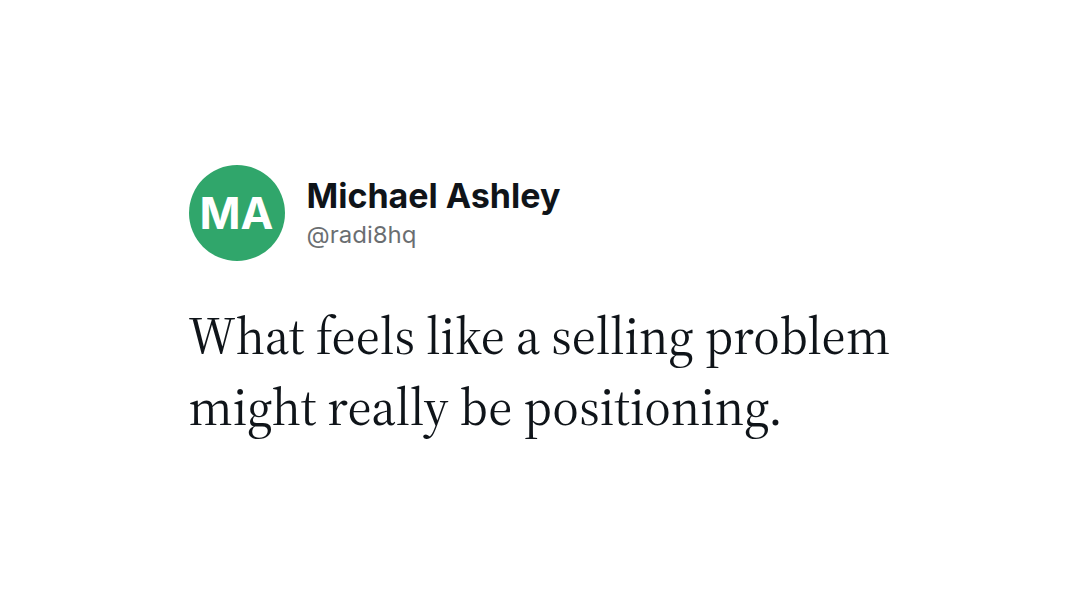
What feels like a selling problem might really be positioning. When you can't say who you help and why, every ask can start to feel like a trick.
If they saw exactly how you got the yes, would you still feel good about it?
Where does the discomfort show up for you?
#IndependentConsultant #ExecutiveCoach #CoachingBusiness #ConsultingBusiness #Positioning #GoingIndependent #Solopreneur #SmallBusinessOwner #PersonalBrand …more
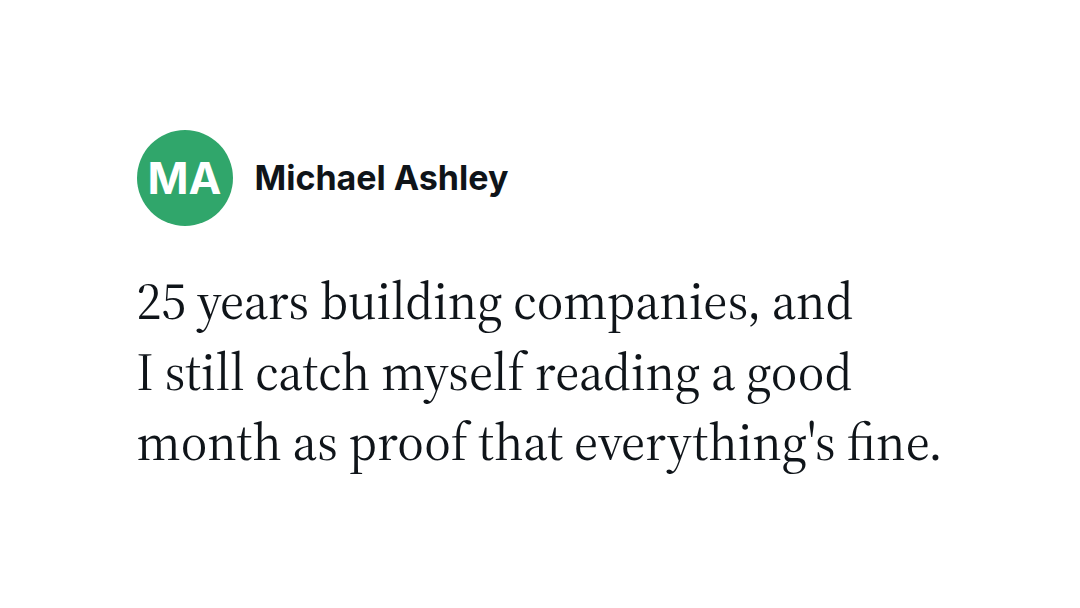
25 years building companies, and I still catch myself reading a good month as proof that everything's fine.
The speaker in the video I've linked in the first comment would push back on that, and the point is theirs, not mine. Constant achievement and striving can mask deeper physiological and psychological imbalances, and surface-level metrics, the "everything looks normal" kind, will miss the real problem. In their words: "we want to understand what's happening upstream that causes those things to change."
When everything looks normal on paper, the real question is what's happening upstream that's causing things to change.
Startup founders, this one lands close to home. The next launch, the next milestone, the next win... the numbers say normal, so we keep going, and whatever is shifting underneath, in us or in the business, might not show up in the numbers until it's expensive.
So the next time a good month tells me everything's fine, I want to ask what changed upstream first. The full conversation, and how the speaker thinks about looking upstream, is in the first comment.
#Founders #Startups #Entrepreneurship …more
 View on LinkedIn
Also on
'/%3E%3Cpath fill='%23fff' d='M12 7.3A4.7 4.7 0 1 0 16.7 12 4.7 4.7 0 0 0 12 7.3Zm0 7.8A3.1 3.1 0 1 1 15.1 12 3.1 3.1 0 0 1 12 15.1Zm5-8a1.1 1.1 0 1 0 1.1 1.1A1.1 1.1 0 0 0 17 7.1Zm-5 1.5c-1.5 0-1.7 0-2.3.1a3.8 3.8 0 0 0-1.3.2 2.2 2.2 0 0 0-.8.5 2.2 2.2 0 0 0-.5.8 3.8 3.8 0 0 0-.2 1.3c-.1.6-.1.8-.1 2.3s0 1.7.1 2.3a3.8 3.8 0 0 0 .2 1.3 2.2 2.2 0 0 0 .5.8 2.2 2.2 0 0 0 .8.5 3.8 3.8 0 0 0 1.3.2c.6.1.8.1 2.3.1s1.7 0 2.3-.1a3.8 3.8 0 0 0 1.3-.2 2.5 2.5 0 0 0 1.3-1.3 3.8 3.8 0 0 0 .2-1.3c.1-.6.1-.8.1-2.3s0-1.7-.1-2.3a3.8 3.8 0 0 0-.2-1.3 2.2 2.2 0 0 0-.5-.8 2.2 2.2 0 0 0-.8-.5 3.8 3.8 0 0 0-1.3-.2c-.6-.1-.8-.1-2.3-.1Zm0-1.6c1.5 0 1.7 0 2.4.1a5.5 5.5 0 0 1 1.8.3 3.8 3.8 0 0 1 2.2 2.2 5.5 5.5 0 0 1 .3 1.8c.1.7.1.9.1 2.4s0 1.7-.1 2.4a5.5 5.5 0 0 1-.3 1.8 3.8 3.8 0 0 1-2.2 2.2 5.5 5.5 0 0 1-1.8.3c-.7.1-.9.1-2.4.1s-1.7 0-2.4-.1a5.5 5.5 0 0 1-1.8-.3 3.8 3.8 0 0 1-2.2-2.2 5.5 5.5 0 0 1-.3-1.8C4 13.7 4 13.5 4 12s0-1.7.1-2.4a5.5 5.5 0 0 1 .3-1.8 3.8 3.8 0 0 1 2.2-2.2 5.5 5.5 0 0 1 1.8-.3C10.3 5 10.5 5 12 5Z'/%3E%3C/svg%3E)
Told 2 times, Nov 6, 2026 – Nov 13, 2026
· Bluesky · Open
When someone tells me "everything looks normal," I get curious.
Constant striving can hide what's really wrong, and the numbers that say 'everything looks normal' might not be measuring it.
30 minutes to look under yours: https://calendly.com/foclarity
How do you make your track record legible to the right clients without it turning into a highlight reel?
You spent a career making good calls. Now you're out on your own, and here's the trap: a list of wins is a highlight reel, and coaches and consultants who go independent learn fast that buyers are suspicious of those. A highlight reel shows outcomes. It hides what a prospective client actually wants to see — how you think.
Your judgment is what you're really selling. So show the calls, not just the trophies. The bet you made when the data was thin. The client you turned away. The problem you named before anyone else saw it. When you narrate the decision — the options, the reasoning, what you'd do again — a stranger can watch how you decide. That's credibility someone can verify, not applause they take on faith.
Want help turning your judgment into a body of work the right clients can actually read? Start here: https://mashley.com
#IndependentConsultant #Coaching #GoingIndependent #ThoughtLeadership #Positioning …more
This post has video.
Watch it on the channel.
A test for when you're tempted to add another income stream: each one is a whole business to build from scratch. Adding feels productive... then six months on, nothing has traction. What one thing, all-in, would make the rest easier or unnecessary? …more
Channel names and logos are trademarks of their respective owners.