Founder at Radi8 // Executive Coach // Host of the Inspiring Founders Podcast
· LinkedIn
·
Three weeks ago I added a question to the front of Radi8 that disqualifies people.
Someone arrives, they're enthusiastic, and the honest answer is not yet. The pieces aren't in place for it to work for them, and if they sign up anyway they'll spend a month proving that and then leave.
The usual way to handle this is to let them in and hope. Take the money, hope they figure it out, watch them go in six weeks and file it under churn. I've run companies that did exactly that, and it looks like growth for about one quarter.
So now there's one question, asked before anything else, and if the answer says they're not ready they don't get sold to. They get told what to fix first, and an offer of help fixing it.
Here's what surprised me. Saying not yet to the wrong fit made the right fit obvious, to them as much as to me, and the people who clear that question show up already believing it will work, because something asked them to prove it would.
Most of us do the opposite, we widen the door when things go quiet, because it feels like the safe move. It's the most expensive one available. Every bad-fit client takes a slot a good one could have used, and they leave carrying a story about you.
Who are you letting in right now that you already know isn't a fit?
#IndependentConsultant#Coaching#Positioning#GoingIndependent…more
Organization focused on AI leadership and innovation for the Fourth Industrial Revolution, based in Silicon Valley
· LinkedIn
·
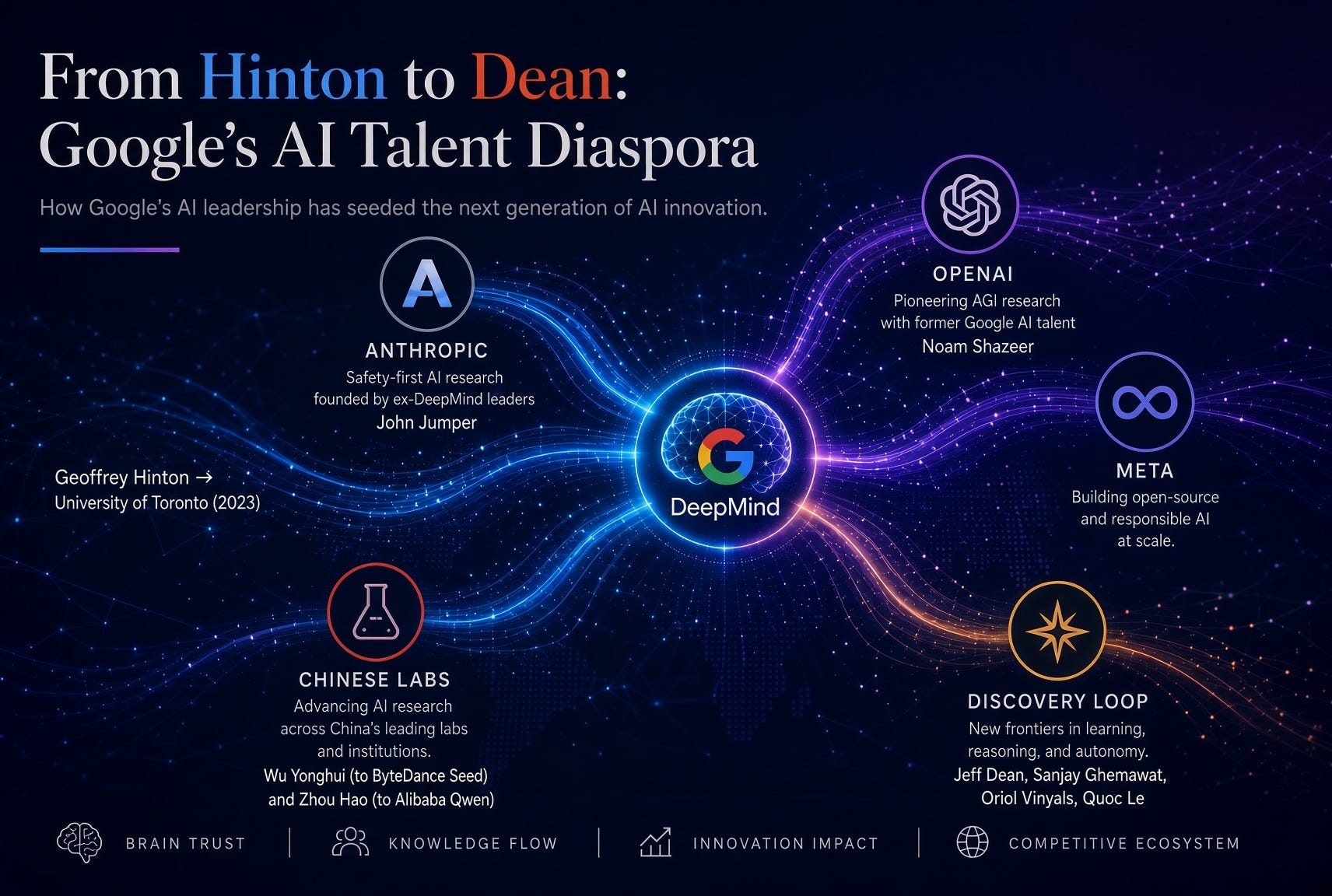
From Hinton to Dean: Google's AI Talent Diaspora
Jeff Dean is one of the true legends in the field. When people of that caliber leave to start something new, talent follows. Discovery Loop (Dean + Sanjay Ghemawat + Oriol Vinyals + Quoc Le) is already proving the point — reports this week put them in talks for ~$1B at a ~$10B valuation while still in the earliest stage and just beginning to hire.
This is not a new pattern. It is the acceleration of one I covered in AI L4IR.
Geoffrey Hinton left Google in 2023 so he could speak freely about AI risks. The original Transformer authors all eventually left. In the more recent wave we have seen clear directional flows: multiple high-profile researchers (including Nobel laureate John Jumper and key Gemini/AlphaFold contributors) to Anthropic; Noam Shazeer and others to OpenAI; and researchers such as Denny Zhou and Dawn Song to Meta's Superintelligence efforts. Some have even moved beyond the first destination — Shazeer being the clearest serial case (Google → Character.AI → back to Google → OpenAI).
Every major lab has now either lost or gained from the concentrated pool Google spent years building. Pure-play labs, companies like Cohere, and Chinese efforts all benefit when deep expertise becomes more distributed. The result is faster diffusion of systems knowledge, research taste, and experimental methods — which compresses gaps even as competition intensifies.
For Google, this can still be a useful crisis if treated that way.
Visible high-profile exits force the hard questions: Are we fast enough? Is ownership and focus real enough inside the walls? Is compute allocation clear? The organizations that treat talent loss as pure damage usually keep losing. The ones that use it as a forcing function to raise the internal bar often come out sharper on velocity and retention.
Google still has residual depth, infrastructure, and the ability to back the people who leave (as it is doing with Discovery Loop). The test is whether the new leadership structure and the pressure from these exits produce a genuine step-up — or whether the pattern simply continues.
Legends leaving doesn't just create competitors. It raises the competitive temperature for everyone, including the place they left. …more
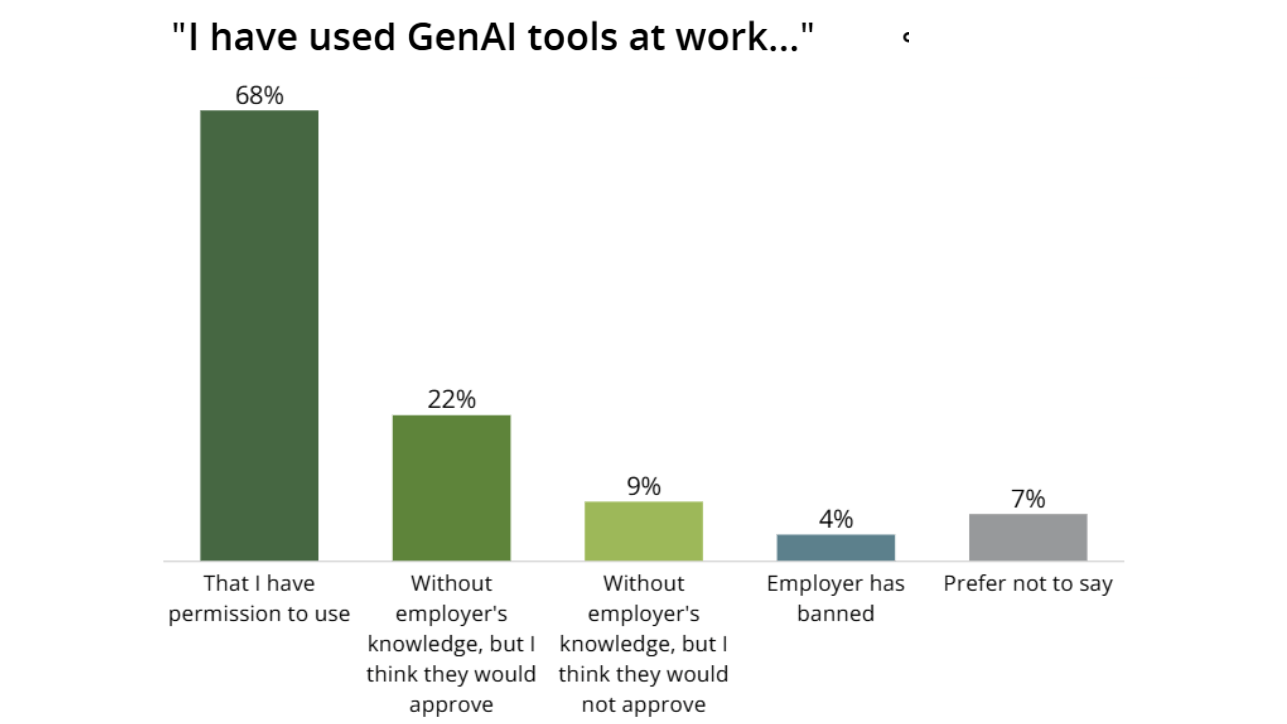
British workers are spending £958 million of their own money per year on AI tools their employers won't buy them.
That's the headline from Deloitte's largest-ever single-country study of workplace AI use — 25,000 UK workers surveyed. But the number that should actually keep enterprise leaders up at night is the one underneath it: 31% of workers using AI at work are doing it without their employer knowing.
Shadow AI is not a future risk. It is a present reality.
The study found that 63% of UK workers have used generative AI, but half have received no training for it, and 65% say their leaders discuss AI without a clear understanding of what it actually does. Workers report saving 70 minutes a week on average — but nearly a quarter still sense a stigma attached to using it at work.
The pattern that emerges: GenAI use is widespread but shallow. People have tried it. Few use it daily. Most stick to familiar tasks like writing emails and searching for information rather than rethinking how work is done.
The implication for enterprise marketing and B2B teams is direct. If your employees are spending their own money on AI tools because your company hasn't provided sanctioned ones, two things are true simultaneously. Your people are motivated enough to self-fund productivity tools. And you have no visibility into what data is going into those tools, what outputs are being used, or what liability you're accumulating.
The technology investment conversation has shifted. The question is no longer whether your team is using AI. It's whether they're using yours.
https://www.deloitte.com/uk/en/issues/generative-ai/genai-workforce-survey.html#AIGovernance#B2BMarketing…more
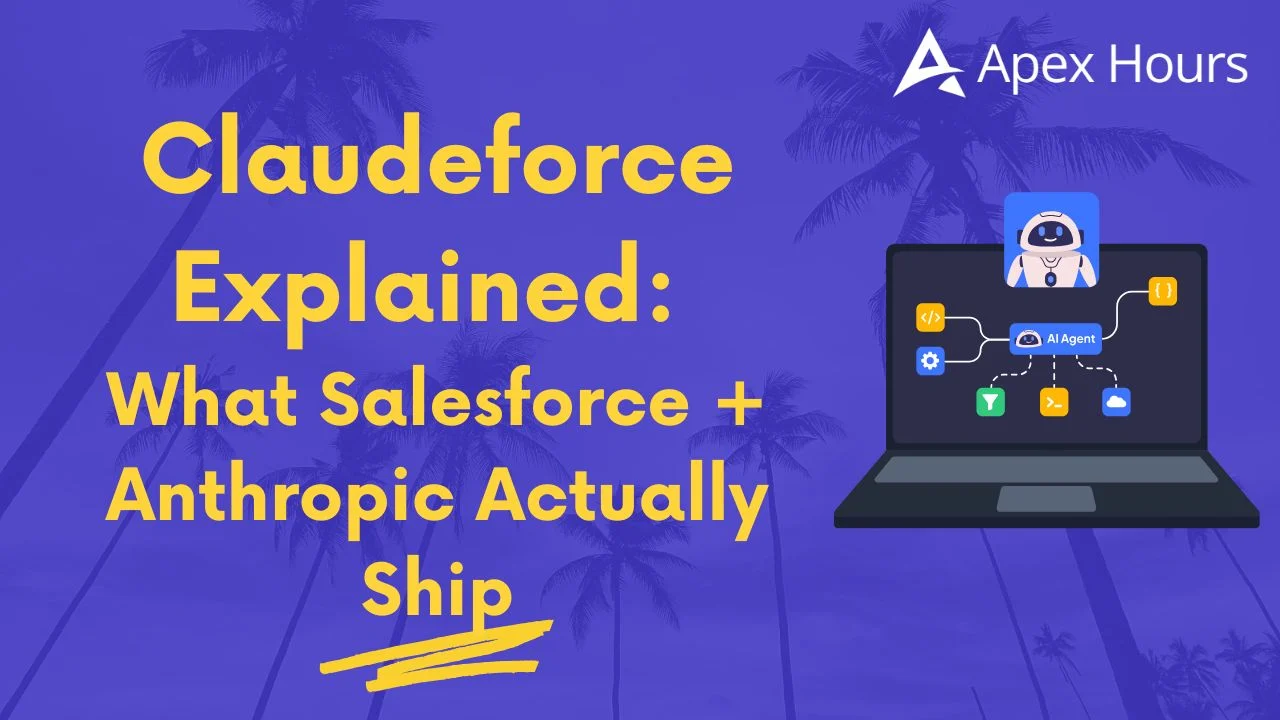
Salesforce and Anthropic did not just announce a partnership. They named it.
That distinction matters more than it sounds. Most partnership announcements follow the same pattern: a press release, a joint quote, a few weeks of coverage, then nothing. The name fades because there is nothing to hold onto.
Claudeforce is different. It borrowed Claude's brand equity, added Salesforce's "force" suffix — the first time Salesforce has ever given that suffix to another company's product name — and created something that sounds like a product line rather than a deal memo. Announced on the same day as Salesforce's Q2 earnings, with CRM stock jumping 12–14% after hours. Then Matthew McConaughey showed up in the ad. Everything landed at once.
The strategic bet underneath the branding: if you use Claude, you now have a reason to lean into Salesforce. If you use Salesforce, you have a reason to lean into Claude. Benioff's exact framing was "probabilistic intelligence alone doesn't run a company, and deterministic systems don't reason." He called it the SaaSpocalypse being over — the idea that AI tools would replace enterprise software rather than fuse with it.
What Claudeforce actually ships: Salesforce inside Claude as a plugin with 37 prebuilt sales skills, Claude as the default reasoning model inside Agentforce, and Claude as the default model powering Slackbot.
For B2B marketers, the naming lesson holds regardless of the product. Start with the headline. Work backwards to what's achievable. A name that sounds like a product is a campaign in itself — and it's the one thing competitors cannot copy the same week.
https://www.salesforceben.com/salesforce-and-anthropic-announce-claudeforce-in-q2-27-earnings/#B2BMarketing#AIStrategy…more
Samsung's instinct when Apple announced the iPhone Duo foldable was exactly right. Capitalize on a competitor's weak moment. They've been selling foldables since 2019, Apple just joined — "Let us know when you're done reheating our leftovers" wrote itself.
The execution missed.
"Reheating our leftovers" reads like it was written by someone who is not in the room with the people they're trying to reach. Clever on paper. Doesn't land. The follow-up posts were more of the same — four tweets that felt like a brief was checked rather than a reaction that was felt.
What they should have done: an actor in a studio within 30 minutes of the announcement, filming a fake Apple keynote, making the whole thing so absurd that anyone holding an iPhone Duo felt the joke. Make it visual. Make it shareable. Make it something people forward into group chats. That's the move.
The brand banter playbook is not "post a witty line." It is "move faster than anyone expected, with something that genuinely makes people laugh rather than nod politely."
Whenever you have a moment to take market share from a competitor, you have to jump on it. Samsung knew the moment was there. They just didn't hit it hard enough.
For B2B brands watching competitor moves, the lesson is the same. It's not enough to react. You have to react in a way that makes the other side look like they're playing in your leftovers — not you.
https://rollingout.com/2026/09/10/samsung-trolls-apple-foldable-iphone-duo/#B2BMarketing#ContentStrategy…more
Founder at Radi8 // Executive Coach // Host of the Inspiring Founders Podcast
· LinkedIn
·
“Vitamin or pain killer?” - advisors love to ask this question about your product. And they love to tell you it has to be a pain killer, because it’s easier to sell. But the truth is less about pain and more about understanding your customer.
When I was 23 I worked at Threshold, one of the largest distributors of vitamins and supplements to the industry. They easily sold hundreds of millions of dollars every year into supplement stores all over the country.
What made them special wasn’t their inventory. It was their sales organization.
Every sales rep would spend time on the phone with their customers, they knew them by name, they talked like old friends. But more than that they spent time educating. And in turn their customers, the shop owners, educated their own customers.
What they created was an environment of conscious empathy and learning for people who didn’t want pain killers.
So here’s the question for your business: Are you chasing the same customers as all your competitors? The ones looking for pain killers?
Or are you building a community that’s tired of popping pills and wants a real, long-term solution?
Selling “vitamins” isn’t bad, it’s just very different from selling “pain killers” …more
Your product launch timeline just became a regulatory risk surface.
Anthropic launched Claude Fable 5 on Tuesday, June 9. By Friday, June 12, the US Commerce Department had issued an export-control directive forcing the company to shut it down globally.
This is the first time an export-control directive has ever been used to pull a publicly deployed AI model mid-operation.
Here's what matters for B2B marketers in enterprise tech:
You can no longer assume your launch will stay live. Anthropic priced Fable 5, ran benchmarks, built go-to-market assets, and had three days of availability before Amazon researchers found a prompting vulnerability that triggered a government response. Commerce Secretary Howard Lutnick issued the directive at 5:21 PM ET. Because Anthropic couldn't verify user citizenship in real time, they disabled access for everyone.
I've worked on launches at Proofpoint, Druva, and MinIO where regulatory uncertainty was background noise. It's now foreground risk. The gap between launch readiness and regulatory approval is compressing, and most content strategies aren't built for that.
If you're launching a technical product in a space where compliance, export controls, or security clearances matter, your content needs to be modular enough to pivot without rewriting everything. That means scenario planning for delayed releases, restricted availability, or post-launch changes to positioning.
The discipline here is the same one I learned in the Army: you don't get to choose the conditions. You build systems that hold under pressure.
If you're launching in a regulated space and want to stress-test your content strategy for regulatory scenarios, send me a DM. I offer a 30-minute consultation where I'll review your approach and give you three actionable improvements you can implement this week. https://theaipixel.substack.com/p/claude-fable-5-launched-tuesday-by…more
Organization focused on AI leadership and innovation for the Fourth Industrial Revolution, based in Silicon Valley
· LinkedIn
·
Two AI Stumbles in One Week: Why Values-Based Leadership Must Be Distributed
In the space of just three days this month, two major AI companies highlighted a critical weakness in how leadership is practiced today.
On July 10, Apple filed a lawsuit alleging that OpenAI's hardware division, led by former Apple executive Tang Tan, engaged in a coordinated effort to steal trade secrets. Just three days earlier, Meta launched a feature in its new Muse Image tool that allowed users to generate AI images of people by simply tagging their public Instagram accounts — with the feature turned on by default and no notification to the person whose likeness was used. Meta removed the feature days later after widespread backlash.
These incidents are very different in nature. The allegations against OpenAI, if true, point to something deeper than a miscalculation. They suggest a potential breakdown in ethical boundaries at a leadership level inside a high-growth organization. Meta's case, while serious, looks more like a failure of judgment — moving fast under competitive pressure without properly accounting for user expectations around consent and likeness rights.
What connects both cases is this: when the financial and competitive stakes are extremely high, internal pressure can distort decision-making. Even experienced leaders are influenced by the culture and incentives around them. Company culture is not neutral — it either reinforces ethical guardrails or makes it easier to overlook them.
In my book AI L4IR: Leadership and the 4th Industrial Revolution, I argue that ethical leadership in this era cannot remain concentrated at the top. It must be highly distributed — embedded in how product teams, engineers, recruiters, and middle managers make decisions every day.
When billions of dollars and strategic positioning are on the line, relying on a small group of senior leaders to catch every ethical risk is unrealistic. Organizations that build cultures where people at all levels feel empowered (and expected) to ask "Should we?" — not just "Can we?" — will be far better positioned to innovate responsibly and maintain trust.
I explore both incidents and the broader leadership implications in more detail here:
https://kentkaufman.substack.com/p/two-ai-stumbles-in-one-week-why-values
How are you thinking about building stronger ethical decision-making into your teams as AI capabilities continue to advance? …more
When Pope Leo XIV released his first encyclical, Magnifica Humanitas, he deliberately connected the Church's response to artificial intelligence with the 135th anniversary of Rerum Novarum.
He calls for AI to be "disarmed" of logics of domination, insists that lethal decisions must never be fully delegated to machines, and contrasts the prideful Tower of Babel with the patient, collaborative rebuilding of Jerusalem — where every person contributes their section of the wall.
This is not only a religious document. It is a profound leadership text for our time.
In the Second Edition of my book, AI L4IR: Leadership and the Fourth Industrial Revolution – How Did We Get Here and Where Are We Going? (releasing later in 2026), I've expanded Chapter 14 to explore the powerful convergence between Pope Leo XIV's vision and the model of highly distributed ethical leadership that runs throughout the book.
Both traditions — one rooted in formal religious teaching, the other in secular ethical reasoning — arrive at the same essential conclusion: Human agency must remain central. Truth must be actively protected. Responsibility must be widely shared. And technological power must be oriented toward human flourishing rather than domination.
As we move deeper into the cognitive industrial revolution, leaders will need more than technical skill. We will need moral clarity, critical thinking, and the humility to keep asking: What kind of humanity are we building?
I'm excited to share the full Second Edition later this year.
What are your thoughts on the intersection of faith traditions, ethical leadership, and AI governance?
#AI#Leadership#Ethics#ArtificialIntelligence#FourthIndustrialRevolution
"Good Judgment Required" https://www.axios.com/2026/09/08/googles-gemini-enterprise-legal-halimah-delaine-prado
1 big thing: Google's general counsel just drew the line every enterprise AI buyer needs to understand
AI can democratize access to good legal advice. It cannot replace the exercise of good judgment. Google's own general counsel said so — while launching an AI product built for law firms.
Why it matters: The same principle applies to B2B marketing. AI can surface information faster, draft more efficiently, and scale content production. It cannot replace the judgment that decides which of two reasonable-sounding strategies will actually move pipeline.
Driving the news:
Google launched Gemini Enterprise for Legal, an AI platform for law firms and in-house legal teams covering briefs, contract management, regulatory monitoring, and data discovery.
→ General counsel Halimah DeLaine Prado: "The practice of law will always fundamentally rise and fall on the exercise of good judgment"
→ More than 2,000 cases involving AI-generated hallucinations have been identified by legal researcher Damien Charlotin — lawyers sanctioned for false citations, misattributed quotes, and misrepresented cases
Zoom in:
Goldman Sachs CIO Marco Argenti argued enterprises should not rule out open-weight models — including Chinese models — so long as they follow a four-layer security framework: model testing, secure inference environments, monitored agent permissions, and controlled data access.
Yes, but: Goldman's current open-model usage is mostly US-based. The framework exists precisely because the risk is real.
Be smart: The legal sector's AI hallucination problem is a preview of what happens in any professional domain when speed replaces judgment. Build the review layer before you need it, not after.
The bottom line: AI gives you more time to think. Use it.
https://www.axios.com/2026/09/08/googles-gemini-enterprise-legal-halimah-delaine-prado#AIGovernance#B2BMarketing…more
Founder at Radi8 // Executive Coach // Host of the Inspiring Founders Podcast
· LinkedIn
·
I've built a handful of companies. The ones that actually worked all followed the same shape — and it's close to the opposite of what most founders are told to do.
Build the thing. Set a foundation under it. Hand it to someone who can scale it. Then go do it again.
For years I thought the handoff was me failing. You start something, pour yourself into it, and then… you leave? It felt like abandonment. Now I think it's the whole point. My job is to make something exist and make it stand on its own — not to be the reason it keeps standing.
There's research that reframed this for me. Studying 200+ startups, Noam Wasserman found that founders are most likely to be pushed out right after their biggest wins. Not their failures — their wins. Because hitting the milestone changes the job underneath them. Inventing and scaling reward different instincts, and the thing that made you great at the first often makes you the bottleneck in the second.
So I stopped treating my exit as a threat and started treating it as a design requirement. If I build it right, it shouldn't need me. Durability doesn't come from a founder's presence — it comes from the people, process, and structure that outlast any one person.
The test I use now is simple: if I stepped away for 90 days, what would quietly break? Wherever the answer is "everything," that's not a vacation problem. It's a design problem.
If you stepped away for 90 days — what would quietly break first? …more
I build companies so they don't need me.
Build it. Set a foundation. Hand it to someone who can scale it. Repeat.
For years I thought the handoff was me failing. It's the whole point — something standing on its own is the win.
Founder at Radi8 // Executive Coach // Host of the Inspiring Founders Podcast
· X
·
My first business got me sent to the principal's office.
Bought Hubba Bubba for 25¢, split the pack, sold each for 25¢. A quarter became $1.25.
A teacher saw me moving product and assumed I was dealing. It was gum.
Entrepreneurship is just noticing where you can add value. …more
Founder at Radi8 // Executive Coach // Host of the Inspiring Founders Podcast
· LinkedIn
·
Three things I got wrong about marketing across three startups:
1. I treated it as a phase. "We'll do marketing once the product is ready." Then the product was ready, the launch window closed, and we were starting from zero on awareness with a runway clock ticking. Marketing isn't a phase. It's a habit you build before you need it.
2. I hired it out too early. The first agency we paid wrote posts that sounded nothing like us, ran ads against the wrong audience, and I spent more time briefing them than I would have spent posting myself. Outsourcing only works after you know what good looks like for your business.
3. I confused volume with consistency. We did sprints — two weeks of daily posts, then silence for a month. The algorithm punishes that pattern. So does your audience. Three posts a week, every week, beats fifteen posts in a burst followed by nothing.
What I do now is the opposite of all three. Marketing is the first habit, not the last. I run my own content with AI-assisted workflows so I know what good looks like before I delegate. And I optimize for showing up every week, not for output spikes.
That's what I'm teaching at my workshop on May 28th in San Jose at the MLK Library, hosted by the Silicon Valley Small Business Development Center. The exact workflows I use now, after three startups and one exit.
If you can't make it, book a free 15 to 20 minute marketing audit and I'll help you skip the mistakes I made.
https://www.radi8.com/free-audit?utm_source=linkedin&utm_campaign=free_audit&utm_content=post_id
DM me if you want the workshop link. …more
Founders who engage early with accelerators get more from the program.
The same is true for marketing.
Treating marketing like a deadline task costs momentum, customer insights, and time.
Start a small, consistent engine now that keeps you visible without draining budget or focus.
I help founders run their own marketing faster and for less than hiring consultants. Send me a message to schedule a free marketing audit. #startupshttps://www.santacruzworks.org/news/best-founders-apply-early



'/%3E%3Cpath fill='%23fff' d='M12 7.3A4.7 4.7 0 1 0 16.7 12 4.7 4.7 0 0 0 12 7.3Zm0 7.8A3.1 3.1 0 1 1 15.1 12 3.1 3.1 0 0 1 12 15.1Zm5-8a1.1 1.1 0 1 0 1.1 1.1A1.1 1.1 0 0 0 17 7.1Zm-5 1.5c-1.5 0-1.7 0-2.3.1a3.8 3.8 0 0 0-1.3.2 2.2 2.2 0 0 0-.8.5 2.2 2.2 0 0 0-.5.8 3.8 3.8 0 0 0-.2 1.3c-.1.6-.1.8-.1 2.3s0 1.7.1 2.3a3.8 3.8 0 0 0 .2 1.3 2.2 2.2 0 0 0 .5.8 2.2 2.2 0 0 0 .8.5 3.8 3.8 0 0 0 1.3.2c.6.1.8.1 2.3.1s1.7 0 2.3-.1a3.8 3.8 0 0 0 1.3-.2 2.5 2.5 0 0 0 1.3-1.3 3.8 3.8 0 0 0 .2-1.3c.1-.6.1-.8.1-2.3s0-1.7-.1-2.3a3.8 3.8 0 0 0-.2-1.3 2.2 2.2 0 0 0-.5-.8 2.2 2.2 0 0 0-.8-.5 3.8 3.8 0 0 0-1.3-.2c-.6-.1-.8-.1-2.3-.1Zm0-1.6c1.5 0 1.7 0 2.4.1a5.5 5.5 0 0 1 1.8.3 3.8 3.8 0 0 1 2.2 2.2 5.5 5.5 0 0 1 .3 1.8c.1.7.1.9.1 2.4s0 1.7-.1 2.4a5.5 5.5 0 0 1-.3 1.8 3.8 3.8 0 0 1-2.2 2.2 5.5 5.5 0 0 1-1.8.3c-.7.1-.9.1-2.4.1s-1.7 0-2.4-.1a5.5 5.5 0 0 1-1.8-.3 3.8 3.8 0 0 1-2.2-2.2 5.5 5.5 0 0 1-.3-1.8C4 13.7 4 13.5 4 12s0-1.7.1-2.4a5.5 5.5 0 0 1 .3-1.8 3.8 3.8 0 0 1 2.2-2.2 5.5 5.5 0 0 1 1.8-.3C10.3 5 10.5 5 12 5Z'/%3E%3C/svg%3E)