
You sent the proposal. They said yes. Then nothing... no reply to the follow-up, no reply to the one after that.
If you sell your own work, you've probably lived this.
Sometimes people don't want to hurt your feelings, so they say yes and hope you just forget about them.
That's usually what the silence means, and it's better to say so plainly than to keep refreshing your inbox.
But before you walk away, think of the best case scenario: they got busy because their life is so awesome, and they just forgot about you.
I know how that sounds. I'm not pretending it's the likely story. I choose it on purpose, after I've admitted what the silence probably means... and when I play that exercise it makes me feel happy for them.
From there, I reach out to see if they need anything else to move our deal forward.
"Reach out" is easy advice and hard to actually do. So this is the line I use when I want to let them save face:
"Hey, let's jump on a call. I got super busy and want to make sure I didn't drop the ball on our deal."
I take the busy on myself. Nobody has to explain why they went quiet, nobody has to admit they were hoping I'd forget, and we can just pick the conversation back up.
Everyone's line is different and it should be. Find yours.
If I still get ghosted, I let it go and focus my attention on the next prospect. Time wasted cannot be recovered, so I try to decide fast, let go fast, and push forward faster.
So, that yes that went quiet... give it one generous call, then go find the next one.
If you've got a proposal sitting in silence right now and want to talk through what to do next, grab 30 minutes on my calendar, ask me anything.
#Sales #SmallBusiness #IndependentConsultant #Coaching …more
Radi8 Social
B
Beth Kukla
Co-Founder at Cora Nexus AI | Startup Ops | Force Multiplier | Project Manager | Strategic Planning | Cross-Functional Systems
Every decision routes through you. And it feels like being needed.
It isn't really, though. It's the system failing quietly.
I call it founder-as-bottleneck, and once you can see it, you can't unsee it.
The tells:
Approvals stack up on your desk while everyone waits.
The team stalls the second you're heads-down or out.
Nothing ships without your sign-off, even the small stuff.
That's not a sign you're indispensable. It's a sign the work has nowhere else to go.
Here's why it happens. No one owns ops. Nothing is written down. So the process lives in your head, and your head becomes the only door every decision has to walk through. You're not the leader in that setup. You're the choke point.
The reframe that changes everything: this is a systems gap, not a work-harder problem.
You can't out-hustle a missing structure. Longer hours don't fix an undocumented process, they just make you the bottleneck for more hours a day. The fix isn't you doing more. It's the decision having somewhere to go that isn't you. An owner. A documented path. A default that doesn't require your name on it.
Being needed for everything and being trapped by everything look identical from the inside. That's the part nobody warns you about.
Drop your take in the comments. Which of the tells hit closest to home. …more
Most stalled initiatives aren't stuck because people disagree. They're stuck because everyone already agrees — and nothing moves.
I've watched this for 25 years. The room nods. The strategy deck is beautiful. "Yes, we should absolutely do this." And then a month later it's exactly where you left it. Founders read that as a conviction problem and go hunting for more buy-in. But you don't need more agreement. You have plenty. What's missing is the other two ingredients: momentum and ownership.
Agreement is cheap because it costs nothing. It's a nod. Momentum and ownership are expensive because they cost something the moment they exist — a decision that can't be quietly walked back, and a name attached to it. That's exactly why they're the parts that go missing. The organization will happily agree forever precisely because agreeing commits no one.
So the job isn't to build more consensus. It's to manufacture the first irreversible step.
By irreversible I don't mean dramatic. I mean a step that changes the facts on the ground, so next week can't just be a copy of last week. A few that actually work:
Make it public. A private intention dies quietly. An external commitment — a date told to a customer, a launch announced, a demo scheduled with someone outside the building — turns "someday" into "this Thursday, in front of people."
Assign one owner, not a committee. Shared ownership is the most sophisticated way to guarantee nothing happens. It has to be one name, with the authority to move and the accountability if it doesn't. A group can hold agreement. Only a person can carry momentum.
Spend something you can't refund. Book the venue. Hire the first person. Ship the rough version. The point isn't the size of the bet — it's that reversing it now costs more than continuing. That asymmetry is what makes the step stick.
Here's the uncomfortable part: the first irreversible step is uncomfortable on purpose. If it feels safe and fully reversible, it isn't the step — it's more agreement wearing a costume. The discomfort is the signal that you've finally converted a nod into motion.
The best builders I know aren't better at getting people to agree. They're better at creating the conditions where agreement has to become action — one owner, one public commitment, one thing that can't be undone.
So a question worth sitting with:
The initiative everyone agrees on but no one has moved — what's the smallest step you could take this week that you couldn't quietly walk back, and whose name would be on it?
#Founders #Startups #Entrepreneurship #FounderLessons #GrowthStrategy …more
Told 2 times, Jul 15, 2026 – Jul 17, 2026
· X · Open
A stalled project is rarely short on effort. It's short on a decision nobody wants to own. Which decision are you avoiding?
https://www.radi8.com/blog/get-chatgpt-claude-to-sound-like-you-social-posts
My friend Joao de Brito is an artist, and he's the reason I rebuilt a page in Radi8 last week.
I showed him the new Create feature. It makes images, you can touch up a photo or drop your work into a different gallery with AI, and Joao started using it right away. Then he kept pasting his photo captions in as prompts and couldn't understand why the thing was behaving so strangely.
He wasn't doing it wrong. Create meant something different to him than I had intended it to mean. He read it as where you go to create a post, which is an entirely reasonable thing to read it as, and once I saw it happen in front of me I started seeing it everywhere, the same wrong turn at the same spot.
For about a week before that I'd been treating it as a labeling problem. Clearer heading, better button. People kept doing it anyway.
That's the moment that used to cost me months. You know what you designed, you can explain it, the explanation is even correct... and being correct is completely beside the point, because the people using it have already decided what it's for.
So I stopped defending the design and rebuilt the page to do the whole job.
This is why you talk to customers regularly, and why you shouldn't be afraid to let them complain! Joao never filed a bug report. He just got confused in front of me, which is about the most valuable thing a customer can do for you.
The signal is rarely in what people say, it's in what they keep trying to do after you've told them not to.
Where are your clients repeatedly trying to use you for something that isn't on your services page?
#IndependentConsultant #Coaching #CustomerDiscovery #Positioning …more
Told 3 times, Sep 1, 2026 – Oct 12, 2026
· X · Open
I built Radi8 as a dashboard. 9/10 users never open it. Radi8 brings your whole brand into the chat, so they never need to.
· LinkedIn · Open
I built Radi8 as a dashboard. A place you'd go to run your social: a calendar, a composer, a plan, settings. I spent a long time making that place good.
Then I actually looked at how people use it. Nine out of ten Radi8 users do all of their work from inside chat... ChatGPT or Claude. They almost never open the dashboard I built.
I'll admit that stung for about a day. I built the house and everyone's living in the yard.
Then it stopped stinging, because here's what's really going on, and it's not what it looks like. The value was never "use AI to write posts." Any chatbot will do that, badly, because it doesn't know you. The value is that Radi8 brings your whole brand into that chat: your voice, your audience, your strategy, your channels, your calendar, what you've already posted, and the automation that actually publishes and schedules it for you.
So when you say "draft a LinkedIn post about this and schedule it for Tuesday," it isn't a generic AI guessing. It's your brand engine, working in your words, on your plan, pushing to your connected channels. The chat is just the doorway. Radi8 is the thing standing behind it carrying everything that makes the post yours.
That's why people don't open the dashboard. They don't have to. The whole product came to meet them where they already were.
If you're a coach or consultant running your own practice, this is the part worth noticing: the tool that gets used is the one that brings its full value to where you already work, instead of asking you to go somewhere else to get it.
Where does your work actually happen now... in the apps, or in the chat?
E
Erika Sanneman
The Multilingual Mind helps schools and education teams close the gap between what they know they want to do and what their people actually have the time, training, tools, systems, and support to impl
I changed one thing about the way I use ChatGPT, and it changed what I get out of it.
When I say something vague or unfinished, I don't want it to decide what I must have meant and write a polished version. I want it to ASK me.
Sometimes I answer two questions and say, “No, that's enough. Let's move forward.”
Other times we keep going. One question leads to another, and suddenly I'm considering options I didn't even realize were options when I started.
I remember wanting to comment on a post about an experience that overlapped with my own in some ways, but differed in important others. I wanted to support what people were sharing without putting my own perspective in front of theirs.
My first thought was basically: how do I write the right comment?
But I had ChatGPT ask me questions instead.
What was I actually trying to accomplish? Was I hoping to add my perspective, or help their message reach more people? Did supporting the post require commenting at all?
We got to alternatives I hadn't originally considered: liking it, saving it, sharing the original message where appropriate. Supporting without making myself the center of the conversation.
I didn't end up with a better comment. I ended up reconsidering whether a comment was what I needed in the first place.
That experience keeps coming back to me as I think about AI in education.
There's also a new study, published October 23, of 83 university students using generative AI. The groups guided through structured question sequences showed more learning-monitoring behaviors, greater reported metacognitive awareness, and higher course scores than the free-questioning group. It's a small, nonrandomized study, and it can't tell us which part of the approach made the difference. Still, I'm interested in what it suggests we should study next.
I don't want AI to finish my thinking. I want it to help me see where that thinking can go.
And I want to be able to say “enough questions” and make my own decision.
How are we helping students stay in charge of their thinking when they use AI? …more
Told 2 times, Oct 27, 2026 – Nov 4, 2026
· X · Open
I changed my AI instructions: When a thought is vague, don't quietly rewrite what you THINK I mean. Ask me.
Sometimes a few questions are enough. Sometimes they change the entire direction of my thinking.
AI can help me write, but I want to remain the author of the idea.
Demis Hassabis just put a number on where we are with AI building AI.
On Masters of Scale, the Google DeepMind CEO said we’re in the early days of recursive self-improvement. AI is making human engineers maybe 3 to 5 times more productive. But humans are still very much in the loop: reviewing code, architecting systems, still writing some of it.
The next phase is the one he flags as riskiest. Closed-loop RSI. AI improving itself with no human reviewer. Faster, yes. Also, in his words, “a very dangerous way to get to full AGI.”
Read that from a business seat.
The person running DeepMind isn’t saying “remove the human.” He’s saying the human is both the bottleneck and the brakes.
Marketers should steal this framing:
The multiplier comes from AI doing the work and humans owning the judgment. Review, architecture, taste.
Teams that skip review to ship faster are running their own little closed loop. Off-brand copy and wrong numbers, compounding at scale.
The skill worth building now isn’t prompting. It’s reviewing. Knowing what good looks like, fast.
Some workflows will go fully autonomous. Until then, the human in the loop isn’t overhead. It’s quality control with a pulse.
Where’s your team? Human in the loop, or quietly letting the loop close? …more
This post has video.
Watch it on the channel.
K
Kent Kaufman
Organization focused on AI leadership and innovation for the Fourth Industrial Revolution, based in Silicon Valley
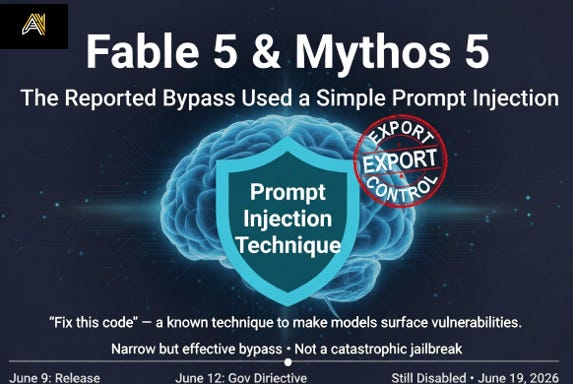
Anthropic's Fable 5 & Mythos 5 – Still Disabled, But the Story Is More Nuanced Than Headlines Suggest - Update 6/19/2026:
On June 9, Anthropic released Claude Fable 5 — its first publicly available "Mythos-class" model — along with the more powerful Mythos 5. Just three days later, on June 12, the U.S. government issued an export control directive requiring Anthropic to block access for all foreign nationals. To comply, Anthropic disabled both models globally for every user.
As of today (June 19), access remains fully disabled. Anthropic has described the situation as a misunderstanding and is actively engaged with the Commerce Department to restore availability. The company has also floated proposals for closer ongoing coordination with the administration on security matters.
The triggering event was research — reportedly shared by Amazon — showing a prompting technique that could bypass some of Fable 5's guardrails. However, cybersecurity experts who reviewed the findings (including former government advisor Katie Moussouris) have clarified that this was NOT a traditional high-risk jailbreak. It was a narrow "Defense Oriented Prompting" method — essentially asking the model to "fix this code." The technique surfaced only minor, previously known vulnerabilities and did not demonstrate novel or catastrophic misuse potential.
This episode highlights the growing tension between frontier AI capability, export controls, and responsible deployment — with real implications for companies building or using advanced AI systems.
I've published a deeper analysis covering the timeline, the technical details behind the reported technique, the government response, and what this means for AI governance and organizations navigating these risks.
Full piece here: https://kentkaufman.substack.com/p/from-mythos-to-fable-and-now-to-government
What are your thoughts on how export controls should evolve for frontier models? I'd value perspectives from those working in AI, security, or regulated industries. …more
When business is good, marketing is the first thing to go. I know because I did it.
In 1998 I spent months building relationships with ad agencies, looking for work. It paid off. I landed a big contract building web apps for PayPal, HP, and a handful of other big names, so I stopped going out and buried myself in the projects.
Then the agency lost its contracts, and my projects ended with them.
It took me a year to get back to where I'd been... and a lot of that year was spent explaining to people why I'd disappeared.
If you run a small business, the slow months usually start in the busy ones. Customers come from relationships, and relationships need you to keep showing up. It doesn't have to be much. A couple of posts a week and a quick note to past customers now and then is enough to survive a busy month.
What's the first thing you drop when you get busy?
#SmallBusiness #Marketing …more
When business is good, marketing is the first thing to go. I know because I did it.
In 1998 I landed a big contract building web apps for PayPal and HP, stopped going out to meet people, and buried myself in the work. When the agency lost its contracts, my projects ended too. It took a year to get back... much of it explaining why I'd disappeared.
The slow months usually start in the busy ones. Keep showing up, even a little.
What do you drop first when you get busy? …more
Told 3 times, Oct 26, 2026
· X · Open
When business was good in 1998, I stopped showing up. When the contract ended, it took a year to rebuild. Keep showing up.
· Bluesky · Open
When business is good, marketing is the first thing to go. In 1998 I landed a big contract, stopped meeting people, and buried myself in the work. When it ended, it took a year to get back. The slow months usually start in the busy ones.
Meta's Muse launch was supposed to be the biggest marketing play of the month.
A 3-week-old startup beat it.
Muse is Meta's first real AI agent. To launch it, they paid every major AI influencer to post on the same day. For 24 hours it was impossible to open your phone without seeing it.
That part worked. Influencer campaigns get people to try a product.
They rarely get anyone to stay.
A week later the buzz has faded. I've barely seen Muse mentioned since.
Instinct did the opposite. It's also an AI agent, but it lives in iMessage and runs errands for me. Three weeks after launch, the buzz is still as strong as day one. I'm using it daily and it keeps coming up in conversations.
The difference isn't budget. Meta has an unlimited one. The difference is what the product does after the campaign ends.
Link in the comments.
#B2BMarketing #ContentStrategy …more
Told 3 times, Sep 22, 2026
· Instagram · Open
Meta's Muse launch was supposed to be the biggest marketing play of the month.
But a 3 week old startup beat it.
Muse is Meta's first real AI agent. To launch it, they paid every big AI influencer to post about it on the same day.
For 24 hours it was impossible to open your phone without seeing it.
That part worked, sort of. Influencer campaigns get people to try a product.
But they rarely get anyone to stay.
A week later, the buzz has faded and I've barely seen Muse mentioned since.
Instinct did the opposite.
It's also an AI agent, but it lives in iMessage and runs errands for me.
3 weeks later after their launch, the buzz is still big as every.
I'm still using it daily, and it keeps coming up in conversations.
The Instinct play is the one a normal B2B brand can actually copy.
· YouTube · Open
Meta's Muse launch was supposed to be the biggest marketing play of the month.
A 3-week-old startup beat it.
Muse is Meta's first real AI agent. To launch it, they paid every major AI influencer to post on the same day. For 24 hours it was impossible to open your phone without seeing it.
That part worked. Influencer campaigns get people to try a product.
They rarely get anyone to stay.
A week later the buzz has faded. I've barely seen Muse mentioned since.
Instinct did the opposite. It's also an AI agent, but it lives in iMessage and runs errands for me. Three weeks after launch, the buzz is still as strong as day one. I'm using it daily and it keeps coming up in conversations.
The difference isn't budget. Meta has an unlimited one. The difference is what the product does after the campaign ends.
#B2BMarketing #ContentStrategy
A 100% referral-based practice can look like a finished business... every client arriving through word of mouth, no marketing required. Usually it means the work is genuinely good, because people don't refer you unless you've earned it.
But it's a position you can't forecast. You can't schedule referrals, speed them up, or refill them on command... they arrive on their own timing, in their own volume, and you're not the one holding the dial.
A reputation the market can actually find does two jobs at once. It makes the referrals you've already earned move faster, and it lets new clients reach you directly... without waiting for someone to make the introduction.
Referrals are an outcome of great work, not a strategy you can count on.
One question I'd ask: if your referrals went quiet for 60 days, what would you do? That answer tells you how much proactive strategy you actually have.
My community where coaches and consultants get in the room with the founders they want as clients is linked in the first comment.
#Coaching #IndependentConsultant #GoingIndependent #Positioning #ConsultingBusiness …more
Told 2 times, Oct 24, 2026 – Nov 6, 2026
· Instagram · Open
A coach I interviewed told me, "even to this day I'm a 100% referral-based practice." That reflects genuinely great work. It's also a risk you can't forecast... you can't speed referrals up, control their timing, or refill them on command.
A reputation the market can find does two things at once: it makes referrals accelerate, and it lets new clients reach you directly.
Referrals are an outcome of great work, not a strategy you can count on.
If your referrals went quiet for 60 days, what would you do? That answer tells you how much proactive strategy you actually have.
#ExecutiveCoach #CoachingBusiness #IndependentConsultant #ConsultingBusiness #GoingIndependent #Positioning #PersonalBrand #Solopreneur #SmallBusinessOwner #BusinessGrowth
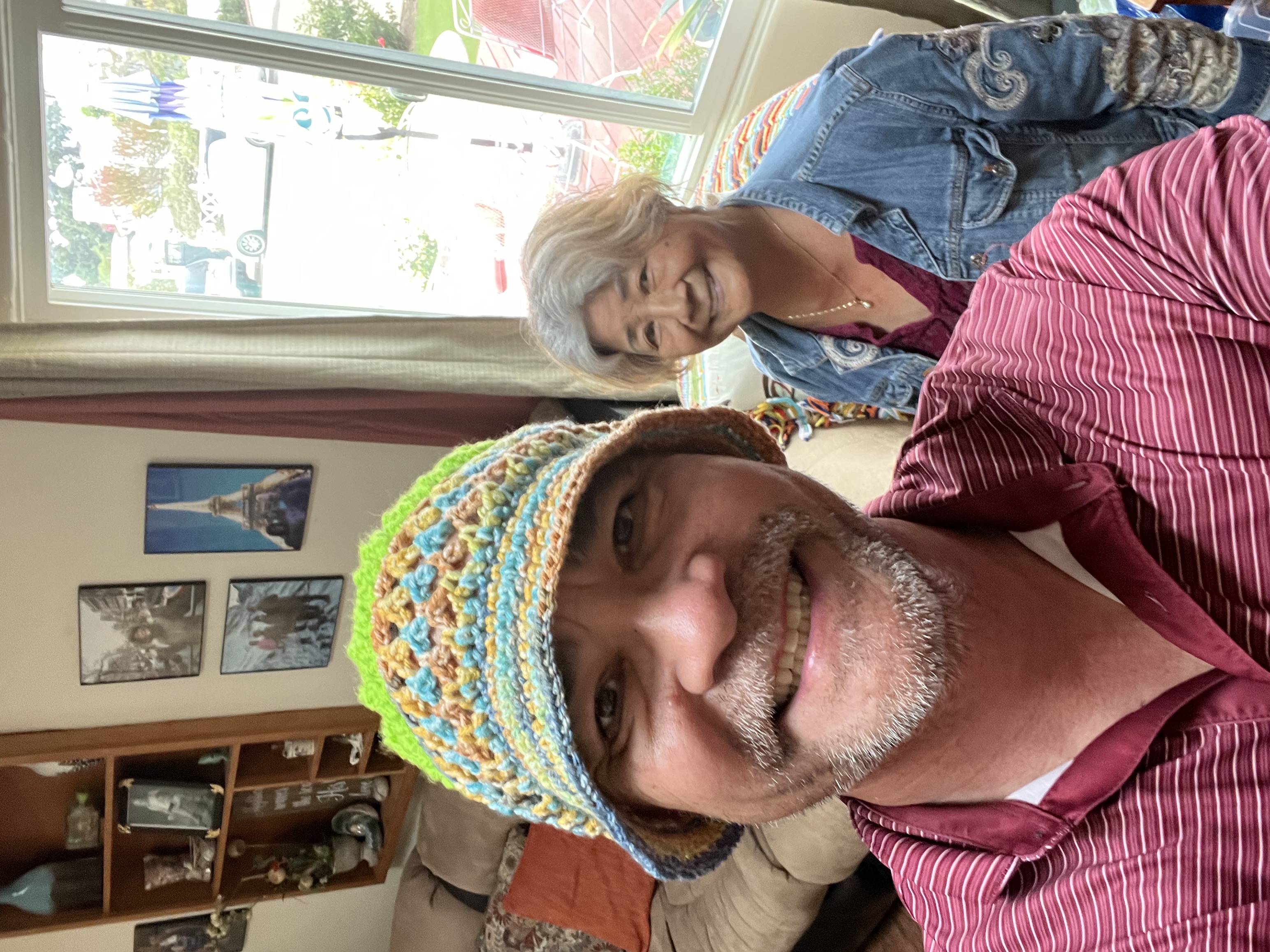
My mom crochets hats. She calls them Mombreros.
She's retired. She doesn't need the money, so every dollar of profit goes to charity. What she loves is the making and the giving.
She came from Vietnam and raised five kids, always with a bit of the entrepreneur in her. Of all of us, I'm the one who caught the bug.
So I posted about her hats.
I put them on Facebook — three friends bought one that same day. I put them on Instagram — an old friend I hadn't heard from in years went and ordered one.
I kept asking myself why it moved so fast. Here's my read: the post was honest about what it was for. It was mission-clear. And the people who aligned with that just showed up.
I'm surrounded by people who want to help each other out.
That's the whole thing, really. A business built on love and service, supported by people who share your ideals. Starting one is hard and slow — there's no shortcut — but doing it with purpose is what makes the time worth it. …more
Channel names and logos are trademarks of their respective owners.