Today's post is 318 words, a 2-minute read.
Sources: Every.to — "Our Agents, Ourselves"
1 big thing: How forward-thinking teams are turning institutional knowledge into reusable AI skills
The best thinking in your marketing organization lives in someone's head. Every.to is running an experiment to change that.
Why it matters: In B2B marketing, your most valuable asset is not your tech stack. It is the judgment of the people who know your brand, your buyers, and what actually works. That knowledge walks out the door every time someone leaves.
Driving the news:
Every.to is capturing the decision-making patterns of their best employees and encoding them as reusable AI skills.
→ Their best editor's headline instincts, their top strategist's brief methodology — documented and accessible via AI
→ One Walleye Capital CEO now requires AI use for all 400 employees — not as a suggestion, but as a baseline operational standard
Zoom in:
Companies spent months answering the same 33 questions from executives on how to roll out AI — covering strategy, tool selection, governance, and winning over skeptics.
→ Every.to published those answers publicly for the first time this week
Yes, but: Encoding institutional knowledge takes deliberate documentation most teams defer indefinitely because it does not show up in this quarter's deliverables.
Be smart: Start with your highest-leverage knowledge holder. Document how they think about one recurring decision — a content brief, a headline, a channel call — and build from there. One reusable skill that reflects real expertise beats a hundred generic prompts.
The bottom line: Your best marketer's instincts should not be a single point of failure.
https://every.to/context-window/the-case-for-cloning-your-coworkers#AIMarketing#B2BMarketing…more
Busy founders and stalled founders often look identical from the outside. Both are working constantly. The difference is what happens to all that effort.
Here's the pattern I've watched for 25 years: activity that isn't built on a system doesn't compound. You do the outreach, the post, the follow-up, the demo — and then next week you start from zero and do them all again. It feels like progress because it's exhausting. But nothing accumulates. You're not building an engine; you're pushing the car.
A system is just the opposite. It's a motion you run once, learn from, and improve — so the next turn is a little sharper than the last. That's what compounding actually is: the same effort producing more each time because the thing underneath it is getting better.
The trap for a stalled founder isn't laziness. It's the opposite. There's so much motion that you can't tell which of it is worth turning into a system and which is just noise burning the hours.
Here's the filter I use. One question separates the signal from the noise:
Which single motion, if it got 20% better every time we ran it, would change the trajectory of the business?
That's the one to systematize. Not the ten things that feel urgent — the one whose improvement curve actually bends the outcome. Usually it's unglamorous: how you talk to customers, how a lead becomes a conversation, how you decide what to build next. Almost never the thing that's loudest on your calendar.
Then be honest about the rest. Most of what fills a stalled founder's week is motion that will never compound no matter how well you execute it. That's not a productivity problem you fix with a better tool or another hire. It's a focus problem. Cutting it isn't losing ground — it's freeing the attention the one motion needs to become a real system.
The uncomfortable part: you can't systematize everything, and trying to is its own form of noise. Compounding demands you pick.
So the question worth sitting with this week:
Of everything you're doing right now, which one motion is actually worth turning into a system — and what would you have to stop doing to give it the attention it needs?
#Founders#Startups#Entrepreneurship#FounderLessons#GrowthStrategy…more
Across four companies and 25 years, my go-to-market got better every time. Here's the most important thing I learned.
Stop trying to do everything at once.
Most growth problems look like marketing problems.
But when I dig in with founders, the issue is usually lack of focus.
Too many audiences.
Too many messages.
Too many priorities.
Too many opportunities.
What actually works: one audience segment, one message, one channel, one objective. Run it long enough to learn something.
The lesson isn't about marketing.
It's about decision-making.
The companies that grow fastest are often the ones that say no most often.
What's one thing you're working on right now that you know should probably wait?
Most stuck practices aren't under-resourced. They're over-complicated.
I see it with almost every coach and consultant I advise. Three audiences. Five offers. Two newsletters, a podcast idea, a course half-built, a website redesign in progress. Everything is "almost working," which is another way of saying nothing is.
When growth stalls, the instinct is to add more: channels, offers, effort. After 25 years of building companies, I trust the opposite pattern. Momentum comes from removing decisions. A few things running well compound faster than many things running at half strength.
A practice has one engine: a clear person, with a clear problem, hearing a clear promise, through one reliable channel. Everything beyond that is optional until the engine runs. Most of what fills a stuck practice-owner's week is complexity that will never compound no matter how well it's executed.
Here's the exercise I run with clients. List everything you're doing to grow. Then ask one question of each item: if this got 20% better every month, would it change the trajectory of my business? Most items fail the test immediately. The one or two that pass — that's the business. The rest is noise wearing a to-do list.
Cutting will feel like retreat. Give it two weeks and it starts to feel like focus.
What's the one decision that, if you made it this week, would unblock everything else in your practice?
#IndependentConsultant#Coaching#ConsultingBusiness#GoToMarket
Co-Founder at Cora Nexus AI | Startup Ops | Force Multiplier | Project Manager | Strategic Planning | Cross-Functional Systems
· LinkedIn
·
The best co-founders aren't two builders - they're a builder and an execution artist.
I've noticed the teams that struggle early often have the same problem: everyone wants to build. Nobody wants to build the systems around the building.
Which makes sense. Especially in the early stages, momentum feels like everyone sprinting in the same direction. But building the product and building the business are two different jobs.
One person is asking, "What's possible?"
The other is asking, "How do we do this 100 more times without everything catching fire?"
You don't always need another co-founder for that. Sometimes you need someone who can step in, build the operational foundation, and hand owners and founders back the time they're spending putting out fires.
That's my favorite part of the job. Ops isn't known to be glamorous - but dang, it is to me.
P.S. Did I just make up "execution artist"? I'm keeping it. It's either a COO or a Bond villain. Either way, I'm here for it and just wish it looked less sinister on a business card. …more
Co-Founder at Cora Nexus AI | Startup Ops | Force Multiplier | Project Manager | Strategic Planning | Cross-Functional Systems
· LinkedIn
·
"We're too early for operations."
I've heard this a lot recently, and get the instinct. When you're still chasing product-market fit or racing toward the next milestone, ops feels like something you can worry about later.
But think about building a house. You don't pour the foundation after the second floor is framed. You pour it first, because everything above it depends on how solid it is.
Operations is your foundation.
The informal, ad hoc ways you work at 5 people won't hold together at 20. If you haven't built basic structure, documentation, and execution habits early on, things don't just slow down. They break.
It's never too early to get ops in order. Early is exactly when the foundation has to be built right. …more
If you're solving the same problem every week, you don't have a task problem. You have a structure problem.
It's one of the clearest patterns I've learned across four startups and a lot of advising rooms: recurring firefighting is almost never about the fire in front of you. The same issue keeps coming back because something in the system — how work flows, who owns what, how decisions get made — keeps producing it. You can put the fire out beautifully every single time, and it will still be there next Tuesday.
W. Edwards Deming made this point decades ago, and it still holds. In Out of the Crisis, he estimated that about 94% of the problems in any operation belong to the system, not the people — only around 6% trace to a true one-off. Read that again: the overwhelming majority of what looks like individual failure is actually structural. So when the same thing breaks over and over, blaming the person doing the task is the most expensive mistake you can make.
The fix is slower up front and far cheaper over time. Instead of solving the instance, you step back and ask what keeps generating it — then you change that. Redesign the handoff. Clarify the ownership. Remove the step that keeps failing. Do it once, at the structural level, and the symptom stops recurring instead of demanding your attention forever.
Firefighting feels productive because it's visible and urgent. But a leader's real job isn't to be the best firefighter in the building. It's to build something that stops catching fire.
What's the problem that keeps coming back no matter how many times you solve it — and what structure might be quietly producing it? …more
Deming counted: ~94% of problems belong to the system, not the people.
So when the same thing breaks every week, blaming the person doing the task is the most expensive mistake you can make.
Organization focused on AI leadership and innovation for the Fourth Industrial Revolution, based in Silicon Valley
· LinkedIn
·
Most AI transformation efforts stall because leaders underestimate the organizational redesign required. The technology is the easier part. The harder work is redefining how teams collaborate, which roles need new skills, and what decisions can no longer be made the same way.
We see this pattern consistently. Leaders invest in AI tools and then expect existing workflows to absorb them. What actually happens is friction. Teams unsure of their new responsibilities. Processes that conflict with what the technology enables. Decision rights that no longer match the speed or scale of AI-driven insights.
This is both a technical problem and It is a leadership problem that requires a different skill set than most organizations currently have.
Our workshops at AI Institute of Silicon Valley focus on closing this gap. They walk you through the frameworks for identifying which roles need transformation, how to redesign workflows around AI capabilities, and how to implement change in a way that your organization can sustain.
These sessions are built for executives and business leaders who are past the exploratory phase and need practical guidance to move forward. You will leave with tools you can apply immediately to your own transformation initiatives.
We offer scheduled workshops throughout the year. If your organization has specific challenges or needs a tailored approach, we also design custom workshops that address your unique context.
If you are leading AI transformation and facing the challenge of organizational redesign, these workshops provide the clarity and methods to navigate it effectively.
Sign up for a scheduled session or contact us to discuss a custom workshop for your team.
https://aiisv.org/…more
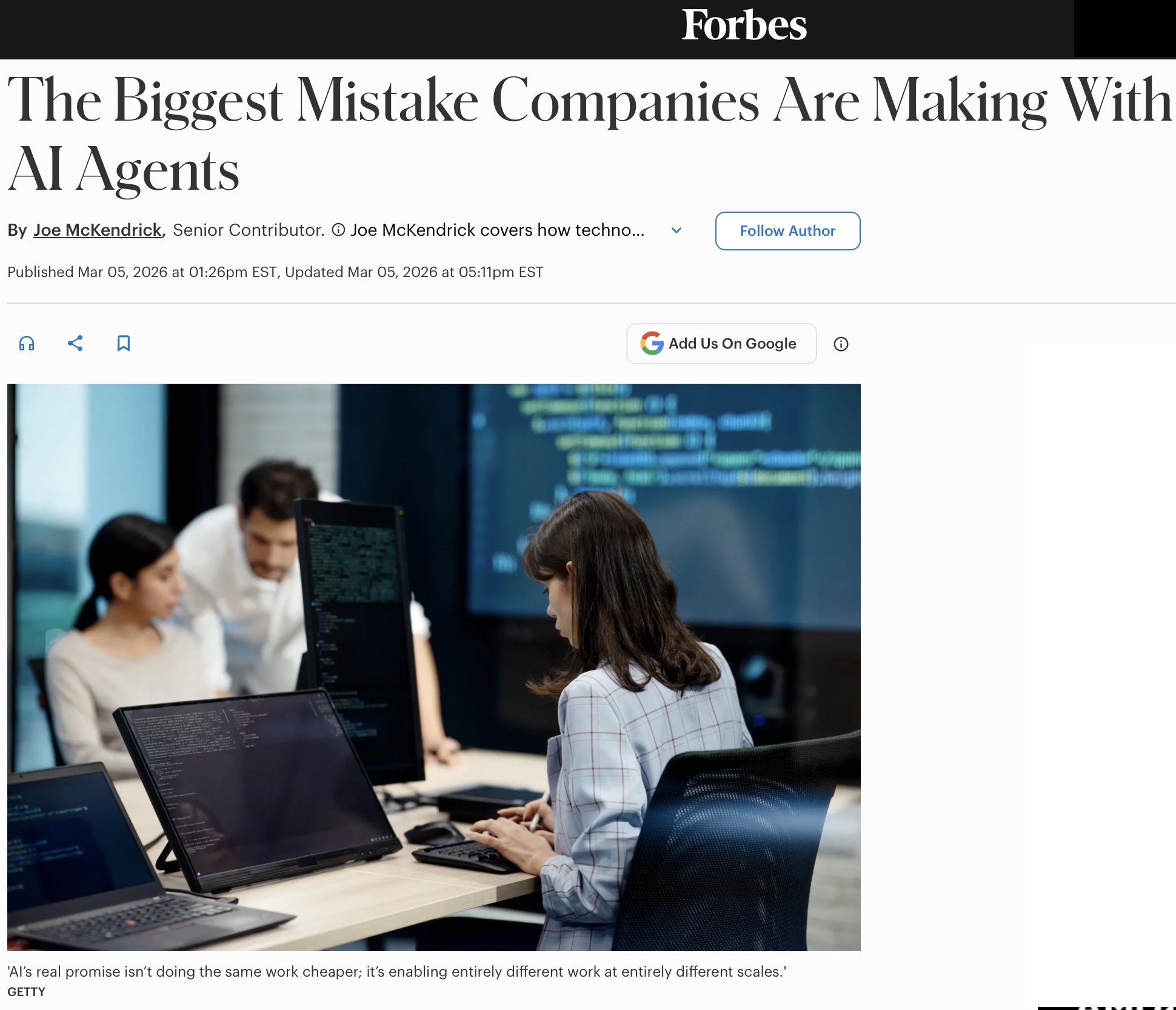
As covered in Forbes, Joe McKendrick summarizes Brian Solis' ServiceNow research on human + AI. The core mistake I see is treating AI agents only as task replacers instead of partners. From building startups and launching programs I learned three practical steps: map workflows to define human/agent decision points; measure quality and trust, not just speed; run small frontline pilots with clear handoffs and governance. Send me a message to discuss pilot designs. #AIhttps://briansolis.com/2026/03/forbes-publishes-brian-solis-latest-ai-research-the-biggest-mistake-companies-are-making-with-ai-agents/…more
Inspiring Founders Podcast is available on Apple Podcasts. If you want to learn from other founders, check it out.
I learned early that a good idea rarely guarantees survival. After launching early initiatives I found two practical levers that matter: repeatable operational rhythms and access to mentors who help navigate inevitable pivots.
The Inspiring Founders Podcast digs into these realities with founders who share what actually worked and what didn’t. If you want practical takeaways, subscribe and listen. If you want to get more involved in the startup ecosystem, send me a message. #foundershttps://podcasts.apple.com/us/podcast/inspiring-founders-podcast/id1847207641…more


 View on LinkedIn
Also on