

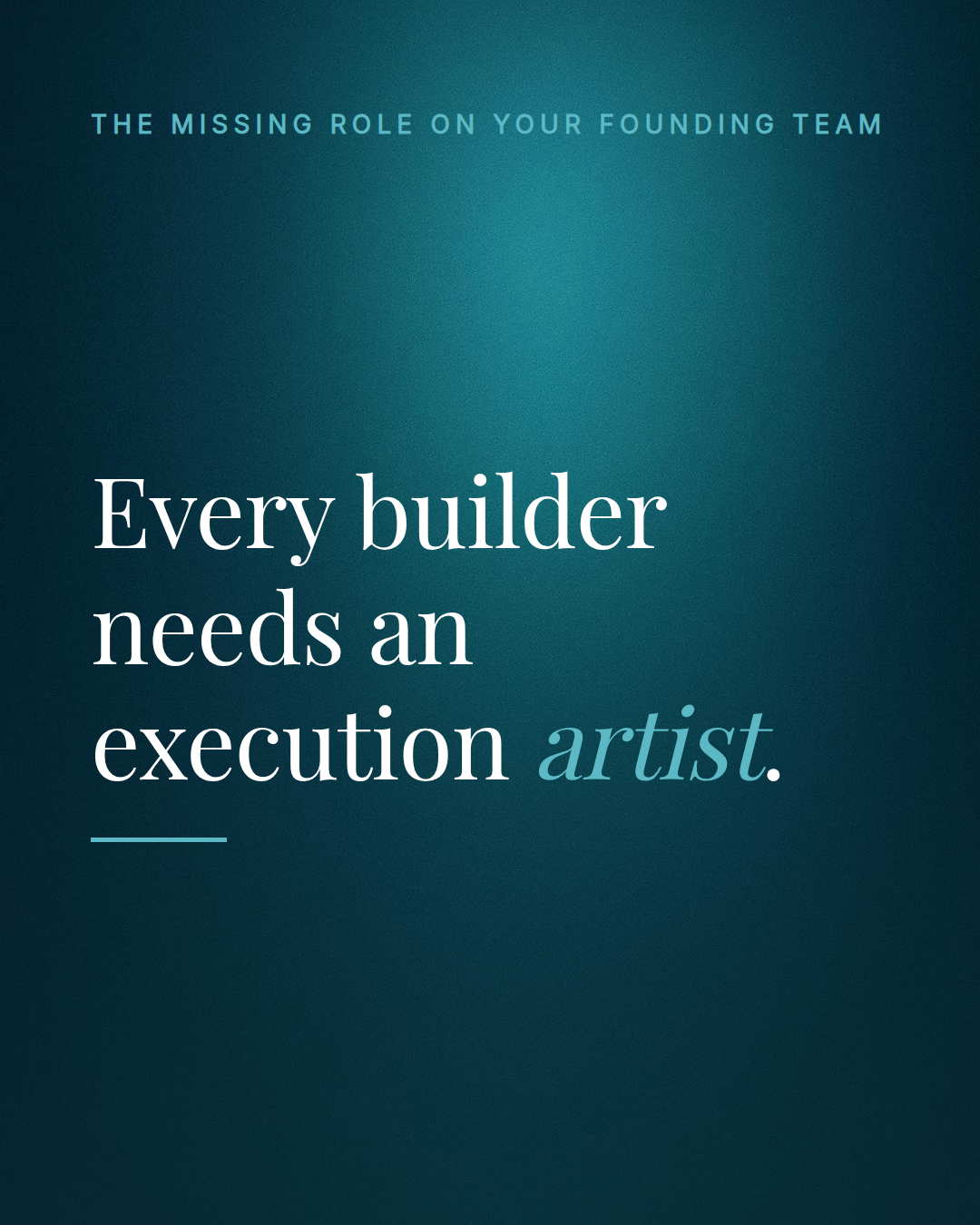
Going Independent
M

Michael Ashley
Founder at Radi8 // Executive Coach // Host of the Inspiring Founders Podcast
Talent, timing, network — none of it matters if you quit before the moment arrives.
After building several companies and advising a lot of people who've struck out on their own, if you asked me for the one trait that separates the people who make it from the people who don't, it wouldn't be intelligence, or connections, or perfect timing. It's perseverance.
And I don't mean the motivational-poster version. Most people who go independent don't stop because they've failed. They stop because they haven't succeeded yet — and in a hard moment, those two things feel identical. They're not.
Real perseverance isn't blind stubbornness. It's staying in motion, adapting, and keeping the door open long enough for something to actually happen. The hardest stretch is never the leap. It's the long middle — when you've left the title behind, you're doing the work, and the clients aren't showing up yet.
What I've come to believe is that the distance between wanting to quit and the breakthrough is usually shorter than it feels in the moment — but you only find that out if you're still standing there when it comes.
If you're in that middle right now, growing a coaching or consulting business of your own: what's keeping you in the game? What would help you stay?
🎙️ From my conversation with Julia Lucidi on the Founder Tactics podcast — full episode linked in the first comment.
#IndependentConsultant #Coaching #Solopreneur #GoingIndependent #PersonalBrand …more
M
Michael Ashley
Founder at Radi8 // Executive Coach // Host of the Inspiring Founders Podcast
The revolution of independence is starting.
For most of my career, building a successful business required assembling a company.
Employees.
Departments.
Agencies.
Specialists.
Today, AI is changing that equation.
One founder with expertise, good judgment, and the right tools can now create leverage that used to require an entire team.
That's a massive shift.
But it creates a new challenge.
If expertise is no longer scarce, what is?
Trust.
Visibility.
Reputation.
The ability to consistently show up and demonstrate how you think.
I believe we're entering an era where reputation becomes one of the most valuable business assets a person can own.
Not because everyone needs to become a creator.
Because everyone who sells expertise needs to become discoverable.
Consultants.
Advisors.
Founders.
Coaches.
Fractional executives.
The future belongs to people who can turn what they know into trust.
That's the shift I'm watching most closely. …more
M
Michael Ashley
Founder at Radi8 // Executive Coach // Host of the Inspiring Founders Podcast
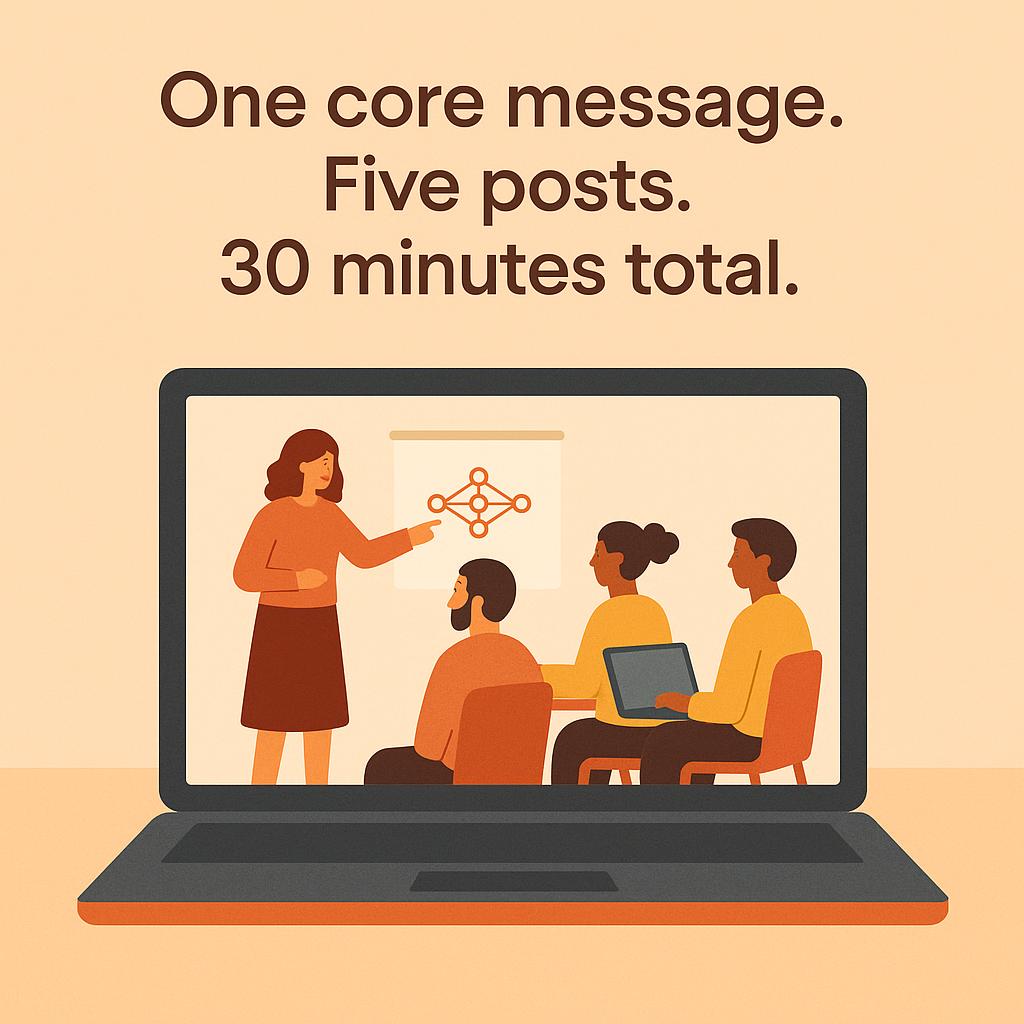
Here's a workflow you can steal. One core message → five LinkedIn posts in 30 minutes.
Step 1 (5 min): Pick one thing you believe about your industry. Not a tip. A point of view. Example: "Most marketing advice for small business owners is wrong because it assumes you have a marketing team."
Step 2 (5 min): Write it as a single declarative sentence. That's your core message.
Step 3 (10 min): Generate five angles on it with AI. Story angle (a moment this was true). Contrarian angle (what people get wrong). Tactical angle (one thing to do differently). Mistake angle (what you used to do). Persona angle (who specifically this hurts).
Step 4 (10 min): For each angle, write the first two lines yourself — that's the hook. Let AI fill in the middle. Edit the ending so the CTA sounds like you.
That's it. Five posts. Same core idea, five different doors into it. Your audience won't feel repetition because each post leads with a different shape of thought.
I'm walking through this workflow plus two more — competitor research in 10 minutes, and an editorial system that runs in 15 minutes a day — at my workshop on May 28th in San Jose at the MLK Library, hosted by the Silicon Valley Small Business Development Center.
If you can't make it, book a free 15 to 20 minute marketing audit and I'll run this workflow with you on your business.
https://www.radi8.com/free-audit?utm_source=linkedin&utm_campaign=free_audit&utm_content=post_id
DM me if you want the workshop link. …more
Told 14 times, Apr 10, 2026 – May 25, 2026
· LinkedIn · Open
Simple, outcome-focused positioning beats clever complexity.
Winning brands choose one customer problem, one distinct approach, and one measurable early growth channel.
If your go-to-market or early channels feel unclear, start with three things:
- a one-sentence positioning statement,
- two content themes mapped to buyer stages,
- and one channel to test for 90 days with a single KPI.
I launched three startups (one major acquisition) and advised three that reached billion-dollar exits. Sign up for a free marketing audit and consultation.
https://www.radi8.com/free-audit
#SMB #Marketing #AI
· LinkedIn · Open
Big news: Radi8 is now on Claude. 🎉
We just launched our official MCP server — which means small business owners can now access Radi8 directly inside Claude, Anthropic's AI assistant.
Your marketing plan. Your brand voice. Your content calendar. All of it, live inside your AI assistant.
Here's what that actually means in practice:
→ Ask Claude to draft content straight from your Radi8 plan
→ Get copy that already knows your campaign goals and brand voice
→ Go from strategy to published content in minutes, not hours
No more re-explaining your business to an AI every time you sit down to write. No more switching between tabs and copy-pasting context. Claude now knows what you're trying to accomplish — because it's connected to the plan you already built.
For small business owners doing marketing without a team, this is the gap-closer you've been waiting for.
If you want to see what this could look like for your business, I'm offering a free 15–20 minute marketing audit this month. Just a real conversation about where you are and what's possible.
👉 Book your free audit: https://www.radi8.com/free-audit?utm_source=linkedin&utm_campaign=free_audit&utm_content=test
This is just the beginning. More to come. 🚀
· LinkedIn · Open
I used to spend 3–4 hours a week on marketing. Now it's closer to 45 minutes.
The difference? I stopped doing it manually.
AI-assisted workflows have changed the game for small business owners — not because AI does your thinking, but because it eliminates the busywork: the formatting, the repurposing, the "how do I say this?" moments.
I'm also running a free workshop on May 28th in San Jose where I'll walk through exactly how I do this — live demos, real templates, no fluff.
But if you can't wait until May (or aren't in the Bay Area), I'm doing free 15–20 minute marketing audits this month. We'll look at where you're wasting time and what an AI-assisted workflow could look like for your business.
👉 Learn more about the workshop: https://www.radi8.com/blog/workshop-may-28th-marketing-with-ai
Or book a free audit directly: https://www.radi8.com/free-audit?utm_source=linkedin&utm_campaign=free_audit&utm_content=apr_plan
Comment below or DM me — happy to chat.
· LinkedIn · Open
One lesson the recent conversation around brand strategy and positioning keeps reinforcing: clarity wins.
Define who you serve, the problem you solve, and the outcome you deliver. Those three answers turn go-to-market decisions into tests, reveal the single repeatable early-growth channel to focus on, and create messaging that converts.
Proof: I launched three startups (one acquisition exit) and advised three that reached billion-dollar exits: an IPO, a merger, and a private equity sale.
If an unclear GTM or uncertainty about early channels is holding you back, send me a message. I’ll run a free marketing audit and map one high-impact channel plus 30-day priorities. I lead Radi8, where we help SMBs run practical, repeatable marketing.
· X · Open
I just had a full conversation with my laptop and it ran my entire marketing operation. Built a custom MCP server connected to Claude. This isn't AI helping me write. It's AI running the workflow. Free 15–20 min audit this month → https://www.radi8.com/free-audit?utm_source=x&utm_campaign=free_audit&utm_content=fun_post
· LinkedIn · Open
I just had a full conversation with my laptop and it ran my entire marketing operation.
No clicking. No tab-switching. No copy-pasting between 6 tools.
I built a custom MCP server — think of it as a direct nerve connection between me and Claude. I talk to it. It drafts posts, builds briefs, schedules content, pulls my strategy. Done.
This isn't "AI helping me write." This is AI running the workflow.
Small business owners are out here spending 10+ hours a week on marketing busywork. I just compressed that into a conversation.
Want to see what that looks like for your business? I'm doing free 15–20 min audits this month. We'll find your quick wins and build you a system that actually runs.
Book here → https://www.radi8.com/free-audit?utm_source=linkedin&utm_campaign=free_audit&utm_content=fun_post
· LinkedIn · Open
Most small business owners don't have a marketing problem.
They have a *time* problem.
You already know what you should be doing — staying in front of prospects, posting consistently, following up. But between running operations, serving clients, and putting out fires, marketing is always the first thing that gets pushed.
The fix isn't hiring an agency or spending more money. It's having a simple, repeatable workflow you can actually stick to.
Here's what that looks like in practice:
→ A content template you fill in once a week (30 min max)
→ A short list of topics you rotate through — no blank page syndrome
→ A posting schedule that doesn't require you to live on LinkedIn
I've helped founders build systems like this from scratch. Once it's in place, staying visible stops feeling like a chore.
If your marketing feels inconsistent or overwhelming, I offer a free 15–20 minute audit to help you see exactly where the gaps are and what to fix first.
No pitch. Just clarity.
DM me or grab a spot here → https://www.radi8.com/free-audit?utm_source=linkedin&utm_campaign=free_audit&utm_content=test
· LinkedIn · Open
Most small business owners want to use AI for marketing but don't know which task to automate first.
On May 28 in San Jose, I'm running a free workshop where you'll see live demos, get templates you can use the next day, and walk away with a repeatable workflow for content planning and post creation.
I've launched three startups with one acquisition exit and advised three more through billion-dollar exits. I know what it's like to handle your own marketing with no team and no time.
Seats are limited. Read the full details and register on my blog here https://www.radi8.com/blog/workshop-may-28th-marketing-with-ai
· LinkedIn · Open
Most small business owners don't need a bigger marketing budget. You need a repeatable system that doesn't eat up hours every week.
I'm now offering a free marketing audit for small business owners who need clarity on what to post and how to build a system.
Sign up for a spot https://www.radi8.com/free-audit
· LinkedIn · Open
The #1 thing I hear from small business owners about marketing: "I just don't have time."
Here's what I've found: it's rarely a time problem. It's a system problem.
When you have to start from scratch every week — staring at a blank post, figuring out what to write, editing, scheduling — of course it takes forever. But when you have templates, a simple workflow, and a few AI tools doing the repetitive work? It takes 30–45 minutes a week.
That's what I'll be showing at my free workshop on May 28th in San Jose. Live demos, real templates, and a workflow you can plug in the next day.
Comment "workshop" below and I'll send you the link, or grab a spot here → https://www.radi8.com/blog/workshop-may-28th-marketing-with-ai
· LinkedIn · Open
Most small business owners I talk to aren't bad at marketing.
They're just exhausted by it.
They spend hours staring at a blank screen, posting inconsistently, then going quiet for weeks because life got busy.
The fix isn't more willpower — it's a repeatable workflow.
When you have a simple system: what to post, when to post, how to write it fast — marketing stops feeling like a second job.
I've built and exited three startups, and the one thing that always separated growing companies from stalled ones was whether marketing was a habit or a hustle.
If you're a small business owner and you're not sure where to start — or you've been "meaning to get consistent" for a while now — I'm offering free 15–20 minute marketing audits this month.
No pitch. Just a real conversation about where you are and what would actually help.
👉 Book yours here: https://www.radi8.com/free-audit?utm_source=linkedin&utm_campaign=free_audit&utm_content=apr_plan
DM me if you have questions first.
· LinkedIn · Open
If you're a consultant or solo founder, you have a problem most marketing advice ignores: you are the product.
You can't hand your sales calls to someone else. You can't outsource your point of view. And you can't go quiet for two months without watching your inbound dry up — because nobody else can show up as you.
That's why "just hire a marketing person" doesn't work for solo operators. The voice has to be yours. The thinking has to be yours. The relationships have to be yours.
But that doesn't mean marketing has to eat your week.
What works for solo founders and consultants I advise is a tight, repeatable workflow: one prep block on Monday, posts queued for the week, 15 minutes a day on engagement. AI handles the heavy lifting on drafts. You handle the hooks, the point of view, and the relationships. The system runs even when client work is slammed.
That's what I'm teaching at my workshop on May 28th in San Jose at the MLK Library, hosted by the Silicon Valley Small Business Development Center. Built specifically for people who can't outsource being the face of the business.
If you can't make it, book a free 15 to 20 minute marketing audit. I'll look at how you're showing up now and help you build a workflow that doesn't compete with your billable hours.
https://www.radi8.com/free-audit?utm_source=linkedin&utm_campaign=free_audit&utm_content=post_id
DM me if you want the workshop link.
· Instagram · Open
I rebuilt my entire product in 30 days using AI.
Not because I wanted to move fast.
Because I had to prove something to myself.
Could AI actually do the work founders avoid because it feels too repetitive, too time-consuming, or just not worth the mental energy?
I picked the hardest problem I know.
Marketing content.
Most founders I work with know they should post more. They understand consistency builds trust. But they're not writers. They don't have time to research topics. And the idea of planning a month of posts sounds exhausting.
So they don't do it.
Or they do it once, burn out, and stop.
I wanted to see if Claude could handle the parts that slow people down: finding what to say, drafting it in your voice, keeping a calendar full without starting from scratch every week.
The result surprised me.
Not because it replaced judgment. It didn't.
But because it removed the friction. The blank page problem. The decision fatigue.
What used to take me two hours now takes twenty minutes.
And the quality is better because I'm editing and refining instead of grinding through first drafts.
We're launching Radi8 in March. It's built for founders who want to stay visible but refuse to live on social media.
If this resonates, follow along. I'll be sharing what I'm learning as we go.
And if you want to talk through your own marketing workflow, send me a message. Happy to walk you through what's working.
M
Michael Ashley
Founder at Radi8 // Executive Coach // Host of the Inspiring Founders Podcast
The objection I keep hearing about startup marketing, and why I still disagree
Common pushback: “You cannot start marketing until the go-to-market is nailed.” That mindset keeps early-career professionals waiting instead of building skills that prove them. After 20 years working with startups, I use a simple alternative: treat early marketing as a learning engine.
Three practical moves:
1) Run a 2–4 week micro-project tied to one customer hypothesis.
2) Run two low-cost channel tests and capture outcomes.
3) Document a one-page case study that shows insight and decisions.
These deliver portfolio-ready work, mentorship opportunities, and clear next steps into product, operations, or startup roles.
Send me a message if you want a one-page template or to talk through an idea. Ask me about Radi8 if you want help automating this into ongoing content. …more
 View on LinkedIn
Also on
View on LinkedIn
Also on
M
Michael Ashley
Founder at Radi8 // Executive Coach // Host of the Inspiring Founders Podcast
The future is about your brand, not your resume. About 37% of the US workforce already works independently. They get hired for a clear brand promise, a simple value proposition, and concrete proof points rather than a sequence of interviews.
AI is not taking your job, it’s accelerating this shift.
I built Radi8 to help you get to freedom faster.
https://www.radi8.com …more
Channel names and logos are trademarks of their respective owners.