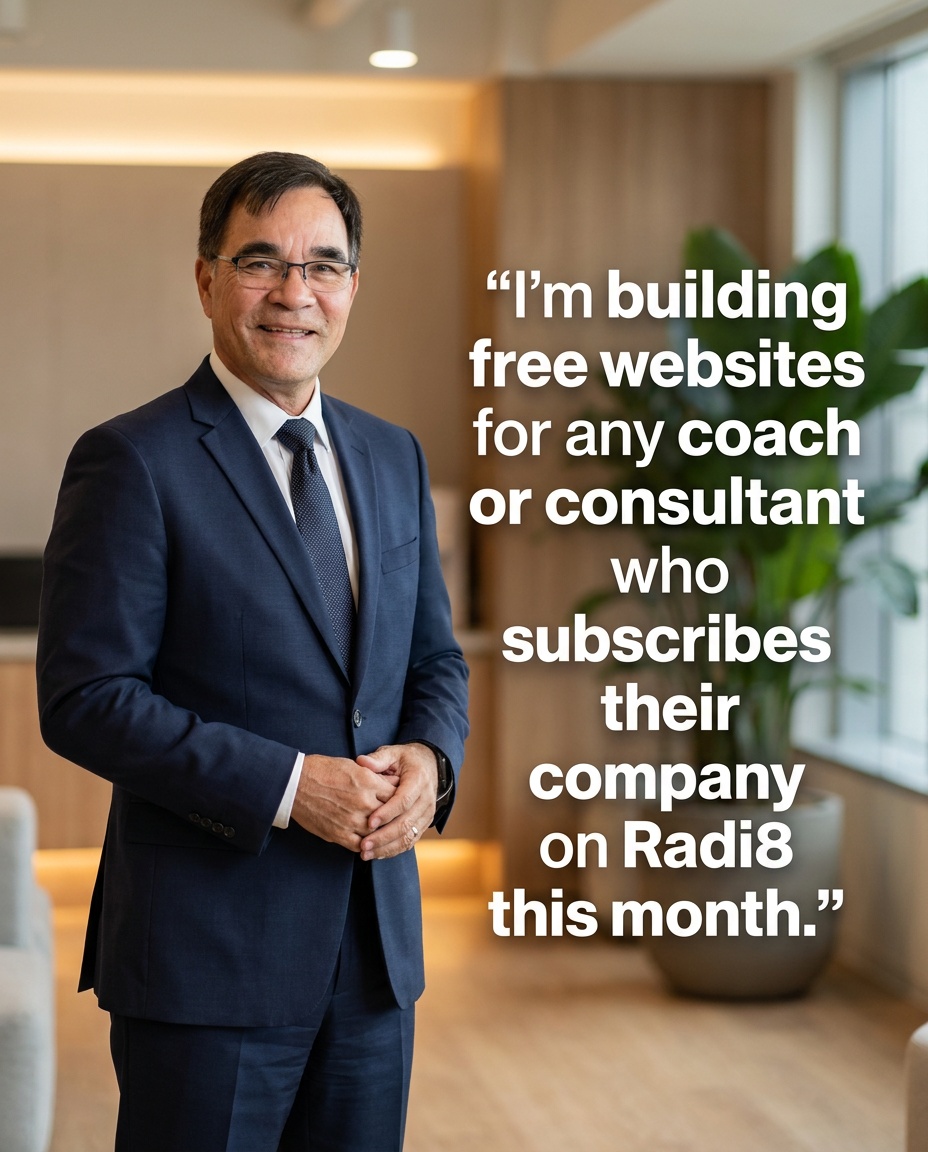
I will build a free website for any new coach or consultant who subscribes to Radi8 this month.
For most coaches and consultants going out on their own, the website is the thing that never gets done.
You know it matters. It's where a referral goes to size you up before they ever reach out. But it sits at the bottom of the list, behind actual client work — half-built, and saying a fraction of what you'd say if someone asked you across a table.
But a website isn't decoration. It's evidence. It's where the market watches how you think before they decide to book a call. When it's vague, the people most likely to hire you quietly move on, and you never see it happen.
So this month I'm doing something about it. Anyone who subscribes to Radi8 this month, I'll build the website myself, no charge. Radi8 keeps you visible and posting consistently. The site gives that work a home the right clients can actually find.
This isn't a blank template you look wrestle with alone. We get the positioning right first — who you help and what changes for them — then I build a site that carries it.
If yours has been on the someday list, consider this the nudge. Details and link in the first comment.
What's the one thing your current website fails to say about the work you actually do?
#IndependentConsultant #Coaching #Positioning #PersonalBrand #GoingIndependent …more
mashley.com ↗
I’ve spent the better part of 25 years trying to understand two things: which problems are worth solving, and what is the simplest way to solve them. That pursuit has led me to start companies, build products, teach entrepreneurship, coach hundreds of founders, and participate in four startup exits—one as a founder and three as an advisor. Along the way, I noticed a pattern. Founders are usually very good at solving problems. The trouble is that we’re often solving the wrong ones. What looks like a sales problem might really be positioning. A marketing problem might begin with not understanding the customer. An execution problem might simply be too many priorities competing for attention. I came to think of this as finding the problem under the problem. When you find it, complicated decisions get simpler, teams align, and a surprising amount of work disappears. Today I coach founders and startup teams around the world to do exactly that. Sometimes it’s a team scaling a company worth billions. Sometimes it’s one person turning what they know into a consulting business. The scale changes, but the work is remarkably similar. Find the problem worth solving. Find the simplest way through it. Then get on with the work that matters.
For most people who go out on their own, the first clients come easy. A former colleague. Someone from the old company. A friend who says "you should talk to my boss." It feels like word of mouth is working, and it convinces you that you'll never need marketing.
Then, somewhere in year one or two, it goes quiet.
Here's what actually happened. Those first clients weren't a pipeline. They were accumulated goodwill — twenty years of people who already knew your work, converting all at once. A one-time asset. Every engagement draws it down, and nothing automatic puts new names in.
That's the real source of feast-or-famine: treating a finite stock of warm contacts like a renewable one.
Refilling the well takes three things.
Positioning people can repeat. "He's great" sends you nobody, because your network can't finish the sentence. Give them the version they can pass along: who you help, and with what.
Visibility beyond your circle. A public body of work lets strangers build trust the way your old colleagues did, by watching how you think over time.
A reason to be remembered this month. Staying quietly excellent means being quietly forgotten. Consistency keeps you on the list when someone's moment of need arrives.
Word of mouth remains the best way to win clients. Building the system that generates it is the actual work.
If you've made the leap: how long did your first wave of clients last, and what did you do when it slowed?
#IndependentConsultant #Coaching #GoingIndependent #ConsultingBusiness …more
Talent, timing, network — none of it matters if you quit before the moment arrives.
After building several companies and advising a lot of people who've struck out on their own, if you asked me for the one trait that separates the people who make it from the people who don't, it wouldn't be intelligence, or connections, or perfect timing. It's perseverance.
And I don't mean the motivational-poster version. Most people who go independent don't stop because they've failed. They stop because they haven't succeeded yet — and in a hard moment, those two things feel identical. They're not.
Real perseverance isn't blind stubbornness. It's staying in motion, adapting, and keeping the door open long enough for something to actually happen. The hardest stretch is never the leap. It's the long middle — when you've left the title behind, you're doing the work, and the clients aren't showing up yet.
What I've come to believe is that the distance between wanting to quit and the breakthrough is usually shorter than it feels in the moment — but you only find that out if you're still standing there when it comes.
If you're in that middle right now, growing a coaching or consulting business of your own: what's keeping you in the game? What would help you stay?
🎙️ From my conversation with Julia Lucidi on the Founder Tactics podcast — full episode linked in the first comment.
#IndependentConsultant #Coaching #Solopreneur #GoingIndependent #PersonalBrand …more
Fast Pencil didn't win because of one clever innovation. It won because four technologies grew up at exactly the same moment — and we happened to be paying attention.
Back in 2007, four enabling layers matured almost simultaneously:
— E-books went mainstream (Kindle launched)
— Print-on-demand made a single copy economical
— Digital distribution meant you didn't need a warehouse or a bookstore
— Real-time online collaboration arrived (early Google Docs)
Any one of those, on its own, was interesting. A neat feature. A "someday" bet.
All four together created a category that couldn't have existed the year before: self-publishing for everyone. Right time, right place, right convergence — and a window that opened wide and then closed fast.
That's the lesson I keep coming back to for founders evaluating a new market. Most people scan for individual trends: "AI is hot," "video is growing," "this platform is exploding." Trends are easy to spot and easy to chase. The durable businesses get built somewhere harder to see — at the intersection, where several enabling layers reach maturity at the same time and suddenly make a hard thing cheap, obvious, and possible.
As I told Julia Lucidi on her Founder Tactics podcast: "being aware of the convergence of technology is huge."
So the real skill isn't spotting the trend everyone's already talking about. It's noticing when three or four separate things quietly cross the line from "almost possible" to "possible" at once. That's the timing window. And it rarely announces itself.
What convergence are you watching right now that others are treating as separate trends? Worth thinking about.
🎙️ From my conversation with Julia Lucidi on the Founder Tactics podcast. Full episode: https://youtu.be/M58Dnn2UAlM
#Founders #Startups #Entrepreneurship #GoToMarket #GrowthStrategy …more
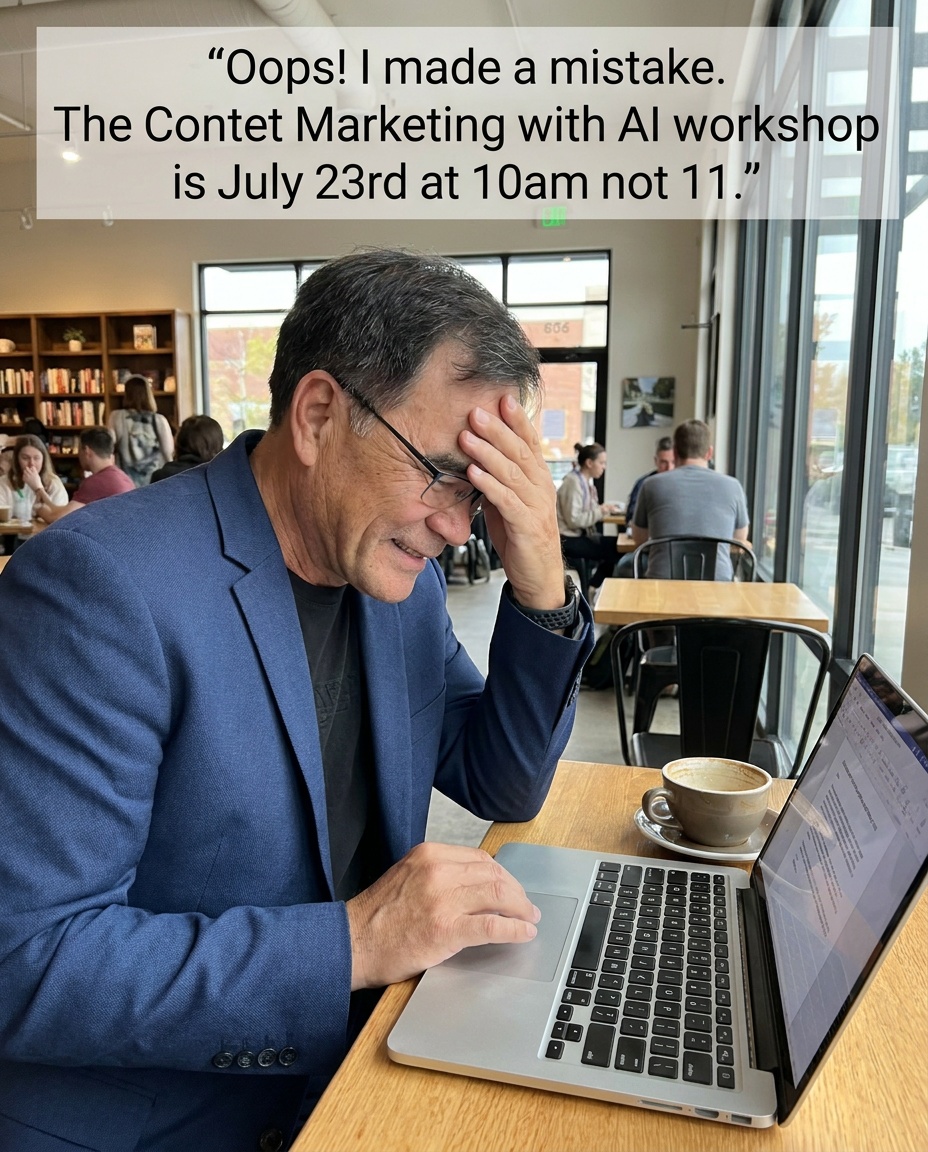
Oops!! I made a mistake.
The Content Marketing with AI workshop starts at 10am, not 11. Same Zoom, same registration link.
If you were already planning to join, move it an hour earlier on your calendar. We'll get into where AI actually fits in a content workflow — where it amplifies clear positioning and customer understanding, and where it just amplifies the confusion if the strategy underneath isn't there yet.
Already registered? Just show up at 10. Not yet? The link's still open — it's in the comments. Grab a spot and I'll see you on Zoom.
#Founders #Startups #Entrepreneurship #AIforBusiness #MarketingSystems …more
Most stalled initiatives aren't stuck because people disagree. They're stuck because everyone already agrees — and nothing moves.
I've watched this for 25 years. The room nods. The strategy deck is beautiful. "Yes, we should absolutely do this." And then a month later it's exactly where you left it. Founders read that as a conviction problem and go hunting for more buy-in. But you don't need more agreement. You have plenty. What's missing is the other two ingredients: momentum and ownership.
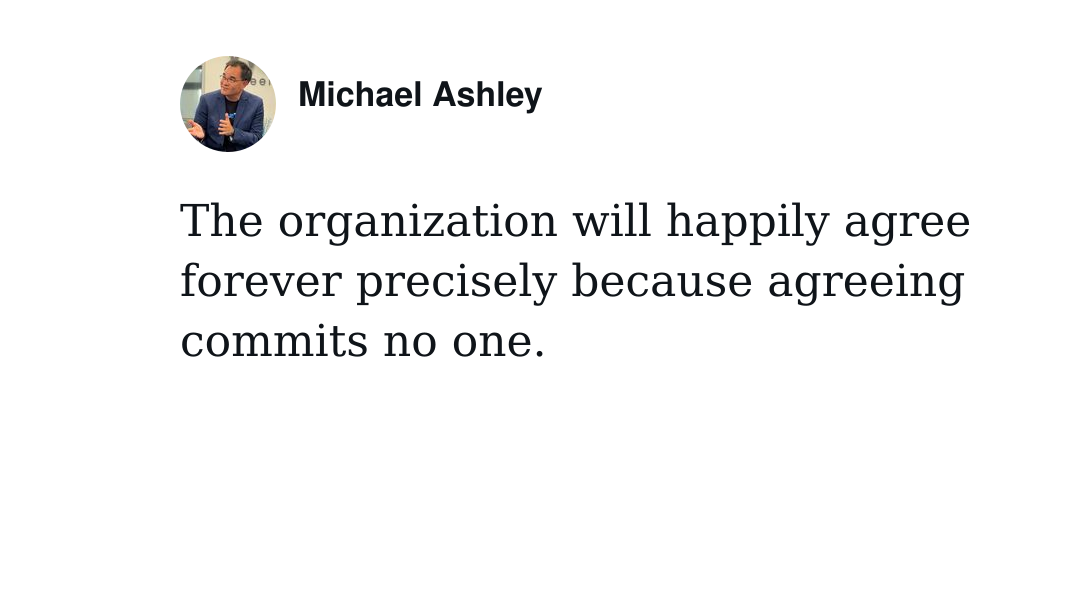
Agreement is cheap because it costs nothing. It's a nod. Momentum and ownership are expensive because they cost something the moment they exist — a decision that can't be quietly walked back, and a name attached to it. That's exactly why they're the parts that go missing. The organization will happily agree forever precisely because agreeing commits no one.
So the job isn't to build more consensus. It's to manufacture the first irreversible step.
By irreversible I don't mean dramatic. I mean a step that changes the facts on the ground, so next week can't just be a copy of last week. A few that actually work:
Make it public. A private intention dies quietly. An external commitment — a date told to a customer, a launch announced, a demo scheduled with someone outside the building — turns "someday" into "this Thursday, in front of people."
Assign one owner, not a committee. Shared ownership is the most sophisticated way to guarantee nothing happens. It has to be one name, with the authority to move and the accountability if it doesn't. A group can hold agreement. Only a person can carry momentum.
Spend something you can't refund. Book the venue. Hire the first person. Ship the rough version. The point isn't the size of the bet — it's that reversing it now costs more than continuing. That asymmetry is what makes the step stick.
Here's the uncomfortable part: the first irreversible step is uncomfortable on purpose. If it feels safe and fully reversible, it isn't the step — it's more agreement wearing a costume. The discomfort is the signal that you've finally converted a nod into motion.
The best builders I know aren't better at getting people to agree. They're better at creating the conditions where agreement has to become action — one owner, one public commitment, one thing that can't be undone.
So a question worth sitting with:
The initiative everyone agrees on but no one has moved — what's the smallest step you could take this week that you couldn't quietly walk back, and whose name would be on it?
#Founders #Startups #Entrepreneurship #FounderLessons #GrowthStrategy …more
Told 2 times, Jul 15, 2026 – Jul 17, 2026
· X · Open
A stalled project is rarely short on effort. It's short on a decision nobody wants to own. Which decision are you avoiding?
https://www.radi8.com/blog/get-chatgpt-claude-to-sound-like-you-social-posts
When your customer research keeps contradicting itself, the problem usually isn't the research. It's that you're talking to two different people and treating them as one.
I see this constantly. A founder runs a dozen conversations, and the signal is all over the map. One group swears the onboarding is the dealbreaker; another barely notices it and cares only about price. Half describe the product as a time-saver; half call it a status thing. The founder concludes "customers are confused" or "the market is fragmented," and goes hunting for a cleverer message to paper over the noise.
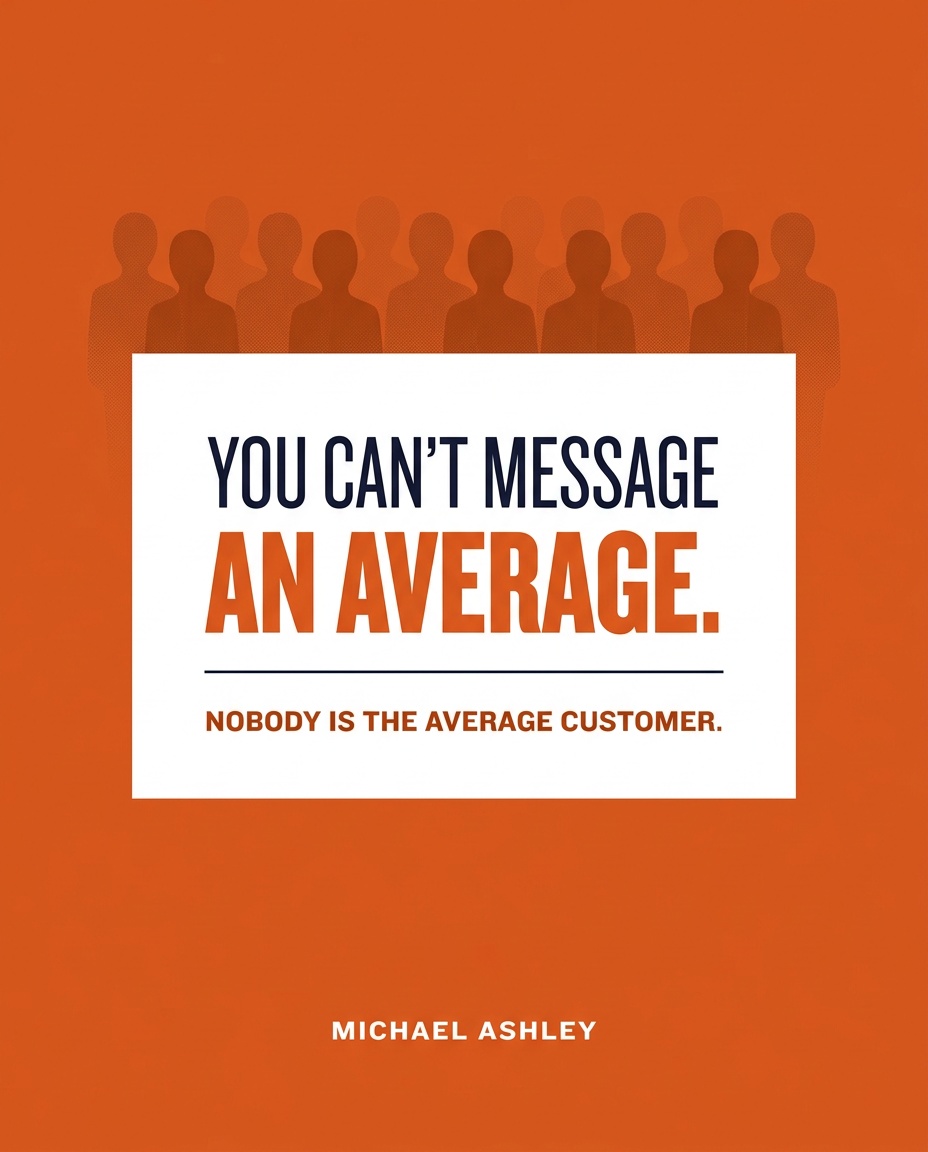
But the noise is the finding. Contradictory insights are what a blended audience sounds like. You're not hearing one confused market — you're hearing two or three coherent ones averaged into mush. And you can't message an average. Nobody is the average customer.
The reason this stalls companies is subtle: an average feels like data. It has quotes, a deck, a ring of rigor. So you make product and go-to-market bets on it — and the bets keep missing, because you're aiming at a person who doesn't exist.
The fix is in how you structure discovery, before you ever synthesize:
Segment on the way in, not on the way out. Decide the cuts that might explain different behavior — job to be done, trigger event, stage, buying context — and tag every conversation as you go. If you only segment after the fact, you've already blended.
Recruit on purpose, not on availability. A convenient sample is a blended sample. Deliberately fill each segment so a pattern in one group can't hide inside the average of all of them.
Read patterns within a segment, never across the pile. The question isn't "what did customers say?" It's "did this segment say the same thing to each other?" Agreement inside a clean segment is a signal. Agreement across a blended pile is a coincidence you'll pay for later.
Here's the bar I hold: an insight is decision-grade only when it's consistent inside a segment you could actually go acquire. Anything short of that isn't evidence — it's an anecdote wearing a percentage sign.
The uncomfortable part is that this makes your findings messier before it makes them clearer. Two sharp, opposing truths are worth more than one blurry consensus. Consensus is comfortable. It's also where stalled companies go to feel productive.
So a question worth sitting with this week:
The last time your customer insights contradicted each other — did you treat it as noise to resolve, or as a sign you were listening to more than one audience at once?
#Founders #Startups #Entrepreneurship #CustomerDiscovery #VoiceOfCustomer …more
"How do I keep from being the bottleneck?"
Most founders think they're the bottleneck because of how much they do. They're actually the bottleneck because of what only they're allowed to decide.
It's a subtle difference, and it's the one that keeps stalled companies stalled. You can hire more people, delegate more tasks, clear your calendar — and still be the single point of failure. Because the work moved, but the authority didn't. Every real decision still routes back to your desk for a yes. The team isn't waiting on capacity. They're waiting on permission.
I've watched this for 25 years across four startups. A founder offloads the doing and keeps the deciding, then wonders why nothing moves when they're heads-down or out of the room. It looks like a delegation problem. It's a decision-rights problem. You gave away the tasks but kept the steering wheel, and a car with one driver can only go one place at a time.
The builders I most respect design the opposite way — on purpose, early, before it's comfortable. They treat decision-rights as something you architect, not something that accumulates by default around whoever started the company. Two questions do most of the work:
For any recurring decision, who owns it — not who advises, who decides? If the honest answer is "me, eventually," you've found a place the company can only move at your speed.
And what does this person need to decide well without me — the context, the constraints, the definition of a good outcome? Authority without judgment is just a faster way to make bad calls. The transfer isn't handing over a decision. It's handing over the thinking behind it, so the call gets made the way you'd make it, whether you're there or not.
Here's the reframe I've come to believe: a venture that can't make decisions without its founder isn't a company yet. It's a talented person with help. The moment it can decide well without you is the moment it becomes durable — something built to outlive your involvement instead of depending on it.
That's not abandonment. It's the point. You're not designing yourself out because you're leaving. You're doing it because a company that needs you for every decision is fragile in exactly the place that looks like strength.
So a question worth sitting with this week:
What's one recurring decision that still routes through you by default — and what would the person closest to it need in order to own it outright?
#Founders #Startups #Entrepreneurship #VentureBuilding #FounderLessons …more
Most people I work with are trying to become indispensable. I spend my time trying to become unnecessary.
That sounds backwards, so let me explain the difference — because it's also the difference between me and the operators and agencies a founder might hire instead.
An agency is designed to keep you as a client. An operator is often measured by how much runs through them. Both, by design, make you a little more dependent every month. That's not a criticism of their intent — it's the incentive built into the arrangement. The longer you need them, the better it works for them.
My job is the opposite. I get handed a hard, ambiguous problem, I build the thing, I set a real foundation under it — and then the win is when a capable operator can take it over and scale it without me in the room. I'm not building a dependency. I'm building something that no longer needs me.
Here's why that matters even if you never hire anyone: dependency on a single person is a hidden fragility. It feels like control. It reads like importance. But it's the crack that doesn't show until the load shifts. In M&A, buyers actually price this — a business that leans too heavily on its founder gets discounted, sometimes steeply, versus one that runs on people, process, and structure. The market is telling you something founders don't want to hear: your irreplaceability is a liability on the balance sheet.
The fix isn't heroics. It's two disciplines most builders skip.
First: document the decisions, not just the outcomes. Anyone can inherit a result. Almost no one can inherit the reasoning — why you chose this customer over that one, why you killed the feature everyone loved, what you'd do if the number moved the wrong way. Outcomes tell your successor what happened. Decisions tell them how to think when you're gone. That's the part that actually transfers.
Second: treat the handoff as the test, not the goodbye. A clean handoff is the only honest proof the foundation is solid. If the thing wobbles the moment you step back, you didn't build a company — you built a role, and you're standing in it. The transfer is where you find out whether the structure was ever real.
I've come to believe the strongest thing you can build is something that outlives your involvement in it. Not because you're leaving tomorrow. Because durability and dependency are opposites, and you have to choose which one you're actually building.
So here's the question worth sitting with:
Is your company built to outgrow you — or to need you?
#Founders #Startups #VentureBuilding #ScalingUp #FounderLessons …more
Told 2 times, Jul 15, 2026
· X · Open
Most people try to become indispensable. I try to become unnecessary.
Founder-dependency feels like control. But in M&A it's priced as a liability — buyers discount it.
Document the decisions, not just the outcomes.
Is your company built to outgrow you — or to need you?
Ask an AI what's best in your category. If you're not in the answer, you're not in the deal. I wrote up why: https://www.radi8.com/blog/show-up-when-buyers-ask-ai-for-recommendations …more
Back in 2007 my mom wrote a book, and no one would publish it.
It's called "Butterfly Girl" — the story of a little girl lost in a storm and her long journey home. She wrote it for one reader: my daughter. She wanted her granddaughter to know where she came from, in her own words. The traditional publishers all passed. A beautiful, personal story about one family's journey wasn't a big enough market for them.
So I told her not to wait for anyone's permission. We'd do it ourselves.
What I didn't fully understand until we were in it: self-publishing back then was brutal. Formatting, printing, distribution, ISBNs, cover files — every step was manual, expensive, and built to make you quit. We pushed through it anyway, and she held her book in her hands. That moment was the whole point.
Then Christmas came. And at the table, one relative after another leaned in and said some version of the same thing: "You know, I have a book in me too. How did you do it?"
That's when it clicked. The pain I'd just spent months fighting through wasn't my mom's problem. It was everyone's problem. As I put it later:
"there's a million other moms out there hundred million other moms you know actually billions of people out there who think they have a book in them and will never publish so it was the business model"
That became FastPencil — an online writing and publishing platform. It didn't start with a market analysis or a TAM slide. It started with one person I loved, one urgent human problem, and a Christmas dinner full of people stuck behind the exact same wall.
I've come to believe this is one of the most underrated sources of a great idea: proximity. Not brainstorming what the market wants in the abstract, but solving something real for someone you actually care about — then noticing how many other people are quietly living the same frustration. The narrow, personal problem is often the universal one wearing a disguise.
So here's my question for you:
Is there a version of this in your own story — a problem you solved for someone close to you that turned out to be universal?
🎙️ From my conversation with Julia Lucidi on the Founder Tactics podcast. Full episode: https://youtu.be/M58Dnn2UAlM …more
I've built a handful of companies. The ones that actually worked all followed the same shape — and it's close to the opposite of what most founders are told to do.
Build the thing. Set a foundation under it. Hand it to someone who can scale it. Then go do it again.
For years I thought the handoff was me failing. You start something, pour yourself into it, and then… you leave? It felt like abandonment. Now I think it's the whole point. My job is to make something exist and make it stand on its own — not to be the reason it keeps standing.
There's research that reframed this for me. Studying 200+ startups, Noam Wasserman found that founders are most likely to be pushed out right after their biggest wins. Not their failures — their wins. Because hitting the milestone changes the job underneath them. Inventing and scaling reward different instincts, and the thing that made you great at the first often makes you the bottleneck in the second.
So I stopped treating my exit as a threat and started treating it as a design requirement. If I build it right, it shouldn't need me. Durability doesn't come from a founder's presence — it comes from the people, process, and structure that outlast any one person.
The test I use now is simple: if I stepped away for 90 days, what would quietly break? Wherever the answer is "everything," that's not a vacation problem. It's a design problem.
If you stepped away for 90 days — what would quietly break first? …more
Told 2 times, Jul 12, 2026
· X · Open
I build companies so they don't need me.
Build it. Set a foundation. Hand it to someone who can scale it. Repeat.
For years I thought the handoff was me failing. It's the whole point — something standing on its own is the win.
Channel names and logos are trademarks of their respective owners.