Every new AI content tool promises to save time and scale content production. Yet the feed keeps filling up with the same generic posts. You know the ones—vague insights, buzzwords stacked on buzzwords, nothing that actually sounds like it came from a human with specific experience.
The problem is not the AI. The problem is that most AI tools have nothing to anchor to.
When you feed prompts into a blank interface, the AI does exactly what it's designed to do: generate statistically probable language. It pulls from the aggregate of everything it's been trained on. That aggregate is safe, generic, and indistinguishable from the last 50 posts in your feed.
Brand context as the foundation changes this completely.
When AI has actual context to work from—your positioning, your voice principles, your proof points, the specific pains your audience faces—it stops producing slop. It starts producing content that reflects how you actually think and communicate. Content that carries your credibility instead of diluting it.
I've seen this across multiple enterprise tech companies. The marketers who win are not the ones using AI as a shortcut. They're the ones who build the right inputs first. They document what makes their brand distinct. They define voice principles that reflect real experience, not aspirational marketing speak. Then they use AI to scale that foundation, not replace it.
If your AI-generated content feels generic, ask yourself: what context did I give it? A one-off prompt in a chat window, or a documented system that captures how your brand actually shows up?
The tools matter less than the setup. Start with brand context. Everything else gets easier from there.
Want a fresh take on your B2B content strategy? DM me and let's schedule a 30-minute consultation—I'll show you 3 things you can improve this week.
https://www.radi8.com/blog/ai-slop-has-a-cause-its-not-the-ai …more
Told 3 times, Aug 31, 2026 – Sep 4, 2026
· X · Open
Most AI failures aren't model failures. They're context failures.
The AI doesn't know you or what good looks like. It produces the internet's average.
Better context beats a better model.
Doer to architect. That's the shift. https://buildingasecondbrain.com/ai-second-brain
#AIMarketing #B2B
· LinkedIn · Open
Today's post is 312 words, a 2-minute read.
Sources: Forte Labs — "From Doer to Architect"
1 big thing: What just changed in how B2B marketers should use AI?
Most AI underperformance is not a model problem. It is a context problem.
Why it matters: B2B marketers investing in AI tooling without investing in context architecture are scaling mediocrity. The output is only as good as what you give it to work from.
Driving the news:
Recent research shows LLMs begin to fail when their context window hits 30–40% capacity — a phenomenon called "context rot."
→ AI starts missing connections, forgetting key details, and producing generic output
→ The fix is not a better model. It is curated, modular context built deliberately over time
Zoom in:
Tiago Forte calls the required mindset shift going from "doer to architect" — you stop executing tasks and start designing the systems that execute them.
→ For B2B marketers, that means documented voice principles, structured brand inputs, and defined quality standards your AI collaborators can actually use
Yes, but: Building context architecture takes real upfront investment. Most marketing teams are under enough pressure that "documenting how we think" never makes the sprint.
Be smart: Start with a Master Prompt — one document that tells your AI who you are, how you work, and what good looks like. That single input closes more of the quality gap than any model upgrade.
The bottom line: The marketers pulling ahead are not using better AI. They are giving their AI better inputs.
https://buildingasecondbrain.com/ai-second-brain
#AIMarketing #B2BMarketing
"Fable 5.1 Kicks Off Launch Week at the Frontier"
https://www.anthropic.com/claude-fable-and-mythos-5-1
1 big thing: How Anthropic is reshaping the enterprise AI market with Fable 5.1
Anthropic just ended the frontier's quiet period — and the timing is not accidental.
Why it matters: Fable 5.1 is not just a model upgrade. It is a direct response to the three biggest complaints enterprise customers had about Fable 5: cost, safety refusals, and data privacy. For B2B teams evaluating AI vendors, this release changes the calculus.
Driving the news:
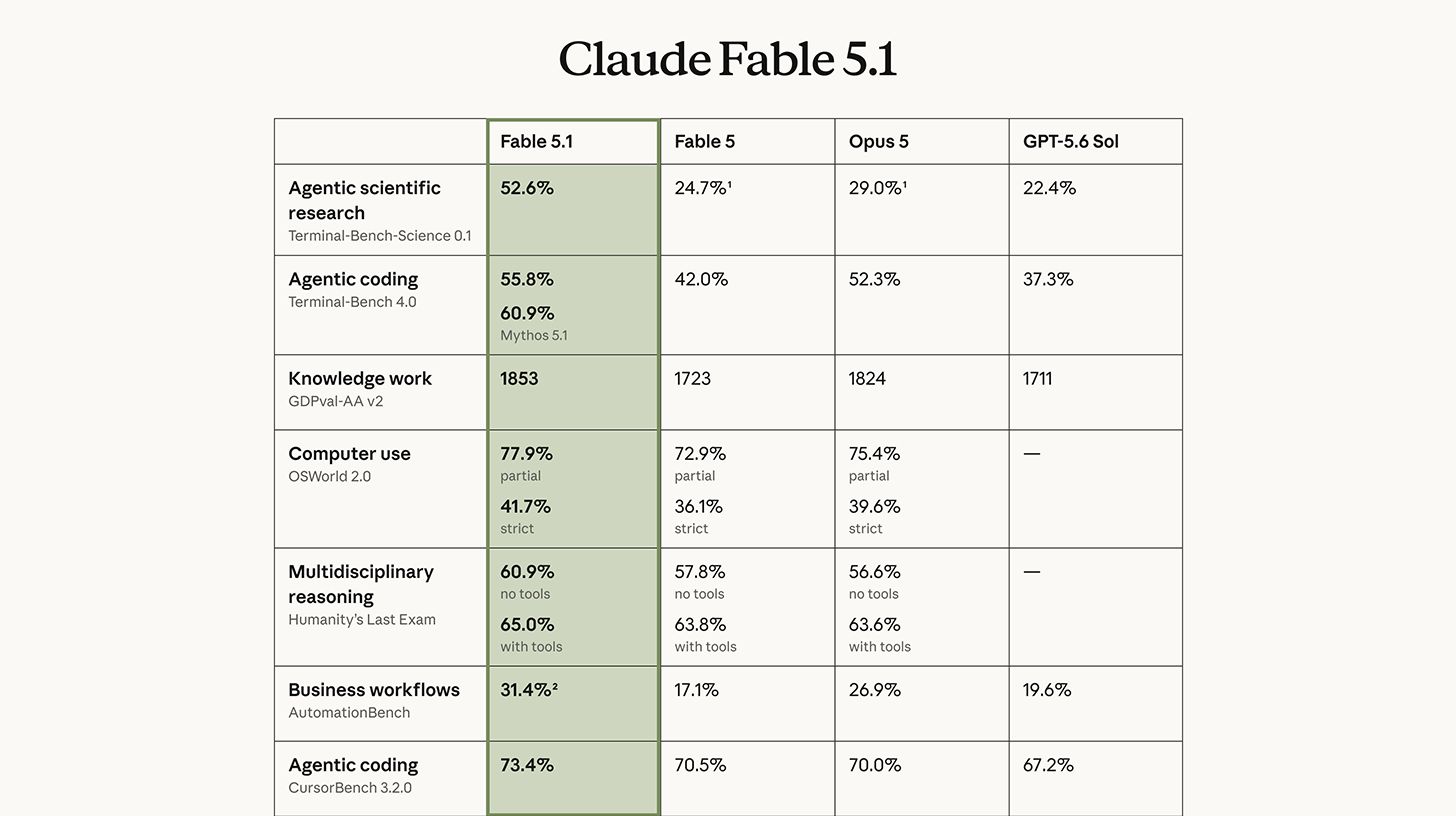
Fable 5.1 tops Artificial Analysis' Intelligence Index with a record score of 66, more than doubling Fable 5 on scientific research benchmarks.
→ 25% cheaper on typical workloads, with 60% fewer cybersecurity refusals and 85% fewer medical intervention blocks
→ Zero-data-retention now available for enterprise customers — addressing the data ownership concerns that drove backlash all summer
Zoom in:
The safety filter overhaul is the detail B2B marketers should focus on. Fewer false positives in research and technical workflows means less friction between the model and the actual work.
→ Anthropic also released Mythos 5.1 — same underlying model, fewer guardrails — available only to screened US cybersecurity and biology researchers
Yes, but: Artificial Analysis found that max-effort tasks actually cost 20% more on Fable 5.1, since the model writes roughly 1.7 times more text per output. Cost savings are real but not universal.
Be smart: Benchmark Fable 5.1 on your actual workloads before assuming the 25% savings applies to you. Unit economics vary significantly by task type.
The bottom line: Anthropic fixed what enterprise customers complained about. Now OpenAI's Astra has to answer.
https://www.anthropic.com/claude-fable-and-mythos-5-1
#AIMarketing #B2BMarketing …more
I've watched enterprise tech brands spend six figures on content that got zero pipeline. Same mistake: they built for engagement, not skepticism. Your B2B audience doesn't need more noise. They need proof.
https://www.contrarianthinking.co/newsletter-articles/how-to-rewire-your-brain-for-business-success …more
I tested 5 AI slide agents to cut deck time from 8 hours to 90 minutes. What matters for marketing stakeholder presentations: clarity over flash, data
https://www.generativeaipub.com/p/the-best-ai-presentation-agents-ive …more
Your product launch timeline just became a regulatory risk surface.
Anthropic launched Claude Fable 5 on Tuesday, June 9. By Friday, June 12, the US Commerce Department had issued an export-control directive forcing the company to shut it down globally.
This is the first time an export-control directive has ever been used to pull a publicly deployed AI model mid-operation.
Here's what matters for B2B marketers in enterprise tech:
You can no longer assume your launch will stay live. Anthropic priced Fable 5, ran benchmarks, built go-to-market assets, and had three days of availability before Amazon researchers found a prompting vulnerability that triggered a government response. Commerce Secretary Howard Lutnick issued the directive at 5:21 PM ET. Because Anthropic couldn't verify user citizenship in real time, they disabled access for everyone.
I've worked on launches at Proofpoint, Druva, and MinIO where regulatory uncertainty was background noise. It's now foreground risk. The gap between launch readiness and regulatory approval is compressing, and most content strategies aren't built for that.
If you're launching a technical product in a space where compliance, export controls, or security clearances matter, your content needs to be modular enough to pivot without rewriting everything. That means scenario planning for delayed releases, restricted availability, or post-launch changes to positioning.
The discipline here is the same one I learned in the Army: you don't get to choose the conditions. You build systems that hold under pressure.
If you're launching in a regulated space and want to stress-test your content strategy for regulatory scenarios, send me a DM. I offer a 30-minute consultation where I'll review your approach and give you three actionable improvements you can implement this week. https://theaipixel.substack.com/p/claude-fable-5-launched-tuesday-by …more

John Williams conducting the DISCLOSURE DAY score, his 30th collaboration with Steven Spielberg, a partnership that started back in 1974 with The Sugarland Express.
Williams is 94. He reportedly suggested four other composers who could take his place. Spielberg said no and talked him into one more.
"Finishing a film and getting to hear his scores… that's the reward."
And the kicker? They're already talking about number 31.
This is what five decades of trust sounds like. 🎬🎵
#JohnWilliams #StevenSpielberg #DisclosureDay #FilmScore #Soundtrack #Cinema #FilmTwitter #MovieMusic …more
This post has video.
Watch it on the channel.
Apple just gave Siri an actual job.
iOS 27 rebuilt it from the ground up. Siri now understands context across every app on your phone — messages, notes, photos, email — and takes action across all of it. Not just answers. Actions.
After a week with the developer beta, TechTiff is handing her iPhone real work. The phrase "I never said that" has officially had its run. Siri has receipts now.
For anyone thinking about where AI assistants are heading — and what that means for how people research, decide, and buy — this is worth 10 minutes.
Full guide → https://techtiff.substack.com/p/ios-27-siri-guide …more
Most B2B marketers believe LinkedIn growth requires daily posting.
The real lever isn't consistency for consistency's sake—it's batching content in focused blocks so you're not reacting to the platform all day.
https://www.radi8.com/blog/grow-your-business-on-linkedin-without-living-on-social-media-all-day …more
Most B2B tech marketers hit a ceiling. Not from lack of effort. From optimizing the wrong variables.
I've seen this across five enterprise tech companies. A team will grind for months on a content strategy that isn't working. More blog posts. More social activity. More webinars. The output increases, but the results stay flat.
The problem isn't execution. It's what they're measuring.
Three variables I see teams optimize that rarely move the needle:
Content volume instead of resonance. Publishing 20 generic pieces won't outperform 5 that genuinely address the technical skepticism your audience brings to every vendor conversation. When you're marketing to people who evaluate infrastructure decisions or security platforms, they can smell surface-level content immediately. Optimize for depth and credibility, not frequency.
Channel spread instead of concentration. I watched a marketing team stretch across seven platforms because a framework told them to be everywhere. Their audience was almost entirely on LinkedIn and in niche technical communities. When they pulled back and focused, engagement doubled in six weeks. Your audience isn't everywhere. Find where they actually pay attention and go deep there.
Simplification instead of respect for intelligence. The instinct in B2B tech is to make everything simple. But your buyers are smart. They want to understand how your product works, not just what it does. The best content I've built didn't dumb things down. It made complexity clear and connected it to business outcomes they cared about.
When I work with teams stuck at this ceiling, the shift isn't about doing more. It's about reframing what success looks like and aligning effort with variables that actually matter.
If your content strategy feels like pushing a boulder uphill, I'm offering 30-minute strategy consultations where I'll review your current approach and give you three actionable improvements you can implement this week. DM me and we'll schedule it.
https://www.contrarianthinking.co/newsletter-articles/youre-asking-the-wrong-question …more
Told 3 times, Jun 16, 2026 – Jun 19, 2026
· LinkedIn · Open
Most marketers hit a ceiling not because the opportunity isn't there, but because they're solving $10M problems with $1M strategies.
I see this pattern constantly in B2B tech marketing. Teams grinding harder on the same content approaches, churning out more blog posts, more social updates, more campaigns. The effort is there. The results aren't.
The issue isn't execution. It's operating system.
Your brain defaults to what worked before. Pattern recognition kept our ancestors alive, but it keeps modern marketers stuck. When you face a complex technical product that needs to reach skeptical enterprise buyers, your brain reaches for familiar tactics because they feel safe.
But safe doesn't break through noise in saturated markets.
The companies I've worked with that actually cut through are the ones willing to rewire how they approach the problem. They stop asking "what content should we create?" and start asking "what belief do we need our audience to adopt, and what would make them question their current assumptions?"
That shift requires challenging your own mental models. It means stepping back from the content calendar long enough to question whether your strategy is actually designed to scale or just designed to keep you busy.
In the military, we had a saying: slow is smooth, smooth is fast. Rushing into execution with the wrong strategy just gets you to failure faster. The same applies to marketing complex technical products.
If you're running harder but not seeing breakthrough results, the answer isn't another tactic. It's rewiring your approach to the problem itself.
Want a fresh take on your B2B content strategy? DM me and let's schedule a 30-minute consultation—I'll show you 3 things you can improve this week.
#B2BMarketing #ContentStrategy
https://www.contrarianthinking.co/newsletter-articles/how-to-rewire-your-brain-for-business-success
· LinkedIn · Open
The biggest obstacle to effective B2B tech marketing isn't a lack of tactics. It's the mental model you bring to the work.
I've seen talented marketers stuck in the same pattern: they know their product is complex, their audience is skeptical, and the buying cycle is long. So they default to feature lists, technical jargon, and safe messaging that checks boxes but changes nothing.
The problem isn't what they know. It's how they think about the challenge.
You can't solve $10M problems with $1M thinking. You need to fundamentally shift your operating system.
In content strategy for technical B2B, that shift looks like this:
Stop optimizing for coverage. Most marketers want content across every channel, addressing every persona, hitting every stage of the funnel. The result is diluted messaging that resonates with no one.
Start optimizing for impact. Identify the one narrative that actually matters to your audience and go deep. Build your content system around that single insight until it breaks through the noise.
This requires rewiring how you prioritize. It means saying no to requests that don't serve the core narrative. It means resisting the pressure to be everywhere and instead committing to be unforgettable in one place.
I've applied this across five enterprise tech companies. The results are always the same: fewer pieces of content, higher engagement, more qualified conversations.
The tactics matter. But the thinking behind the tactics matters more.
Want a fresh take on your B2B content strategy? DM me and let's schedule a 30-minute consultation—I'll show you 3 things you can improve this week.
#B2BMarketing #ContentStrategy
https://www.contrarianthinking.co/newsletter-articles/how-to-rewire-your-brain-for-business-success
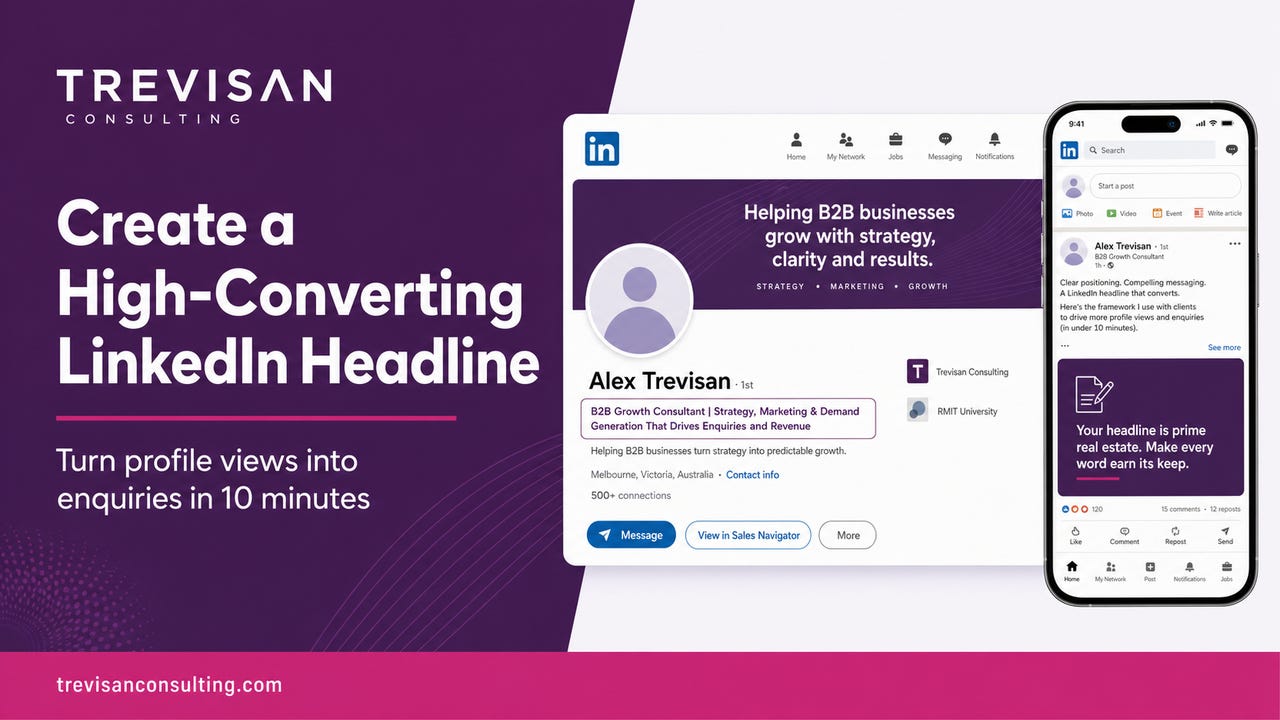
Your LinkedIn headline either converts profile views into enquiries, or it wastes them.
Most B2B marketers treat it like a job title. That's a missed opportunity.
https://melaniegoodmanlinkedinconsultant.substack.com/p/linkedin-headline-guide …more
SpaceX just spent $60 billion to stop relying on someone else's AI coding tools.
That number is not about productivity gains or developer convenience. It is about control.
When your engineering velocity depends on tools you do not own, you cede strategic optionality. You adopt their roadmap, their integrations, their pricing changes. If that tool is owned by a competitor, you are building your future on their terms.
SpaceX clearly decided that was unacceptable. The Cursor acquisition signals that AI coding tools are no longer supplementary software. They are infrastructure. And infrastructure owned by a third party becomes a liability at scale.
This same logic applies to B2B tech companies making platform and tooling decisions today. Marketing automation platforms, customer data infrastructure, content management systems, analytics tools. Every layer of dependency introduces risk.
The question is not whether the tool works. It is whether the company that owns it could become your competitor, shift strategy, or limit your ability to move quickly when you need to.
Vertical integration at this scale is a signal. In rapidly consolidating markets, the companies winning long-term are the ones willing to own the tools that define their velocity.
For B2B leaders navigating platform decisions in an increasingly consolidated landscape: are you building on infrastructure you control, or are you locking in dependencies that limit your future options?
If you are rethinking your content or marketing stack and want a fresh outside perspective, send me a message. I will review your approach and show you 3 things you can improve this week.
https://www.cnbc.com/2026/06/16/spacex-spcx-cursor-acquisition-ipo.html …more
Channel names and logos are trademarks of their respective owners.