
Positioning
Work by Michael Ashley · Everyone on Positioning
M

Michael Ashley
Founder at Radi8 // Executive Coach // Host of the Inspiring Founders Podcast
This is how you create great content for your customers - be specific, generous, and valuable.
Elizabeth Greenfield runs a functional wellness practice. Her ideal clients are people dealing with exhaustion, weight gain, and feeling wired despite doing everything right. Classic signs of chronic stress.
She could post generic wellness tips. Drink more water. Get more sleep. Eat better.
Instead, she publishes content that connects stress to something most people don't know about: how cortisol alters DNA methylation and accelerates biological aging at the cellular level.
That level of specificity does two things.
First, it signals expertise. It shows she understands the root cause, not just the symptoms.
Second, it attracts the right people. Someone who's tried everything and still feels terrible is going to stop scrolling when they see content that explains why nothing has worked.
This is the pattern I see in content that actually converts.
It's not about being everywhere or posting every day. It's about understanding your audience well enough to name the problem they're experiencing in a way that makes them feel seen.
If you're struggling to figure out what to post, start here:
What's the specific problem your ideal customer is dealing with right now? Not the surface-level frustration. The underlying issue they might not even have words for yet.
Then create content that connects the dots.
You don't need a big budget or a content team. You need clarity on what your audience is trying to solve.
If you want help translating that into a repeatable content workflow, comment and I'll reach out.
https://www.lizgreenfield.com/blog-1-1/h08r5dhgllb0kfyalh0zrty7ukbgic …more

Told 3 times, May 20, 2026 – Aug 4, 2026
· LinkedIn · Open
I've launched four companies. Each one taught me something different about marketing.
But the lesson that shows up every single time is this: the product rarely loses. The story does.
At my second company, we had a genuinely better product than the competition. Better features, better pricing, better support. We still struggled to get traction for the first year.
When I finally sat down and rewrote our messaging, I realized what was wrong. Everything we said described what we built. None of it named the problem our customer was already losing sleep over.
The fix was simple but not obvious: lead with the pain, not the product.
Before: "We help companies manage distributed teams more efficiently."
After: "Your best people are burning out because they're spending half their day coordinating instead of building."
Same product. Completely different response.
The rule I now follow for every piece of marketing copy: if you could put your competitor's logo on it and it would still make sense, rewrite it. Your message should only work for you.
What's the last message you changed that had a bigger impact than you expected?
· LinkedIn · Open
The post that earns a hundred likes from other consultants is often the same one that wins zero clients.
When you're new to being visible, you write toward the approval that feels safest. Other people in your field. Former colleagues. The peers whose respect you spent a career earning. They understand your shorthand. They nod at the clever framework. They leave the generous comment that makes posting feel worth it.
But the client you want is almost never in that room.
It looks like a content problem. It's actually a customer-understanding problem. Writing for your friends, you reach for what impresses people who already know the field. Writing for your customer, you reach for the thing keeping them up at 2am — described in the plain words they'd actually use, not the vocabulary of your profession.
Those two audiences want opposite things. Your peers want to see how much you know. Your customer wants to feel understood. The more you optimize for the first, the more invisible you become to the second, because sophistication reads as noise to someone who just wants their problem named.
Read your last five posts and ask who would nod hardest. If it's people who could do your job, you're writing for the wrong room. If it's people who'd hire you, you're getting warm.
The fix isn't louder or more polished. It's a smaller, clearer picture of one person you're trying to help, and the discipline to write to them even when the applause comes from somewhere else.
When you catch yourself writing for the room instead of the client, what usually pulls you back?
#IndependentConsultant #Coaching #Positioning #CustomerDiscovery #ThoughtLeadership
M
Michael Ashley
Founder at Radi8 // Executive Coach // Host of the Inspiring Founders Podcast
Your first clients came easy. That's exactly why the next ones feel impossible.
When you went independent, the phone rang. A former colleague needed help. Someone who'd watched you work for years passed your name along. Within a few months you had your first handful of clients, and it felt like proof the whole thing would work.
Here's what actually happened. You didn't build a way to win clients. You cashed in years of goodwill, all at once. Every person who'd seen you deliver inside the org, every bit of trust you'd earned over a career, converted into work the moment you were available to hire.
That's a stockpile, not a pipeline. A stock is finite. It draws down. You spend it faster than you notice, because it arrived without any effort you could repeat. When it runs low, there's nothing underneath to refill it. The well was full the day you started on your own. It doesn't refill on its own.
A pipeline is different. It refills because you built the thing that fills it. Two parts do most of that work.
Positioning people can repeat. Your old network vouched for you from memory. Strangers can't. If someone can't say in one sentence what you do and who it's for, the recommendation stops at "they're great" — which wins no one.
Visibility beyond your circle. The people who already know you are a fixed number. Growth lives with the people who don't, and they only find you if you're somewhere they can watch how you think.
The trap isn't that you did anything wrong. The first wave working is the very thing that convinces you nothing needs to change. Then it quietly runs dry, and it looks like the market cooled, when really the well just emptied.
Genuine question: how did your first three clients actually find you, and has that kept working?
#IndependentConsultant #Coaching #GoingIndependent #Positioning #PersonalBrand …more
M
Michael Ashley
Founder at Radi8 // Executive Coach // Host of the Inspiring Founders Podcast
Hashtags are a small thing that quietly tells you something bigger: most founders are still managing their presence one post at a time, in their head, instead of turning what they've learned into a system.
Here's what I mean. Every channel has its own unspoken rules. LinkedIn suppresses reach on posts that push people off-platform, so links belong in the first comment, not the body. Hashtags work differently on LinkedIn than they do on X — a handful of categorization tags at the end here, almost none there. None of that is complicated. It's just a set of preferences you have to remember and apply, every single time, forever. That's exactly the kind of repetitive judgment that never gets done consistently when it lives only in your head.
So I recorded a short walk-through of how I actually run this inside Claude.ai, driving Radi8 directly. In it I check how I've been using hashtags, set hashtag preferences per channel, walk through my scheduled LinkedIn and X posts to add them, and turn "move the LinkedIn link into the first comment" into a standing preference so I never have to think about it again.
The point isn't the tool. It's the shift underneath it. I'm not asking AI to decide what to say or how to sound — that's mine. I'm asking it to remember my rules and apply them the same way every time, so consistency stops depending on my memory on a busy Tuesday. AI amplifies the preferences, focus, and voice you feed it. It doesn't invent them. That's why the founders getting real leverage from it aren't the ones automating the most — they're the ones who got clear on their own rules first, then handed the execution off.
I am the founder of Radi8, so this is me sharing the journey in public, not a pitch. Happy to point anyone who's curious in the right direction.
For the founders here: how much of how you show up online lives as an actual repeatable system versus a decision you re-make from scratch every time you post?
#Founders #Startups #Entrepreneurship #AIforBusiness #MarketingSystems …more
This post has video.
Watch it on the channel.
Told 4 times, May 30, 2026 – Jul 30, 2026
· LinkedIn · Open
Thursday I was in San Jose facilitating a workshop on AI and social media marketing.
I pivoted about ten minutes in.
The room was full of aspiring and early-stage business owners — people who've been pouring everything into getting their business off the ground. As I looked around, it became obvious the AI demo wasn't what they needed most.
So we went back to basics. Brand and voice. Defining your customer. Understanding what a marketing funnel actually does — and why none of the tools matter until that foundation is solid.
After the session, several people came up and shared their stories. One founder had been trying to get his business off the ground for 18 months and couldn't figure out why nothing was gaining traction. He hadn't yet clearly defined who his customer was, what problem he was solving, or why anyone should choose him over the alternative.
I've seen this pattern for 25 years. These aren't rookie mistakes. They're the gaps that never get addressed when you're just trying to survive the launch.
The most sophisticated AI in the world won't fix a messaging problem. It'll just make the wrong message louder.
If you're an early-stage founder who needs a room of people who get it — join the Inspiring Founders community on Skool. Free, no pitch, just founders helping founders.
👇 https://www.skool.com/inspiring-founders-5861/about
· LinkedIn · Open
When Claude has an outage, I book a tee time.
That's half a joke. The other half is the actual point.
My LinkedIn presence runs on an AI system now. It drafts in my voice, stays on brand, and keeps me visible on the weeks I'm heads-down with clients. When the model goes down for an hour, nothing urgent breaks. I go hit a few balls, and it's back before I've three-putted.
Here's the part people miss when they hear that. The AI isn't what makes it work. What makes it work is everything underneath it: a clear picture of who I serve, the problems they'd describe in their own words, the way I think about their work. Feed a tool that, and it amplifies it. Feed it a vague "I help people grow," and you get vague content, faster.
I watch a lot of coaches and consultants reach for AI hoping it will hand them a strategy. It won't. It can't decide who you're for or what you stand for. That's still your job, and it's the part nobody taught you inside the org, where the brand behind you did the vouching. Get that decision sharp, and a tool can turn it into consistent visibility while you do the work you're actually great at.
The tee time is real. So is the reason I can take it.
If you've tried using AI for your own content: did it save you time, or mostly make the missing message more obvious?
#IndependentConsultant #Coaching #AIforBusiness #Positioning #PersonalBrand
· LinkedIn · Open
Most founders I talk to already know they should be more visible. What they can't do is make it sustainable.
You write one good post, it lands, and then three weeks vanish because the actual business needs you. The intention was never the problem. The system was.
I've watched this quietly stall otherwise strong companies — not because the founder has nothing worth saying, but because turning hard-won expertise into a consistent, on-brand body of work is real work, and it's the first thing to fall off a busy week.
AI changes the math here, though not the way most people assume. It won't invent your positioning or your point of view. Feed it a blurry message and it will produce blurry content faster. But once you're clear on your promise and your voice, it can take the part that used to eat your week — drafting, designing, scheduling — and compress it into something you can actually keep up with.
That's what I'm walking through in a live workshop.
📅 July 23rd, 11am
💻 Online — join from anywhere
Hands-on, we'll cover:
• Generating posts that sound like you, not like a robot
• Creating brand-aligned images without a designer
• Scheduling a full month of content in about 30 minutes
It's built for founders who are tired of starting from zero every week and want a repeatable system — not another burst of activity that never compounds.
Seats are limited. Register with the link in the comments.
#Founders #Startups #Entrepreneurship #AIforBusiness #MarketingSystems
M
Michael Ashley
Founder at Radi8 // Executive Coach // Host of the Inspiring Founders Podcast
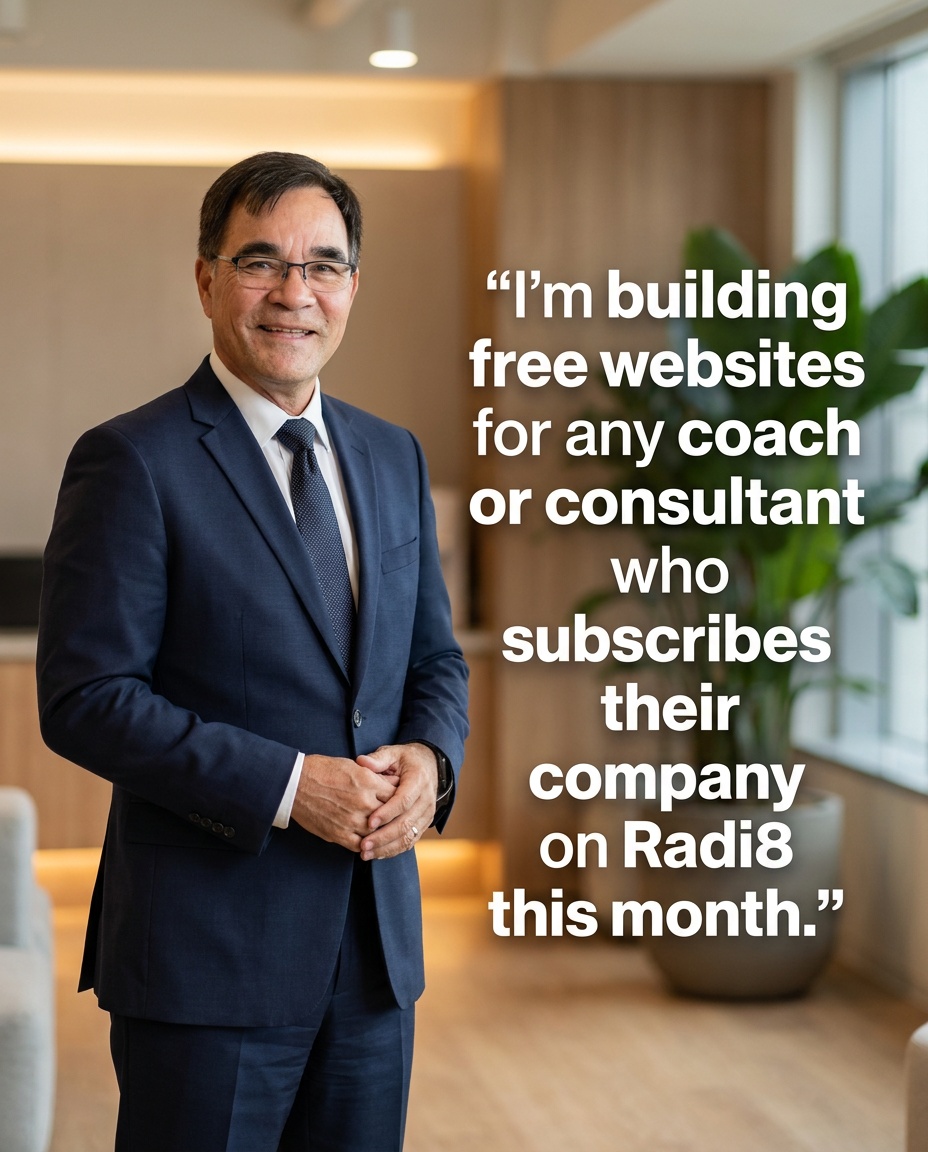
I will build a free website for any new coach or consultant who subscribes to Radi8 this month.
For most coaches and consultants going out on their own, the website is the thing that never gets done.
You know it matters. It's where a referral goes to size you up before they ever reach out. But it sits at the bottom of the list, behind actual client work — half-built, and saying a fraction of what you'd say if someone asked you across a table.
But a website isn't decoration. It's evidence. It's where the market watches how you think before they decide to book a call. When it's vague, the people most likely to hire you quietly move on, and you never see it happen.
So this month I'm doing something about it. Anyone who subscribes to Radi8 this month, I'll build the website myself, no charge. Radi8 keeps you visible and posting consistently. The site gives that work a home the right clients can actually find.
This isn't a blank template you look wrestle with alone. We get the positioning right first — who you help and what changes for them — then I build a site that carries it.
If yours has been on the someday list, consider this the nudge. Details and link in the first comment.
What's the one thing your current website fails to say about the work you actually do?
#IndependentConsultant #Coaching #Positioning #PersonalBrand #GoingIndependent …more
M
Michael Ashley
Founder at Radi8 // Executive Coach // Host of the Inspiring Founders Podcast
When your customer research keeps contradicting itself, the problem usually isn't the research. It's that you're talking to two different people and treating them as one.
I see this constantly. A founder runs a dozen conversations, and the signal is all over the map. One group swears the onboarding is the dealbreaker; another barely notices it and cares only about price. Half describe the product as a time-saver; half call it a status thing. The founder concludes "customers are confused" or "the market is fragmented," and goes hunting for a cleverer message to paper over the noise.
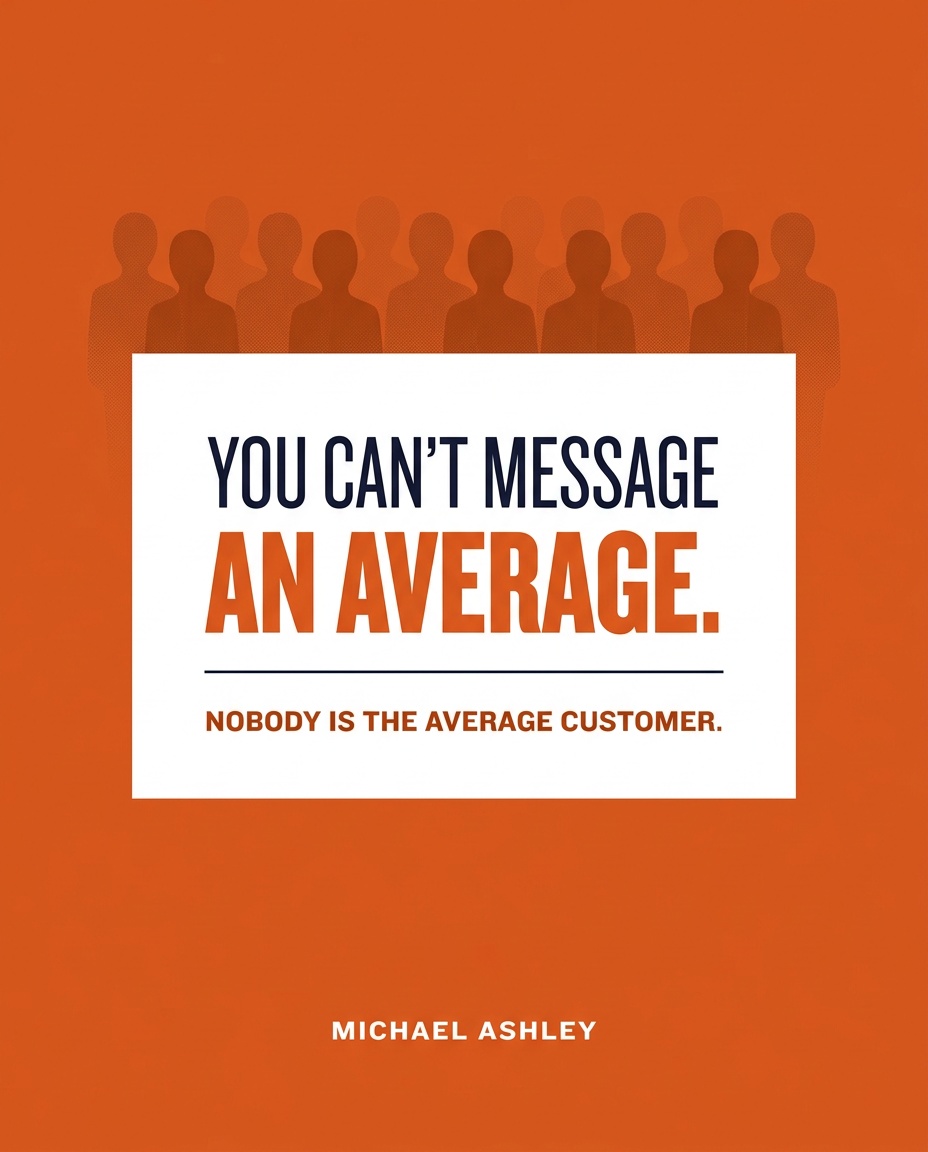
But the noise is the finding. Contradictory insights are what a blended audience sounds like. You're not hearing one confused market — you're hearing two or three coherent ones averaged into mush. And you can't message an average. Nobody is the average customer.
The reason this stalls companies is subtle: an average feels like data. It has quotes, a deck, a ring of rigor. So you make product and go-to-market bets on it — and the bets keep missing, because you're aiming at a person who doesn't exist.
The fix is in how you structure discovery, before you ever synthesize:
Segment on the way in, not on the way out. Decide the cuts that might explain different behavior — job to be done, trigger event, stage, buying context — and tag every conversation as you go. If you only segment after the fact, you've already blended.
Recruit on purpose, not on availability. A convenient sample is a blended sample. Deliberately fill each segment so a pattern in one group can't hide inside the average of all of them.
Read patterns within a segment, never across the pile. The question isn't "what did customers say?" It's "did this segment say the same thing to each other?" Agreement inside a clean segment is a signal. Agreement across a blended pile is a coincidence you'll pay for later.
Here's the bar I hold: an insight is decision-grade only when it's consistent inside a segment you could actually go acquire. Anything short of that isn't evidence — it's an anecdote wearing a percentage sign.
The uncomfortable part is that this makes your findings messier before it makes them clearer. Two sharp, opposing truths are worth more than one blurry consensus. Consensus is comfortable. It's also where stalled companies go to feel productive.
So a question worth sitting with this week:
The last time your customer insights contradicted each other — did you treat it as noise to resolve, or as a sign you were listening to more than one audience at once?
#Founders #Startups #Entrepreneurship #CustomerDiscovery #VoiceOfCustomer …more
 View on LinkedIn
Also on
View on LinkedIn
Also on

Founders spend weeks building campaigns.
Then discover the message doesn't resonate.
I've learned to do the opposite.
Test the message first.
5 conversations will teach you more than 50 hours of campaign planning. …more
M
Michael Ashley
Founder at Radi8 // Executive Coach // Host of the Inspiring Founders Podcast
AI made expertise abundant.
It did not make trust abundant.
For years, expertise was a competitive advantage.
If you knew something others didn't, you could build a business around it.
Today, anyone can ask Chat and get a decent answer in seconds.
That changes the game.
The question is no longer:
'What do you know?'
The question is:
'Why should I trust you?'
Trust comes from consistency.
Experience.
Judgment.
Reputation.
People don't hire advisors, consultants, founders, and experts because they have information.
They hire them because they trust how they think.
That's why I believe trust is becoming one of the most valuable assets in the age of AI.
Expertise may be abundant.
Trust is still scarce. …more
M
Michael Ashley
Founder at Radi8 // Executive Coach // Host of the Inspiring Founders Podcast
Juicero raised $120 million and shut down four years later.
The product was impressive. A beautifully engineered juicer that squeezed proprietary juice packs. The pitch was compelling. Fresh, cold-pressed juice at home with zero mess.
But none of that mattered because they misjudged the market.
They built a $400 machine for a customer who didn't exist at scale. Worse, when reporters discovered you could squeeze the packs by hand and get the same result, the entire value proposition collapsed.
This wasn't a failure of execution. It was a failure of go-to-market strategy.
If you're a small business owner handling your own marketing, the same mistake shows up in smaller ways every day.
You build something without validating whether your audience actually wants it. You position a feature instead of a benefit. You invest time creating content that sounds good internally but doesn't connect with the people you're trying to reach.
The fix starts with three questions before you build or launch anything:
Who is this for, specifically? Not a broad market. A real person with a real problem.
What job are they hiring this to do? Juicero thought people wanted convenience. Turns out they wanted juice, and convenience meant not buying a $400 machine.
How will they discover this solves their problem? If your positioning doesn't make the value obvious in seconds, you're asking too much of your audience.
Juicero had the funding, the team, and the product. What they didn't have was a clear understanding of their customer or a go-to-market strategy grounded in reality.
You don't need $120 million to learn this lesson. You just need to ask the right questions before you spend time and money on the wrong strategy.
If you're not sure whether your positioning and content strategy are connecting with your audience, book a free 15-20 minute marketing audit. I'll walk you through where to focus first.
https://www.radi8.com/free-audit?utm_source=linkedin&utm_campaign=free_audit&utm_content=post_id
Case study: https://www.smartwareadvisors.com/blogs/insights/case-study-juicero-overbuilt-mvp-amp-misjudged-market …more
 View on LinkedIn
Also on
View on LinkedIn
Also on
M
Michael Ashley
Founder at Radi8 // Executive Coach // Host of the Inspiring Founders Podcast
Impressive to see Lilly launch LillyPod, the first NVIDIA DGX SuperPOD with DGX B300 systems. Is it even possible to compete in this space anymore? My experience launching startups and programs says yes, if you lean into startup advantages: pick a narrow, clinically meaningful problem you can validate fast; secure or partner for unique data and domain workflows; design pilots that align with regulatory and procurement paths. If you are building in this space, send me a message. #AIinPharma
https://blogs.nvidia.com/blog/lilly-ai-factory-live/ …more

Channel names and logos are trademarks of their respective owners.