Founder at Radi8 // Executive Coach // Host of the Inspiring Founders Podcast
· LinkedIn
·
A resume is a list of claims. A body of work is evidence. The market has quietly stopped trusting the first and started reading the second.
For most of your career, your judgment was vouched for by things around you. The title said you were senior. The company's name meant the work found you and the brand stood behind it. Your reputation lived inside the building, in the heads of the people who watched you do the work. A resume was enough because it pointed back to institutions that carried the weight for you.
Then you left. The title, the brand, the internal reputation — that whole apparatus stayed behind. And a resume, on its own, is a set of assertions a stranger has no reason to believe.
Here's the shift underneath it. Professional identity moved from private to public. People used to bring you in on the strength of where you'd been. Now they want to see how you think before they ever reach out. Not a claim that you're good. Evidence, out in the open, that they can read for themselves.
That's what a body of work is. A post that walks through how you'd approach a messy problem. A talk. A teardown of something in your field. Each one is a small piece of proof, and over time they add up to something a resume can't produce: a picture of your judgment that the right client can study before they spend a dollar.
This is why visibility isn't vanity. You're not performing. You're building the evidence that used to be someone else's job to provide, so the right people can see how you think and decide they want you in the room.
What's one piece of work that brought you a client — a post, a talk, a teardown? And what made it land?
#IndependentConsultant#Coaching#GoingIndependent#PersonalBrand#ThoughtLeadership…more
Founder at Radi8 // Executive Coach // Host of the Inspiring Founders Podcast
· LinkedIn
·
A short one to close the month.
I've spent July writing about positioning, focus, and what it takes to turn what you know into a business that wins clients. So here's the question I'd actually like you to answer:
What did you have to unlearn when you went out on your own?
The habits that made you great inside an organization — trusting the work to find you, staying modest about your wins, letting the company's brand do the talking — are often the exact habits that stall an independent practice.
I'll go first: I had to unlearn building quietly. For years my work spoke through companies and products. On my own, invisible good work is just invisible.
Your turn. What did you have to unlearn — or what are you still unlearning? I'll read and reply to every answer.
#IndependentConsultant#Coaching#GoingIndependent#PersonalBrand…more
Founder at Radi8 // Executive Coach // Host of the Inspiring Founders Podcast
· LinkedIn
·
Hashtags are a small thing that quietly tells you something bigger: most founders are still managing their presence one post at a time, in their head, instead of turning what they've learned into a system.
Here's what I mean. Every channel has its own unspoken rules. LinkedIn suppresses reach on posts that push people off-platform, so links belong in the first comment, not the body. Hashtags work differently on LinkedIn than they do on X — a handful of categorization tags at the end here, almost none there. None of that is complicated. It's just a set of preferences you have to remember and apply, every single time, forever. That's exactly the kind of repetitive judgment that never gets done consistently when it lives only in your head.
So I recorded a short walk-through of how I actually run this inside Claude.ai, driving Radi8 directly. In it I check how I've been using hashtags, set hashtag preferences per channel, walk through my scheduled LinkedIn and X posts to add them, and turn "move the LinkedIn link into the first comment" into a standing preference so I never have to think about it again.
The point isn't the tool. It's the shift underneath it. I'm not asking AI to decide what to say or how to sound — that's mine. I'm asking it to remember my rules and apply them the same way every time, so consistency stops depending on my memory on a busy Tuesday. AI amplifies the preferences, focus, and voice you feed it. It doesn't invent them. That's why the founders getting real leverage from it aren't the ones automating the most — they're the ones who got clear on their own rules first, then handed the execution off.
I am the founder of Radi8, so this is me sharing the journey in public, not a pitch. Happy to point anyone who's curious in the right direction.
For the founders here: how much of how you show up online lives as an actual repeatable system versus a decision you re-make from scratch every time you post?
#Founders#Startups#Entrepreneurship#AIforBusiness#MarketingSystems…more
Thursday I was in San Jose facilitating a workshop on AI and social media marketing.
I pivoted about ten minutes in.
The room was full of aspiring and early-stage business owners — people who've been pouring everything into getting their business off the ground. As I looked around, it became obvious the AI demo wasn't what they needed most.
So we went back to basics. Brand and voice. Defining your customer. Understanding what a marketing funnel actually does — and why none of the tools matter until that foundation is solid.
After the session, several people came up and shared their stories. One founder had been trying to get his business off the ground for 18 months and couldn't figure out why nothing was gaining traction. He hadn't yet clearly defined who his customer was, what problem he was solving, or why anyone should choose him over the alternative.
I've seen this pattern for 25 years. These aren't rookie mistakes. They're the gaps that never get addressed when you're just trying to survive the launch.
The most sophisticated AI in the world won't fix a messaging problem. It'll just make the wrong message louder.
If you're an early-stage founder who needs a room of people who get it — join the Inspiring Founders community on Skool. Free, no pitch, just founders helping founders.
👇 https://www.skool.com/inspiring-founders-5861/about
When Claude has an outage, I book a tee time.
That's half a joke. The other half is the actual point.
My LinkedIn presence runs on an AI system now. It drafts in my voice, stays on brand, and keeps me visible on the weeks I'm heads-down with clients. When the model goes down for an hour, nothing urgent breaks. I go hit a few balls, and it's back before I've three-putted.
Here's the part people miss when they hear that. The AI isn't what makes it work. What makes it work is everything underneath it: a clear picture of who I serve, the problems they'd describe in their own words, the way I think about their work. Feed a tool that, and it amplifies it. Feed it a vague "I help people grow," and you get vague content, faster.
I watch a lot of coaches and consultants reach for AI hoping it will hand them a strategy. It won't. It can't decide who you're for or what you stand for. That's still your job, and it's the part nobody taught you inside the org, where the brand behind you did the vouching. Get that decision sharp, and a tool can turn it into consistent visibility while you do the work you're actually great at.
The tee time is real. So is the reason I can take it.
If you've tried using AI for your own content: did it save you time, or mostly make the missing message more obvious?
#IndependentConsultant#Coaching#AIforBusiness#Positioning#PersonalBrand
Most founders I talk to already know they should be more visible. What they can't do is make it sustainable.
You write one good post, it lands, and then three weeks vanish because the actual business needs you. The intention was never the problem. The system was.
I've watched this quietly stall otherwise strong companies — not because the founder has nothing worth saying, but because turning hard-won expertise into a consistent, on-brand body of work is real work, and it's the first thing to fall off a busy week.
AI changes the math here, though not the way most people assume. It won't invent your positioning or your point of view. Feed it a blurry message and it will produce blurry content faster. But once you're clear on your promise and your voice, it can take the part that used to eat your week — drafting, designing, scheduling — and compress it into something you can actually keep up with.
That's what I'm walking through in a live workshop.
📅 July 23rd, 11am
💻 Online — join from anywhere
Hands-on, we'll cover:
• Generating posts that sound like you, not like a robot
• Creating brand-aligned images without a designer
• Scheduling a full month of content in about 30 minutes
It's built for founders who are tired of starting from zero every week and want a repeatable system — not another burst of activity that never compounds.
Seats are limited. Register with the link in the comments.
#Founders#Startups#Entrepreneurship#AIforBusiness#MarketingSystems
Founder at Radi8 // Executive Coach // Host of the Inspiring Founders Podcast
· LinkedIn
·
Visibility has become part of the job.
I don't think most founders have accepted this yet.
Twenty years ago, you could build a successful business with very little public presence.
Today, that's becoming harder.
Not because people want influencers.
Because people need signals.
Before they buy.
Before they refer.
Before they trust.
They want evidence.
How do you think?
What do you believe?
Have you solved this problem before?
The market used to discover expertise through institutions.
Today, it increasingly discovers expertise through content.
That's why visibility isn't vanity.
It's discoverability.
And for expertise-driven businesses, discoverability is becoming a competitive advantage. …more
Founder at Radi8 // Executive Coach // Host of the Inspiring Founders Podcast
· LinkedIn
·
We're halfway through the year. I've been doing a lot of thinking about what's actually worked in my marketing vs. what I thought would.
Here's my honest take.
What I expected to work: a polished content calendar, consistent posting across multiple channels, well-designed assets.
What actually moved the needle: direct conversations that started from a single, specific LinkedIn post that named an exact pain point my audience was feeling.
The post wasn't clever. It wasn't visually interesting. It was just specific and true. It got more inbound messages than anything I'd posted in the previous three months combined.
The lesson I keep relearning: marketing feedback loops are much shorter than founders think. You can know within 30 days whether a message is working — if you're watching the right signal. Not follower count. Not impressions. Conversations started.
That's the metric I watch now above everything else. How many people responded to something I wrote and said "this is exactly what I'm dealing with"? That's the leading indicator that content is building pipeline.
The other thing that worked: teaching something specific in every post instead of sharing opinions. Opinions get likes. Teaching gets DMs. DMs become customers.
My Inspiring Founders community on Skool is where I share what I'm learning as I learn it — if you want to follow along, join us. It's free: https://www.skool.com/inspiring-founders-5861/about…more
Founder at Radi8 // Executive Coach // Host of the Inspiring Founders Podcast
· LinkedIn
·
Most founders I work with are genuinely compelling in conversation. They can hold a room, tell a story, make you lean in.
Then they sit down to write a post and it becomes a press release.
Here's the framework I keep coming back to — I use it in my peer groups, in my advisory work, and in my own content.
Three parts:
1. The moment you identified the problem. Not "I noticed a gap in the market." The actual moment — specific, concrete, a little uncomfortable. That's where people trust you.
2. What you tried that didn't work. This is the part most founders skip. It's also where the trust gets built. Showing your failed attempts tells people you arrived at your answer honestly, not theoretically.
3. What you discovered that did work. Not "here's the solution." Here's what I found, tested, and now actually use.
The reason this works: it's the structure of every good story ever told. Problem, struggle, resolution. Your audience has heard a thousand "here's a tip" posts. They haven't heard your specific version of steps 1 and 2.
Try it on your next post. Start with the moment, not the lesson.
Comment "voice" and I'll send you the full one-page framework I share with founders. …more
Founder at Radi8 // Executive Coach // Host of the Inspiring Founders Podcast
· X
·
Most founders are more compelling in conversation than they are in writing.
Why?
Because when they write, they try to sound professional.
When they talk, they sound human.
Your audience wants the second version. …more
Founder at Radi8 // Executive Coach // Host of the Inspiring Founders Podcast
· LinkedIn
·
In every founder peer group I run, someone says some version of this: "I know I need to be posting more, but I don't want to sound like I'm just selling all the time."
I hear this constantly. And I understand it. Nobody wants to be that person.
Here's what I tell them.
Salesy content isn't caused by selling. It's caused by skipping the value step.
Look at your last 10 posts. How many of them taught something, shared a hard-won lesson, or gave your audience something they could use today? How many were asking for something — a click, a follow, a demo?
The ratio matters more than the message.
When your feed is mostly valuable, your promotional posts don't feel like interruptions. They feel like a natural next step from someone your audience already trusts.
The rule I follow: for every post that promotes something, publish two that teach or share something genuinely useful. Not rephrased common knowledge. Something specific to your experience.
It's not about being less promotional. It's about earning the right to promote.
What's your biggest challenge when it comes to showing up consistently? Comment or DM me — I'm genuinely curious. …more
Founder at Radi8 // Executive Coach // Host of the Inspiring Founders Podcast
· LinkedIn
·
A lot of founders ask me how I use Claude and Radi8 together. Here's the honest answer: I don't really "use Claude" anymore. Not the way most people think.
I don't write prompts. I don't paste in context. I don't explain my audience or my voice or my offers every time I sit down to create content.
Radi8 handles all of that.
My brand context, my strategy, my campaign plan, my voice, my proof points — it's all stored in Radi8. When Claude works inside Radi8, it already knows everything it needs to know. It's not starting from scratch. It's starting from me.
The workflow:
1. Open Radi8 and pull up my campaign plan for the month
2. Pick the piece of content I'm working on — the brief is already there
3. Generate — Claude writes from my brief, my brand, my voice
4. One quick edit pass, maybe 5 minutes
5. Schedule
That's it. No prompt engineering. No re-explaining yourself every session. No output that sounds like it could have come from anyone.
The insight most people miss about AI content tools: the problem was never the AI. It was the setup. When the AI knows your business as well as you do, it stops feeling like a tool and starts feeling like a collaborator.
That's what I built Radi8 to do.
DM me "workflow" and I'll show you how it works. …more
Most people think AI content sounds generic because AI isn't good enough.
Wrong.
AI sounds generic because you're giving it generic context.
The quality of the output is usually a reflection of the quality of the input.
Context > prompts.
After 25+ years building and exiting startups, I've noticed a pattern.
The founders who stay visible and grow aren't spending more time on marketing. They've built better systems and made better strategic decisions.
Here's something most people miss about AI marketing tools: the output quality has nothing to do with the tool and everything to do with the input.
If you paste a blank prompt into Claude and ask it to write a LinkedIn post, you'll get something generic. That's not an AI problem. That's a context problem.
What changed for me was building my brand context into Radi8 first — my audience, my voice, my offers, what I never say. Now when I generate content, it sounds like I wrote it. Because in a real sense, I did. I just did it once, systematically, instead of re-explaining myself every time.
The lesson isn't "use AI."
It's that better tools rarely fix a strategy problem.
Whether it's AI, marketing, sales, or customer acquisition, the quality of the outcome is usually constrained by the quality of the thinking that comes before it.
How much context are you giving AI before you ask it to create content?
Founder at Radi8 // Executive Coach // Host of the Inspiring Founders Podcast
· LinkedIn
·
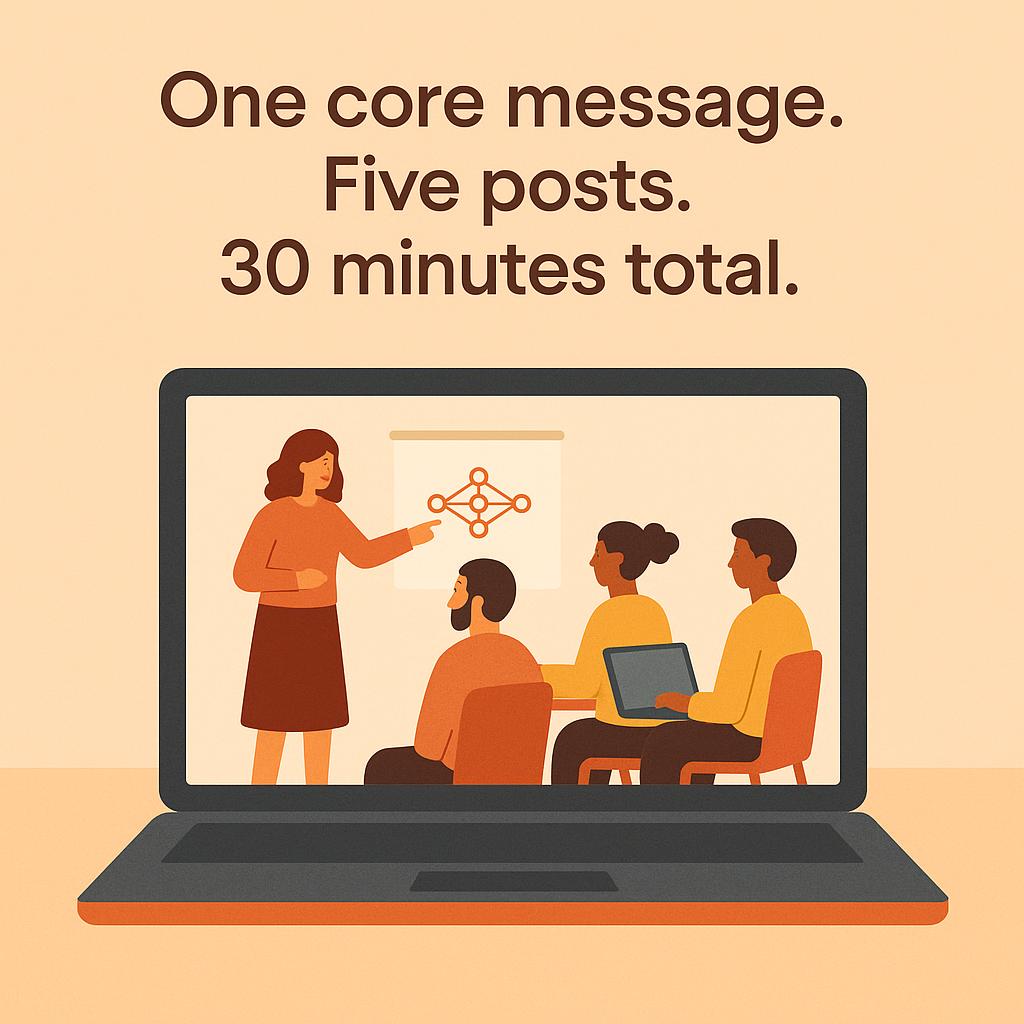
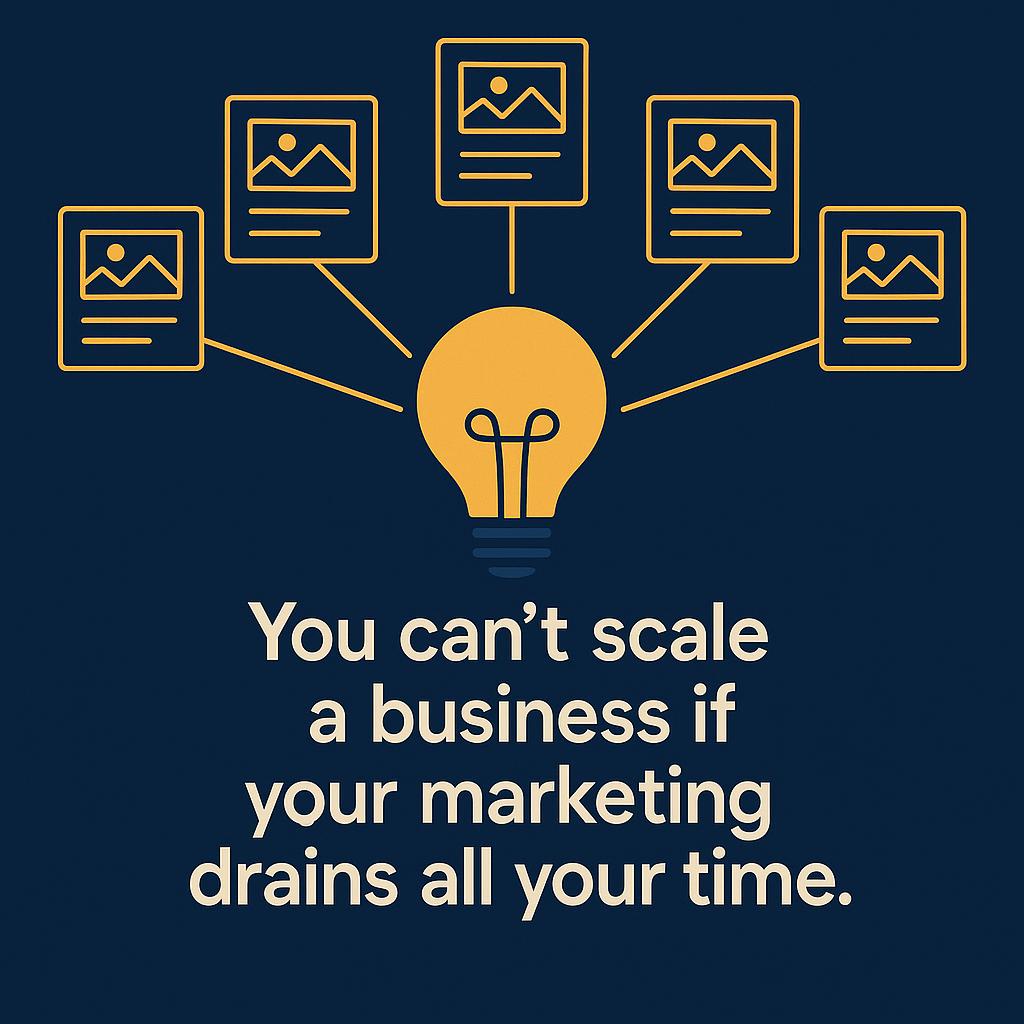
Here's a workflow you can steal. One core message → five LinkedIn posts in 30 minutes.
Step 1 (5 min): Pick one thing you believe about your industry. Not a tip. A point of view. Example: "Most marketing advice for small business owners is wrong because it assumes you have a marketing team."
Step 2 (5 min): Write it as a single declarative sentence. That's your core message.
Step 3 (10 min): Generate five angles on it with AI. Story angle (a moment this was true). Contrarian angle (what people get wrong). Tactical angle (one thing to do differently). Mistake angle (what you used to do). Persona angle (who specifically this hurts).
Step 4 (10 min): For each angle, write the first two lines yourself — that's the hook. Let AI fill in the middle. Edit the ending so the CTA sounds like you.
That's it. Five posts. Same core idea, five different doors into it. Your audience won't feel repetition because each post leads with a different shape of thought.
I'm walking through this workflow plus two more — competitor research in 10 minutes, and an editorial system that runs in 15 minutes a day — at my workshop on May 28th in San Jose at the MLK Library, hosted by the Silicon Valley Small Business Development Center.
If you can't make it, book a free 15 to 20 minute marketing audit and I'll run this workflow with you on your business.
https://www.radi8.com/free-audit?utm_source=linkedin&utm_campaign=free_audit&utm_content=post_id
DM me if you want the workshop link. …more
Simple, outcome-focused positioning beats clever complexity.
Winning brands choose one customer problem, one distinct approach, and one measurable early growth channel.
If your go-to-market or early channels feel unclear, start with three things:
- a one-sentence positioning statement,
- two content themes mapped to buyer stages,
- and one channel to test for 90 days with a single KPI.
I launched three startups (one major acquisition) and advised three that reached billion-dollar exits. Sign up for a free marketing audit and consultation.
https://www.radi8.com/free-audit#SMB#Marketing#AI
Big news: Radi8 is now on Claude. 🎉
We just launched our official MCP server — which means small business owners can now access Radi8 directly inside Claude, Anthropic's AI assistant.
Your marketing plan. Your brand voice. Your content calendar. All of it, live inside your AI assistant.
Here's what that actually means in practice:
→ Ask Claude to draft content straight from your Radi8 plan
→ Get copy that already knows your campaign goals and brand voice
→ Go from strategy to published content in minutes, not hours
No more re-explaining your business to an AI every time you sit down to write. No more switching between tabs and copy-pasting context. Claude now knows what you're trying to accomplish — because it's connected to the plan you already built.
For small business owners doing marketing without a team, this is the gap-closer you've been waiting for.
If you want to see what this could look like for your business, I'm offering a free 15–20 minute marketing audit this month. Just a real conversation about where you are and what's possible.
👉 Book your free audit: https://www.radi8.com/free-audit?utm_source=linkedin&utm_campaign=free_audit&utm_content=test
This is just the beginning. More to come. 🚀
I used to spend 3–4 hours a week on marketing. Now it's closer to 45 minutes.
The difference? I stopped doing it manually.
AI-assisted workflows have changed the game for small business owners — not because AI does your thinking, but because it eliminates the busywork: the formatting, the repurposing, the "how do I say this?" moments.
I'm also running a free workshop on May 28th in San Jose where I'll walk through exactly how I do this — live demos, real templates, no fluff.
But if you can't wait until May (or aren't in the Bay Area), I'm doing free 15–20 minute marketing audits this month. We'll look at where you're wasting time and what an AI-assisted workflow could look like for your business.
👉 Learn more about the workshop: https://www.radi8.com/blog/workshop-may-28th-marketing-with-ai
Or book a free audit directly: https://www.radi8.com/free-audit?utm_source=linkedin&utm_campaign=free_audit&utm_content=apr_plan
Comment below or DM me — happy to chat.
One lesson the recent conversation around brand strategy and positioning keeps reinforcing: clarity wins.
Define who you serve, the problem you solve, and the outcome you deliver. Those three answers turn go-to-market decisions into tests, reveal the single repeatable early-growth channel to focus on, and create messaging that converts.
Proof: I launched three startups (one acquisition exit) and advised three that reached billion-dollar exits: an IPO, a merger, and a private equity sale.
If an unclear GTM or uncertainty about early channels is holding you back, send me a message. I’ll run a free marketing audit and map one high-impact channel plus 30-day priorities. I lead Radi8, where we help SMBs run practical, repeatable marketing.
I just had a full conversation with my laptop and it ran my entire marketing operation.
No clicking. No tab-switching. No copy-pasting between 6 tools.
I built a custom MCP server — think of it as a direct nerve connection between me and Claude. I talk to it. It drafts posts, builds briefs, schedules content, pulls my strategy. Done.
This isn't "AI helping me write." This is AI running the workflow.
Small business owners are out here spending 10+ hours a week on marketing busywork. I just compressed that into a conversation.
Want to see what that looks like for your business? I'm doing free 15–20 min audits this month. We'll find your quick wins and build you a system that actually runs.
Book here → https://www.radi8.com/free-audit?utm_source=linkedin&utm_campaign=free_audit&utm_content=fun_post
Most small business owners don't have a marketing problem.
They have a *time* problem.
You already know what you should be doing — staying in front of prospects, posting consistently, following up. But between running operations, serving clients, and putting out fires, marketing is always the first thing that gets pushed.
The fix isn't hiring an agency or spending more money. It's having a simple, repeatable workflow you can actually stick to.
Here's what that looks like in practice:
→ A content template you fill in once a week (30 min max)
→ A short list of topics you rotate through — no blank page syndrome
→ A posting schedule that doesn't require you to live on LinkedIn
I've helped founders build systems like this from scratch. Once it's in place, staying visible stops feeling like a chore.
If your marketing feels inconsistent or overwhelming, I offer a free 15–20 minute audit to help you see exactly where the gaps are and what to fix first.
No pitch. Just clarity.
DM me or grab a spot here → https://www.radi8.com/free-audit?utm_source=linkedin&utm_campaign=free_audit&utm_content=test
Most small business owners want to use AI for marketing but don't know which task to automate first.
On May 28 in San Jose, I'm running a free workshop where you'll see live demos, get templates you can use the next day, and walk away with a repeatable workflow for content planning and post creation.
I've launched three startups with one acquisition exit and advised three more through billion-dollar exits. I know what it's like to handle your own marketing with no team and no time.
Seats are limited. Read the full details and register on my blog here https://www.radi8.com/blog/workshop-may-28th-marketing-with-ai
Most small business owners don't need a bigger marketing budget. You need a repeatable system that doesn't eat up hours every week.
I'm now offering a free marketing audit for small business owners who need clarity on what to post and how to build a system.
Sign up for a spot https://www.radi8.com/free-audit
The #1 thing I hear from small business owners about marketing: "I just don't have time."
Here's what I've found: it's rarely a time problem. It's a system problem.
When you have to start from scratch every week — staring at a blank post, figuring out what to write, editing, scheduling — of course it takes forever. But when you have templates, a simple workflow, and a few AI tools doing the repetitive work? It takes 30–45 minutes a week.
That's what I'll be showing at my free workshop on May 28th in San Jose. Live demos, real templates, and a workflow you can plug in the next day.
Comment "workshop" below and I'll send you the link, or grab a spot here → https://www.radi8.com/blog/workshop-may-28th-marketing-with-ai
Most small business owners I talk to aren't bad at marketing.
They're just exhausted by it.
They spend hours staring at a blank screen, posting inconsistently, then going quiet for weeks because life got busy.
The fix isn't more willpower — it's a repeatable workflow.
When you have a simple system: what to post, when to post, how to write it fast — marketing stops feeling like a second job.
I've built and exited three startups, and the one thing that always separated growing companies from stalled ones was whether marketing was a habit or a hustle.
If you're a small business owner and you're not sure where to start — or you've been "meaning to get consistent" for a while now — I'm offering free 15–20 minute marketing audits this month.
No pitch. Just a real conversation about where you are and what would actually help.
👉 Book yours here: https://www.radi8.com/free-audit?utm_source=linkedin&utm_campaign=free_audit&utm_content=apr_plan
DM me if you have questions first.
If you're a consultant or solo founder, you have a problem most marketing advice ignores: you are the product.
You can't hand your sales calls to someone else. You can't outsource your point of view. And you can't go quiet for two months without watching your inbound dry up — because nobody else can show up as you.
That's why "just hire a marketing person" doesn't work for solo operators. The voice has to be yours. The thinking has to be yours. The relationships have to be yours.
But that doesn't mean marketing has to eat your week.
What works for solo founders and consultants I advise is a tight, repeatable workflow: one prep block on Monday, posts queued for the week, 15 minutes a day on engagement. AI handles the heavy lifting on drafts. You handle the hooks, the point of view, and the relationships. The system runs even when client work is slammed.
That's what I'm teaching at my workshop on May 28th in San Jose at the MLK Library, hosted by the Silicon Valley Small Business Development Center. Built specifically for people who can't outsource being the face of the business.
If you can't make it, book a free 15 to 20 minute marketing audit. I'll look at how you're showing up now and help you build a workflow that doesn't compete with your billable hours.
https://www.radi8.com/free-audit?utm_source=linkedin&utm_campaign=free_audit&utm_content=post_id
DM me if you want the workshop link.
I rebuilt my entire product in 30 days using AI.
Not because I wanted to move fast.
Because I had to prove something to myself.
Could AI actually do the work founders avoid because it feels too repetitive, too time-consuming, or just not worth the mental energy?
I picked the hardest problem I know.
Marketing content.
Most founders I work with know they should post more. They understand consistency builds trust. But they're not writers. They don't have time to research topics. And the idea of planning a month of posts sounds exhausting.
So they don't do it.
Or they do it once, burn out, and stop.
I wanted to see if Claude could handle the parts that slow people down: finding what to say, drafting it in your voice, keeping a calendar full without starting from scratch every week.
The result surprised me.
Not because it replaced judgment. It didn't.
But because it removed the friction. The blank page problem. The decision fatigue.
What used to take me two hours now takes twenty minutes.
And the quality is better because I'm editing and refining instead of grinding through first drafts.
We're launching Radi8 in March. It's built for founders who want to stay visible but refuse to live on social media.
If this resonates, follow along. I'll be sharing what I'm learning as we go.
And if you want to talk through your own marketing workflow, send me a message. Happy to walk you through what's working.
Founder at Radi8 // Executive Coach // Host of the Inspiring Founders Podcast
· LinkedIn
·
Three things I got wrong about marketing across three startups:
1. I treated it as a phase. "We'll do marketing once the product is ready." Then the product was ready, the launch window closed, and we were starting from zero on awareness with a runway clock ticking. Marketing isn't a phase. It's a habit you build before you need it.
2. I hired it out too early. The first agency we paid wrote posts that sounded nothing like us, ran ads against the wrong audience, and I spent more time briefing them than I would have spent posting myself. Outsourcing only works after you know what good looks like for your business.
3. I confused volume with consistency. We did sprints — two weeks of daily posts, then silence for a month. The algorithm punishes that pattern. So does your audience. Three posts a week, every week, beats fifteen posts in a burst followed by nothing.
What I do now is the opposite of all three. Marketing is the first habit, not the last. I run my own content with AI-assisted workflows so I know what good looks like before I delegate. And I optimize for showing up every week, not for output spikes.
That's what I'm teaching at my workshop on May 28th in San Jose at the MLK Library, hosted by the Silicon Valley Small Business Development Center. The exact workflows I use now, after three startups and one exit.
If you can't make it, book a free 15 to 20 minute marketing audit and I'll help you skip the mistakes I made.
https://www.radi8.com/free-audit?utm_source=linkedin&utm_campaign=free_audit&utm_content=post_id
DM me if you want the workshop link. …more
Founders who engage early with accelerators get more from the program.
The same is true for marketing.
Treating marketing like a deadline task costs momentum, customer insights, and time.
Start a small, consistent engine now that keeps you visible without draining budget or focus.
I help founders run their own marketing faster and for less than hiring consultants. Send me a message to schedule a free marketing audit. #startupshttps://www.santacruzworks.org/news/best-founders-apply-early
Founder at Radi8 // Executive Coach // Host of the Inspiring Founders Podcast
· LinkedIn
·
Most founders I talk to say the same thing: "I don't have time for marketing, and I can't afford to hire it out."
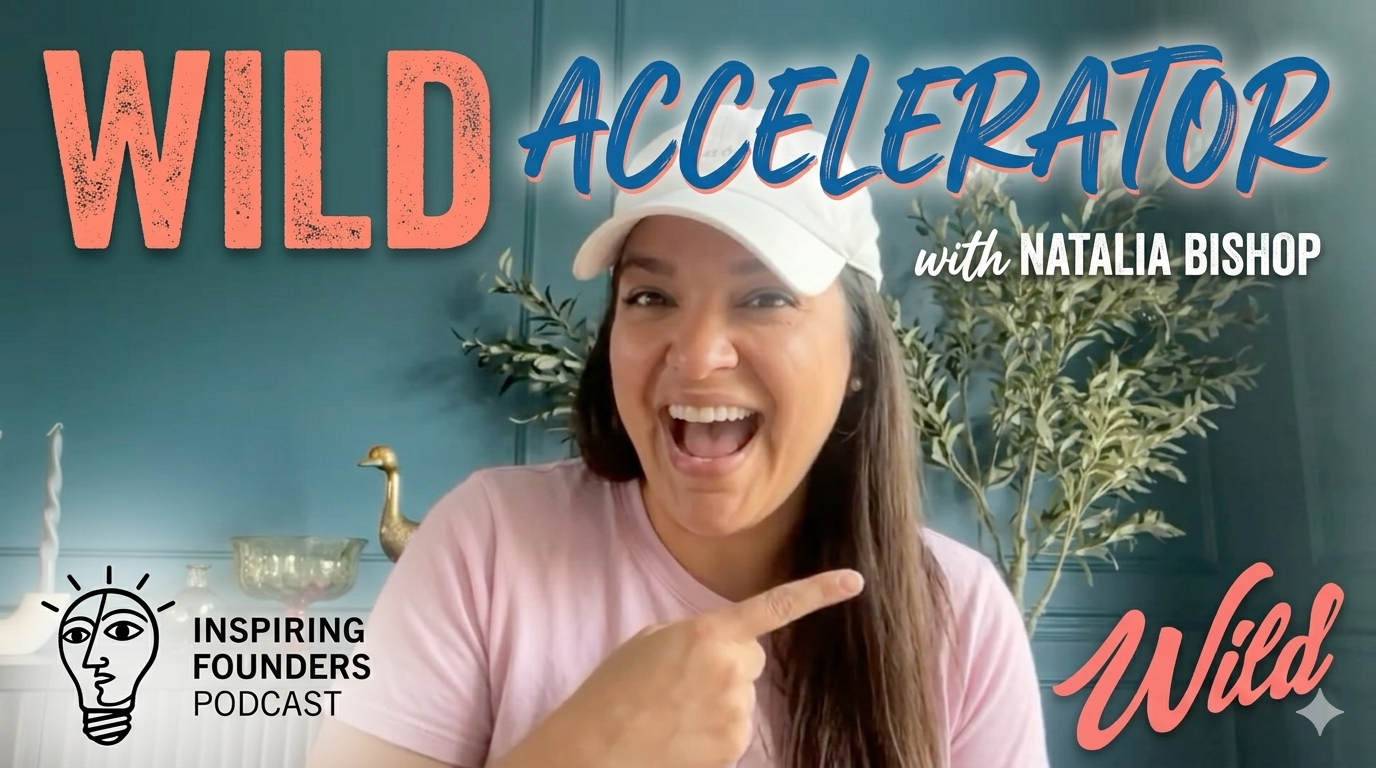
Natalia Bishop, founder of the WILD Accelerator, told me something that stuck. She said most of the founders she works with have the idea and the drive. What they don't have is a system to stay visible without burning out.
That resonated because it's the exact challenge I see with early-stage founders every week. You're building the product, closing deals, managing cash flow — and somehow you're supposed to stay top of mind with prospects and investors too.
In our conversation on the Inspiring Founders Podcast, Natalia walked through how WILD supports founders from underrepresented backgrounds with grants, mentorship, and leadership coaching. One of the most valuable things they offer isn't funding. It's helping founders build a repeatable system for showing up consistently, even when resources are tight.
You don't need a full marketing team to stay engaged with your audience. You need a workflow that's simple, repeatable, and doesn't eat your week.
If you're handling your own marketing and want a system that fits your schedule, book a free 15-minute marketing audit with me. I'll walk you through one or two quick wins and a repeatable content workflow you can run yourself.
https://www.radi8.com/free-audit?utm_source=linkedin&utm_campaign=free_audit&utm_content=podcast-8
P.S. The full conversation with Natalia about building support systems for underserved founders is live on the Inspiring Founders Podcast — on YouTube, Spotify, or Apple Podcasts.
https://www.inspiringfounders.com/podcast…more
You know LinkedIn matters for your business. You also know you're not posting enough.
The problem isn't that you don't have anything to say. It's that maintaining a consistent presence feels like a full-time job you don't have time for.
Most advice on LinkedIn growth assumes you have hours every day to scroll, engage, and post. That's not realistic if you're running a business.
Here's what actually works: a repeatable workflow that doesn't require living on social media.
The goal isn't to go viral. It's to stay visible and helpful to the people who matter to your business. Consistency beats volume every time.
If you're ready to build a practical content workflow that fits your schedule, send me a message. I'll walk you through a free 15-minute audit and show you one or two quick wins you can use right away.
https://www.radi8.com/blog/grow-your-business-on-linkedin-without-living-on-social-media-all-day
I'm offering a free audit for small business owners who need clarity on what to post and how to stay consistent — without burning hours on marketing every week.
Most founders I work with don't struggle because they lack ideas. They struggle because they don't have a repeatable system. Every post feels like starting from scratch.
After three startups and advising companies through billion-dollar exits, here's what I know: the founders who win aren't the most creative. They're the ones with systems they can run week after week.
A free 15–20 minute audit. We'll:
- Identify 1–2 quick wins you can implement this week
- Sketch a simple workflow that fits your schedule
- Give you templates you can reuse without starting from zero
Not a sales pitch. A focused conversation.
Book here: https://www.radi8.com/free-audit?utm_source=linkedin&utm_campaign=free_audit&utm_content=post_id#marketing#smallbusiness
I'm putting on a workshop for personal and small brands who want to learn how to use social media with AI.
May 28th in San Jose at the MLK Library. Hosted by the Silicon Valley Small Business Development Center.
If you run your own marketing, you know the problem. You know LinkedIn matters. You know you should be posting more. But you don't have time to spend hours on content calendars or scrolling through feeds.
Most small business owners I work with feel stuck between two options: ignore social media and lose visibility, or live on it full-time.
There's a third option: build one repeatable habit that takes 15 minutes a day.
That's what I'll walk through at the workshop. Practical workflows and time-saving templates you can use the same week. No fluff—just the steps that let you stay engaged with prospects without the time drain.
I've launched three startups with one acquisition exit. I know what works when you don't have a team or a budget.
We'll cover how to use AI tools to speed up ideation, how to structure a simple editorial calendar, and how to turn one idea into multiple posts without starting from scratch every time.
You'll walk away with workflows you can implement immediately and a clear plan for your first week of content.
If you want to stop guessing what to post and start showing up consistently without the time sink, this is built for you.
Register through the Silicon Valley Small Business Development Center.
A founder I was advising last year told me she'd written the same LinkedIn post four times and never published any of them.
Not because the post was bad. Because every time she sat down to finish it, something more urgent showed up — a customer email, a payroll question, a bug. By Friday, the draft was stale and she felt guilty, so she closed the tab.
That's the marketing problem nobody talks about. It's not that founders don't know what to say. It's that the moment between "I have something to say" and "I hit publish" is full of friction, and the friction always wins.
I've launched three startups and had one acquisition exit. I've watched smart founders let their pipeline go quiet for the same reason — not lack of ideas, lack of a repeatable system that survives a chaotic week.
That's what I'm teaching at my workshop on May 28th in San Jose at the MLK Library, hosted by the Silicon Valley Small Business Development Center. Three AI-assisted workflows that close the gap between thinking and posting:
A week of posts in 30 minutes.
Competitor research in 10.
An editorial system that runs even when your week falls apart.
If you're in the Bay Area, come. If you're not, book a free 15 to 20 minute marketing audit and I'll help you build the same system for your business.
https://www.radi8.com/free-audit?utm_source=linkedin&utm_campaign=free_audit&utm_content=post_id
DM me if you want the workshop link.
I'm running a workshop with the Silicon Valley SBDC on May 28: Marketing with AI — Digital Workforce Transformation Part 2.
If you dislike being on social media but still need to stay visible, I'll walk through a simple, repeatable process to generate content ideas, use AI to cut the time you spend posting, and turn posts into conversations that lead to customers.
Comment below and I’ll send details, or send me a message. #MarketingWithAIhttps://luma.com/mignm1bx
I'm opening up a few consulting slots for founders who need help getting their go-to-market strategy or positioning unstuck.
If you're running your own marketing and keep hitting the same walls—no time to plan campaigns, no budget for an agency, or you're not sure what message actually lands—I can help you build something practical that works without taking over your life.
I've launched three startups with one acquisition exit. I've advised three others that had billion-dollar exits: one IPO, one merger, one private equity deal. I know what it takes to position a product, build messaging that converts, and plan campaigns that don't require a full-time team to execute.
Right now, I work with founders and small business owners through Radi8, an app that makes it easier to run repeatable digital marketing campaigns. But I also take on a limited number of one-on-one consulting clients when the fit is right.
If you want to talk through your positioning, get clarity on your messaging, or map out a campaign plan you can actually stick to, send me a message.
#consulting#startupmarketing


 View on LinkedIn
 View on X