
Erika Sanneman
The Multilingual Mind helps schools and education teams close the gap between what they know they want to do and what their people actually have the time, training, tools, systems, and support to impl
Active Creator • 2-week run


'/%3E%3Cpath fill='%23fff' d='M12 7.3A4.7 4.7 0 1 0 16.7 12 4.7 4.7 0 0 0 12 7.3Zm0 7.8A3.1 3.1 0 1 1 15.1 12 3.1 3.1 0 0 1 12 15.1Zm5-8a1.1 1.1 0 1 0 1.1 1.1A1.1 1.1 0 0 0 17 7.1Zm-5 1.5c-1.5 0-1.7 0-2.3.1a3.8 3.8 0 0 0-1.3.2 2.2 2.2 0 0 0-.8.5 2.2 2.2 0 0 0-.5.8 3.8 3.8 0 0 0-.2 1.3c-.1.6-.1.8-.1 2.3s0 1.7.1 2.3a3.8 3.8 0 0 0 .2 1.3 2.2 2.2 0 0 0 .5.8 2.2 2.2 0 0 0 .8.5 3.8 3.8 0 0 0 1.3.2c.6.1.8.1 2.3.1s1.7 0 2.3-.1a3.8 3.8 0 0 0 1.3-.2 2.5 2.5 0 0 0 1.3-1.3 3.8 3.8 0 0 0 .2-1.3c.1-.6.1-.8.1-2.3s0-1.7-.1-2.3a3.8 3.8 0 0 0-.2-1.3 2.2 2.2 0 0 0-.5-.8 2.2 2.2 0 0 0-.8-.5 3.8 3.8 0 0 0-1.3-.2c-.6-.1-.8-.1-2.3-.1Zm0-1.6c1.5 0 1.7 0 2.4.1a5.5 5.5 0 0 1 1.8.3 3.8 3.8 0 0 1 2.2 2.2 5.5 5.5 0 0 1 .3 1.8c.1.7.1.9.1 2.4s0 1.7-.1 2.4a5.5 5.5 0 0 1-.3 1.8 3.8 3.8 0 0 1-2.2 2.2 5.5 5.5 0 0 1-1.8.3c-.7.1-.9.1-2.4.1s-1.7 0-2.4-.1a5.5 5.5 0 0 1-1.8-.3 3.8 3.8 0 0 1-2.2-2.2 5.5 5.5 0 0 1-.3-1.8C4 13.7 4 13.5 4 12s0-1.7.1-2.4a5.5 5.5 0 0 1 .3-1.8 3.8 3.8 0 0 1 2.2-2.2 5.5 5.5 0 0 1 1.8-.3C10.3 5 10.5 5 12 5Z'/%3E%3C/svg%3E)

Erika Sanneman is the founder of The Multilingual Mind, a consulting and learning-design practice that helps schools close the gap between what they expect people to do and the time, training, tools, and systems people actually have. She works at the intersection of multilingual and culturally responsive education, instructional coaching, restorative practice, curriculum design, and operational systems, always asking what conditions need to change before adding another initiative. With 13+ years of experience across Montessori, Spanish immersion, curriculum coordination, and school-based coaching and leadership, Erika translates research and big ideas into practical tools that build capacity without burning people out. Her approach is grounded in a core conviction: most problems that look like motivation or resistance are actually skill, system, clarity, or implementation problems waiting to be diagnosed correctly.
Workforce Development
Montessori Education
Inclusive Education
Mentorship
Language Immersion
Content Workflow
Workshops
Restorative Practices
multilingual and Spanish immersion education
instructional coaching and teacher development
professional learning design
restorative practices and systems
E
Erika Sanneman
The Multilingual Mind helps schools and education teams close the gap between what they know they want to do and what their people actually have the time, training, tools, systems, and support to impl
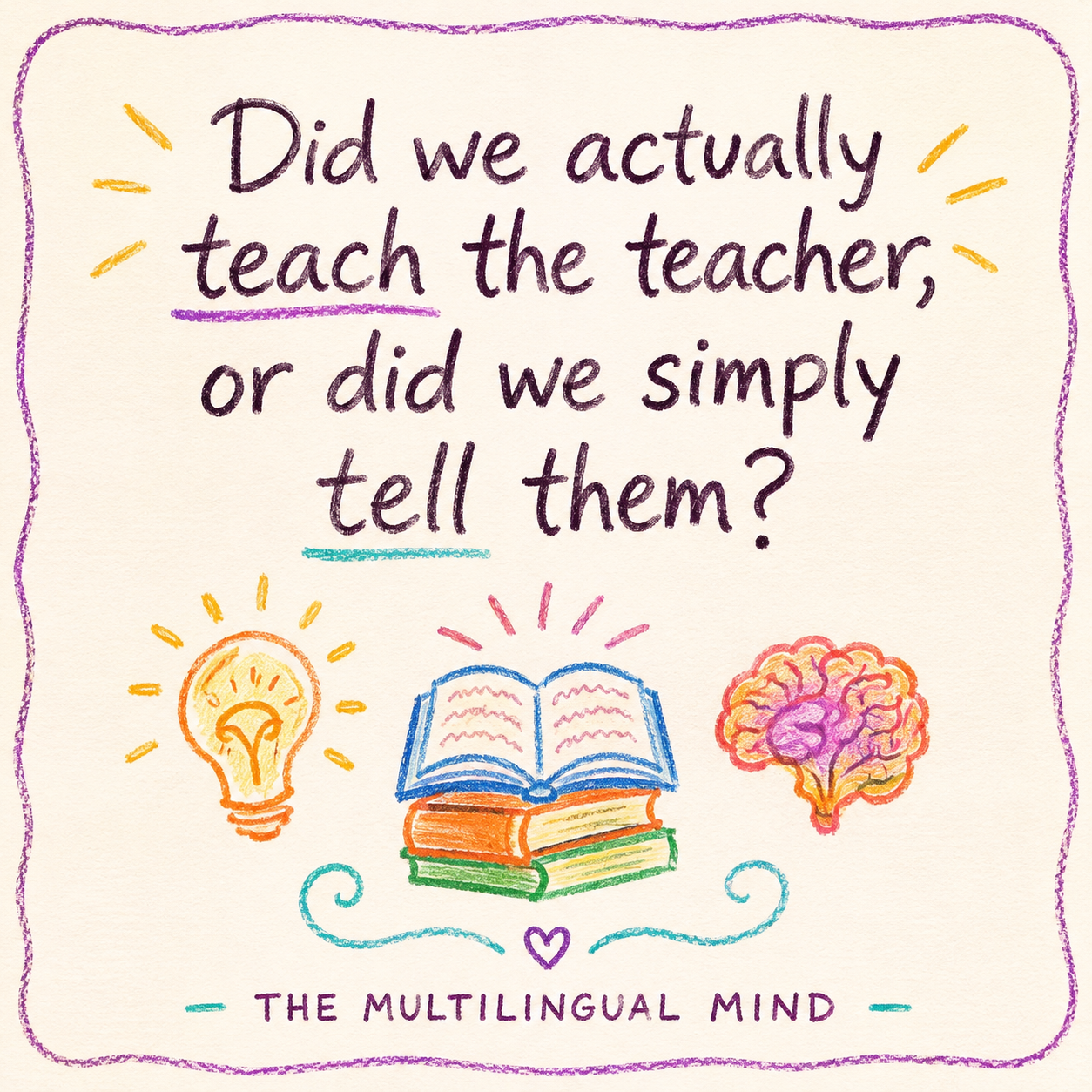
Did we actually teach the teacher,
or did we simply tell them?
Professional learning does not end when the presentation ends.
Understanding, practice, feedback, reflection, and another chance to try are part of the learning too.
New on The Multilingual Mind.
#ProfessionalLearning #TeacherDevelopment #InstructionalCoaching #AdultLearning #TheMultilingualMind …more
E
Erika Sanneman
The Multilingual Mind helps schools and education teams close the gap between what they know they want to do and what their people actually have the time, training, tools, systems, and support to impl
I’m testing something new and looking for a few small-business owners who have at least one task they are very tired of doing manually.
Think:
client follow-up
scheduling
intake
emails
documents
content
data entry
onboarding
repetitive admin
I’m offering a few AI Workflow Quick Audits where we spend 45 minutes looking at what you’re doing now, what actually needs a human, and where AI or automation could reasonably make the work lighter.
You leave with a written workflow map and a concrete place to start.
I’m offering the first few at $275 while I build this side of my consulting work.
If you own a small business and immediately thought of one task you wish would disappear from your week, message me what it is. …more
 View on LinkedIn
Also on
E
Erika Sanneman
The Multilingual Mind helps schools and education teams close the gap between what they know they want to do and what their people actually have the time, training, tools, systems, and support to impl
An accent isn't automatically a language mistake.
I teach pronunciation because I want students to communicate. I don't want them thinking their voice needs to sound like mine to be legitimate.
Here's the Short:
https://youtu.be/EQNU-T0pprY …more
E
Erika Sanneman
The Multilingual Mind helps schools and education teams close the gap between what they know they want to do and what their people actually have the time, training, tools, systems, and support to impl
A coach who has spent years working one-on-one gets handed group facilitation, and almost immediately the worry starts: do I actually know how to facilitate a PLC? Do I have the right skills for this?
It is an understandable question. It is also, usually, the wrong one to ask first.
Because the coach already knows how to have a good conversation. That part is not missing. What is missing is information. Before learning a single framework, the more useful move is to find out the parameters and what this PLC is actually for. Where did the idea come from in the first place? Was it an ask from teachers? A suggestion from a resource? Does the principal have an intended goal, or an interest in how it should be used? Was there a theme, topic, or setup they were hoping the coach would run with?
There are plenty of frameworks for starting and leading PLCs, across all kinds of topics in the field. So the coach is not starting from nothing. But knowing which framework fits, or whether one is even needed, depends on knowing the context first. The technical how-to is not the beginning of the work.
And here is the piece most likely to get skipped. Before anything else, it is worth knowing whether this PLC is going to add unnecessary burden onto teachers and onto the coach, or whether it is something teachers actually want and need and will want to engage in. That distinction changes everything. If it is something that comes from or is wanted by the teachers, the coach can channel that WITHness into the spirit and planning and logistics.
There is a practical version of this too. If time is already protected and interest already exists, a whole category of logistics and marketing steps are simply off the coach's plate, the steps that otherwise have to be figured out at the same time as the technical how-to's of facilitation. That is a lot to carry at once. Finding out it is already handled, or already wanted, is not a small thing.
So if a new facilitation role just landed on your desk, maybe the first question is not whether you have the right skills. Maybe it is what this is for, and who it is actually coming from.
What would change if you asked that one first? …more

Told 2 times, Oct 15, 2026 – Nov 10, 2026
· LinkedIn · Open
A coach who has spent years working one-on-one gets handed group facilitation, and almost immediately the worry starts: do I actually know how to facilitate a PLC? Do I have the right skills for this?
It is an understandable question. It is also, usually, the wrong one to ask first.
Because the coach already knows how to have a good conversation. That part is not missing. What is missing is information. Before learning a single framework, the more useful move is to find out the parameters and what this PLC is actually for. Where did the idea come from in the first place? Was it an ask from teachers? A suggestion from a resource? Does the principal have an intended goal, or an interest in how it should be used? Was there a theme, topic, or setup they were hoping the coach would run with?
There are plenty of frameworks for starting and leading PLCs, across all kinds of topics in the field. So the coach is not starting from nothing. But knowing which framework fits, or whether one is even needed, depends on knowing the context first. The technical how-to is not the beginning of the work.
And here is the piece most likely to get skipped. Before anything else, it is worth knowing whether this PLC is going to add unnecessary burden onto teachers and onto the coach, or whether it is something teachers actually want and need and will want to engage in. That distinction changes everything. If it is something that comes from or is wanted by the teachers, the coach can channel that WITHness into the spirit and planning and logistics.
There is a practical version of this too. If time is already protected and interest already exists, a whole category of logistics and marketing steps are simply off the coach's plate, the steps that otherwise have to be figured out at the same time as the technical how-to's of facilitation. That is a lot to carry at once. Finding out it is already handled, or already wanted, is not a small thing.
So if a new facilitation role just landed on your desk, maybe the first question is not whether you have the right skills. Maybe it is what this is for, and who it is actually coming from.
What would change if you asked that one first?
E
Erika Sanneman
The Multilingual Mind helps schools and education teams close the gap between what they know they want to do and what their people actually have the time, training, tools, systems, and support to impl
Spanish class game: describe something WITHOUT naming it.
“Se usa para cortar papel.”
Someone guesses “¡Tijeras!” Then switch roles.
I love giving students ways to keep the conversation going even when the exact word disappears on them. …more
E
Erika Sanneman
The Multilingual Mind helps schools and education teams close the gap between what they know they want to do and what their people actually have the time, training, tools, systems, and support to impl
Sometimes the best teaching move is to wait.
One of my favorite Montessori reminders is that not every unexpected moment needs an immediate correction.
Sometimes a child uses something differently than I expected, and my first job is simply to watch for another second before I step in.
What are they noticing? What are they trying? What might I miss if I interrupt too quickly?
Observation first. Then decide what the moment actually needs.
#Montessori #MontessoriEducation #Observation #ChildDevelopment #TheMultilingualMind …more
This post has video.
Watch it on the channel.
E
Erika Sanneman
The Multilingual Mind helps schools and education teams close the gap between what they know they want to do and what their people actually have the time, training, tools, systems, and support to impl
One of the trickier decisions in a Montessori inventory sounds ridiculously small: what number goes on the material?
I like to start at the beginning of a subject area and work along the shelves. But I also know what happens when you finish numbering and then discover another set tucked away in a box.
I don't want to renumber half a school because we found one missing piece of the puzzle.
So I keep two things separate: the inventory number identifies the material; the recorded shelf location tells us where it belongs in the sequence.
When another set turns up, it gets the next available inventory number. It can still go between two earlier-numbered materials on the shelf.
I do the same with completeness. “Complete,” “incomplete,” and “unknown” mean different things. And a complete set might still need laminating, so that goes in the notes.
This is exactly the kind of detail I wanted the spreadsheet to handle when I designed it. Schools can use it independently, while consulting a trained guide or the relevant references for materials they need help identifying.
Here's the Lower Elementary version:
https://www.teacherspayteachers.com/Product/AMS-Aligned-Montessori-Materials-Inventory-Lower-Elementary-17834885 …more
E
Erika Sanneman
The Multilingual Mind helps schools and education teams close the gap between what they know they want to do and what their people actually have the time, training, tools, systems, and support to impl
I was reading the U.S. Government Accountability Office's March 2026 review of K–12 professional development, and what caught my attention was the uncertainty.
The meta-analyses it reviewed generally linked professional development with better student test scores. But the evidence was mixed on which specific components were driving those outcomes. Even coaching didn't show the same association across every review.
Meanwhile, 67% of teachers in the nationally representative survey cited in the report said collaborative learning with other teachers improved their teaching or their students' learning. That's a report of perceived usefulness, not proof that every PLC works.
For me, that is a reminder to stop prescribing a particular format before diagnosing the conditions.
What are teachers trying to do differently? What support will they have when they attempt it? And how will we know if the learning is transferring into practice?
I'd rather ask those questions first than declare that one PD model is the answer. …more
E
Erika Sanneman
The Multilingual Mind helps schools and education teams close the gap between what they know they want to do and what their people actually have the time, training, tools, systems, and support to impl
I grew up bilingual. I also grew up hearing plenty of opinions about which ways of speaking were “proper.”
And now, as an educator, I think about what children are hearing when we correct them.
Sometimes we're teaching a useful pronunciation distinction. Great. But other times the message is much bigger than the sound itself: you don't sound like the people we've decided are the standard.
I don't want students to be afraid to speak because they're worried about sounding wrong before they've even finished their thought.
So I made a new Short about accents and language learning for The Multilingual Mind:
https://youtu.be/EQNU-T0pprY
If you grew up speaking more than one language, or learned one later, were you ever made to feel that the way you sounded mattered more than what you were trying to say? …more
E
Erika Sanneman
The Multilingual Mind helps schools and education teams close the gap between what they know they want to do and what their people actually have the time, training, tools, systems, and support to impl
I keep coming back to something when we talk about restorative practices: an apology can be meaningful, but it isn't the entire repair.
What happens afterward?
Do the people involved understand what changed for the other person? Is there a realistic agreement about what needs to happen differently? Does anyone check whether the relationship or working conditions actually improved?
This matters with adults just as much as with children. Sometimes people are ready for a conversation. Sometimes they need time, support, or a different process before they can participate safely and honestly.
I don't want restorative practice reduced to getting the right words spoken in the right order.
What does meaningful follow-through look like in the teams you work with? …more
E
Erika Sanneman
The Multilingual Mind helps schools and education teams close the gap between what they know they want to do and what their people actually have the time, training, tools, systems, and support to impl
There's a difference between helping a student communicate more clearly and teaching them that their voice is somehow wrong.
I think we blur that distinction far too often.
Of course pronunciation is something we can teach. Sometimes adjusting a sound makes a message easier to understand. But an accent isn't, by itself, a language error. And whose accent are we even treating as the standard?
I've spent a lot of time thinking about that question as a bilingual person and a language educator. It affects what we correct, how we correct it, and what students learn about whether they belong in the language they're learning.
I recorded a new YouTube Short for The Multilingual Mind about why accents aren't language mistakes:
https://youtu.be/EQNU-T0pprY
I'd love to know how other language teachers help students develop pronunciation without making one way of sounding seem inherently more legitimate than all the others. …more
Channel names and logos are trademarks of their respective owners.