I’ve spent the better part of 25 years trying to understand two things: which problems are worth solving, and what is the simplest way to solve them. That pursuit has led me to start companies, build products, teach entrepreneurship, coach hundreds of founders, and participate in four startup exits—one as a founder and three as an advisor.
Along the way, I noticed a pattern. Founders are usually very good at solving problems. The trouble is that we’re often solving the wrong ones. What looks like a sales problem might really be positioning. A marketing problem might begin with not understanding the customer. An execution problem might simply be too many priorities competing for attention.
I came to think of this as finding the problem under the problem. When you find it, complicated decisions get simpler, teams align, and a surprising amount of work disappears.
Today I coach founders and startup teams around the world to do exactly that. Sometimes it’s a team scaling a company worth billions. Sometimes it’s one person turning what they know into a consulting business. The scale changes, but the work is remarkably similar.
Find the problem worth solving. Find the simplest way through it. Then get on with the work that matters.
Founder at Radi8 // Executive Coach // Host of the Inspiring Founders Podcast
· LinkedIn
·
Everyone going independent gets the same advice: own your authority. Be the expert. Command the room. The most convincing builder I listened to this month argued the opposite.
Tom Shen made the point in Episode 7 of the Inspiring Founders podcast, and it's stuck with me since. His exact words: "I believe that the heart of an entrepreneur starts with humbleness."
Read that as weakness and you'll miss it. It's not self-doubt. It's positioning yourself to learn from everyone around you. Tom's version: when you're the dumbest person in the room, you absorb the most. Humility doesn't get celebrated in entrepreneurial circles — not because it's soft, but because it doesn't look like winning. It just happens to be what makes winning possible.
I think this lands hardest for the people I work with — coaches, consultants, and advisors who spent a career somewhere the authority came with the title. When you go out on your own, that authority doesn't come with you. The learning posture does. The faster you trade "I already know this" for "show me what I'm missing," the faster the transition goes.
Ego tells you to have the answers. Humility gets you the ones that actually matter.
What's one belief about going independent that humility has forced you to revisit?
#IndependentConsultant#Coaching#GoingIndependent#PersonalBrand#ThoughtLeadership…more
Founder at Radi8 // Executive Coach // Host of the Inspiring Founders Podcast
· LinkedIn
·
A short one to close the month.
I've spent July writing about positioning, focus, and what it takes to turn what you know into a business that wins clients. So here's the question I'd actually like you to answer:
What did you have to unlearn when you went out on your own?
The habits that made you great inside an organization — trusting the work to find you, staying modest about your wins, letting the company's brand do the talking — are often the exact habits that stall an independent practice.
I'll go first: I had to unlearn building quietly. For years my work spoke through companies and products. On my own, invisible good work is just invisible.
Your turn. What did you have to unlearn — or what are you still unlearning? I'll read and reply to every answer.
#IndependentConsultant#Coaching#GoingIndependent#PersonalBrand…more
Founder at Radi8 // Executive Coach // Host of the Inspiring Founders Podcast
· LinkedIn
·
Hashtags are a small thing that quietly tells you something bigger: most founders are still managing their presence one post at a time, in their head, instead of turning what they've learned into a system.
Here's what I mean. Every channel has its own unspoken rules. LinkedIn suppresses reach on posts that push people off-platform, so links belong in the first comment, not the body. Hashtags work differently on LinkedIn than they do on X — a handful of categorization tags at the end here, almost none there. None of that is complicated. It's just a set of preferences you have to remember and apply, every single time, forever. That's exactly the kind of repetitive judgment that never gets done consistently when it lives only in your head.
So I recorded a short walk-through of how I actually run this inside Claude.ai, driving Radi8 directly. In it I check how I've been using hashtags, set hashtag preferences per channel, walk through my scheduled LinkedIn and X posts to add them, and turn "move the LinkedIn link into the first comment" into a standing preference so I never have to think about it again.
The point isn't the tool. It's the shift underneath it. I'm not asking AI to decide what to say or how to sound — that's mine. I'm asking it to remember my rules and apply them the same way every time, so consistency stops depending on my memory on a busy Tuesday. AI amplifies the preferences, focus, and voice you feed it. It doesn't invent them. That's why the founders getting real leverage from it aren't the ones automating the most — they're the ones who got clear on their own rules first, then handed the execution off.
I am the founder of Radi8, so this is me sharing the journey in public, not a pitch. Happy to point anyone who's curious in the right direction.
For the founders here: how much of how you show up online lives as an actual repeatable system versus a decision you re-make from scratch every time you post?
#Founders#Startups#Entrepreneurship#AIforBusiness#MarketingSystems…more
Thursday I was in San Jose facilitating a workshop on AI and social media marketing.
I pivoted about ten minutes in.
The room was full of aspiring and early-stage business owners — people who've been pouring everything into getting their business off the ground. As I looked around, it became obvious the AI demo wasn't what they needed most.
So we went back to basics. Brand and voice. Defining your customer. Understanding what a marketing funnel actually does — and why none of the tools matter until that foundation is solid.
After the session, several people came up and shared their stories. One founder had been trying to get his business off the ground for 18 months and couldn't figure out why nothing was gaining traction. He hadn't yet clearly defined who his customer was, what problem he was solving, or why anyone should choose him over the alternative.
I've seen this pattern for 25 years. These aren't rookie mistakes. They're the gaps that never get addressed when you're just trying to survive the launch.
The most sophisticated AI in the world won't fix a messaging problem. It'll just make the wrong message louder.
If you're an early-stage founder who needs a room of people who get it — join the Inspiring Founders community on Skool. Free, no pitch, just founders helping founders.
👇 https://www.skool.com/inspiring-founders-5861/about
When Claude has an outage, I book a tee time.
That's half a joke. The other half is the actual point.
My LinkedIn presence runs on an AI system now. It drafts in my voice, stays on brand, and keeps me visible on the weeks I'm heads-down with clients. When the model goes down for an hour, nothing urgent breaks. I go hit a few balls, and it's back before I've three-putted.
Here's the part people miss when they hear that. The AI isn't what makes it work. What makes it work is everything underneath it: a clear picture of who I serve, the problems they'd describe in their own words, the way I think about their work. Feed a tool that, and it amplifies it. Feed it a vague "I help people grow," and you get vague content, faster.
I watch a lot of coaches and consultants reach for AI hoping it will hand them a strategy. It won't. It can't decide who you're for or what you stand for. That's still your job, and it's the part nobody taught you inside the org, where the brand behind you did the vouching. Get that decision sharp, and a tool can turn it into consistent visibility while you do the work you're actually great at.
The tee time is real. So is the reason I can take it.
If you've tried using AI for your own content: did it save you time, or mostly make the missing message more obvious?
#IndependentConsultant#Coaching#AIforBusiness#Positioning#PersonalBrand
Most founders I talk to already know they should be more visible. What they can't do is make it sustainable.
You write one good post, it lands, and then three weeks vanish because the actual business needs you. The intention was never the problem. The system was.
I've watched this quietly stall otherwise strong companies — not because the founder has nothing worth saying, but because turning hard-won expertise into a consistent, on-brand body of work is real work, and it's the first thing to fall off a busy week.
AI changes the math here, though not the way most people assume. It won't invent your positioning or your point of view. Feed it a blurry message and it will produce blurry content faster. But once you're clear on your promise and your voice, it can take the part that used to eat your week — drafting, designing, scheduling — and compress it into something you can actually keep up with.
That's what I'm walking through in a live workshop.
📅 July 23rd, 11am
💻 Online — join from anywhere
Hands-on, we'll cover:
• Generating posts that sound like you, not like a robot
• Creating brand-aligned images without a designer
• Scheduling a full month of content in about 30 minutes
It's built for founders who are tired of starting from zero every week and want a repeatable system — not another burst of activity that never compounds.
Seats are limited. Register with the link in the comments.
#Founders#Startups#Entrepreneurship#AIforBusiness#MarketingSystems
Founder at Radi8 // Executive Coach // Host of the Inspiring Founders Podcast
· LinkedIn
·
A few weeks of teaching. One small offer today.
If you're a coach, consultant, advisor, or fractional executive building a business of your own — and something isn't moving the way it should — book 30 minutes with me and ask me anything about your business.
No pitch. No discovery interrogation. Just a working session on your hardest current question: positioning that won't sharpen, feast-or-famine months, an offer that gets compliments but never clients, a message that lands in the room and disappears online.
What you'll leave with: a clearer read on the real problem (it's usually one level below the one you brought), and one or two concrete next steps you can act on this week.
Why I do this free: it's how I'd want to evaluate an advisor myself. Watch how someone thinks before you decide anything. If it's useful, there are ways to keep working together. If the 30 minutes is all you need, that's a good outcome too.
I made this leap myself. Sold my company, built a consulting practice, learned most of these lessons at full price. The whole point of the call is that you get them cheaper.
Link to book is in the first comment. Bring your hardest question.
#IndependentConsultant#Coaching#ConsultingBusiness#GoingIndependent…more
Founder at Radi8 // Executive Coach // Host of the Inspiring Founders Podcast
· LinkedIn
·
In 25 years I've watched founders quietly kill good ideas and pour a year into bad ones — for the exact same reason. They never separated the idea from the way it was framed.
When a project stalls, the instinct is to read it as an effort problem. Work harder. Add a hire. Run one more push. But most stalled projects aren't stuck at the effort level. They're stuck at the root-problem level — and no amount of effort fixes a problem you've diagnosed wrong. You just get to the wall faster.
There are really only two reasons a project won't move, and they look identical from the inside:
The idea is wrong. There's no real problem underneath it, or no one who'll pay to solve it. Effort here is expensive theater.
The framing is wrong. The problem is real and worth solving — but you've aimed it at the wrong buyer, entered through the wrong door, or described it in words that don't match how anyone actually experiences it. Effort here isn't wasted; it's just pointed at the wrong target.
The trap is that both feel the same. Both produce silence, flat numbers, and a team that's working hard with nothing to show. So before you spend more, the question isn't "how do we push harder?" It's "which of these two am I actually looking at?"
Here's the diagnostic I run:
Does the problem exist when you're not in the room? A real problem shows up in what people already do — the workarounds, the spreadsheets, the money they're spending to cope. If the problem only appears when you pitch it, you likely have an idea problem, not a framing one. Effort won't save it.
Change the words, not the product — does the response change? Describe the same thing to the same person using their language, their trigger, their stakes. If a sharper frame suddenly gets nods where you got blank stares, the idea was never the issue. The framing was.
Follow the "no." When people pass, are they saying "I don't have that problem" or "I have it, but not like that / not from you"? The first is an idea signal. The second is a framing signal — and it's fixable without starting over.
Would a different buyer make this obvious? Sometimes the idea is right and the audience is wrong. Moving the same solution to a segment that feels the pain acutely turns a hard sell into an easy one. That's framing, not effort.
The reason this matters: the cost of confusing the two is enormous. Treat a framing problem as an effort problem and you burn a year grinding on something that only needed a repositioning. Treat an idea problem as a framing problem and you keep polishing the message on a thing the market was never going to buy.
Clarity here is cheaper than persistence. Diagnose the root before you spend the next quarter on the symptom.
So a question worth sitting with this week:
The project that's stalled right now — are you actually sure it's a bad idea, or have you just never tested whether it's a framing problem wearing a bad-idea disguise? …more
Before a client builds anything — the new website, the course, the funnel, the rebrand — I ask the same questions. Most projects don't survive them. That's the point.
Coaches and consultants are builders by nature. When growth stalls, the instinct is to make something: a new offer, a new content plan, a new brand. Building feels like progress. Building the wrong thing is the most expensive form of standing still.
So before anything gets built, I ask:
Who exactly is this for? I want a person you could name, with a problem they'd describe in their own words. A demographic doesn't count.
What evidence says they want it? Behavior is evidence: what they already do, already pay for, already work around. Encouragement from friends is not.
What are they doing about this problem today? If the answer is "nothing," be careful. People who live comfortably with a problem rarely pay to solve it.
Why you? What in your background makes you the credible one, and can a stranger see that credibility, or does it live only in your head?
What's the one constraint? If everything feels equally important, nothing is. Name the single thing that, once moved, unlocks the rest.
Clients sometimes get frustrated at this stage. They came with a solution, and I keep questioning the diagnosis. That's the job. A sharper problem definition beats more effort every time, and it costs a lot less than finding out after launch.
Which of these would be hardest for you to answer with real evidence today?
#IndependentConsultant#Coaching#CustomerDiscovery#IdealClient
Founder at Radi8 // Executive Coach // Host of the Inspiring Founders Podcast
· LinkedIn
·
Busy founders and stalled founders often look identical from the outside. Both are working constantly. The difference is what happens to all that effort.
Here's the pattern I've watched for 25 years: activity that isn't built on a system doesn't compound. You do the outreach, the post, the follow-up, the demo — and then next week you start from zero and do them all again. It feels like progress because it's exhausting. But nothing accumulates. You're not building an engine; you're pushing the car.
A system is just the opposite. It's a motion you run once, learn from, and improve — so the next turn is a little sharper than the last. That's what compounding actually is: the same effort producing more each time because the thing underneath it is getting better.
The trap for a stalled founder isn't laziness. It's the opposite. There's so much motion that you can't tell which of it is worth turning into a system and which is just noise burning the hours.
Here's the filter I use. One question separates the signal from the noise:
Which single motion, if it got 20% better every time we ran it, would change the trajectory of the business?
That's the one to systematize. Not the ten things that feel urgent — the one whose improvement curve actually bends the outcome. Usually it's unglamorous: how you talk to customers, how a lead becomes a conversation, how you decide what to build next. Almost never the thing that's loudest on your calendar.
Then be honest about the rest. Most of what fills a stalled founder's week is motion that will never compound no matter how well you execute it. That's not a productivity problem you fix with a better tool or another hire. It's a focus problem. Cutting it isn't losing ground — it's freeing the attention the one motion needs to become a real system.
The uncomfortable part: you can't systematize everything, and trying to is its own form of noise. Compounding demands you pick.
So the question worth sitting with this week:
Of everything you're doing right now, which one motion is actually worth turning into a system — and what would you have to stop doing to give it the attention it needs?
#Founders#Startups#Entrepreneurship#FounderLessons#GrowthStrategy…more
Across four companies and 25 years, my go-to-market got better every time. Here's the most important thing I learned.
Stop trying to do everything at once.
Most growth problems look like marketing problems.
But when I dig in with founders, the issue is usually lack of focus.
Too many audiences.
Too many messages.
Too many priorities.
Too many opportunities.
What actually works: one audience segment, one message, one channel, one objective. Run it long enough to learn something.
The lesson isn't about marketing.
It's about decision-making.
The companies that grow fastest are often the ones that say no most often.
What's one thing you're working on right now that you know should probably wait?
Most stuck practices aren't under-resourced. They're over-complicated.
I see it with almost every coach and consultant I advise. Three audiences. Five offers. Two newsletters, a podcast idea, a course half-built, a website redesign in progress. Everything is "almost working," which is another way of saying nothing is.
When growth stalls, the instinct is to add more: channels, offers, effort. After 25 years of building companies, I trust the opposite pattern. Momentum comes from removing decisions. A few things running well compound faster than many things running at half strength.
A practice has one engine: a clear person, with a clear problem, hearing a clear promise, through one reliable channel. Everything beyond that is optional until the engine runs. Most of what fills a stuck practice-owner's week is complexity that will never compound no matter how well it's executed.
Here's the exercise I run with clients. List everything you're doing to grow. Then ask one question of each item: if this got 20% better every month, would it change the trajectory of my business? Most items fail the test immediately. The one or two that pass — that's the business. The rest is noise wearing a to-do list.
Cutting will feel like retreat. Give it two weeks and it starts to feel like focus.
What's the one decision that, if you made it this week, would unblock everything else in your practice?
#IndependentConsultant#Coaching#ConsultingBusiness#GoToMarket
Founder at Radi8 // Executive Coach // Host of the Inspiring Founders Podcast
· LinkedIn
·
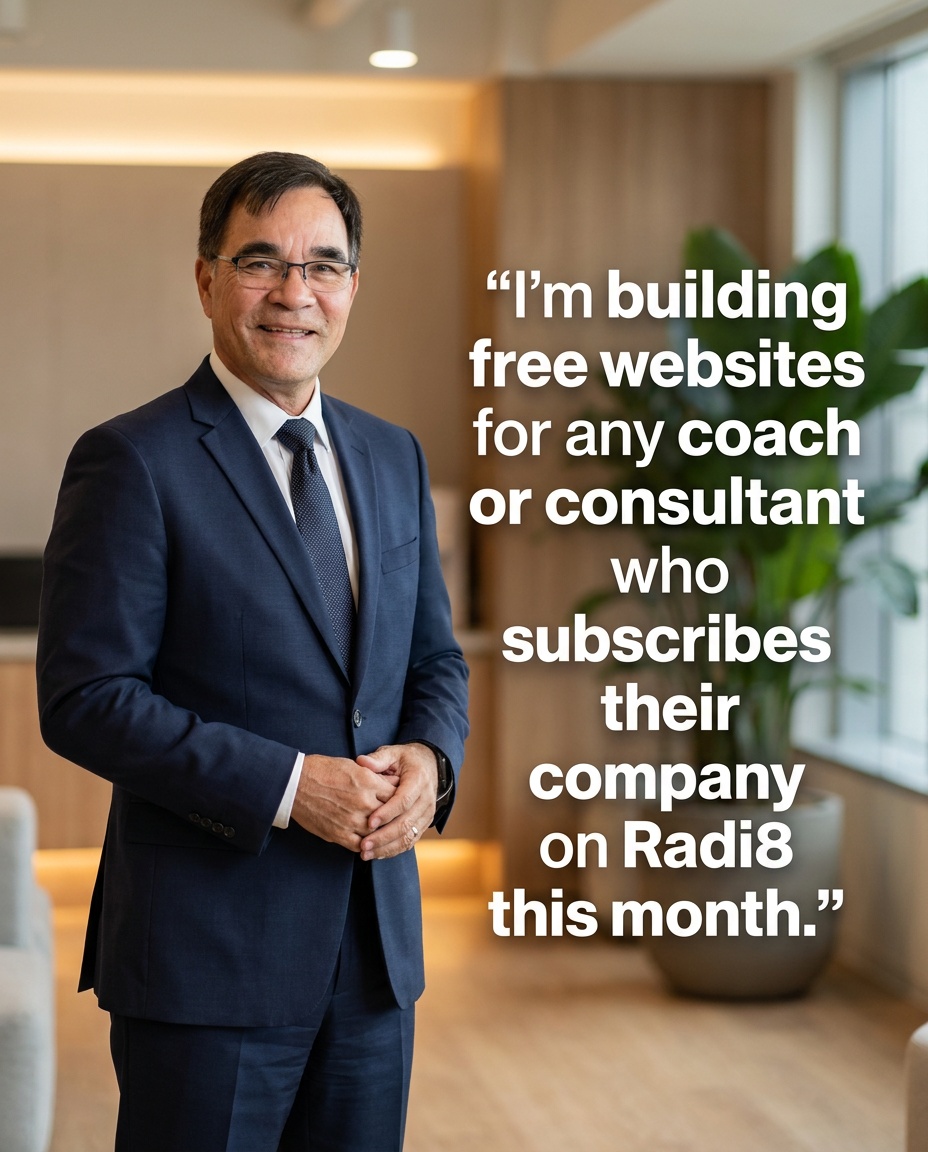
I will build a free website for any new coach or consultant who subscribes to Radi8 this month.
For most coaches and consultants going out on their own, the website is the thing that never gets done.
You know it matters. It's where a referral goes to size you up before they ever reach out. But it sits at the bottom of the list, behind actual client work — half-built, and saying a fraction of what you'd say if someone asked you across a table.
But a website isn't decoration. It's evidence. It's where the market watches how you think before they decide to book a call. When it's vague, the people most likely to hire you quietly move on, and you never see it happen.
So this month I'm doing something about it. Anyone who subscribes to Radi8 this month, I'll build the website myself, no charge. Radi8 keeps you visible and posting consistently. The site gives that work a home the right clients can actually find.
This isn't a blank template you look wrestle with alone. We get the positioning right first — who you help and what changes for them — then I build a site that carries it.
If yours has been on the someday list, consider this the nudge. Details and link in the first comment.
What's the one thing your current website fails to say about the work you actually do?
#IndependentConsultant#Coaching#Positioning#PersonalBrand#GoingIndependent…more
Founder at Radi8 // Executive Coach // Host of the Inspiring Founders Podcast
· LinkedIn
·
For most people who go out on their own, the first clients come easy. A former colleague. Someone from the old company. A friend who says "you should talk to my boss." It feels like word of mouth is working, and it convinces you that you'll never need marketing.
Then, somewhere in year one or two, it goes quiet.
Here's what actually happened. Those first clients weren't a pipeline. They were accumulated goodwill — twenty years of people who already knew your work, converting all at once. A one-time asset. Every engagement draws it down, and nothing automatic puts new names in.
That's the real source of feast-or-famine: treating a finite stock of warm contacts like a renewable one.
Refilling the well takes three things.
Positioning people can repeat. "He's great" sends you nobody, because your network can't finish the sentence. Give them the version they can pass along: who you help, and with what.
Visibility beyond your circle. A public body of work lets strangers build trust the way your old colleagues did, by watching how you think over time.
A reason to be remembered this month. Staying quietly excellent means being quietly forgotten. Consistency keeps you on the list when someone's moment of need arrives.
Word of mouth remains the best way to win clients. Building the system that generates it is the actual work.
If you've made the leap: how long did your first wave of clients last, and what did you do when it slowed?
#IndependentConsultant#Coaching#GoingIndependent#ConsultingBusiness…more
Founder at Radi8 // Executive Coach // Host of the Inspiring Founders Podcast
· LinkedIn
·
Talent, timing, network — none of it matters if you quit before the moment arrives.
After building several companies and advising a lot of people who've struck out on their own, if you asked me for the one trait that separates the people who make it from the people who don't, it wouldn't be intelligence, or connections, or perfect timing. It's perseverance.
And I don't mean the motivational-poster version. Most people who go independent don't stop because they've failed. They stop because they haven't succeeded yet — and in a hard moment, those two things feel identical. They're not.
Real perseverance isn't blind stubbornness. It's staying in motion, adapting, and keeping the door open long enough for something to actually happen. The hardest stretch is never the leap. It's the long middle — when you've left the title behind, you're doing the work, and the clients aren't showing up yet.
What I've come to believe is that the distance between wanting to quit and the breakthrough is usually shorter than it feels in the moment — but you only find that out if you're still standing there when it comes.
If you're in that middle right now, growing a coaching or consulting business of your own: what's keeping you in the game? What would help you stay?
🎙️ From my conversation with Julia Lucidi on the Founder Tactics podcast — full episode linked in the first comment.
#IndependentConsultant#Coaching#Solopreneur#GoingIndependent#PersonalBrand…more
Founder at Radi8 // Executive Coach // Host of the Inspiring Founders Podcast
· LinkedIn
·
Fast Pencil didn't win because of one clever innovation. It won because four technologies grew up at exactly the same moment — and we happened to be paying attention.
Back in 2007, four enabling layers matured almost simultaneously:
— E-books went mainstream (Kindle launched)
— Print-on-demand made a single copy economical
— Digital distribution meant you didn't need a warehouse or a bookstore
— Real-time online collaboration arrived (early Google Docs)
Any one of those, on its own, was interesting. A neat feature. A "someday" bet.
All four together created a category that couldn't have existed the year before: self-publishing for everyone. Right time, right place, right convergence — and a window that opened wide and then closed fast.
That's the lesson I keep coming back to for founders evaluating a new market. Most people scan for individual trends: "AI is hot," "video is growing," "this platform is exploding." Trends are easy to spot and easy to chase. The durable businesses get built somewhere harder to see — at the intersection, where several enabling layers reach maturity at the same time and suddenly make a hard thing cheap, obvious, and possible.
As I told Julia Lucidi on her Founder Tactics podcast: "being aware of the convergence of technology is huge."
So the real skill isn't spotting the trend everyone's already talking about. It's noticing when three or four separate things quietly cross the line from "almost possible" to "possible" at once. That's the timing window. And it rarely announces itself.
What convergence are you watching right now that others are treating as separate trends? Worth thinking about.
🎙️ From my conversation with Julia Lucidi on the Founder Tactics podcast. Full episode: https://youtu.be/M58Dnn2UAlM#Founders#Startups#Entrepreneurship#GoToMarket#GrowthStrategy…more
Founder at Radi8 // Executive Coach // Host of the Inspiring Founders Podcast
· LinkedIn
·
Oops!! I made a mistake.
The Content Marketing with AI workshop starts at 10am, not 11. Same Zoom, same registration link.
If you were already planning to join, move it an hour earlier on your calendar. We'll get into where AI actually fits in a content workflow — where it amplifies clear positioning and customer understanding, and where it just amplifies the confusion if the strategy underneath isn't there yet.
Already registered? Just show up at 10. Not yet? The link's still open — it's in the comments. Grab a spot and I'll see you on Zoom.
#Founders#Startups#Entrepreneurship#AIforBusiness#MarketingSystems…more
Founder at Radi8 // Executive Coach // Host of the Inspiring Founders Podcast
· LinkedIn
·
Most stalled initiatives aren't stuck because people disagree. They're stuck because everyone already agrees — and nothing moves.
I've watched this for 25 years. The room nods. The strategy deck is beautiful. "Yes, we should absolutely do this." And then a month later it's exactly where you left it. Founders read that as a conviction problem and go hunting for more buy-in. But you don't need more agreement. You have plenty. What's missing is the other two ingredients: momentum and ownership.
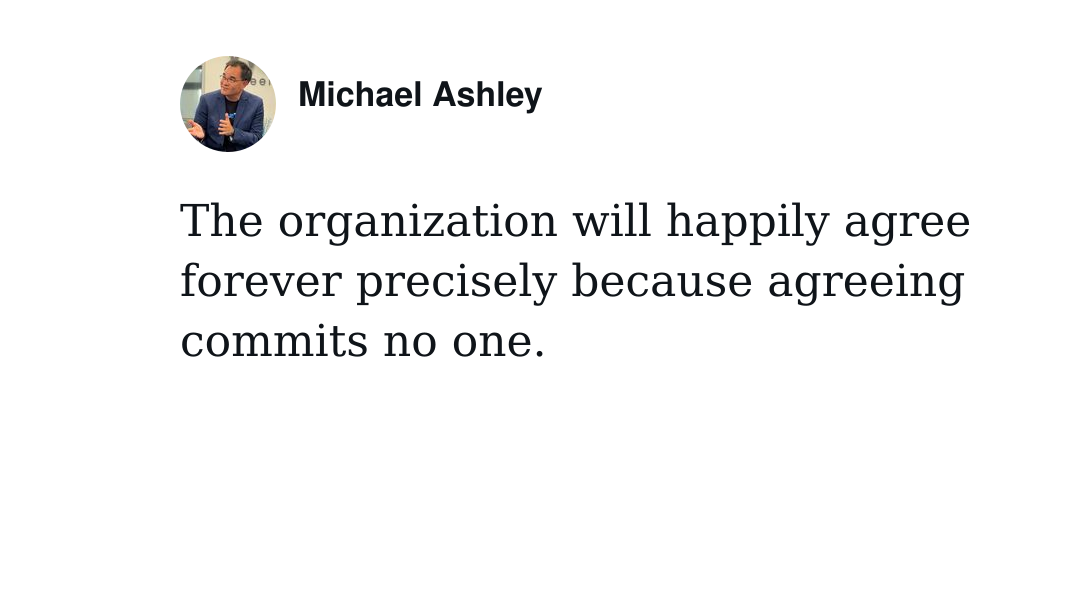
Agreement is cheap because it costs nothing. It's a nod. Momentum and ownership are expensive because they cost something the moment they exist — a decision that can't be quietly walked back, and a name attached to it. That's exactly why they're the parts that go missing. The organization will happily agree forever precisely because agreeing commits no one.
So the job isn't to build more consensus. It's to manufacture the first irreversible step.
By irreversible I don't mean dramatic. I mean a step that changes the facts on the ground, so next week can't just be a copy of last week. A few that actually work:
Make it public. A private intention dies quietly. An external commitment — a date told to a customer, a launch announced, a demo scheduled with someone outside the building — turns "someday" into "this Thursday, in front of people."
Assign one owner, not a committee. Shared ownership is the most sophisticated way to guarantee nothing happens. It has to be one name, with the authority to move and the accountability if it doesn't. A group can hold agreement. Only a person can carry momentum.
Spend something you can't refund. Book the venue. Hire the first person. Ship the rough version. The point isn't the size of the bet — it's that reversing it now costs more than continuing. That asymmetry is what makes the step stick.
Here's the uncomfortable part: the first irreversible step is uncomfortable on purpose. If it feels safe and fully reversible, it isn't the step — it's more agreement wearing a costume. The discomfort is the signal that you've finally converted a nod into motion.
The best builders I know aren't better at getting people to agree. They're better at creating the conditions where agreement has to become action — one owner, one public commitment, one thing that can't be undone.
So a question worth sitting with:
The initiative everyone agrees on but no one has moved — what's the smallest step you could take this week that you couldn't quietly walk back, and whose name would be on it?
#Founders#Startups#Entrepreneurship#FounderLessons#GrowthStrategy…more



'/%3E%3Cpath fill='%23fff' d='M12 7.3A4.7 4.7 0 1 0 16.7 12 4.7 4.7 0 0 0 12 7.3Zm0 7.8A3.1 3.1 0 1 1 15.1 12 3.1 3.1 0 0 1 12 15.1Zm5-8a1.1 1.1 0 1 0 1.1 1.1A1.1 1.1 0 0 0 17 7.1Zm-5 1.5c-1.5 0-1.7 0-2.3.1a3.8 3.8 0 0 0-1.3.2 2.2 2.2 0 0 0-.8.5 2.2 2.2 0 0 0-.5.8 3.8 3.8 0 0 0-.2 1.3c-.1.6-.1.8-.1 2.3s0 1.7.1 2.3a3.8 3.8 0 0 0 .2 1.3 2.2 2.2 0 0 0 .5.8 2.2 2.2 0 0 0 .8.5 3.8 3.8 0 0 0 1.3.2c.6.1.8.1 2.3.1s1.7 0 2.3-.1a3.8 3.8 0 0 0 1.3-.2 2.5 2.5 0 0 0 1.3-1.3 3.8 3.8 0 0 0 .2-1.3c.1-.6.1-.8.1-2.3s0-1.7-.1-2.3a3.8 3.8 0 0 0-.2-1.3 2.2 2.2 0 0 0-.5-.8 2.2 2.2 0 0 0-.8-.5 3.8 3.8 0 0 0-1.3-.2c-.6-.1-.8-.1-2.3-.1Zm0-1.6c1.5 0 1.7 0 2.4.1a5.5 5.5 0 0 1 1.8.3 3.8 3.8 0 0 1 2.2 2.2 5.5 5.5 0 0 1 .3 1.8c.1.7.1.9.1 2.4s0 1.7-.1 2.4a5.5 5.5 0 0 1-.3 1.8 3.8 3.8 0 0 1-2.2 2.2 5.5 5.5 0 0 1-1.8.3c-.7.1-.9.1-2.4.1s-1.7 0-2.4-.1a5.5 5.5 0 0 1-1.8-.3 3.8 3.8 0 0 1-2.2-2.2 5.5 5.5 0 0 1-.3-1.8C4 13.7 4 13.5 4 12s0-1.7.1-2.4a5.5 5.5 0 0 1 .3-1.8 3.8 3.8 0 0 1 2.2-2.2 5.5 5.5 0 0 1 1.8-.3C10.3 5 10.5 5 12 5Z'/%3E%3C/svg%3E)


 View on LinkedIn