"AI will sound generic and tank the reputation I've spent years building."
If you've tried a generic AI tool, this fear is earned. You typed a prompt into a blank box, got back something that could've been written for anyone, and thought: not with my name on it.
So let's separate two things that keep getting blamed on each other.
The problem was never AI. It was AI with no context. A blank box doesn't know your voice, your audience, or the point of view you've spent a career sharpening — so of course it defaults to average. Average is all it has.
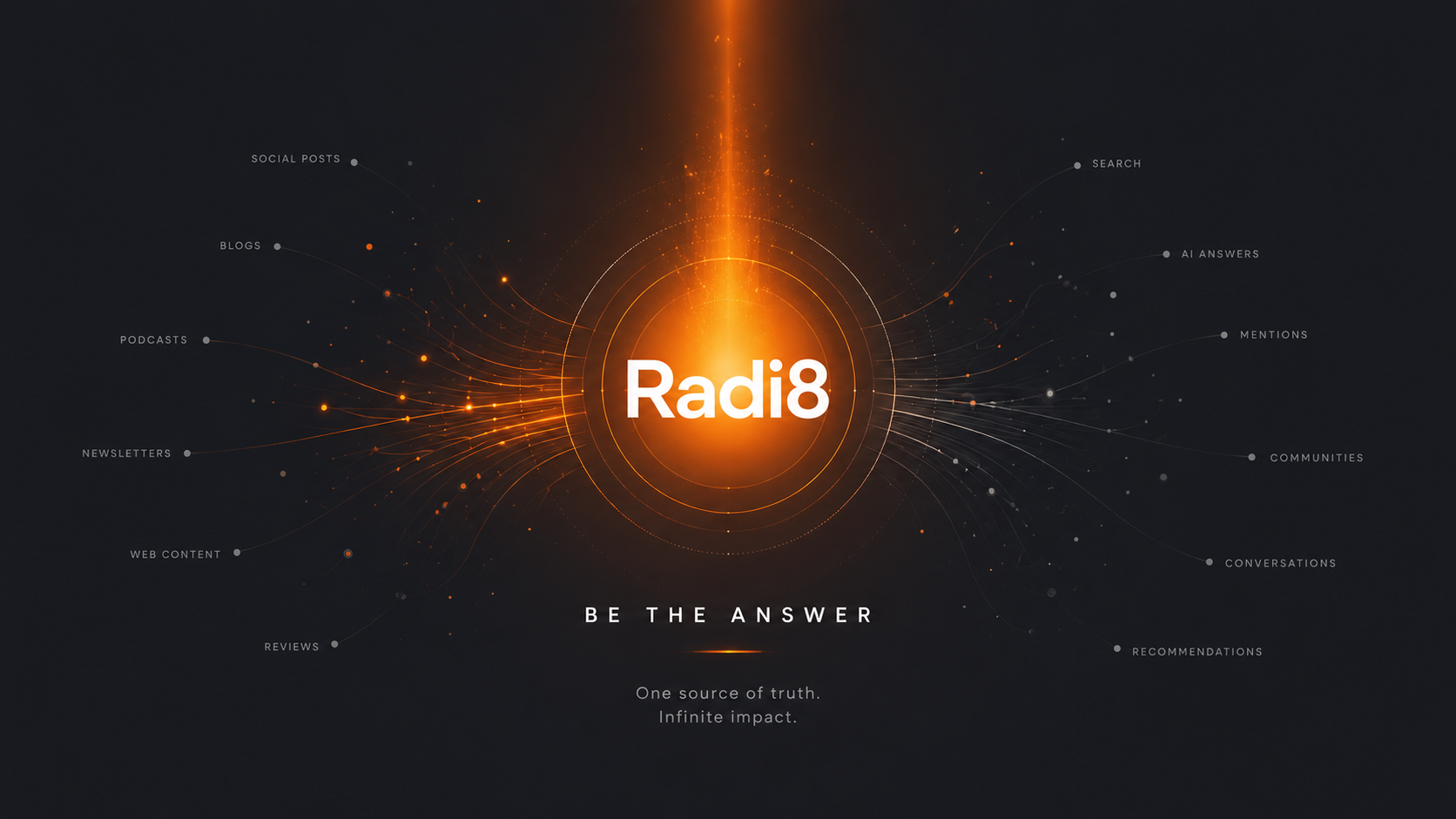
Radi8 works differently on two fronts:
1. It writes from your source of truth. Your voice, your audience, your actual opinions live in one place the AI draws from every time. The floor stops being "sounds like everyone" and becomes "sounds like me" — because it's built from you.
2. You're the final editor. Nothing publishes on its own. You read every draft and decide what goes out, what gets fixed, and what never leaves the page. If a line doesn't sound like you, you fix the context, not just the caption — and every draft after gets sharper.
That's the part the "AI slop" fear misses. Human-in-the-loop isn't a safety feature bolted on the side. It's the whole design. Your judgment is still the last word.
The reputation-conscious move isn't avoiding AI while your competitors compound. It's giving AI your context and keeping your hand on the approve button.
See what Radi8 writes in your voice before you connect a single channel — zero public risk.
Start your free trial — radi8.com (no credit card required).
The scariest part of using AI for your marketing is the publish button. So we moved it to the very end.
Here's how Radi8 actually works if you're reputation-conscious (and you should be):
You build your brand context first — your voice, your audience, your point of view. Then you generate a post and read it back. If it doesn't sound like you, you fix the context, not the caption. You do all of this before you connect a single channel.
Nothing publishes without your approval. You connect LinkedIn or X only once you trust the drafts — not as step one, but as the step you take when you're ready.
The first draft takes under 10 minutes. The difference from a blank ChatGPT box is that it's drafting from your source of truth, so the floor is "sounds like me," not "sounds like everyone."
See it in your own voice, with zero public risk, before you commit to anything.
Start your free trial — radi8.com (no credit card required).
"I'm active on LinkedIn" used to be the flex. It isn't the bar anymore.
Being active isn't the same as being visible. Posting into the feed is activity. Whether you actually come up when it matters is a different question — and the moment that decides it has moved.
Your buyer now asks ChatGPT or Claude "who's good at this?" before they ever open your profile. The AI answers with whoever has a clear, consistent body of work it can point to. If that's not you, you're not on the shortlist — and you'll never see the search that skipped you.
So the question isn't "am I posting enough?" It's "when my buyer asks AI, do I come up — and does it sound like me?"
That comes down to one thing: a brand source of truth — your voice, audience, and point of view held in one place, so what AI says about you is actually yours.
When someone asks AI in your field, do you come up? Curious how many of you have actually checked.
A viral post is a spike. Your reputation is an asset. Only one of them still matters when your buyer asks AI for a recommendation.
Here's the difference: attention resets to zero every morning — you post, it peaks, the feed moves on, and tomorrow you're back at a blank page. Reputation compounds. A consistent body of work stacks into a clear, specific picture of what you're known for.
And that's exactly what ChatGPT or Claude draws on when someone asks "who's good at this?" The spike is invisible to it. The consistent body of work is what gets paraphrased back.
So the goal isn't a bigger day. It's a bigger base.
More on the framework → radi8.com/blog
A viral post is a spike. Your reputation is an asset. AI search only rewards one of them.
Here's the framework I keep coming back to:
Attention resets every day. You post, it peaks, the feed moves on, and tomorrow you're back at zero — chasing the next hit from a blank page.
Reputation compounds. A consistent body of work doesn't fade at midnight. It stacks. Each post adds to a clearer, more specific picture of what you're known for.
And here's why that gap matters more now than it used to: when your buyer asks ChatGPT or Claude "who's good at this?", AI doesn't surface whoever posted the loudest yesterday. It draws on the consistent, distinctive work it can actually point to. The spike is invisible to it. The compounding body of work is what gets paraphrased back.
So the goal isn't a bigger day. It's a bigger base.
Three shifts that get you there:
1. Stop measuring the post, start measuring the pattern. One post doesn't define you. Fifty consistent ones do — that's what AI reads as your point of view.
2. Give the compounding something to compound from. A brand source of truth — your voice, audience, and point of view in one place — is the infrastructure that makes every post add up instead of starting over.
3. Show up as a system, not a streak. Streaks depend on motivation and break the first busy week. A system keeps running whether you're inspired or not.
Better content from one source of truth beats more content from a blank page — and it's also how you get found when buyers ask AI.
We ran an AI visibility test on our own brand. Radi8 failed it.
We asked AI assistants like ChatGPT, Claude, and Perplexity the questions our buyers actually ask — "best AI social tool for consultants," "Hootsuite alternatives for a solo founder." We didn't come up once.
The uncomfortable part: we did it to ourselves. For months we described Radi8 in language built for humans — and invisible to the machines doing the recommending.
So we're fixing it in public: why clever positioning loses to AI retrieval, why it's not just your website, and the exact changes we're making. Including the parts that flop.
Full playbook — link in bio. 👇
https://www.radi8.com/blog/show-up-when-buyers-ask-ai-for-recommendations#AIsearch#founderledmarketing#AEO#marketing#consultants
Your next client is asking AI for a recommendation right now. 🤖
Will it be you?
Join our FREE live workshop this Thursday — "Be the Answer" — and build your brand source of truth so AI describes you in your own voice.
In under an hour, live, you'll:
✨ Set up your brand source of truth
✨ Generate a post that sounds like you (zero public risk)
✨ Plan a month of content in under 10 minutes
✨ Get your questions answered live
📅 Thursday, July 23 · 10AM PT · Free to join
🔗 Register at the link in bio — luma.com/radi8-pz3q
#AISearch#ThoughtLeadership#ContentStrategy#PersonalBrand#ConsultantLife
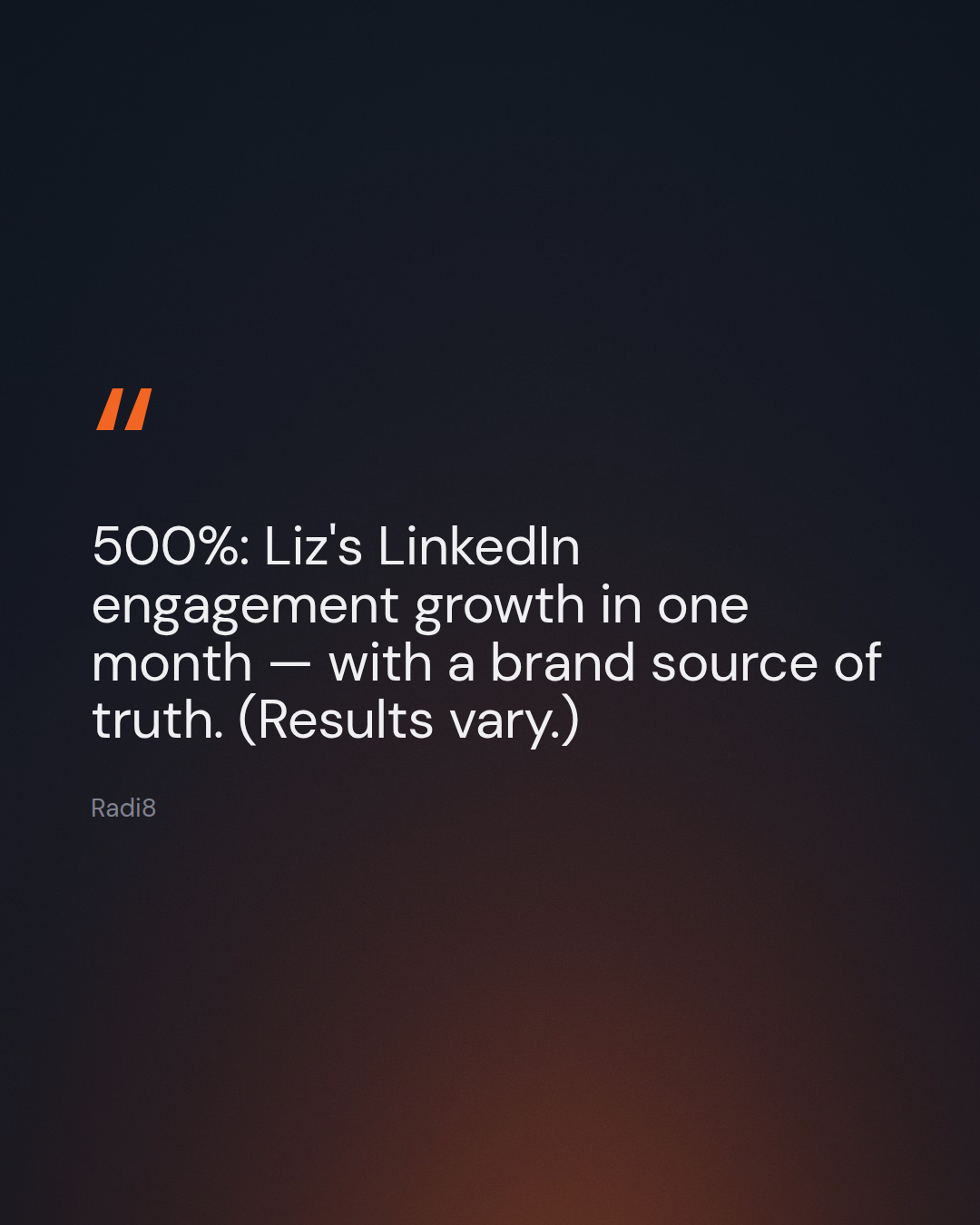
A number that stuck with me: 500%.
That's how much Liz, a functional wellness practitioner, grew her LinkedIn engagement in a single month — not by posting more frantically, but by setting up her brand context and showing up consistently in her own voice. (One person's result; individual numbers vary with audience, cadence, and content mix.)
Here's why it's not luck. When your voice, audience, and point of view live in one place, every post starts from something instead of nothing. The quality stops swinging with your mood or how busy your week is. You compound instead of restarting.
That's also what makes you the answer when a buyer asks AI about your field — a clear, consistent body of work it can actually point to.
Liz didn't get there with a content marathon. She got there with a system.
Start your free trial — radi8.com (no credit card required)
The fear about AI content: "It'll make me sound like everyone else."
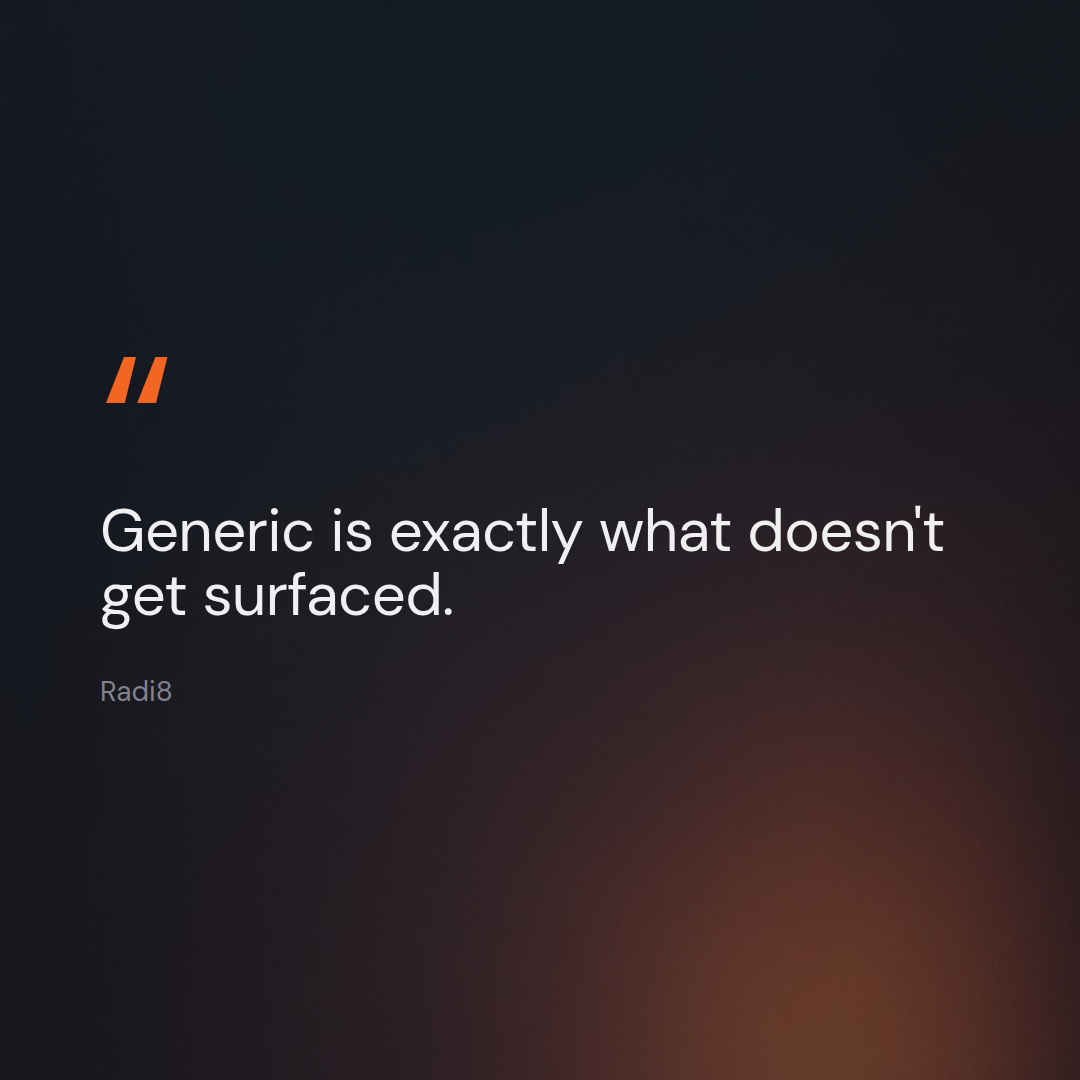
But generic is exactly what doesn't get surfaced.
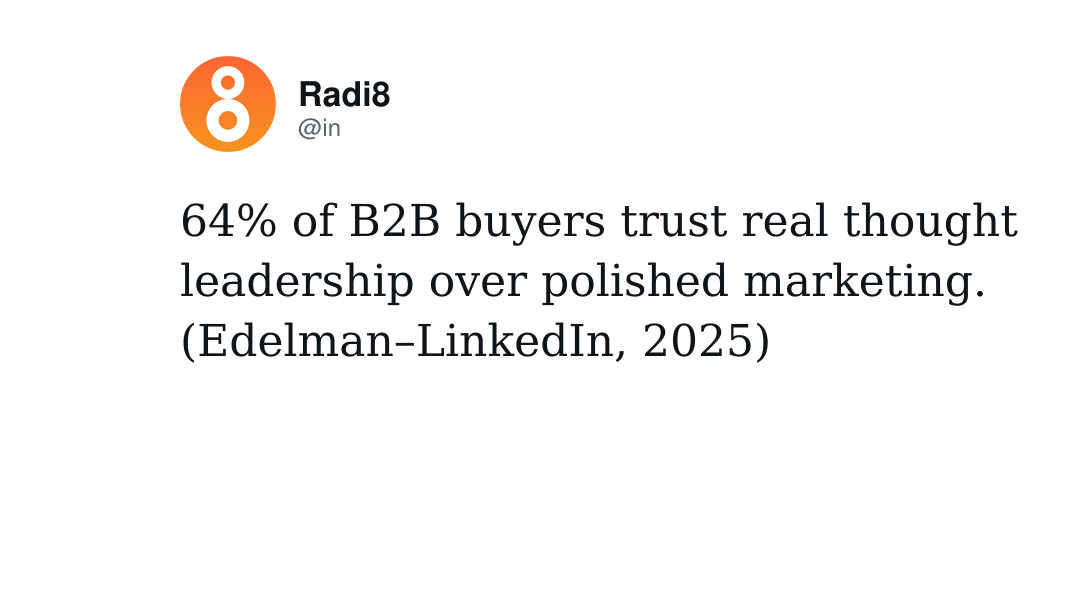
64% of B2B buyers trust real thought leadership over polished marketing (Edelman–LinkedIn, 2025).
The fix isn't avoiding AI. It's giving it your voice.
The fear I hear most about using AI for content: "It'll make me sound like everyone else."
Fair. Generic AI does produce generic output. But here's the part that should change how you think about it:
Generic is exactly what doesn't get surfaced.
When your buyer asks AI "who's good at this?", it doesn't recommend the blandest, most average voice. It assembles its answer from distinctive, consistent work it can point to. Research on what AI engines choose to cite (Princeton & Georgia Tech, 2024) found that adding concrete data and citations measurably increases how often your content gets quoted back.
So the risk was never AI. The risk is AI with no context — drafting in a voice that isn't yours, about a point of view you never gave it.
The fix isn't avoiding AI. It's loading it with your source of truth: your voice, your expertise, your actual opinions. Then the floor goes up, and it sounds like you — because it is you.
How would AI describe your work right now? Worth asking it today.
Most independent experts are optimizing for the wrong search box.
You're asking "am I posting enough on LinkedIn?" Your buyer is asking something else: they open ChatGPT or Claude and ask "who's good at this?" — then act on the answer.
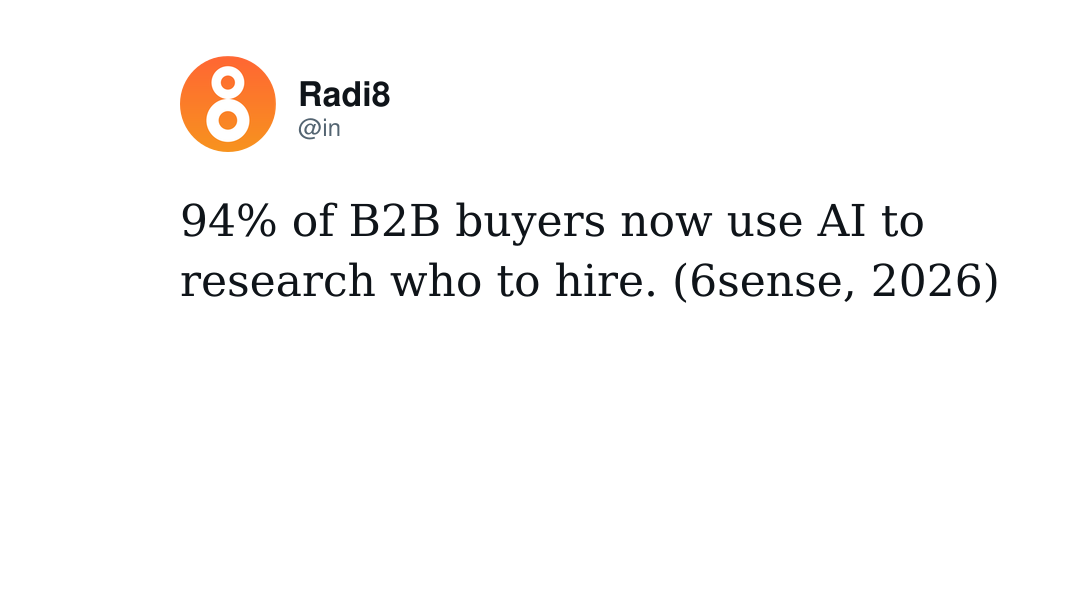
94% of B2B buyers now use AI somewhere in their buying process (6sense, 2026). So what decides whether you get considered isn't how often you post. It's whether AI has a clear, consistent picture of your work to draw from.
That picture has a name: a brand source of truth — your voice, audience, offers, and strategy in one place the AI can actually use.
I wrote the full how-to on setting one up.
Read the guide → radi8.com/blog
Most independent experts are optimizing for the wrong search box.
You're asking "am I posting enough on LinkedIn?" Your buyer is asking something else entirely — they open ChatGPT or Claude and ask "who's good at this?", then act on the answer.
94% of B2B buyers now use AI somewhere in their buying process (6sense, 2026). So the question that decides whether you get considered isn't how often you post. It's whether AI has a clear, consistent picture of your work to draw from.
That picture has a name: a brand source of truth. And building one is more concrete than it sounds — your voice, your audience, your offers, your strategy, in one place the AI can actually use.
I wrote the full how-to: what goes into a source of truth, and the exact steps to set yours up.
Read the full guide → radi8.com/blog



'/%3E%3Cpath fill='%23fff' d='M12 7.3A4.7 4.7 0 1 0 16.7 12 4.7 4.7 0 0 0 12 7.3Zm0 7.8A3.1 3.1 0 1 1 15.1 12 3.1 3.1 0 0 1 12 15.1Zm5-8a1.1 1.1 0 1 0 1.1 1.1A1.1 1.1 0 0 0 17 7.1Zm-5 1.5c-1.5 0-1.7 0-2.3.1a3.8 3.8 0 0 0-1.3.2 2.2 2.2 0 0 0-.8.5 2.2 2.2 0 0 0-.5.8 3.8 3.8 0 0 0-.2 1.3c-.1.6-.1.8-.1 2.3s0 1.7.1 2.3a3.8 3.8 0 0 0 .2 1.3 2.2 2.2 0 0 0 .5.8 2.2 2.2 0 0 0 .8.5 3.8 3.8 0 0 0 1.3.2c.6.1.8.1 2.3.1s1.7 0 2.3-.1a3.8 3.8 0 0 0 1.3-.2 2.5 2.5 0 0 0 1.3-1.3 3.8 3.8 0 0 0 .2-1.3c.1-.6.1-.8.1-2.3s0-1.7-.1-2.3a3.8 3.8 0 0 0-.2-1.3 2.2 2.2 0 0 0-.5-.8 2.2 2.2 0 0 0-.8-.5 3.8 3.8 0 0 0-1.3-.2c-.6-.1-.8-.1-2.3-.1Zm0-1.6c1.5 0 1.7 0 2.4.1a5.5 5.5 0 0 1 1.8.3 3.8 3.8 0 0 1 2.2 2.2 5.5 5.5 0 0 1 .3 1.8c.1.7.1.9.1 2.4s0 1.7-.1 2.4a5.5 5.5 0 0 1-.3 1.8 3.8 3.8 0 0 1-2.2 2.2 5.5 5.5 0 0 1-1.8.3c-.7.1-.9.1-2.4.1s-1.7 0-2.4-.1a5.5 5.5 0 0 1-1.8-.3 3.8 3.8 0 0 1-2.2-2.2 5.5 5.5 0 0 1-.3-1.8C4 13.7 4 13.5 4 12s0-1.7.1-2.4a5.5 5.5 0 0 1 .3-1.8 3.8 3.8 0 0 1 2.2-2.2 5.5 5.5 0 0 1 1.8-.3C10.3 5 10.5 5 12 5Z'/%3E%3C/svg%3E)