Most experts optimize for the wrong search box.
You ask "am I posting enough on LinkedIn?" Your buyer asks ChatGPT "who's good at this?"
94% of B2B buyers now use AI to research vendors (6sense, 2026).
The full how-to → radi8.com/blog
I'm running one live session on this — and you're invited.
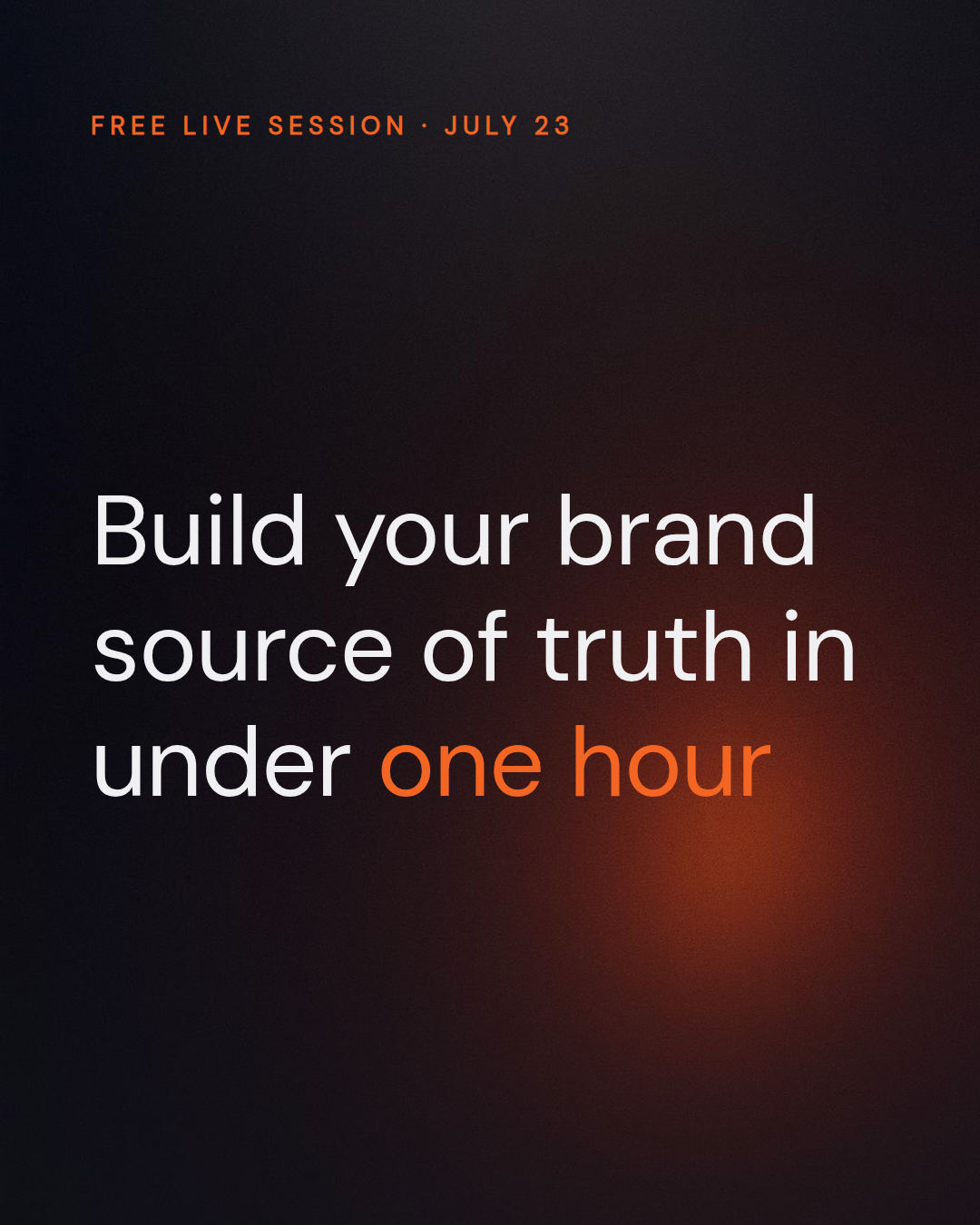
Be the Answer: build your brand source of truth, live.
Thursday, July 23 · 10:00 AM PT · free to attend
In under an hour, hands-on, we'll set up the thing that decides whether AI recommends you when your buyer asks. You'll walk out with:
— Your brand context built (voice, audience, point of view)
— A post drafted in your own voice — zero public risk
— A month of content planned in about 10 minutes
No fluff, no pitch marathon. Bring your laptop and a real question about your work.
Register → https://luma.com/radi8-pz3q
The fear I hear most about using AI for content: "It'll make me sound like everyone else."
Fair — generic AI does produce generic output. But here's the part that should change how you think about it: generic is exactly what doesn't get surfaced or trusted.
64% of B2B buyers say they trust real thought leadership over polished marketing materials (Edelman–LinkedIn, 2025). When your buyer asks AI "who's good at this?", it points to distinctive, consistent work — not the blandest voice in the room.
So the risk was never AI. It's AI with no context. The fix is loading it with your source of truth — your voice, your expertise, your actual opinions — so it sounds like you, because it is you.
How would AI describe your work right now?
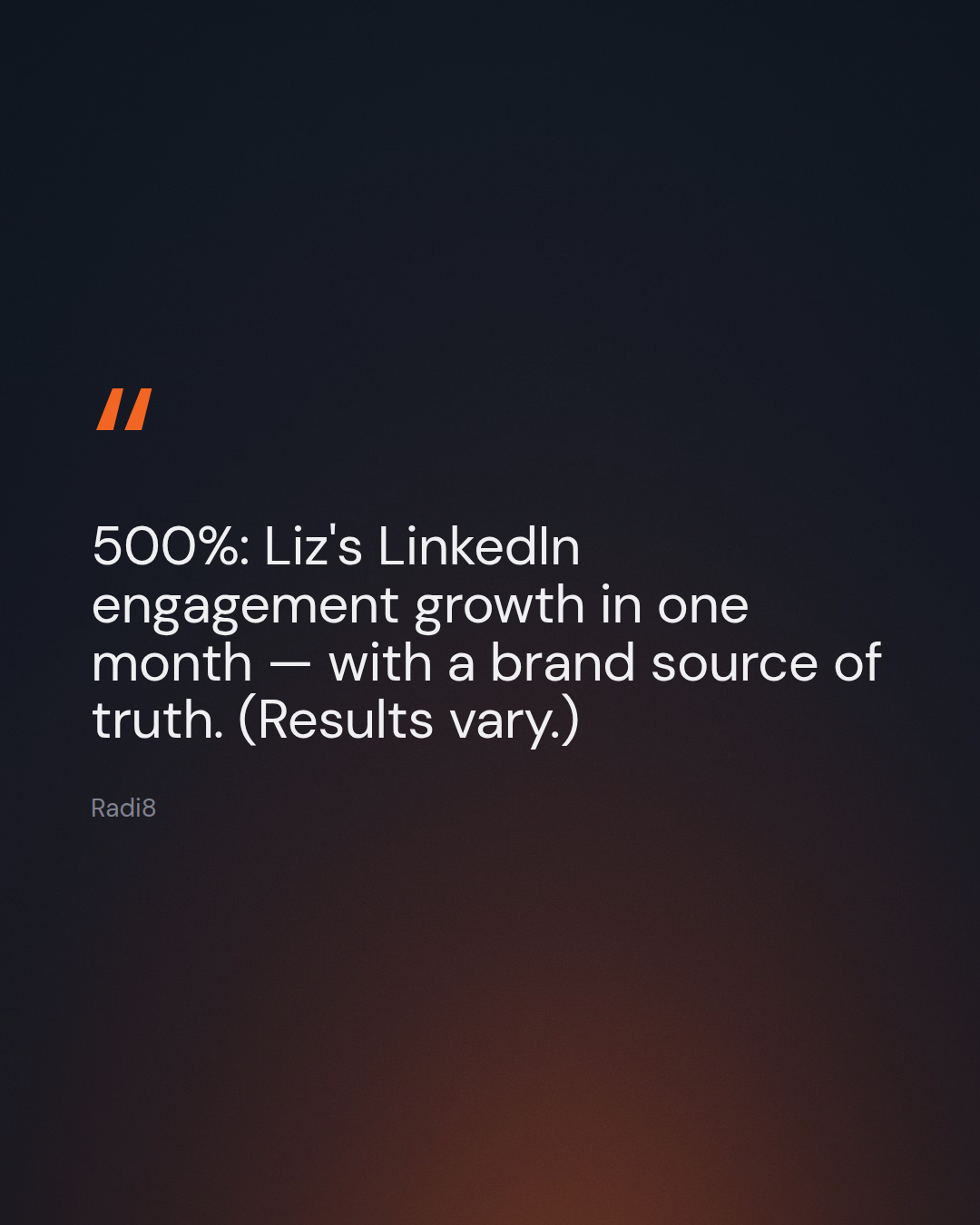
A number that stuck with me: 500%.
That's how much Liz, a functional wellness practitioner, grew her LinkedIn engagement in a single month — not by posting more frantically, but by setting up her brand context and showing up consistently in her own voice. (One person's result; individual numbers vary with audience, cadence, and content mix.)
Here's why it's not luck. When your voice, audience, and point of view live in one place, every post starts from something instead of nothing. You compound instead of restarting.
That's also what makes you the answer when a buyer asks AI about your field — a consistent body of work it can point to.
Liz didn't get there with a content marathon. She got there with a system.
Start your free trial — radi8.com (no credit card required)
"Brand source of truth" gets thrown around a lot. Here's what it actually means.
It's not a scheduler. It's not a folder of prompts you paste in each time. It's a persistent memory of your brand — your voice, your audience, your offers, your strategy — held in one place.
Why it matters: every time you start from a blank page, the tool forgets who you are, and the output sounds generic. And generic doesn't compound.
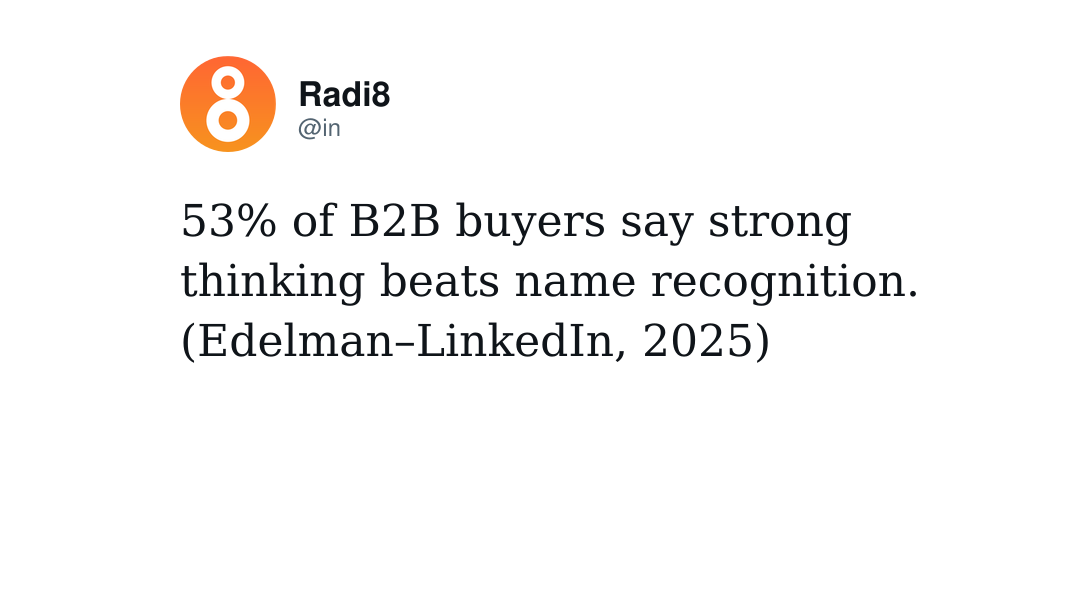
The 2025 Edelman–LinkedIn study warns that look-alike AI content gives a buying group nothing to react to — while 53% of decision-makers say that when your thinking is strong enough, name recognition matters less.
Better content from one source of truth beats more content from a blank page. That's the whole game.
Full breakdown → radi8.com/blog
What "brand source of truth" actually means 👇
Not a scheduler. Not a prompt folder. A persistent memory of your brand — voice, audience, offers, strategy — in one place.
Start from a blank page and the tool forgets who you are. The output sounds generic — and generic doesn't compound. 53% of decision-makers say strong thinking beats name recognition (Edelman–LinkedIn, 2025).
Better content from one source of truth beats more content from a blank page. 🔗 Full breakdown — link in bio.
#brandstrategy#founderledmarketing#personalbranding#contentstrategy#consultants#aimarketing
"Brand source of truth" gets thrown around a lot. Here's what it actually means.
It's not a scheduler. It's not a folder of prompts you paste in each time.
It's a persistent memory of your brand — your voice, your audience, your offers, your strategy — held in one place.
Why that matters:
Every time you start a post from a blank page, you start from zero. The tool forgets who you are. The output sounds generic. And generic doesn't compound.
That's not just a feeling. The 2025 Edelman–LinkedIn B2B Thought Leadership study warns that generic, look-alike AI content gives a buying group nothing to react to — while 53% of decision-makers say that when your thinking is strong enough, a brand's name recognition matters less. The bar was never volume. It's a clear, consistent point of view.
A source of truth is how you clear it. It loads your context into the AI you already use — Claude or ChatGPT — so every draft stays on-brand. Not just inside one app, but anywhere AI is answering questions about your work.
Better content from one source of truth beats more content from a blank page.
That's the whole game.
Full breakdown → radi8.com/blog
The new first impression isn't your website. It's the answer AI gives when your buyer asks "who's good at this?"
Think about how a buying decision actually starts now. Before anyone lands on your homepage, before they ask a peer, they open ChatGPT or Claude and ask for a recommendation. That answer is your first impression — and you didn't write it.
Buyers now rank AI above vendor websites as their top research source (Forrester, 2026). The page you've spent the most time on isn't where you're being judged first anymore.
So the question isn't "is my website good?" It's "when AI describes my work, is it accurate — and does it sound like me?"
If you're not the answer, your competitor is. I'm unpacking how to fix that all month.
When your buyer asks AI in your field, what comes up?
The new first impression isn't your website 👇
It's the answer AI gives when your buyer asks "who's good at this?"
Buyers now rank AI above vendor websites as their top research source (Forrester, 2026). If you're not the answer, your competitor is.
Fixing that all month. Follow along 🔗
#aisearch#founderledmarketing#personalbranding#contentstrategy#consultants#solopreneur
The new first impression isn't your website.
It's the answer your buyer gets when they ask ChatGPT or Claude "who's good at this?" — before they ever land on your homepage.
Buyers now rank AI above vendor websites as their top research source (Forrester, 2026). So the page you've polished most isn't where you're judged first anymore.
The real question: when AI describes your work, is it accurate — and does it sound like you? If you're not the answer, your competitor is.
I'm unpacking how to fix that all month. Follow along.
Your buyer asks AI before they Google you.
For years, "being visible" meant one thing: am I active on LinkedIn? That bar just moved.
Now — before anyone Googles you, before they ask a peer for a referral — they ask ChatGPT or Claude: "Who's good at [my problem]?"
This isn't a hunch. Forrester's 2026 Buyers' Journey Survey — nearly 18,000 business buyers — found generative AI is now the single most meaningful research source in B2B, named by more than twice as many buyers as any other, ahead of vendor websites and sales reps. And in G2's latest buyer report, one in three ended up choosing a vendor they'd never heard of before AI put it in front of them.
Here's the part that matters: AI doesn't surface whoever posts the most. It surfaces — and paraphrases — whoever has a clear, consistent body of work it can point to.
So two questions decide whether you're in that answer:
— When your buyer asks AI, do you come up?
— And when you do, does it sound like you?
Both come down to one thing: a brand source of truth. One place that holds your voice, your audience, and your point of view — so what AI says about you is actually yours.
This month I'm unpacking how to build one.
When someone asks AI in your field — do you come up?




'/%3E%3Cpath fill='%23fff' d='M12 7.3A4.7 4.7 0 1 0 16.7 12 4.7 4.7 0 0 0 12 7.3Zm0 7.8A3.1 3.1 0 1 1 15.1 12 3.1 3.1 0 0 1 12 15.1Zm5-8a1.1 1.1 0 1 0 1.1 1.1A1.1 1.1 0 0 0 17 7.1Zm-5 1.5c-1.5 0-1.7 0-2.3.1a3.8 3.8 0 0 0-1.3.2 2.2 2.2 0 0 0-.8.5 2.2 2.2 0 0 0-.5.8 3.8 3.8 0 0 0-.2 1.3c-.1.6-.1.8-.1 2.3s0 1.7.1 2.3a3.8 3.8 0 0 0 .2 1.3 2.2 2.2 0 0 0 .5.8 2.2 2.2 0 0 0 .8.5 3.8 3.8 0 0 0 1.3.2c.6.1.8.1 2.3.1s1.7 0 2.3-.1a3.8 3.8 0 0 0 1.3-.2 2.5 2.5 0 0 0 1.3-1.3 3.8 3.8 0 0 0 .2-1.3c.1-.6.1-.8.1-2.3s0-1.7-.1-2.3a3.8 3.8 0 0 0-.2-1.3 2.2 2.2 0 0 0-.5-.8 2.2 2.2 0 0 0-.8-.5 3.8 3.8 0 0 0-1.3-.2c-.6-.1-.8-.1-2.3-.1Zm0-1.6c1.5 0 1.7 0 2.4.1a5.5 5.5 0 0 1 1.8.3 3.8 3.8 0 0 1 2.2 2.2 5.5 5.5 0 0 1 .3 1.8c.1.7.1.9.1 2.4s0 1.7-.1 2.4a5.5 5.5 0 0 1-.3 1.8 3.8 3.8 0 0 1-2.2 2.2 5.5 5.5 0 0 1-1.8.3c-.7.1-.9.1-2.4.1s-1.7 0-2.4-.1a5.5 5.5 0 0 1-1.8-.3 3.8 3.8 0 0 1-2.2-2.2 5.5 5.5 0 0 1-.3-1.8C4 13.7 4 13.5 4 12s0-1.7.1-2.4a5.5 5.5 0 0 1 .3-1.8 3.8 3.8 0 0 1 2.2-2.2 5.5 5.5 0 0 1 1.8-.3C10.3 5 10.5 5 12 5Z'/%3E%3C/svg%3E)