Stress affects every system in the body. And in perimenopause, the effects on our hormones become even more profound.
Here's what I mean. Most hormone conversations treat cortisol and sex hormones as separate stories — stress over here, estrogen and progesterone over there. But your body doesn't work in silos. Cortisol, your primary stress hormone, is in constant conversation with estrogen, progesterone, testosterone, and DHEA. When one shifts, the others respond.
That's why I look at them together.
Salivary cortisol testing lets us watch what your stress-response system actually does across a day — the morning rise you're meant to have, the taper that should help you wind down by night. Not a single guess pulled from one moment, but the real shape of your rhythm.
Then the DUTCH test layers in the rest of the picture: estrogen, progesterone, testosterone, and DHEA, along with how your body is processing and clearing them. (One honest note, because accuracy matters here: the true daily rhythm is the cortisol piece — for your sex hormones, DUTCH gives you an average of what is happening in a 24-hour time period, which is more meaningful than a single point in time. )
Put those two together and something clarifying happens. The fatigue, the 2 am wake-ups, the mood shifts, the sense that your body isn't responding the way it used to — you stop seeing them as separate issues and start seeing the interplay underneath. That's the difference between managing symptoms one at a time and finally reading the pattern.
I'm walking through exactly how this works in a free webinar on advanced hormone testing — what salivary cortisol and the DUTCH test measure, why standard panels miss it, and what this kind of testing might reveal for you.
Advanced Hormone Testing Webinar
September 21, 5:30 PM PST
If you've been told your labs are "normal" but you know something has shifted, this is the conversation worth having. Save your spot — link in bio.
This is educational and not intended to diagnose or treat any condition.
Stress affects every system in the body. And in perimenopause and menopause, the effects on our hormones become even more profound.
Here's what I mean. Most hormone conversations treat cortisol and sex hormones as separate stories — stress over here, estrogen and progesterone over there. But your body doesn't work in silos. Cortisol, your primary stress hormone, is in constant conversation with estrogen, progesterone, testosterone, and DHEA. When one shifts, the others respond.
That's why I look at them together.
Salivary cortisol testing lets us watch what your stress-response system actually does across a day — the morning rise you're meant to have, the taper that should help you wind down by night. Not a single guess pulled from one moment, but the real shape of your rhythm.
Then the DUTCH test layers in the rest of the picture: estrogen, progesterone, testosterone, and DHEA, along with how your body is processing and clearing them. (One honest note, because accuracy matters here: the true daily rhythm is the cortisol piece — for your sex hormones, DUTCH gives you an average of what is happening in a 24-hour time period, which is more meaningful than a single point in time. )
Put those two together and something clarifying happens. The fatigue, the 2 am wake-ups, the mood shifts, the sense that your body isn't responding the way it used to — you stop seeing them as separate issues and start seeing the interplay underneath. That's the difference between managing symptoms one at a time and finally reading the pattern.
I'm walking through exactly how this works in a free webinar on advanced hormone testing — what salivary cortisol and the DUTCH test measure, why standard panels miss it, and what this kind of testing might reveal for you.
Advanced Hormone Testing Webinar
September 21, 5:30 PM PST
If you've been told your labs are "normal" but you know something has shifted, this is the conversation worth having. Save your spot — link in the comments.
This is educational and not intended to diagnose or treat any condition.
"Everything looks normal."
You've heard those words more than once. But you walked out of that appointment still exhausted, still foggy, still lying awake at 3 a.m., still not feeling good in your own body.
You're not imagining this. And there's a real reason your standard labs can come back "fine" while you clearly aren't.
A standard panel is a single snapshot — one moment, on one morning, in a body whose hormones are in motion all day long. In perimenopause, that motion becomes even more dynamic: estrogen and progesterone don't decline in a predictable line; they fluctuate, and a one-time draw can catch a perfectly ordinary number while missing the pattern underneath what you actually feel. "Normal" labs and real symptoms were never a contradiction. It was a testing gap.
On September 21 at 5:30 PM PST, I'm hosting a free live webinar: Advanced Hormone Testing for Women. I'll walk you through what advanced functional testing actually measures that a standard panel doesn't — hormone metabolites across a full day, your cortisol rhythm, and the clues that finally explain the fatigue, the sleep disruption, the mood shifts, and the sense that your body isn't responding the way it used to.
This isn't about something being "wrong" with you. It's about finally asking your body a question it can actually answer — with data instead of guesswork.
You were right to keep asking. Come learn how to get a real answer.
Reserve your spot — link in the comments.
This is educational and not intended to diagnose or treat any condition.
The mood swings and PMS that hijack a week of every month? That's not a character flaw. It's not "just hormones you have to ride out" or "normal for this time of life."
It's your body reporting on something measurable: the balance between your hormones and how your body is metabolizing them across the cycle.
That distinction matters. Two women can have the "normal" hormones a standard panel reveals — and feel completely different — because the difference isn't only how much you make. It's how you process it.
The DUTCH Plus test maps a picture of your hormone metabolites over 24-hours: not a single moment-in-time snapshot, but a fuller view of what's being produced and how it's being cleared. That's the level of detail that turns "I don't know why I feel like this" into "here's exactly what to look at."
You were right that something was off. Here's how we find out what.
Want to know what DUTCH Plus can actually reveal about your cycle? Link in bio.
You slept eight hours. You had the coffee. You did everything right. And by 10 a.m. you're already running on fumes.
If that's you, I want to say something first: you're not lazy, and you're not imagining it. Bone-deep fatigue that a good night's sleep doesn't touch is not a willpower problem. It's a signal.
Here's what I see over and over with high-achieving women who've been told their labs are "normal." That tired-but-wired feeling — exhausted all day, then oddly buzzing at night — often traces back to cortisol. Not too much, not too little, but firing at the wrong times. Your cortisol is supposed to rise in the morning to wake you up and taper down by night. When the HPA axis (the system that runs your stress response) gets dysregulated, that curve flattens or flips. And you feel it in your bones.
The catch: a single blood draw can't show you this. One blood draw is a snapshot at one moment. Cortisol isn't a snapshot — it's a rhythm across the whole day.
This is where the DUTCH Plus test is different. It captures a true multi-point daily cortisol pattern, including the cortisol awakening response — that first surge after you open your eyes. Instead of guessing, you get to actually see the shape of your day: where it's flat, where it's firing, where it's off.
And seeing the pattern is the first step to addressing the cause instead of pushing through the symptom.
Your exhaustion is your body asking for something. Let's find out what.
Curious what your own cortisol pattern looks like? Learn how the DUTCH Plus test can help reveal it — link in the comments.
This is educational and not intended to diagnose or treat any condition.
"Your labs are normal." If you've heard that while still feeling exhausted, foggy, and not like yourself — the standard panel was never asking the right questions.
The DUTCH test does. It maps how your hormones are actually being made, used, and cleared — the full story most blood work never tells.
On September 22, I'm teaching a live webinar on what the DUTCH test reveals about the midlife hormone shifts you've been told to simply accept — and what becomes possible once you can finally see the whole picture.
This is not symptom management. It's root-cause clarity, backed by real data.
Details coming soon.
#PerimenopauseSupport#FunctionalMedicine#HormoneHealth#MidlifeWomen#DUTCHtest#RootCauseMedicine
If you've been told your hormones are "normal" but you still feel bloated, wired-and-tired, or like your body just isn't yours anymore — the problem might not be your hormones. It might be the picture you were handed.
Here's the piece almost no one explains at the doctor's office.
A blood draw is one moment. One needle, one instant, one number. Your hormones don't hold still like that. They rise and fall across the day, and a single draw catches them mid-motion — whatever they happened to be doing the second the tube filled. It's a snapshot. And a snapshot can look perfectly "normal" while missing the whole story of how you actually feel by 3pm.
The DUTCH test works differently.
Instead of one moment, it looks at your hormone metabolites averaged across a full 24 hours. Metabolites matter because they don't just tell you how much of a hormone you have — they tell you how your body is processing and clearing it. That's the part that so often explains the symptoms: the bloating, the PMS, the heavy or painful periods, the poor response to HRT. Not just "how much," but "what is your body doing with it."
And for cortisol specifically — your stress hormone, the one at the center of HPA axis dysfunction — DUTCH goes further. It maps a true multi-point pattern across the day, including your cortisol awakening response, that first surge your body is supposed to make when you open your eyes. That daily rhythm is where a lot of the fatigue and 2am-wide-awake insomnia stories finally start to make sense.
One honest note, because accuracy matters here: for your sex hormones, DUTCH gives you that 24-hour average — a fuller picture, not a minute-by-minute play-by-play. The true moment-to-moment daily rhythm is the cortisol piece. I'd rather tell you exactly what it does than oversell it.
This is the whole idea behind root-cause work. We stop managing symptoms one at a time and start asking what your body has been trying to tell you all along — with data that actually shows the pattern.
This is educational and not intended to diagnose or treat any condition.
Want the full plain-language breakdown of what DUTCH measures and why it sees what a single blood draw can't? I wrote it all out — link's in the comments.
It's 3am. You fell asleep just fine hours ago — and now you're wide awake, staring at the ceiling, mind humming, unable to get back down.
If that's you, I want to say something first: you're not doing sleep wrong.
You've probably already tried the obvious fixes. Earlier bedtime. No screens. Magnesium. A cooler room. And still, night after night, your body wakes you at almost the same hour and won't let you rest.
Here's what I've learned working with clients: sleep that keeps breaking like this often isn't a sleep-hygiene problem. It's a cortisol-timing problem.
Cortisol is supposed to follow a daily rhythm. Low and quiet at night so you can stay asleep, then rising toward morning to wake you up and carry you into your day. That's the curve your body is built around.
When that curve gets flipped — cortisol spiking in the middle of the night instead of settling — your sleep pays for it. You wake at 3am not because you're anxious or undisciplined, but because your body is following the wrong signal at the wrong hour.
The frustrating part? You can't fix a pattern you can't see. A single blood draw catches one moment. It can't show you the shape of your whole day.
The DUTCH Plus test can. It maps your cortisol across multiple points from morning to night — including the cortisol awakening response, that first surge after you open your eyes. It's how we finally see the rhythm underneath the sleepless nights, instead of guessing at it.
That picture is where real answers start. Not another supplement. The actual pattern.
See how the DUTCH Plus test maps your cortisol rhythm — link in the comments.
This test is not intended to diagnose or treat any condition.
Here's something a single blood draw can't tell you: whether your mornings are being run by a stress-response system that's quietly out of rhythm.
If you've been waking up already tired, wired at night, or foggy until your second coffee — and your bloodwork came back "normal" — this is worth two minutes.
Let me explain cortisol the kitchen-table way.
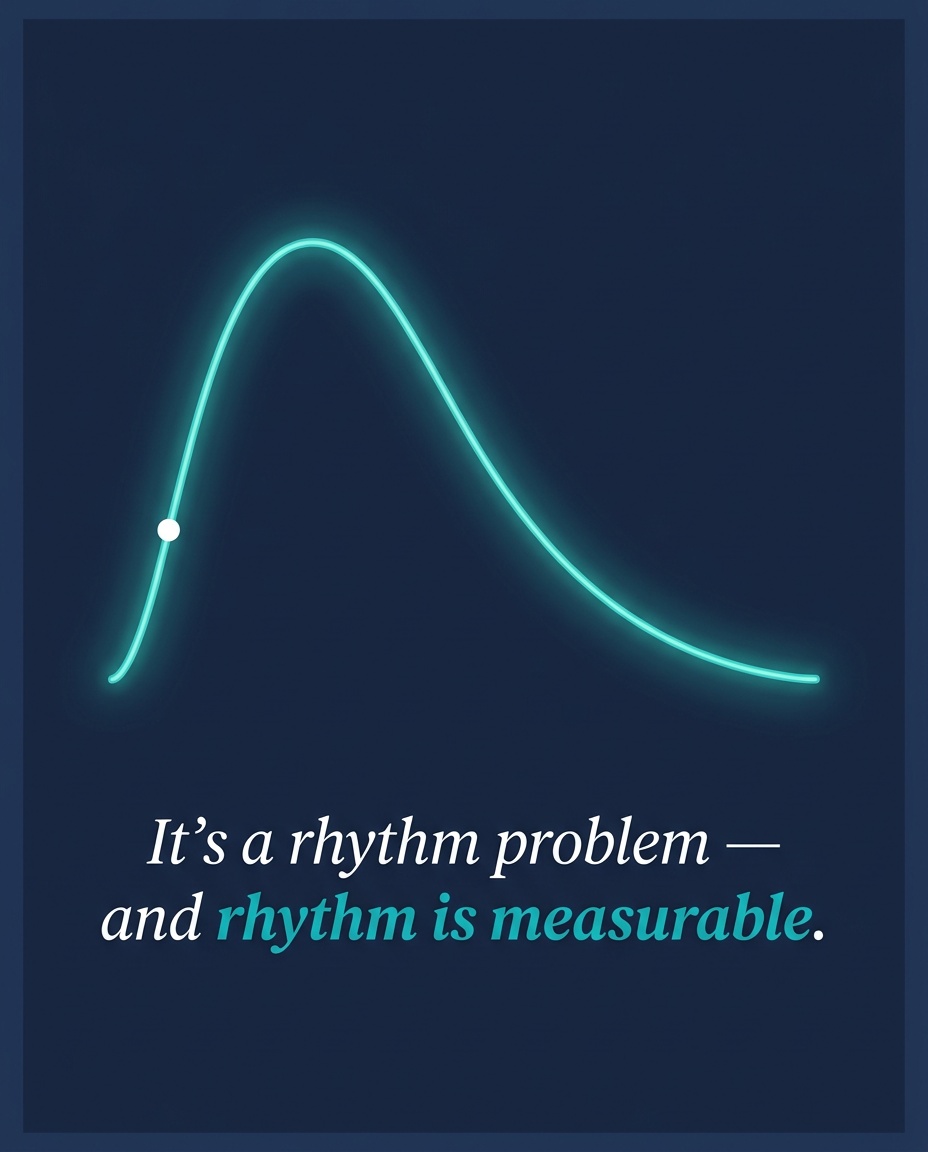
In a healthy pattern, cortisol isn't steady all day. It has a shape. It rises sharply in the first 30–45 minutes after you open your eyes — that early spike is called the cortisol awakening response, or CAR. It's the biological signal that gets you up and moving. Then it tapers, gradually, all day long, so that by night it's low enough to let you rest.
That daily arc — up in the morning, down by evening — is your diurnal curve. And it's one of the clearest windows we have into how your HPA axis, your central stress-response system, is actually functioning. Not how you feel about stress. How your body is handling it.
Here's the piece that matters: a one-time blood draw catches a single point on that curve. One dot. You can't see the shape of a whole day from one dot — and you certainly can't see whether that morning rise is happening the way it should.
The DUTCH test samples at multiple points across the day, so instead of one dot, you get the actual curve — including the CAR. This is the single clearest example of DUTCH capturing a true, multi-point daily pattern (and to be precise: that real diurnal picture is specific to cortisol).
That distinction is often the difference between "there's nothing wrong with you" and "here's the pattern underneath what you've been feeling." Because so often it isn't a mood problem or a discipline problem. It's a rhythm problem — and rhythm is measurable.
If you want to go deeper on how cortisol timing shapes your whole day, I've put the resource in the comments.
(This is educational and not intended to diagnose or treat any condition.)
"Your labs are normal."
You heard those words, and part of you wanted to feel relieved. But you walked out of that appointment still exhausted, still bloated, still lying awake at 3 a.m., still not feeling like yourself.
So let me say the thing no one said to you in that room: you're not imagining this. And there's a real reason your bloodwork came back "fine" while your body clearly isn't.
Here's the piece that changes everything.
A standard blood panel is a single snapshot — one moment, on one morning, in a body whose hormones are moving all day long. Your hormones don't hold still for the lab. They rise and fall, shift and cycle, hour by hour. Catch them at one quiet moment and the number can look perfectly ordinary, even when the larger pattern is anything but.
This is why "normal" labs and real symptoms can live side by side. It was never a contradiction. It was a testing gap.
The DUTCH test was built to close that gap. Instead of one snapshot, it captures an average of your hormone metabolites across a full 24 hours — a fuller picture of what your body is actually doing — plus a true daily pattern for cortisol, including the rise you're meant to have in the morning. That's the difference between glancing at one frame and watching how the day actually unfolds.
None of this is about something being "wrong" with you. It's about finally asking your body a question it can actually answer — and that starts with better data, not more willpower.
If you want to understand what a fuller picture of your hormones actually looks like, I wrote an explainer that walks through it in plain language. Link in the comments.
You were right to keep asking. Let's give your body a way to answer.
This information is educational and not intended to diagnose or treat any condition.
You make hundreds of decisions before lunch. Almost none of them should be about food.
If you're a high-achieving woman, your cognitive energy is your most valuable asset — and most of us spend it in a slow leak. What to eat. What to shop for. What to defrost. Each of those micro-decisions is small on its own, but stacked across a week, they pull from the same finite reserve you need for the work that actually matters.
My nutrition partner, Stephanie Doty, made a point in a recent video that reframes meal planning entirely: "one of the biggest hurdles in meal planning is knowing what to eat."
Notice what she's naming there. The hurdle isn't discipline. You have plenty of that. The hurdle is the open loop — the unmade decision that follows you from the calendar into the kitchen and quietly competes for bandwidth all day.
Here's the clinical reframe: meal planning is not a chore. It's cognitive load management. When you already know what you're eating and what's in the house, you remove the friction from the entire week. And that friction is precisely what drives the impulsive, under-pressure choices that derail people who are otherwise consistent in every area of their lives.
Planning ahead isn't restriction. It's the difference between staying on track and defaulting to whatever is fastest when your reserves are already spent.
Watch Stephanie make the case. The link is in the comments.
So let me ask you: what would your week look like if your nutrition was already decided on Sunday? That clarity is available to you.
If you've spent years eating less and still can't understand why your body won't respond, I want to offer you a different frame.
The problem was never that you needed more discipline. It's that restriction is the wrong tool for the job.
My nutrition partner, Stephanie, made a point in a recent video that I keep coming back to — because it quietly dismantles everything diet culture taught us: "food isn't just fuel it's the key to achieving the results you want."
Here's what that looks like clinically. A structured approach to eating isn't about eating less — it's about eating with precision: the right foods, in the right amounts, at the right times, so your body gets exactly what it needs to thrive. Nutrient density, not calorie counting, is the foundation. Because your metabolism, your hormones, and your energy are not asking you to deprive them. They are asking to be fed well.
This is the reframe so many high-achieving women in their 40s and 50s have never been offered: food is not something to limit. It is your most powerful, most precise tool.
So let me ask you: What would change if you stopped thinking about food as something to limit — and started thinking about it as your most powerful tool?
Watch the full video - link in the comments



'/%3E%3Cpath fill='%23fff' d='M12 7.3A4.7 4.7 0 1 0 16.7 12 4.7 4.7 0 0 0 12 7.3Zm0 7.8A3.1 3.1 0 1 1 15.1 12 3.1 3.1 0 0 1 12 15.1Zm5-8a1.1 1.1 0 1 0 1.1 1.1A1.1 1.1 0 0 0 17 7.1Zm-5 1.5c-1.5 0-1.7 0-2.3.1a3.8 3.8 0 0 0-1.3.2 2.2 2.2 0 0 0-.8.5 2.2 2.2 0 0 0-.5.8 3.8 3.8 0 0 0-.2 1.3c-.1.6-.1.8-.1 2.3s0 1.7.1 2.3a3.8 3.8 0 0 0 .2 1.3 2.2 2.2 0 0 0 .5.8 2.2 2.2 0 0 0 .8.5 3.8 3.8 0 0 0 1.3.2c.6.1.8.1 2.3.1s1.7 0 2.3-.1a3.8 3.8 0 0 0 1.3-.2 2.5 2.5 0 0 0 1.3-1.3 3.8 3.8 0 0 0 .2-1.3c.1-.6.1-.8.1-2.3s0-1.7-.1-2.3a3.8 3.8 0 0 0-.2-1.3 2.2 2.2 0 0 0-.5-.8 2.2 2.2 0 0 0-.8-.5 3.8 3.8 0 0 0-1.3-.2c-.6-.1-.8-.1-2.3-.1Zm0-1.6c1.5 0 1.7 0 2.4.1a5.5 5.5 0 0 1 1.8.3 3.8 3.8 0 0 1 2.2 2.2 5.5 5.5 0 0 1 .3 1.8c.1.7.1.9.1 2.4s0 1.7-.1 2.4a5.5 5.5 0 0 1-.3 1.8 3.8 3.8 0 0 1-2.2 2.2 5.5 5.5 0 0 1-1.8.3c-.7.1-.9.1-2.4.1s-1.7 0-2.4-.1a5.5 5.5 0 0 1-1.8-.3 3.8 3.8 0 0 1-2.2-2.2 5.5 5.5 0 0 1-.3-1.8C4 13.7 4 13.5 4 12s0-1.7.1-2.4a5.5 5.5 0 0 1 .3-1.8 3.8 3.8 0 0 1 2.2-2.2 5.5 5.5 0 0 1 1.8-.3C10.3 5 10.5 5 12 5Z'/%3E%3C/svg%3E)