
Your Market Isn't Where You Live. It's Who You Reach.
Your Market Isn't Where You Live. It's Who You Reach.
There's a story a lot of founders tell themselves when they're building outside a major city.
If only I were in New York. If only I were in Austin. If only I were closer to the investors, the talent, the scene.
It's an understandable story. It's also the wrong one — and it's quietly costing founders in smaller markets more than they realize.
Not because location doesn't matter. It does. But not in the way most people think.
Geography Used to Be a Ceiling. It Isn't Anymore.
For most of business history, where you were determined who you could reach. Your market was your radius. Your network was your neighborhood. Your growth was bounded by geography.
The internet dissolved that ceiling completely.
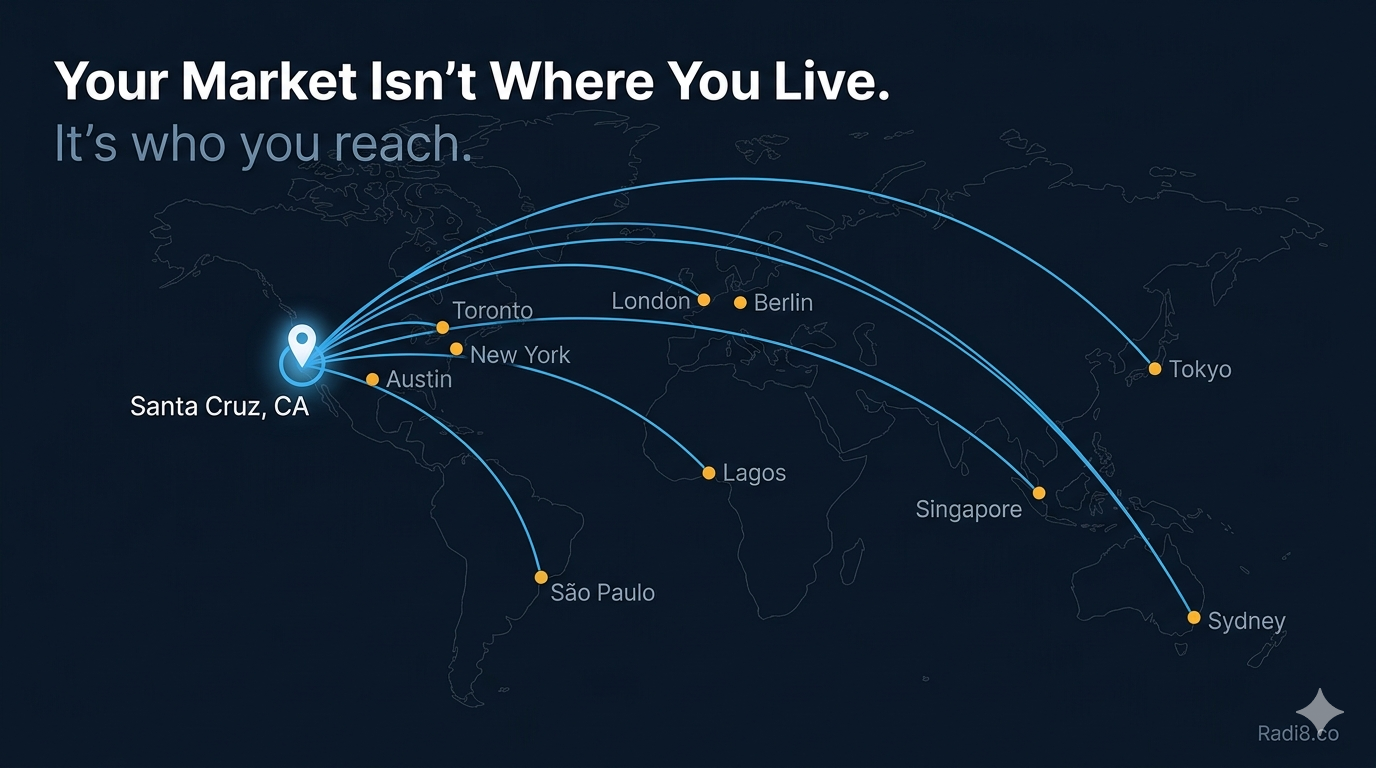
A founder in Santa Cruz, California — population 65,000, no major VC cluster, no Fortune 500 anchor — can reach a customer in Berlin, a partner in Toronto, and an investor in Singapore before lunch. The tools exist. The channels exist. The audience is there.
What most founders in smaller markets are missing isn't access. It's a marketing system designed to use that access well.
The Real Problem Is Attention, Not Location
Here's what actually limits founders outside major hubs: not geography, but visibility.
When you're not in a market where proximity creates automatic credibility — where you can't just show up at the right dinner or get introduced at the right conference — you have to earn attention differently. You have to build it.
That means content. Social presence. A consistent point of view that travels further than you do.
Most founders underinvest here — not because they don't understand its value, but because they're building a product, managing a team, and trying to close customers at the same time. Marketing becomes the thing that happens when there's time left over. There's never time left over.
The founders who break through are the ones who treat marketing as infrastructure, not an afterthought. They build a system that works while they're doing everything else.
Your Location Is an Asset. Use It.
Here's something counterintuitive: being from a smaller, distinctive market is a content advantage — if you lean into it.
Santa Cruz is a perfect example. It has a genuine identity: surf culture and software, ocean and mountains, UCSC's research energy mixed with a community that values independence and craft. That's not a liability to apologize for. That's a story the world doesn't hear enough of — and one that a founder there can own completely.
Authenticity is the scarcest resource in modern marketing. Audiences have developed extraordinary radar for content that's manufactured, generic, or performing for the wrong room. What cuts through is specificity. Real place. Real perspective. Real reason for existing.
A founder building in a tertiary market — Santa Cruz, Boise, Chattanooga, wherever — has something the polished, VC-backed, San Francisco startup doesn't: genuine texture. A story that couldn't have come from anywhere else.
That's not a niche. That's a differentiator.
Smart Marketing Looks Like This
Being proud of where you're from and being strategic about how you grow aren't in tension. The best content marketing does both.
It means publishing content that reflects who you actually are — your values, your community, your way of seeing the problem you solve — while being deliberately designed to reach the people who need what you offer, wherever they are.
It means showing up consistently on the channels where your customers already spend time, with a message that's aligned to your strategy, not just whatever felt timely that week.
It means building a flywheel: content earns attention, attention builds trust, trust converts to customers, customers become community, community generates more content. Repeat.
That system doesn't require a big team or a big budget. It requires clarity and consistency — and the right tools to sustain it without burning out.
You Don't Have to Leave to Scale
The founders who will build the most interesting companies over the next decade won't all be in the same zip code. They'll be distributed, community-rooted, and globally connected.
They'll be proud of where they come from. They'll build authentic brands that travel. And they'll use smart, efficient marketing systems to close the gap between where they are and where their customers are.
If you're building in a market the startup press overlooks — stay. Build something worth finding. And build the marketing engine that makes sure people find it.
Build Your Marketing System — Free
Radi8 is built for founders who want repeatable, authentic marketing without a full-time team behind it.
Use promo code BETA4MAR at signup and get 300,000 free credits to start building the system that grows with you — wherever you're building from.