
What Business Owners Need to Stop Doing with AI If They Want Real Marketing Progress
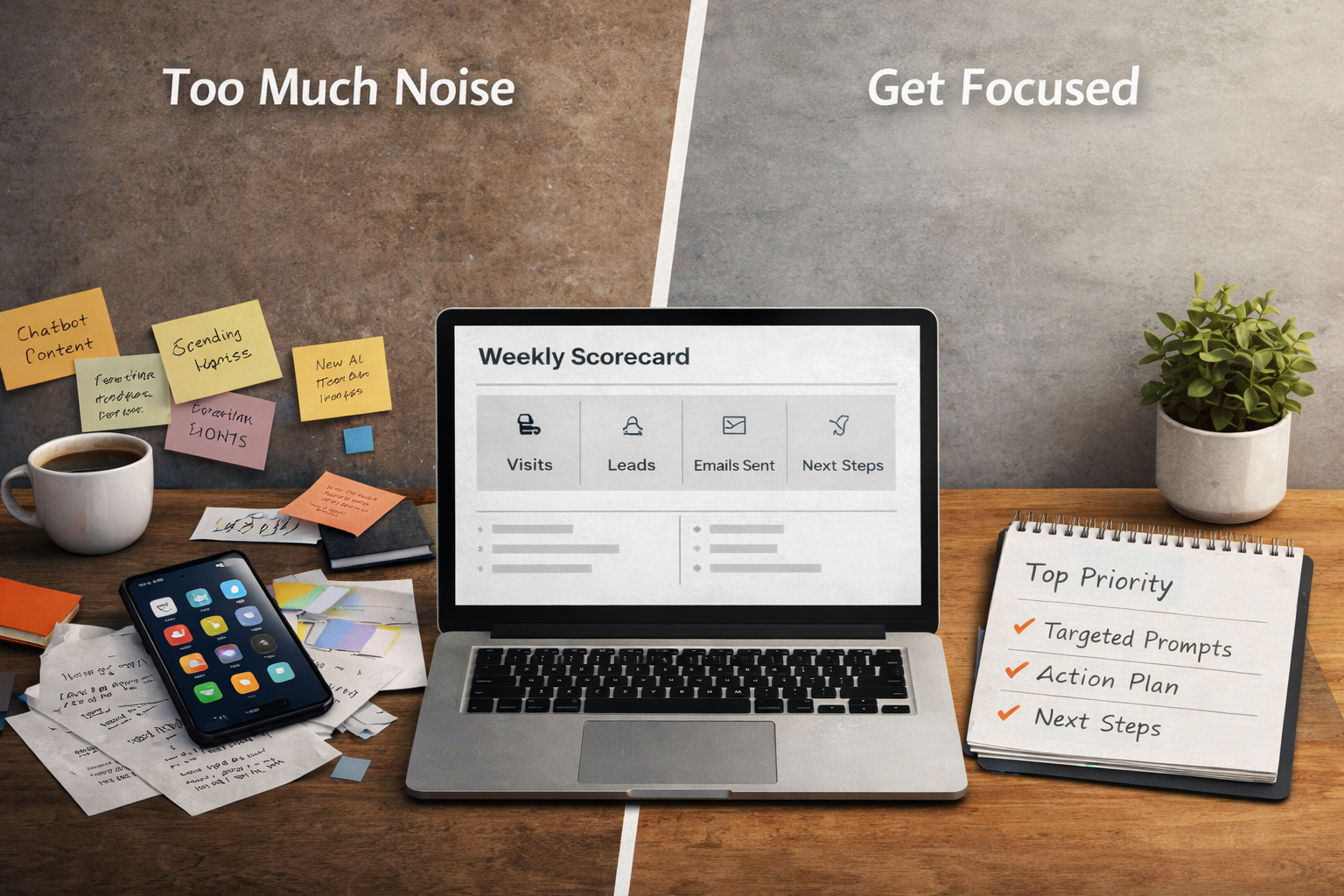
What Business Owners Need to Stop Doing with AI If They Want Real Marketing Progress
Business owners are getting pushed from every direction to “use AI.”
Use it for content. Use it for positioning. Use it for outbound. Use it for research. Use it for automation. Use it for everything.
That pressure creates a familiar pattern: You open three tools, save twelve prompts, generates a pile of content—and still end the week without clearer messaging, better pipeline movement, or a more reliable marketing process.
That’s the problem.
For small business owners, AI only matters if it helps you make better decisions faster and turn them into measurable progress. If it creates more motion without more traction, it’s not helping.
That’s the practical filter behind our May 28 SBDC workshop, Marketing with AI: use AI where it speeds execution—not where it distracts from it.
The real issue isn’t whether you use AI
It’s whether you’re using it for the right work.
Most small business owners don’t need more marketing activity. They need more clarity about:
- What message is actually working
- What priority matters this week
- What action creates forward movement
- What should be measured so they can improve fast
AI can support that—but only if the operating model underneath is clear.
Too often, you use AI to multiply noise:
- More posts without a sharper point of view
- More ideas without a decision rule
- More drafts without a real CTA
- More experiments without a scorecard
It feels productive in the moment. It rarely compounds.
What you need to stop doing with AI
1. Stop chasing every new AI tool
You don’t need a stack that looks impressive in a screenshot.
You need a small set of tools and prompts that help you execute the work that already matters: clarifying your offer, tightening positioning, improving follow-up, and creating a simple rhythm for marketing decisions.
Tool-hopping adds:
- Setup time
- Switching costs
- False confidence
A better question is:
What helps me move one real priority forward this week?
If the answer isn’t clear, skip it.
2. Stop generating content before your message is clear
AI can generate content instantly. That doesn’t mean it should.
If your message is fuzzy, AI will produce polished versions of the wrong thing.
Before you ask for:
- LinkedIn posts
- Email sequences
- Landing pages
You need clarity:
- Who is this for?
- What painful problem are they trying to solve right now?
- What outcome do they actually want?
- Why should they trust your approach?
AI should sharpen your thinking—not replace it.
3. Stop treating prompts like strategy
Prompts are useful tools. They are not a strategy.
A prompt can help you:
- Structure an idea
- Explore angles
- Draft faster
But it won’t decide:
- Which audience matters most
- Which offer to lead with
- Which CTA fits the moment
- What signal actually counts
A saved prompt is only valuable if it supports a repeatable decision or workflow.
Otherwise, it’s just another folder you won’t revisit.
4. Stop asking AI to replace your judgment
AI is great at compression and synthesis.
It is not a substitute for judgment.
You still need to decide:
- What matters now
- What to ignore
- What promise you can actually keep
- What counts as real progress
The right use of AI is not:
“Tell me my strategy.”
It’s:
“Help me pressure-test this, refine it, and turn it into something executable.”
5. Stop optimizing for volume without a scorecard
More output doesn’t equal better marketing.
If you’re producing:
- More posts
- More emails
- More experiments
…but you’re not tracking what works, you’re just scaling noise.
A simple scorecard changes everything.
At this stage, you don’t need complexity. You need visibility:
- Landing page visits
- RSVPs
- Response or reply rates
- Guide downloads
- Conversations started
That’s enough to know what to repeat next week.
What to do instead
The better approach is simpler—and more effective.
Use AI to improve one of these:
1. Faster clarity
Refine:
- Positioning
- Messaging
- Offer framing
- Campaign structure
2. Better execution
Support:
- First drafts
- Channel adaptation
- Follow-ups
- Campaign assets
3. Tighter feedback loops
Review:
- What messages are resonating
- What CTAs are converting
- Where people drop off
- What to adjust next
If AI isn’t improving clarity, execution, or feedback loops—it’s probably not helping.
What this looks like in practice
Let’s say you’re promoting a workshop, product, or early offer.
The wrong approach:
- Generate 20 generic posts
- Rewrite everything in different tones
- Add more tools and complexity
The better approach:
- Define one audience
- Define one practical outcome
- Create one core message
- Use AI to adapt it across blog, email, and social
- Track what actually drives response
That’s how small teams create leverage.
May 28 SBDC workshop - Marketing with AI
This is exactly what we’ll work through in the May 28 SBDC workshop, Marketing with AI.
This is not theory.
It’s a hands-on session where you:
- Apply a few targeted prompts
- Use a simple scorecard
- Work on your actual priorities
- Leave with actions you can execute immediately
No fluff. No tool overload. No abstract frameworks.
Just practical ways to make AI useful for your marketing—this week.
Final thought
If AI is making your marketing more complicated, you’re probably using it in the wrong places.
Start smaller.
Use fewer tools.
Use sharper prompts.
Tie everything to one priority.
Measure what changes in a week.
That’s where real progress starts.
👉 RSVP for the Workshop
If you want a practical way to apply this immediately:
Join the May 28 SBDC workshop: Marketing with AI
You’ll leave with:
- A clear filter for where AI helps (and where it doesn’t)
- A small set of targeted prompts
- A simple scorecard you can use right away
- Concrete next steps for your marketing